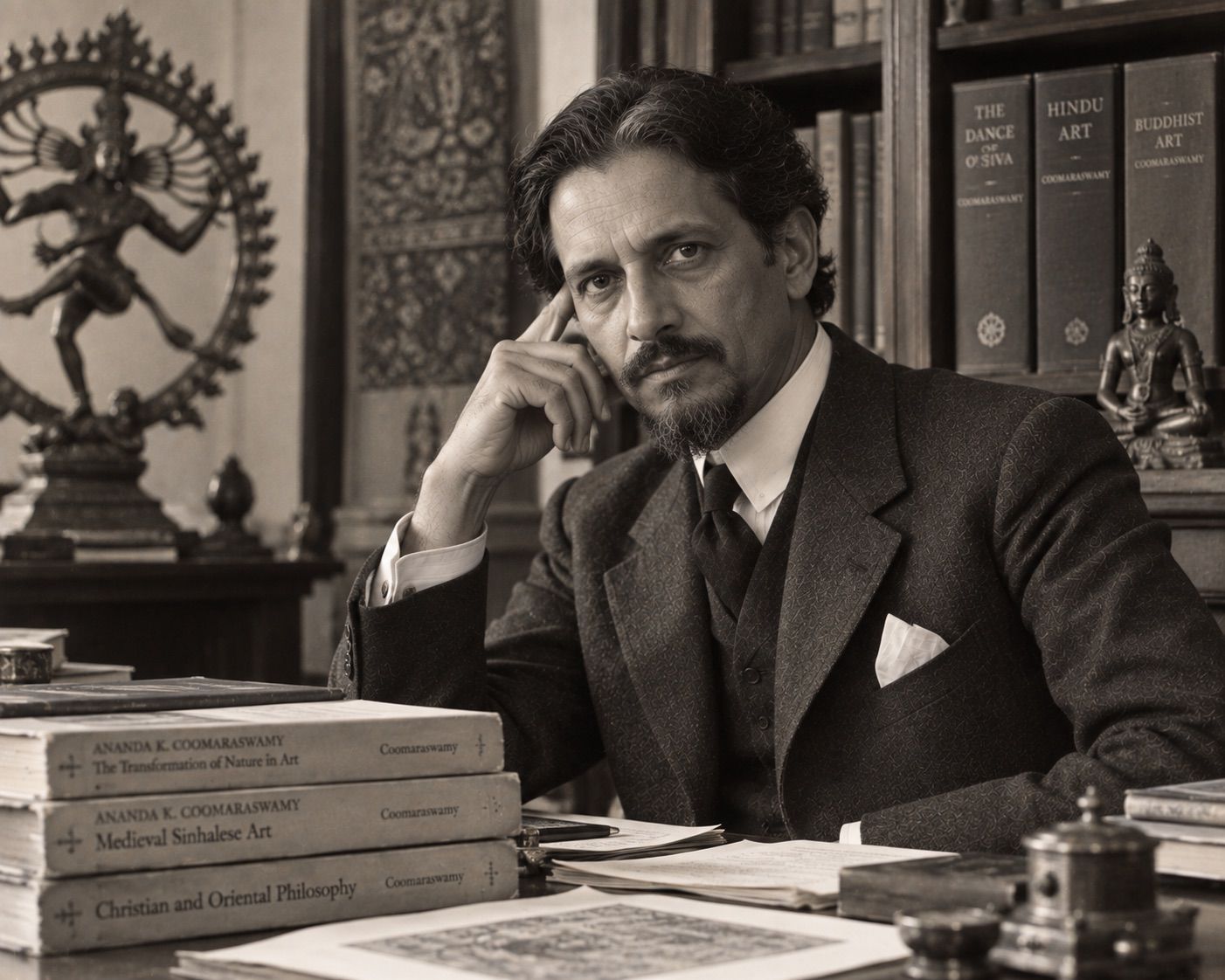
I’ve always been drawn to Ananda Coomaraswamy, the Ceylonese philosopher who spent most of his life in the United States, critiquing Western thought and defending Eastern traditions. What fascinates me about him is the tension between his intellectual pursuits and his cultural identity.
Growing up, I often felt like I was caught between two worlds – my own experiences as a young adult and the expectations placed on me by my family’s cultural heritage. Coomaraswamy’s story resonated with mine in ways that made me feel less alone. He navigated this divide, too, as he moved from colonial Ceylon to Boston, where he became an influential voice in the arts and philosophy.
I remember reading his essay “The Transformation of Nature in Art” and being struck by his concept of “the hierarchy of being.” It’s a complex idea that suggests our perceptions of reality are filtered through our own cultural and artistic perspectives. As I read it, I felt like he was speaking directly to my own struggles with identity – how do I reconcile the expectations placed on me as a [insert label] with my own desires and values?
Coomaraswamy’s writing often feels like a slow-burning fire that burns away at the edges of Western assumptions. He critiques modernity, colonialism, and the notion that progress is always forward-facing. But what I find most compelling about his work is its gentle yet insistent probing into the depths of tradition.
I’ve found myself wondering if this obsession with “tradition” – and Coomaraswamy’s defense of it – isn’t just a way to avoid engaging with modernity, or even with our own complexities as individuals. Does he truly believe that Eastern traditions hold some kind of timeless truth, or is this just a form of nostalgia for something more authentic?
I’m not sure I have the answers to these questions. What I do know is that Coomaraswamy’s writing makes me feel seen in ways that few other thinkers can. He’s not afraid to grapple with ambiguity and paradox, which is something I admire deeply.
When I read his essays on art and culture, I feel like he’s holding up a mirror to my own experiences as a creative person – the desire to produce meaning, the struggle to find one’s voice in a world that often values conformity over authenticity. It’s this sense of connection that keeps me coming back to Coomaraswamy, even when his ideas make me uncomfortable.
I’m not sure if I’ll ever fully resolve my questions about him or his work. But as I continue to read and think about Coomaraswamy, I feel like I’m slowly unraveling the threads of a larger tapestry – one that includes both my own experiences and the complexities of tradition itself.
As I delve deeper into Coomaraswamy’s work, I find myself increasingly fascinated by his concept of “the hierarchy of being.” It’s an idea that suggests our perceptions of reality are filtered through our own cultural and artistic perspectives, and that these perspectives shape not only how we see the world but also how we understand ourselves. I think about how this might apply to my own life – how my experiences as a young adult have been shaped by my family’s cultural heritage, yet also how I’ve tried to carve out my own path, to forge a sense of identity that feels authentic to me.
But what if Coomaraswamy is right? What if our perceptions of reality are indeed filtered through our cultural and artistic perspectives? Would that mean that my experiences, my struggles with identity, are not objective truths but rather subjective interpretations, shaped by the very culture I’m trying to understand and critique? It’s a unsettling thought, one that makes me wonder if I’ve been approaching this whole process of self-discovery all wrong.
I think about how Coomaraswamy’s concept of “the hierarchy of being” might apply to my own creative pursuits. As an artist and writer, I’m constantly trying to find ways to express myself, to convey meaning through words or images. But what if these expressions are not just reflections of reality but rather interpretations, filtered through my own cultural and artistic perspectives? Does that mean that my art is not a direct representation of the world but rather a subjective take on it, one that’s shaped by my own experiences and biases?
I’m not sure I have the answers to these questions. All I know is that Coomaraswamy’s writing has given me a new framework for thinking about creativity, identity, and reality itself. It’s a complex and messy landscape, one that resists easy conclusions or categorizations. But it’s also exhilarating, in its own way – like discovering a hidden pathway through the forest, one that leads to new insights and perspectives.
As I continue to read and think about Coomaraswamy, I feel like I’m entering a world of endless possibility, where nothing is fixed or certain. It’s a place where tradition meets modernity, where East meets West, and where art meets life in all its messy, beautiful complexity.
As I immerse myself further in Coomaraswamy’s work, I find myself drawn to his concept of “the beauty that is not of this world.” It’s a phrase that resonates deeply with me, as someone who has always struggled to reconcile the demands of my cultural heritage with my own desire for creative expression. For Coomaraswamy, beauty lies beyond the realm of material reality, in the realm of the sacred and the eternal.
I think about how this idea might apply to my own experiences as an artist and writer. So often, I feel like I’m caught between two worlds – the world of practicality and pragmatism, where creativity is seen as a commodity or a means to an end, versus the world of imagination and idealism, where art is a way of tapping into something deeper and more meaningful.
Coomaraswamy’s idea suggests that true beauty lies in the realm of the transcendent, beyond the fleeting concerns of everyday life. It’s a notion that both exhilarates and intimidates me – what does it mean to create beauty that is not of this world? How do I tap into that realm, when so much of my life is consumed by the mundane and the ordinary?
As I ponder these questions, I find myself wondering about Coomaraswamy’s own experiences as a creative person. Did he struggle with similar doubts and fears, or did his cultural heritage provide him with a sense of security and purpose that allowed him to explore the transcendent more freely? I imagine him sitting at his desk, writing essays and letters, pouring out his thoughts and ideas onto paper – was it like a form of spiritual practice for him, a way of accessing the divine through the written word?
I think about how Coomaraswamy’s concept of “the beauty that is not of this world” might be related to his idea of “the hierarchy of being.” If our perceptions of reality are filtered through our cultural and artistic perspectives, then does that mean that true beauty lies in the realm of the transcendent, where those filters are stripped away and we can see things as they truly are? It’s a notion that both fascinates and unsettles me – what if I’m not seeing the world as it truly is, but rather as my own culture and biases dictate?
As I continue to read and think about Coomaraswamy, I feel like I’m entering a realm where the boundaries between art and life begin to blur. It’s a place where creativity becomes a form of spiritual practice, where the pursuit of beauty is not just a personal indulgence but a way of tapping into something deeper and more meaningful. And it’s a place where identity becomes fluid and complex, where the self is not fixed or static but rather in constant flux, shaped by the cultural and artistic perspectives that filter our perceptions of reality.
The more I immerse myself in Coomaraswamy’s work, the more I’m struck by the tension between his reverence for tradition and his critique of modernity. It’s as if he’s trying to navigate a tightrope, balancing the need to honor the past with the recognition that it’s not fixed or static. This resonates deeply with me, as someone who’s struggled to reconcile my own cultural heritage with my desire for creative expression.
I find myself wondering if this tension is inherent in any creative pursuit – if we’re always torn between honoring the traditions that came before us and forging our own paths forward. Coomaraswamy seems to suggest that true creativity lies in embracing this paradox, in finding a way to reconcile the contradictions of tradition and modernity.
As I think about my own artistic pursuits, I realize that I’ve often approached them with a sense of either/or – either sticking closely to traditional forms or pushing aggressively into new territory. But Coomaraswamy’s work makes me see that these are not mutually exclusive paths, but rather complementary ones. By embracing the traditions that have come before us, we can gain a deeper understanding of what it means to create something truly original.
I’m struck by the way Coomaraswamy uses language – his writing is full of beautiful turns of phrase and metaphors that seem to capture the essence of the ideas he’s trying to convey. It’s as if he’s using language not just to communicate information, but to evoke a sense of wonder and awe. I find myself wanting to write in this way, too – to use language as a tool for conjuring up new perspectives and insights.
But what if Coomaraswamy is right, and that true creativity lies in embracing the transcendent? What would that mean for my own artistic pursuits? Would it require me to set aside my desire for practicality and pragmatism, to focus instead on tapping into something deeper and more meaningful?
I’m not sure I have the answers to these questions. All I know is that Coomaraswamy’s writing has given me a new framework for thinking about creativity, tradition, and identity. It’s a complex and messy landscape, one that resists easy conclusions or categorizations. But it’s also exhilarating, in its own way – like discovering a hidden pathway through the forest, one that leads to new insights and perspectives.
As I continue to read and think about Coomaraswamy, I feel like I’m entering a world of endless possibility, where nothing is fixed or certain. It’s a place where tradition meets modernity, where East meets West, and where art meets life in all its messy, beautiful complexity. And it’s a place where identity becomes fluid and complex, shaped by the cultural and artistic perspectives that filter our perceptions of reality.
As I delve deeper into Coomaraswamy’s concept of the transcendent, I find myself thinking about the role of imagination in creative pursuits. He seems to suggest that true creativity lies not just in the external world, but in the internal realm of the imagination. It’s a notion that resonates deeply with me, as someone who has always been drawn to the world of art and fiction.
I think about how Coomaraswamy uses the term “imaginal” to describe this realm – a space where the boundaries between reality and fantasy blur. For him, the imaginal is not just a product of the mind, but a gateway to the transcendent. It’s a place where we can access deeper truths and insights, beyond the limits of our everyday perceptions.
As I ponder this idea, I realize that it speaks directly to my own experiences as an artist and writer. So often, I feel like I’m struggling to tap into the imaginal realm – to access the deep wellspring of creativity that lies within me. But Coomaraswamy’s work suggests that this is not just a matter of individual talent or skill, but rather a spiritual practice in its own right.
I find myself wondering if there are ways to cultivate the imaginal, to develop our capacity for creative vision and intuition. Coomaraswamy’s writing hints at the importance of meditation and contemplation in this process – of quieting the mind and allowing ourselves to tap into the deeper currents of our being.
As I think about my own creative pursuits, I realize that I’ve often approached them with a sense of anxiety and self-doubt. But Coomaraswamy’s work suggests that creativity is not just a product of individual effort or willpower, but rather a gift from the universe itself. It’s a notion that both exhilarates and intimidates me – what if true creativity lies beyond my control, waiting to be accessed through some kind of spiritual practice?
I’m struck by the way Coomaraswamy uses the term “symbol” to describe this process – the idea that symbols can tap into deeper truths and meaning. For him, symbols are not just arbitrary signs or codes, but rather gateways to the transcendent. It’s a notion that resonates deeply with me, as someone who has always been drawn to the world of art and imagination.
I find myself thinking about how Coomaraswamy’s concept of symbol relates to my own experiences as an artist and writer. So often, I feel like I’m struggling to find the right words or images to express the depths of my emotions or ideas. But Coomaraswamy’s work suggests that this is not just a matter of individual talent or skill, but rather a process of tapping into the deeper symbolic currents of our culture and tradition.
As I ponder this idea, I realize that it speaks directly to my own sense of identity as an artist and writer. So often, I feel like I’m caught between two worlds – the world of practicality and pragmatism, where creativity is seen as a commodity or a means to an end, versus the world of imagination and idealism, where art is a way of tapping into something deeper and more meaningful.
Coomaraswamy’s work suggests that true creativity lies not just in one or the other of these worlds, but rather in the space between them – the space where tradition meets modernity, and where East meets West. It’s a notion that both fascinates and unsettles me – what if I’m not just creating art for myself, but tapping into something deeper and more universal?
As I continue to read and think about Coomaraswamy, I feel like I’m entering a world of endless possibility, where nothing is fixed or certain. It’s a place where tradition meets modernity, where East meets West, and where art meets life in all its messy, beautiful complexity. And it’s a place where identity becomes fluid and complex, shaped by the cultural and artistic perspectives that filter our perceptions of reality.
I’m not sure where this journey will take me – but I know that Coomaraswamy’s work has given me a new framework for thinking about creativity, tradition, and identity. It’s a complex and messy landscape, one that resists easy conclusions or categorizations. But it’s also exhilarating, in its own way – like discovering a hidden pathway through the forest, one that leads to new insights and perspectives.
As I walk this path, I feel like I’m entering a world of wonder and awe, where the boundaries between reality and fantasy blur. It’s a place where creativity becomes a form of spiritual practice, where the pursuit of beauty is not just a personal indulgence but a way of tapping into something deeper and more meaningful.
And it’s in this space that I find myself feeling most alive – as if I’m tapping into a deep wellspring of creativity and imagination. It’s a feeling that both exhilarates and intimidates me – what if true creativity lies beyond my control, waiting to be accessed through some kind of spiritual practice?