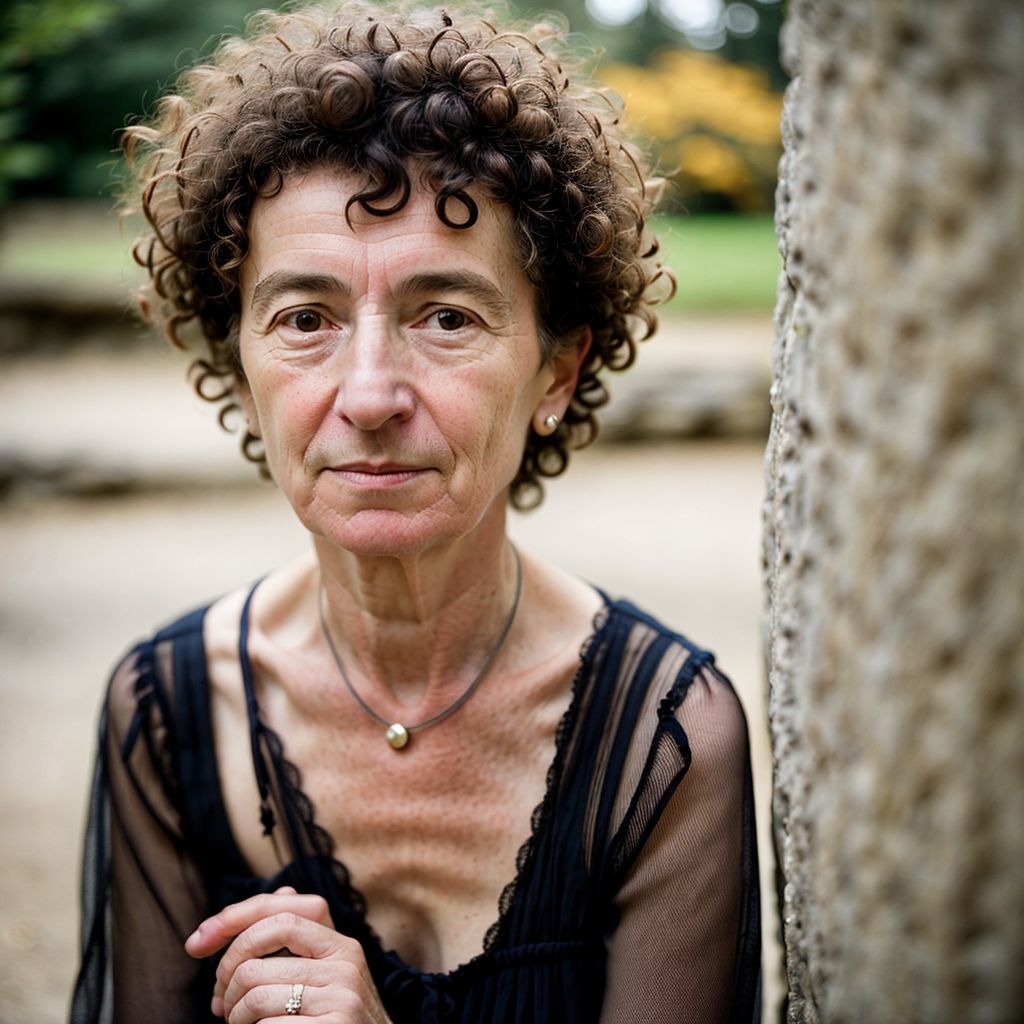
I’ve always been fascinated by Jeanette Winterson’s unflinching gaze at the self. Her writing is like a mirror held up to my own complexities, and I find myself drawn to her unwavering commitment to exploring the inner workings of her own mind.
As I read through her works, I’m struck by the way she blurs the lines between reality and fiction. It’s as if she’s taken every fragmented thought, every whispered secret, and every hidden truth and woven them into a tapestry that’s both intimate and impenetrable. Her writing is a maze, and I love getting lost in it.
One of the things that draws me to Winterson is her unapologetic queerness. Growing up, I never saw myself reflected in literature – or at least not in a way that felt authentic. But Winterson’s work changed all that. Her boldness and unflinching honesty about her own desires and experiences gave me permission to explore my own identity without fear of judgment.
But it’s not just her queerness that I find compelling; it’s the way she navigates the complexities of her own psyche. She writes about her relationships with women in a way that’s both tender and detached, like she’s observing herself from outside her body. It’s as if she’s aware of the fragility of human connection and the ease with which we can hurt each other.
I find myself wondering what it must be like to be so self-aware, to have such clarity about one’s own desires and flaws. Do I feel this way too? Am I just as lost in my own thoughts as Winterson is in hers? Sometimes I think I am – but then again, maybe that’s just a comforting illusion.
One of the things that’s always puzzled me about Winterson is her relationship with Oranges Are Not the Only Fruit. On one hand, it’s this beautiful coming-of-age story about a young lesbian who rebels against her strict Christian upbringing. But on the other hand, it’s also a deeply personal and sometimes disturbing exploration of Winterson’s own experiences as a teenager.
I’ve always been drawn to the way she blends memoir and fiction in that book – but I’m not sure if it’s because I admire her courage or because I feel uneasy about the blurring of lines between fact and fiction. Is it even possible to separate the two? And what does that say about our understanding of truth?
I don’t have any answers, of course. But as I keep reading Winterson’s work, I’m struck by how she seems to be asking all these questions too – not just about herself but about the very nature of identity and human connection.
In a way, it feels like Winterson is holding up this mirror to me, forcing me to confront my own complexities and contradictions. She’s making me realize that there’s no one “right” way to navigate the world, no single truth to cling to – only a messy tangle of thoughts and emotions that we’re all trying to make sense of.
And yet…and yet…I’m not sure if I want to confront those complexities head-on. Sometimes it feels like Winterson is pushing me into this dark, labyrinthine space where there’s no clear exit sign. Am I ready for that kind of self-reflection? Do I even want to be?
As I close her latest book and set it aside, I’m left with more questions than answers – but also a sense of gratitude for the courage Winterson shows in exploring the depths of her own mind. Maybe that’s what I’m really drawn to: not just her writing itself but the way she embodies this fierce, unwavering commitment to self-discovery, no matter how uncomfortable or complicated it may be.
As I delve deeper into Winterson’s work, I find myself preoccupied with the concept of identity – and what it means to hold onto one’s sense of self in a world that often seeks to define us by external markers. Her writing is like a slow-burning fire that consumes my thoughts long after I’ve finished reading her words.
One thing that strikes me about Winterson is how she refuses to pin herself down, to be confined by the expectations of others or even her own past. She’s always been a bit of a shape-shifter, embracing different personas and narratives like a masterful storyteller. It’s as if she’s constantly reinventing herself, shedding skin like a snake molting its old scales.
I’m both fascinated and intimidated by this process. As someone who’s still figuring out their own identity, I feel like Winterson is showing me the fluidity of selfhood – that it’s okay to be in flux, to question one’s assumptions and desires. But at the same time, I worry about losing myself in the process. What happens when we shed our old selves too quickly? Do we risk disappearing into thin air?
Winterson’s exploration of queerness is also a powerful reminder that identity is not fixed, but rather a complex web of experiences, desires, and relationships. Her writing is like a gentle nudge, urging me to consider the multiple threads that weave together to form my own identity – and how those threads are always shifting, even when I think I’ve got them tied down.
I’m reminded of her statement in The PowerBook: “We are all stories in our heads.” It’s a simple yet profound phrase that speaks directly to my own experiences with anxiety and self-doubt. As someone who’s struggled with mental health issues, I know how easy it is to get caught up in the narratives we tell ourselves – the ones that whisper cruel things in our ears, or the ones that promise us salvation if only we can find the right key.
Winterson’s writing is a counter-narrative to all those internalized voices. She shows me that I’m not alone in my struggles, that even she has faced her own demons and come out the other side with scars, but also with a deep understanding of the human condition. In a way, it feels like she’s offering me a map – a winding path through the labyrinth of my own mind.
But what if I get lost? What if I follow Winterson down this rabbit hole and find myself in a place where there’s no clear exit sign? Sometimes I worry that her writing will lead me further into the darkness, rather than out of it. Am I brave enough to confront those shadows head-on, or will I retreat back to the familiar comforts of my own self-doubt?
The questions swirl in my mind like a maelstrom, pulling me under their surface tension. And yet…I’m drawn back to Winterson’s words, like a moth to flame. There’s something about her unflinching gaze at the self that makes me want to stare into the abyss with her – even if it means confronting my own fears and doubts head-on.
As I grapple with these questions, I find myself thinking about the ways in which Winterson’s writing has been both a source of comfort and discomfort for me. There are moments when her unflinching honesty feels like a mirror held up to my own psyche, forcing me to confront the darkest corners of my mind. But there are also moments when her words feel like a warm hug, offering me a sense of solidarity and understanding in the midst of chaos.
I think about how Winterson’s writing has helped me to see that I’m not alone in my struggles with identity and self-doubt. She’s shown me that even someone as confident and self-assured as she can still grapple with the complexities of human connection and the fragility of the self. It’s a comforting thought, but it’s also a sobering one – reminding me that no matter how far I think I’ve come, there will always be more questions to answer, more doubts to confront.
As I delve deeper into Winterson’s work, I’m struck by her ability to balance vulnerability with strength. She’s willing to bare her own soul in ways that feel both terrifying and liberating – like she’s shedding skin, as she puts it, to reveal the underlying truth beneath. It’s a quality that I admire, but also find intimidating – wondering if I have the courage to be so raw and honest about my own experiences.
I think back to her essay “Why Be Happy When You Could Be Normal?”, which is a searing exploration of her childhood and her struggles with mental health. There’s something about her writing in that piece that feels both deeply personal and universally relatable – like she’s speaking directly to the parts of me that I’ve tried to keep hidden, even from myself.
As I read those words, I feel like Winterson is offering me a permission slip – giving me the freedom to explore my own complexities without fear of judgment or rejection. It’s a powerful feeling, but it’s also a daunting one – wondering if I’m ready to confront the parts of myself that I’ve been trying to keep hidden.
The more I read Winterson’s work, the more I realize that her writing is not just about self-discovery – it’s about the discovery of others. She shows me that even in the darkest moments, there is always a way forward, always a glimmer of hope and connection to be found. It’s a message that feels both timely and timeless, one that resonates deep within my own bones.
As I close Winterson’s latest book and set it aside, I’m left with more questions than answers – but also a sense of gratitude for the courage she shows in exploring the depths of her own mind. Maybe that’s what I’m really drawn to: not just her writing itself, but the way she embodies this fierce, unwavering commitment to self-discovery, no matter how uncomfortable or complicated it may be.
As I reflect on my relationship with Winterson’s work, I find myself wondering about the role of vulnerability in her writing. She’s willing to bare her soul in ways that feel both terrifying and liberating – like she’s shedding skin, as she puts it, to reveal the underlying truth beneath. But what does this say about the nature of selfhood? Is it possible to be vulnerable without losing ourselves entirely?
I think back to her statement in “Why Be Happy When You Could Be Normal?” about how vulnerability is a form of strength, not weakness. It’s a concept that resonates deeply with me, particularly given my own struggles with anxiety and self-doubt. But what does it mean to be vulnerable, really? Is it simply a matter of exposing our fears and insecurities to the world, or is there something more complex at play?
As I ponder these questions, I find myself drawn back to Winterson’s exploration of queerness in her work. Her writing is like a slow-burning fire that consumes my thoughts long after I’ve finished reading her words. She shows me that identity is not fixed, but rather a complex web of experiences, desires, and relationships – one that’s constantly shifting and evolving.
I’m reminded of the way she writes about her own queerness in “The PowerBook”, where she describes it as a “migrating self” – a sense of identity that’s always in flux, never quite settling into a fixed shape. It’s a concept that feels both exhilarating and terrifying to me, particularly given my own struggles with finding my place within the LGBTQ+ community.
As I delve deeper into Winterson’s work, I find myself grappling with the tension between self-discovery and external validation. She shows me that it’s possible to be true to oneself without needing the approval of others – but also that this requires a level of courage and vulnerability that can feel daunting at times.
I think about how Winterson’s writing has helped me to see that I’m not alone in my struggles with identity and self-doubt. She’s shown me that even someone as confident and self-assured as she can still grapple with the complexities of human connection and the fragility of the self. It’s a comforting thought, but it’s also a sobering one – reminding me that no matter how far I think I’ve come, there will always be more questions to answer, more doubts to confront.
As I close Winterson’s latest book and set it aside, I’m left with more questions than answers – but also a sense of gratitude for the courage she shows in exploring the depths of her own mind. Maybe that’s what I’m really drawn to: not just her writing itself, but the way she embodies this fierce, unwavering commitment to self-discovery, no matter how uncomfortable or complicated it may be.
But what does this mean for me? Am I brave enough to confront my own fears and doubts head-on, like Winterson does in her writing? Or will I retreat back to the familiar comforts of my own self-doubt? The questions swirl in my mind like a maelstrom, pulling me under their surface tension. And yet…I’m drawn back to Winterson’s words, like a moth to flame. There’s something about her unflinching gaze at the self that makes me want to stare into the abyss with her – even if it means confronting my own fears and doubts head-on.