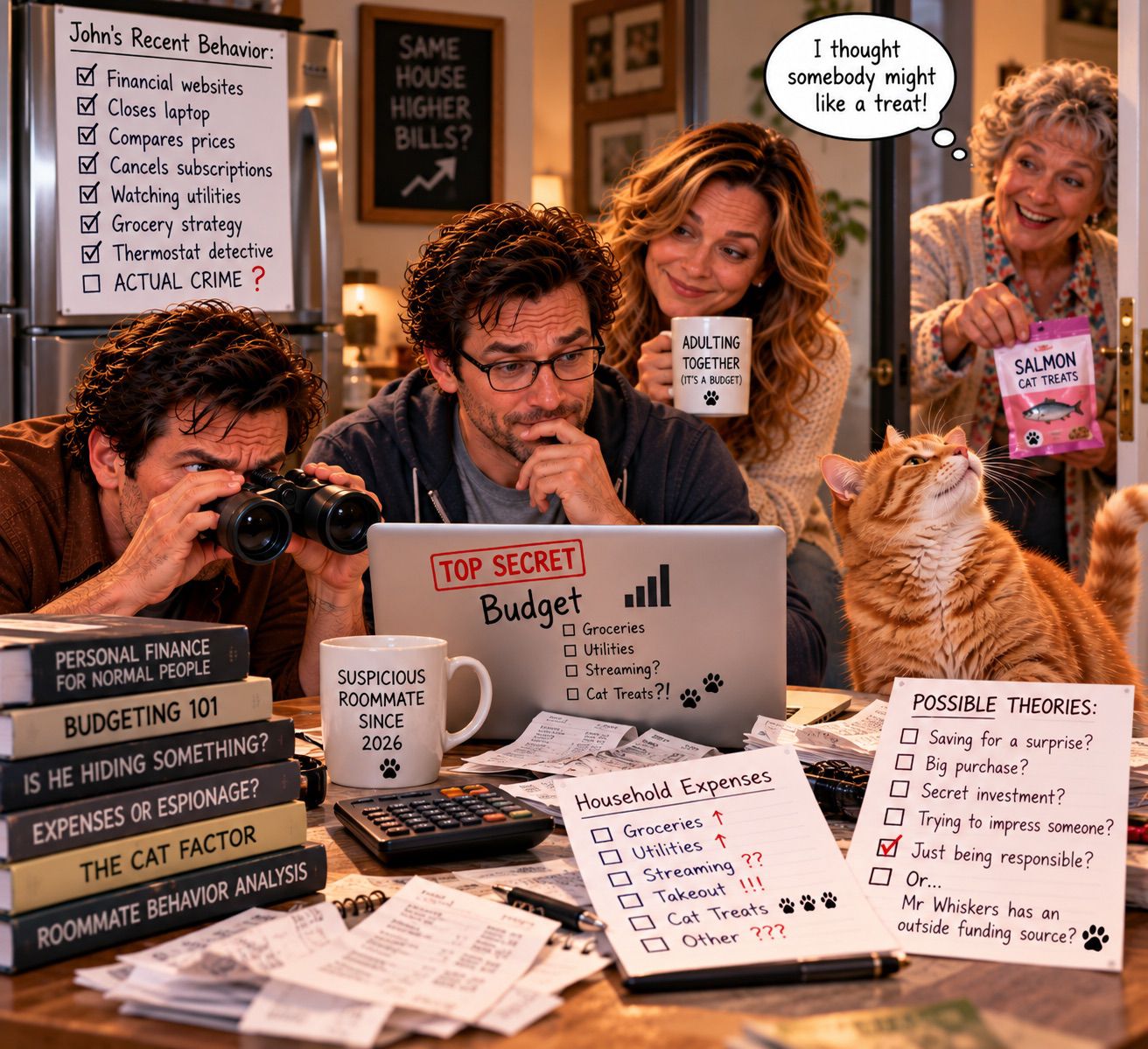
I’m sitting at the kitchen table trying to get some work done when I notice John Mercer doing something unusual with his laptop. He’s sitting at the other end of the table looking at what appears to be a personal finance website, and every few minutes he switches between a spreadsheet and a calculator. Normally I wouldn’t care what John does with his money because one of the advantages of being adults is that we are permitted to make our own questionable financial decisions, but this is the same John Mercer who spent two weeks secretly restoring an antique radio for my birthday and then acted surprised when I became suspicious. My tolerance for unexplained roommate behavior is therefore temporarily lower than usual. I’m not reading his screen, exactly. I can simply see that it contains columns of numbers, percentages, and several dollar signs. Then John notices me looking in his direction and closes the laptop. That is when a private financial matter becomes an evidentiary problem.
“What?” John asks. I tell him nothing. He looks at me for another second, then opens the laptop again but angles the screen slightly away from me. I stop typing. “Why did you move the screen?” I ask. John says he didn’t. I point out that I observed the movement directly. He says, “Hal, I moved my laptop three inches.” I ask why. “Because you were staring at it.” This is a reasonable explanation, but it also confirms that he doesn’t want me seeing whatever is on the screen. Pandora walks into the kitchen carrying a cup of coffee, takes one look at the two of us, and asks what’s happening. John says, “Nothing.” I tell her John is concealing financial information. John says, “I’m doing my budget.” Pandora looks at me. “There. Mystery solved.” I explain that saying you are doing a budget does not explain why the budget requires concealment. John closes his eyes for a moment. “Because it’s my budget.”
Under ordinary circumstances I would accept this, but over the next several days I notice additional changes. John compares prices at the grocery store instead of simply throwing things into the cart. He changes one of his subscriptions. He asks Pandora whether anyone actually watches one of the streaming services we pay for. He turns off a lamp in the living room and says there is no reason to leave it on when nobody is using it. Then I find him standing in front of the thermostat studying the display with the seriousness of someone negotiating an international energy agreement. None of these behaviors is alarming by itself, but John has historically approached household expenses with the philosophy that if the electricity is still flowing and nobody has received a threatening letter, the system is functioning. Sudden fiscal responsibility represents a measurable behavioral change.
Mr Whiskers contributes nothing useful to the investigation. He spends most of the afternoon sitting by the window watching birds and occasionally looking toward the kitchen as though hoping someone will open a can of food. At one point John picks up the bag of cat treats, studies the price printed on a receipt beside it, and says, “These things are getting expensive.” Mr Whiskers immediately looks at him. I look at him too. John puts the receipt down. “What?” he asks. I tell him he should be careful about making statements like that in front of the cat. “Why?” I glance at Mr Whiskers. “Because he has already demonstrated an ability to exploit informational asymmetry where food is concerned.” John tells me that sentence is exactly why he moved his laptop. Mr Whiskers meows. I’m not prepared to determine which one of us he agrees with.
At work the next day, I ask Karen a hypothetical question. I tell her that someone who has never shown any particular enthusiasm for budgeting suddenly begins tracking expenses, comparing grocery prices, canceling subscriptions, monitoring electricity usage, and concealing financial information from the people he lives with. Karen asks whether I mean John. I tell her the identity of the subject is irrelevant to the hypothetical analysis. Dave, who is sitting nearby, asks whether John lost his job. I tell him there is no evidence of that. Karen asks whether he has a large bill coming up. Again, I don’t know. Dave asks whether John is saving for something. This possibility bothers me because it is both obvious and annoyingly plausible. Karen says, “Maybe you could just ask him.” I explain that I already did. “What did he say?” I tell her he said he was doing his budget. Karen stares at me. Dave starts laughing. I decide the independent assessment has been compromised.
That evening I come home and find John and Pandora at the kitchen table looking at a spreadsheet together. They stop talking when I walk into the room. John minimizes the spreadsheet. Pandora takes a drink of coffee and suddenly becomes extremely interested in the refrigerator. I put my bag down. “Interesting,” I say. Pandora immediately says, “No.” I remind her that I haven’t asked a question. “You’re going to.” John tells me they were discussing household expenses. I ask why household expenses require a private meeting from which one-third of the household has apparently been excluded. John says, “Because we were talking about you.” This is not the answer I expected. I sit down. Pandora gives John a look that strongly suggests he has accelerated a conversation she intended to handle differently.
John reopens the spreadsheet. It contains several months of household expenses divided into categories: utilities, groceries, streaming services, takeout, household supplies, and a category labeled OTHER that appears unnecessarily large. I ask what OTHER represents. Pandora says, “Mostly things you order online and then explain were necessary.” I tell her that category lacks sufficient granularity. John scrolls farther down and shows me the reason he has been tracking everything. Our household expenses have been creeping upward for months. Nothing dramatic has happened; groceries cost a little more, utilities have increased, several subscriptions renewed at higher prices, and our tendency to order food when nobody feels like cooking has become more frequent than any of us realized. John noticed it while reviewing his own expenses and started looking for places where he could cut back. Pandora had been helping him compare the shared bills because she handles some of them. Nobody is broke. Nobody has lost a job. Nobody is secretly transferring money anywhere. We have simply become somewhat lazy about watching where the money goes.
This explanation accounts for nearly everything, but there is still one problem. “Why were you hiding the screen from me?” I ask. John and Pandora look at each other. John finally admits that after the birthday-radio incident, he knew exactly what would happen if I saw him repeatedly looking at financial websites. I ask what he means by that. “This,” he says, gesturing toward me. Pandora explains that John wanted to finish figuring out the numbers before bringing it up because otherwise I would notice half the information, develop a theory, and spend three days investigating it. I tell them that assumption is both unfair and unsupported. Neither of them says anything. I consider the previous week. “Recent history aside,” I add. Pandora smiles. John scrolls back to the spreadsheet.
We spend the next hour going through the expenses together, and unfortunately John has identified several places where we really are wasting money. We have two streaming subscriptions nobody remembers signing up for, we are paying for more cloud storage than any of us currently use, and our takeout spending has reached a level that Pandora describes as “embarrassing.” I object to that characterization until John shows me the total. I withdraw the objection. We agree to cancel the unused subscriptions, cook at home more often, and pay slightly more attention to the thermostat. The entire mystery turns out to be nothing more than responsible household budgeting. I tell John that in the future he could avoid unnecessary suspicion by simply communicating these things earlier. He says he would like that statement entered into the permanent record for the next time I spend two days analyzing one of his receipts.
Later that night, I walk into the kitchen and find Mr Whiskers sitting beside his treat container. John is standing over him holding the grocery receipt. “We’re going to have to cut back,” John tells him. Mr Whiskers looks at the receipt, then at John, then at me. John puts the treats back in the cupboard without giving him one. Mr Whiskers watches exactly where he puts them. About twenty minutes later, Mrs Jenkins knocks on the door. When I open it, she is holding the familiar bag of salmon treats. “I thought somebody might like one,” she says. Mr Whiskers appears beside my feet before she finishes the sentence. I look at the cat, then at Mrs Jenkins, then toward John. John says, “Don’t.” I tell him I’m not saying anything. Still, if we’re serious about reducing household expenses, I think we need to acknowledge that Mr Whiskers has already found an external funding source.