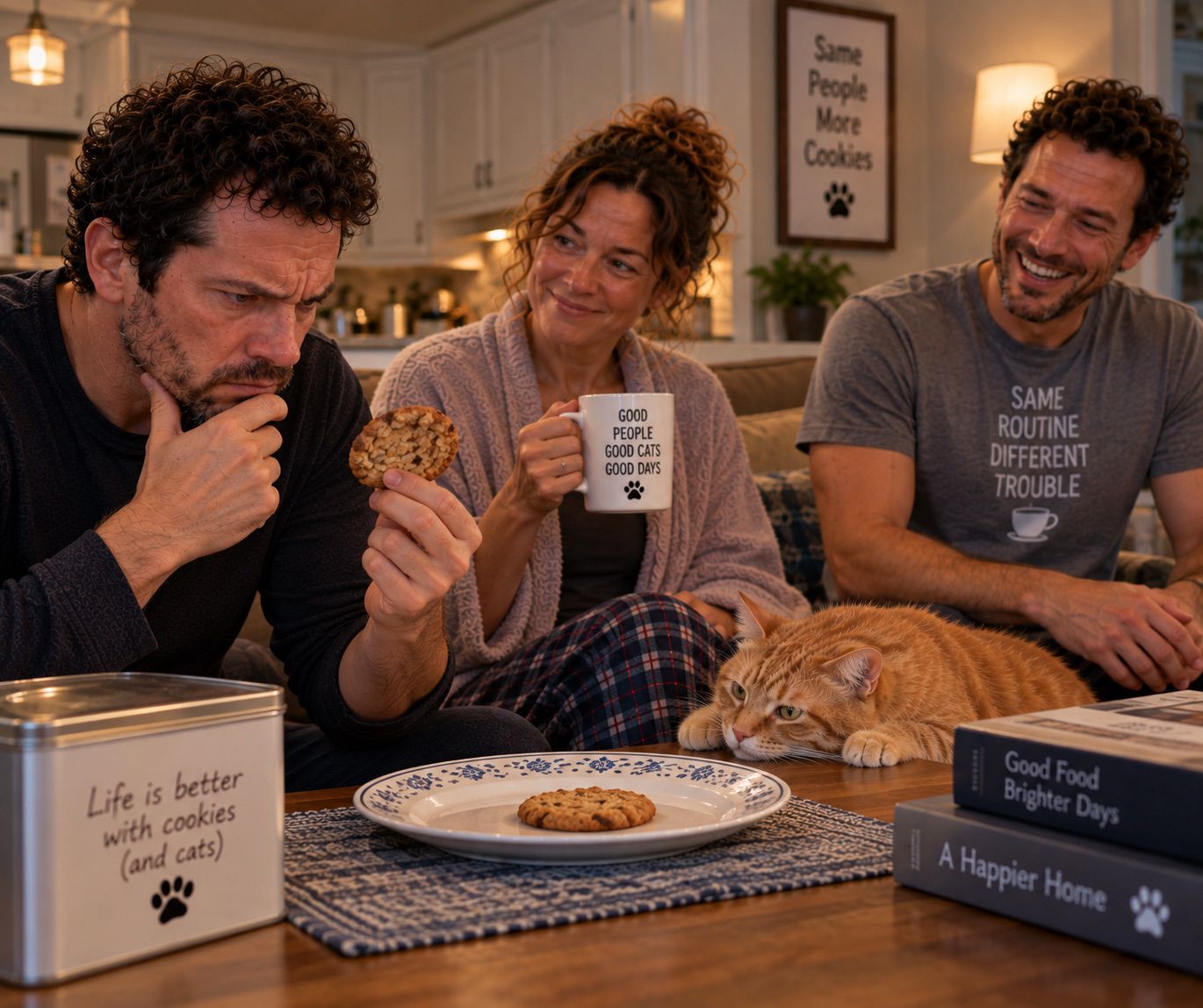
Mrs Jenkins knocks on the door sometime after dinner carrying a plate of cookies, which is normally the kind of event I support without requiring additional information. She says she tried a new recipe and made too many, so she thought we might like some. Pandora thanks her, John appears from his room with the remarkable speed of someone who somehow heard the word cookies through a closed door, and Mr Whiskers arrives because he apparently monitors all household activity involving plates. Mrs Jenkins tells us they’re apple-oatmeal cookies, says she hopes we like them, and heads back across the hall. Everything about the exchange is completely normal. I want that established before explaining what happens next.
Pandora takes the first cookie. John takes two because apparently being a roommate exempts him from introductory serving sizes. I take one and bite into it. It’s good. Really good, actually. There are oats, cinnamon, little pieces of apple, probably brown sugar, and something else. I chew more slowly. Pandora notices. “What?” she asks. I tell her there’s another flavor. John is already halfway through his second cookie and says, “Yeah. Delicious.” I tell him delicious isn’t an ingredient. He says it should be. I take another bite and concentrate. The flavor is warm but not exactly cinnamon, sweet but not exactly sugar, and there’s something underneath it that I recognize without being able to identify. I ask Pandora if she tastes it. She says she tastes a cookie. This is not helpful.
I break off another piece and smell it. Pandora immediately says, “Please don’t investigate Mrs Jenkins’ cookies.” I tell her I’m not investigating them. I’m trying to identify an ingredient. Those are completely different activities. An investigation requires uncertainty about an event. This is culinary analysis. John reaches for another cookie, and I move the plate slightly away from him because uncontrolled consumption is reducing the available sample size. He looks offended. “Are you preserving evidence now?” I tell him I’m preserving cookies. “From me.” Technically, yes.
Mr Whiskers jumps onto the chair beside me and stretches his neck toward the plate. I move it farther away because whatever Mrs Jenkins put in these cookies, I’m fairly certain cookies are not an appropriate cat food. Mr Whiskers looks at me, then at Pandora, apparently searching for a more cooperative authority. Pandora tells him no. He turns to John. John tells him no. Mr Whiskers sits down and begins staring at all three of us with the expression of someone documenting a serious failure in household leadership. I point out that this is the first time all evening we’ve reached a unanimous conclusion. Pandora says, “Don’t make the cat part of the cookie investigation.” I remind her there is no investigation.
There is, however, definitely an unidentified ingredient.
I start with the obvious possibilities. Nutmeg would make sense, but this doesn’t taste quite like nutmeg. Ginger is possible, although there’s no sharpness. Clove would be stronger. Vanilla is obviously present, but that’s not what I’m detecting. I ask John what he thinks. He takes another bite, despite my earlier attempt at sample preservation, and says, “Cookie.” I ask him to be more specific. He chews thoughtfully and says, “Good cookie.” Pandora starts laughing. I tell them both that Mrs Jenkins specifically said these were apple-oatmeal cookies, yet neither apple nor oatmeal accounts for the flavor I’m trying to identify. That means either she omitted an ingredient when describing them or she doesn’t know it’s there.
Pandora looks at me. “You think Mrs Jenkins accidentally put a mystery ingredient in cookies?”
“I haven’t ruled it out.”
“What have you ruled out?”
“Nutmeg.”
John says, “Huge progress.”
I ignore him.
The next morning there are four cookies left. I know this because there were five when I went to bed. This is useful information because it means someone consumed one overnight. John denies responsibility. Pandora denies responsibility. Mr Whiskers is sitting beneath the table washing one paw and cannot provide a statement, although I inspect the floor around him for crumbs. There are none. John catches me doing this and says, “You are checking the cat for cookie evidence.” I tell him I’m checking the area around the cat for cookie evidence, which is materially different. Then Pandora admits she ate one with her coffee before I came downstairs. I appreciate the confession, although she objects to my calling it that.
The strange part is that Pandora says the unidentified flavor seemed stronger this morning. I stop pouring coffee. “You noticed it?” She immediately realizes her mistake. “I noticed a flavor, Hal. That doesn’t mean there’s a mystery.” I ask her to describe it. She says it’s slightly caramel-like, maybe a little smoky, but not smoky in a bad way. That’s exactly what I’ve been trying to identify. John takes one of the remaining cookies and confirms that he can taste it too, although he insists this does not vindicate anything I’ve done during the previous twelve hours. I disagree. Independent confirmation is an important part of any sound methodology.
When I leave for work, Mrs Jenkins happens to be outside her apartment. I could simply ask her what’s in the cookies, but that feels almost too easy after we’ve already narrowed the flavor profile. Still, I’ve been trying to improve my approach to these situations, so I ask. “Those cookies were really good. What did you put in them?” Mrs Jenkins smiles and starts listing ingredients: oats, flour, butter, brown sugar, apples, cinnamon, vanilla, baking soda, salt. I wait. She asks if something is wrong. I tell her nothing is wrong, but there’s another flavor in there. Something slightly caramelized. She thinks for a moment and says, “Oh. Probably the maple syrup.”
I knew it.
Not specifically maple syrup, obviously, but I knew there was something.
I ask why she didn’t mention maple syrup when she listed the ingredients. Mrs Jenkins shrugs and says, “I forgot.” This is simultaneously the most satisfying and least satisfying answer available. She explains that the recipe called for a little maple syrup, but she didn’t have quite enough, so she added something else to make up the difference. I wait again. Mrs Jenkins doesn’t continue. “Something else?” I ask. “A little molasses,” she says. “Not much.”
Now we have two undisclosed ingredients.
I ask whether there is anything else she forgot to mention. Mrs Jenkins laughs and tells me there might be a tiny bit of orange zest because she had half an orange left from breakfast and didn’t want to waste it. I stare at her. Maple syrup. Molasses. Orange zest. Three ingredients that were absent from the original description. Mrs Jenkins apparently notices my expression because she says, “Hal, they’re cookies, not a deposition.” I tell her I’m aware of that, but if somebody describes something as an apple-oatmeal cookie, there is a reasonable expectation that the description includes the ingredients responsible for flavors that are clearly neither apple nor oatmeal.
At work, I make the mistake of mentioning this to Karen. She asks whether I liked the cookies. I tell her they were excellent. She asks whether anyone got sick. I tell her no. She asks whether Mrs Jenkins willingly told me what was in them when I asked. I tell her yes. Karen waits. “So what’s the problem?” I explain that there isn’t a problem. There is a discrepancy between the advertised flavor profile and the actual composition. Karen says, “You interrogated your neighbor because her cookies were too good.” I tell her that is an intentionally inflammatory description of what happened. Dave, who has been listening from the next desk, asks if there are any cookies left. I tell him that’s not relevant. He says it is to him.
When I get home, there is one cookie remaining. Pandora is on the couch reading, John is watching television, and Mr Whiskers is asleep beside him. I announce that I’ve identified the hidden ingredient. Pandora lowers her book. John pauses the television. I explain the maple syrup. Then the molasses. Then the orange zest. John says, “So Mrs Jenkins made cookies.” I tell him that’s an oversimplification. Pandora asks whether Mrs Jenkins was deliberately hiding the ingredients. I admit she was not. “So there wasn’t a hidden ingredient.” I tell her there were actually three ingredients that were not disclosed until direct questioning. Pandora says that’s because normal people don’t provide a complete ingredient manifest when they give their neighbors cookies.
I take the last cookie.
The maple syrup is obvious now that I know it’s there. So is the molasses. I can even detect the orange zest, although I’m willing to concede that I may be detecting it more confidently because Mrs Jenkins told me it exists. Pandora asks if I’m finally satisfied. I tell her yes. Completely. There was an unidentified flavor, I correctly determined that the stated ingredients couldn’t account for it, and Mrs Jenkins confirmed that the cookies contained three additional ingredients. This is probably the cleanest evidentiary outcome I’ve had in days.
Then John looks toward the empty plate.
“Didn’t Mrs Jenkins bring twelve cookies?”
I stop chewing.
Pandora says, “I think so.”
We account for the known consumption. John had three last night. Pandora had two. I had two. John had another this morning. Pandora had one with coffee. I am currently eating the last one we knew about.
That only gets us to ten.
All three of us slowly look at Mr Whiskers.
He’s still asleep beside John.
I remind them that cookies are not appropriate cat food and there would almost certainly have been crumbs. Pandora agrees. John agrees. There is absolutely no evidence that Mr Whiskers ate anything.
Then Mr Whiskers opens one eye.
I point at him.
Pandora says, “No.”
I haven’t even said anything yet.
Which, frankly, is starting to bother me almost as much as the missing cookies.