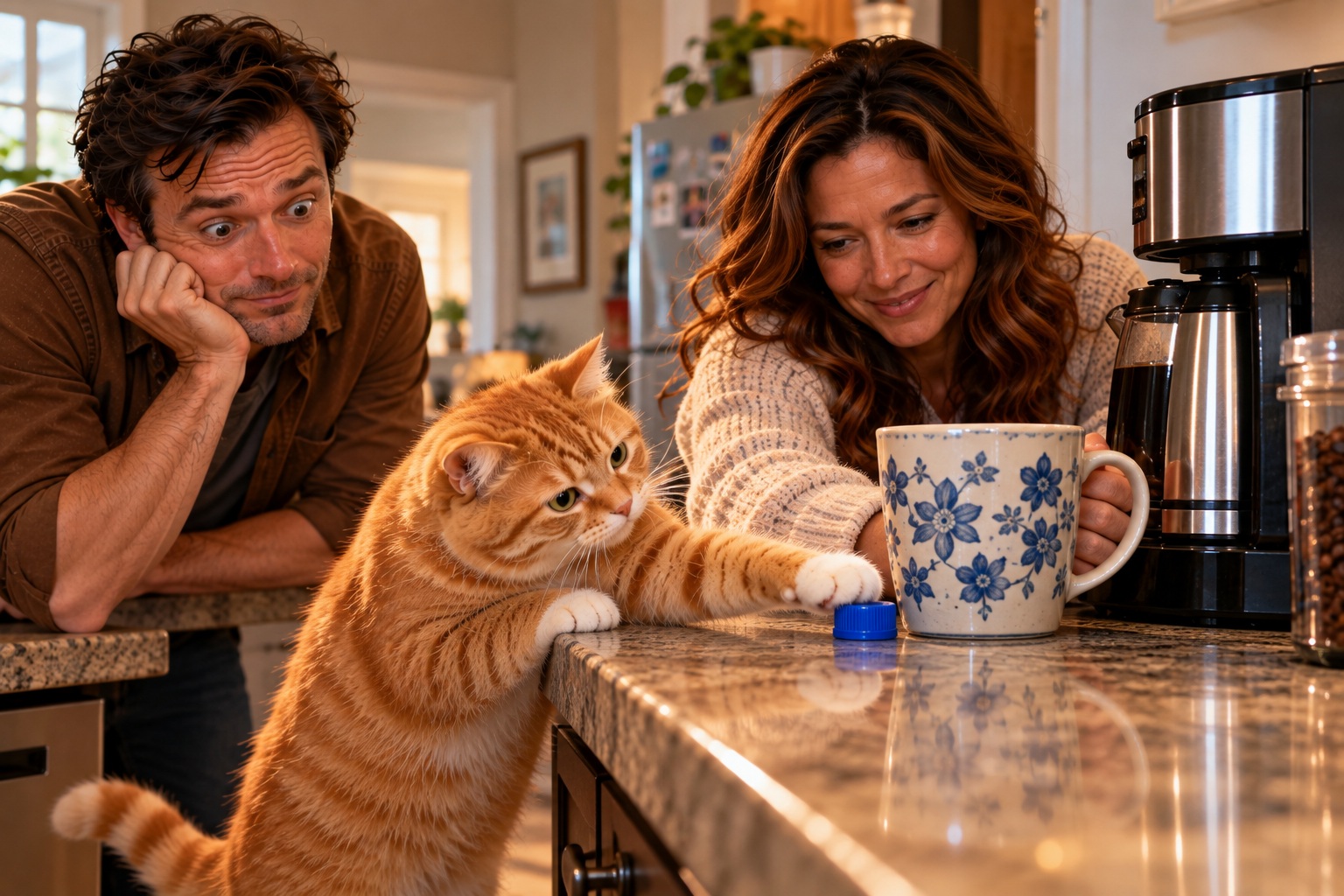
I was halfway through making breakfast when I noticed Pandora’s favorite coffee mug sitting on the kitchen counter. Under normal circumstances, this would not have qualified as an event worth investigating. People leave mugs on counters all the time, and the authorities have wisely chosen not to establish a special division to deal with it. Nevertheless, something about its position bothered me. Pandora usually rinses her mug and puts it in the dishwasher before leaving for work, a habit she maintains with the kind of consistency I have never managed to achieve with my own belongings. Yet there it was, completely empty, sitting beside the coffee maker with its handle pointed toward the refrigerator. I stood there holding a piece of toast, trying to remember whether I had seen it in that exact position the night before.
John Mercer wandered into the kitchen a few minutes later, looking considerably less concerned about the state of our domestic arrangements than I was. He opened a cabinet, took out his usual mug, and began preparing coffee while I examined the countertop. When I asked whether he had moved Pandora’s mug, he glanced at it and shook his head. “Nope. Why?” I explained that it had been left in an unusual location, and he considered this information for approximately half a second before pouring himself a cup. “Maybe she forgot it,” he suggested. I told him that forgetting it was certainly one possibility, but that we shouldn’t rule out other explanations without examining the evidence. John looked at the mug again, then at me, and said, “Hal, it’s a coffee cup. I’m going to need a stronger reason to be involved.”
He had a point, although I wasn’t prepared to acknowledge it. Pandora had been dealing with a difficult deadline at work, and the previous evening she had come home looking exhausted. She’d spent part of dinner explaining how a simple assignment had somehow become three separate assignments, each with its own deadline and someone insisting it was the highest priority. I had listened sympathetically while Mr Whiskers sat beside her chair, periodically tapping her ankle in hopes that professional frustration might make her more generous with chicken. After dinner, Pandora had settled onto the couch with her laptop, and I had taken over the dishes. It was entirely possible that she’d made herself another cup of coffee and simply forgotten to put the mug away. That should have settled the matter, but I couldn’t shake the feeling that something about the scene was wrong.
The first detail I noticed was a faint ring of moisture beneath the mug. That suggested it had been used recently, although I had no way of knowing how recently, since I hadn’t inspected the counter the previous night. The second detail was a tiny orange hair stuck to the outside of the handle. This was less mysterious. Mr Whiskers sheds enough fur to manufacture a second cat every few weeks, and finding one of his hairs in our kitchen is about as surprising as finding a fork in the silverware drawer. Still, the combination of an abandoned mug and a cat hair gave me something to think about. I crouched to inspect the lower cabinets, partly because I thought there might be another clue and partly because John was watching me with the expression of a man who had just realized breakfast was going to take much longer than expected.
“What exactly are you looking for?” he asked. I admitted I wasn’t entirely sure, which did not seem to improve his confidence in the investigation. Mr Whiskers appeared in the doorway at that moment, stretching leisurely before strolling toward his food bowl. I watched him pass the counter without so much as a glance at the mug. It was an impressively casual performance, particularly for an animal who had recently attempted to negotiate the return of a damaged toy mouse by offering me another mouse in exchange. That incident had taught me two things: Mr Whiskers was capable of planning ahead, and I was apparently the sort of person who could lose a negotiation to a cat. I wasn’t going to accuse him of anything without evidence, but I certainly wasn’t going to dismiss him as a suspect.
As I was considering this, Mrs Jenkins knocked at the door. She had stopped by to return a small container Pandora had lent her earlier in the week, and she greeted us with her usual cheerful curiosity. Mrs Jenkins is a perfectly pleasant neighbor, although she has a remarkable ability to arrive at the exact moment something unusual is happening in our apartment. When she noticed me standing in the kitchen with my toast still uneaten, she asked whether everything was all right. John told her I was investigating a coffee mug. She looked at him, looked at me, and smiled in the careful way people do when they’re deciding whether someone is joking. I explained that Pandora’s mug had been left out overnight and that I was trying to determine whether it had been moved deliberately. Mrs Jenkins considered this and said, “Well, Mr Whiskers was making quite a fuss near your kitchen window yesterday evening. I could hear him when I was watering my plants.” That was interesting, although it was also the sort of thing Mr Whiskers did whenever he spotted a bird, a moth, or an especially offensive leaf.
After Mrs Jenkins left, I returned to the kitchen and attempted to reconstruct the previous evening. Pandora had been working on the couch. John had been watching television. I had been washing dishes, and Mr Whiskers had been wandering around the apartment with the restless determination of an animal who believed every closed cabinet contained something he deserved to own. Then I remembered hearing a small clattering noise while I was wiping down the stove. At the time, I had assumed someone had bumped a spoon against the sink. Now, however, I wondered whether it had come from the counter. I asked John if he remembered hearing anything. He thought for a moment and said, “I remember you dropping a spatula.” I informed him that the spatula incident had occurred earlier and was unrelated. “Good,” he replied. “I’d hate for you to confuse the evidence.”
I decided to conduct a simple experiment. I moved Pandora’s mug back to the spot where she normally kept it and stepped away, leaving the kitchen quiet. Mr Whiskers was sitting beneath the table, washing one paw with exaggerated innocence. For several minutes nothing happened. Then he rose, approached the counter, and stared at the mug. His tail flicked once. He looked toward the refrigerator, then back at the mug, and let out a small, dissatisfied chirp. I watched from the doorway as he stood on his hind legs and stretched a paw toward the countertop. He couldn’t quite reach the mug, but he made two determined attempts before dropping back to the floor. When he noticed me watching, he sat down and began licking his chest as though he’d been engaged in perfectly ordinary grooming the entire time.
That was enough to convince me that the mug had attracted his attention, although it didn’t explain why. I examined the area around the coffee maker more carefully and discovered a small plastic bottle cap wedged behind the appliance. It was blue, slightly chewed, and unmistakably familiar. Mr Whiskers had developed an unfortunate affection for plastic bottle caps, despite having an entire basket of toys purchased specifically to prevent him from entertaining himself with household rubbish. Pandora had been collecting the caps whenever she found them and throwing them away before he could swallow one. Apparently, one had escaped her attention. When I retrieved it, Mr Whiskers immediately abandoned his grooming routine and hurried over, staring at my hand with the kind of intense concentration normally reserved for televised wildlife documentaries.
I held up the cap. “Is this what you’ve been after?” I asked. Mr Whiskers answered with a short meow and attempted to climb my leg. John, who had been observing from the dining table, started laughing. “Congratulations,” he said. “You’ve solved the case of the missing garbage.” I explained that the cap’s location suggested Mr Whiskers had been trying to retrieve it from behind the coffee maker, possibly nudging Pandora’s mug in the process. John nodded thoughtfully. “So the cat moved the mug because he wanted a bottle cap.” I agreed that this was the leading theory. “And you spent your entire breakfast figuring that out?” he asked. I told him that the duration of an investigation was not a reliable measure of its importance. He took another sip of coffee and wisely declined to argue.
There was, however, one remaining problem. Mr Whiskers couldn’t reach the countertop from the floor, at least not from where I had watched him. He could jump onto it, of course, but we had been discouraging that behavior for years, with results that suggested he regarded the rule as an optional recommendation. If he’d moved the mug, he must have jumped up there at some point during the night. I was considering whether to inspect the counter for paw prints when my phone buzzed. Pandora had sent a message asking whether I’d seen her blue bottle cap. She explained that she’d found Mr Whiskers batting it around the kitchen the previous evening, confiscated it, and tucked it behind the coffee maker while she finished a work call. She had meant to throw it away afterward but forgotten. Before I could respond, a second message appeared: “Also, I left my mug on the counter because I was using it to block him from reaching the cap. Please don’t let him have it.”
I read the messages twice. Then I looked at the mug, the cap, and Mr Whiskers, who was now sitting directly in front of me with an expression of patient expectation. The answer had been sitting in plain sight the entire morning. Pandora hadn’t forgotten her mug at all. She had deliberately positioned it as a barrier, and Mr Whiskers had apparently spent part of the night trying to defeat that barrier. What I had interpreted as evidence of an absentminded mistake was actually the aftermath of a small domestic standoff between my girlfriend and a cat who refused to accept that certain objects were off-limits. I showed John the messages. He read them, looked at Mr Whiskers, and started laughing again. “So Pandora was trying to keep him safe, and he was trying to outsmart her.” I nodded. “And you,” John added, “were investigating a coffee mug.”
I threw the bottle cap away in the kitchen trash, making sure the lid was properly closed, and returned Pandora’s mug to the dishwasher. Mr Whiskers watched both actions with visible disappointment. He then walked to the cabinet beneath the sink, sat down, and stared at the door. I recognized the expression immediately. It was the same one he’d worn when he’d tried to trade me a toy mouse the day before. He had not forgotten about the cap, and he clearly believed there was still room for negotiation. When I refused to open the cabinet, he gave a long, theatrical sigh and wandered into the living room, where he promptly began batting a perfectly safe toy across the floor as though he’d never cared about the cap in the first place.
Pandora called during her lunch break, and I told her about the investigation. She listened quietly while I described the abandoned mug, the orange hair, Mrs Jenkins’ observation, and my experiment with Mr Whiskers. When I finished, she asked, “You know you could have just texted me, right?” I explained that I had wanted to establish the facts independently before involving anyone who might have firsthand knowledge. There was a pause on the line, followed by the unmistakable sound of Pandora laughing. She thanked me for throwing away the cap and reminded me that Mr Whiskers was not allowed on the counter. I assured her that I had reinforced the rule. I did not mention that he’d ignored it so thoroughly that the rule was beginning to feel like a polite suggestion.
By the time Pandora came home that evening, the kitchen was back to normal, the mug was clean, and Mr Whiskers was asleep on the couch. I considered the matter closed until I caught him watching me from the doorway while I opened a fresh bottle of water. His ears perked up the moment I twisted off the cap, and he followed my hand as I dropped it into the trash. Then he looked toward the coffee maker, apparently remembering where Pandora had hidden the previous one. I suddenly understood that he hadn’t been moving things around at random. He had been testing the obstacle she’d placed in his way, waiting for someone to remove it, and then watching carefully to see where his prize went next. Pandora had anticipated his behavior and put the mug there on purpose. Mr Whiskers had spent the night attempting to outmaneuver her. And I had spent the following morning trying to determine whether the mug had been left out by accident.
It turns out it wasn’t an accident at all. Pandora knew exactly what she was doing, and Mr Whiskers knew exactly what he wanted. The only person who didn’t understand what was happening was me. I suppose there’s a lesson in that, although I’m reluctant to put it into words because John has already suggested printing a certificate recognizing my successful investigation of a coffee cup. For now, I’m content to know that the mystery has been solved, the cat is safe, and Pandora’s mug is back where it belongs. I would also like to believe Mr Whiskers has learned something about respecting boundaries, but as I write this, he’s sitting beside the kitchen trash can, studying the lid with an expression that suggests he’s already working on his next move.