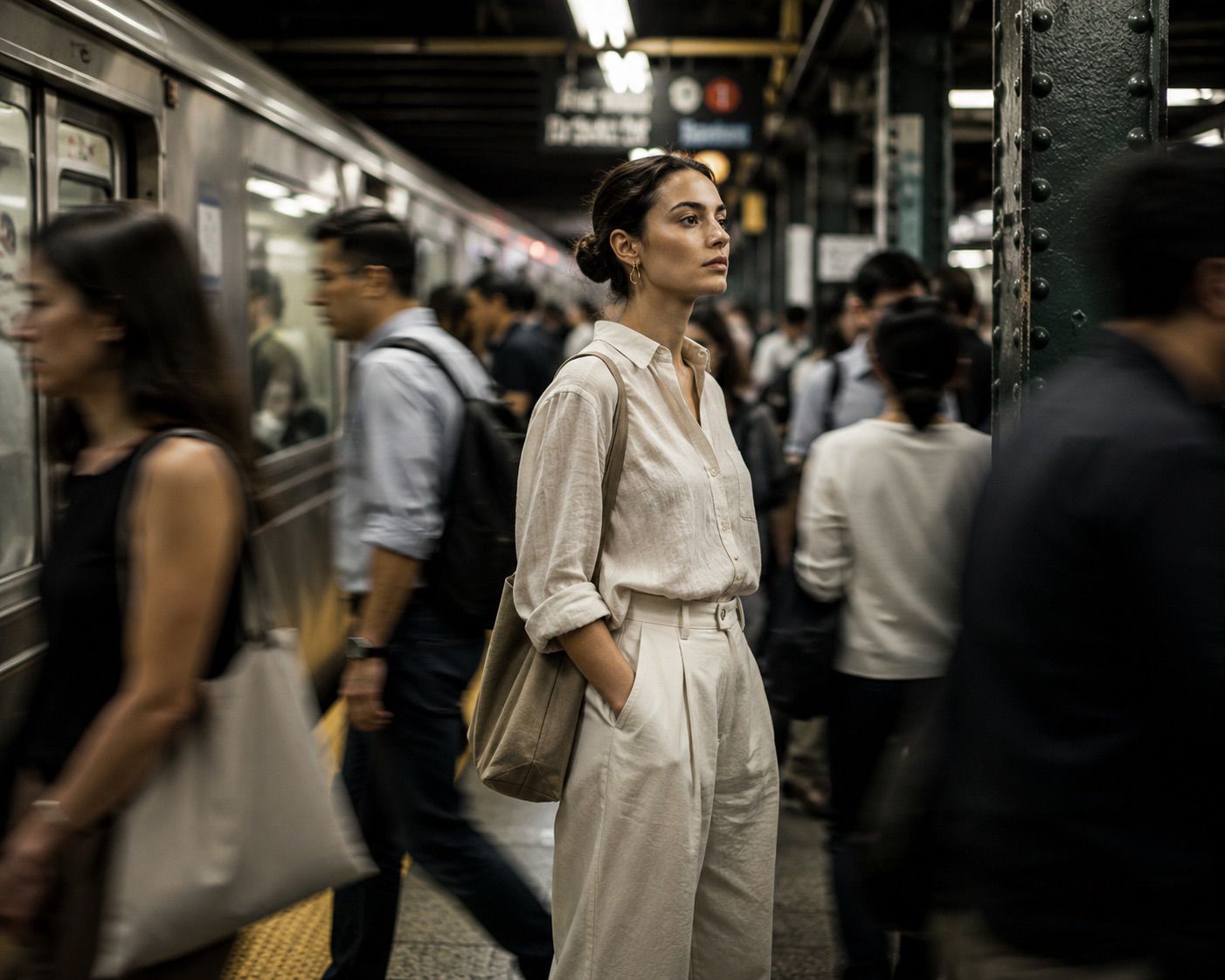
In the midst of this sweltering season, it’s not uncommon to see individuals sacrificing their well-being for the sake of optimization. The modern obsession with efficiency and productivity has led many to neglect a fundamental aspect of human nature: the need for rest and recuperation. As I take note of my surroundings — the bustling streets, crowded cafés, and endless stream of notifications — it becomes clear that exhaustion is not just a personal issue, but a societal one.
Consider the modern professional’s wardrobe, for instance. The ubiquitous athleisure trend, once a staple of athletic pursuits, has become an everyday uniform. While its comfort and practicality are undeniable, I’d argue that this shift also speaks to our collective exhaustion. We’re no longer dressing for the activity at hand; we’re dressing for the exhaustion that follows. Gone are the tailored suits and crisp dresses of yesteryear, replaced by stretchy fabrics and elastic waistbands — a sartorial concession to our weary bodies.
And yet, this emphasis on comfort has also led to a homogenization of personal style. As I walk through city streets, I’m struck by the sea of sameness that surrounds me. The yoga pants, hoodies, and sneakers — all staples of a wardrobe that prioritizes ease over elegance. Where is the nuance? The flair? The individuality? In our quest for comfort, have we lost sight of what makes us unique?
Of course, this isn’t just an issue of aesthetics; it’s also one of emotional labor. We’re constantly being told to optimize, streamline, and do more with less — and yet, we’re neglecting the very thing that allows us to function: our energy reserves. I see people pushing themselves to their limits day after day without so much as a moment’s pause to recharge. It’s no wonder that burnout has become an epidemic.
But what’s driving this phenomenon? Is it simply a matter of personal responsibility — that we’re not taking care of ourselves — or is there something more systemic at play? I’d argue that our societal emphasis on productivity and achievement plays a significant role. We’re living in a world where busyness is treated as a badge of honor, where the phrase “I’m so busy” has become a status symbol. It’s no wonder people feel compelled to push themselves to their limits; anything less is perceived as failure.
As I observe couples on dates, I notice a similar trend. The emphasis on shared activities and “quality time” has led to a neglect of personal space and solitude. We’re so focused on being with others — whether it’s our partner, friends, or family — that we’ve forgotten the value of being alone. And yet, research consistently suggests that solitude plays an essential role in cognitive function, creativity, and emotional well-being.
This isn’t merely an issue of individual habits; it’s also one of social ritual. We’ve become conditioned to prioritize others’ needs above our own, often forgetting what it means to care for ourselves. I see people sacrificing their own desires and interests to accommodate someone else’s — whether a partner, child, or friend. Yet this form of self-sacrifice can become toxic. By consistently placing others above ourselves, we neglect the very thing that allows us to function: our energy reserves.
In the heat of summer, when the sun beats down relentlessly and our bodies feel drained of vitality, it becomes tempting to sacrifice style for comfort. But I’d argue that this is precisely when we need to prioritize elegance — not in a superficial sense, but as a means of preserving dignity and composure. When we care for ourselves and prioritize our own needs, we become better equipped to handle the demands of modern life.
Consider the art of dressing for summer heat. It isn’t simply about throwing on a sundress or a pair of shorts; it’s about creating an outfit that allows us to move with ease and poise even amid sweltering temperatures. A lightweight linen shirt or a pair of tailored trousers can prioritize comfort and elegance simultaneously.
In this sense, fashion can be seen as a form of self-care — not merely about looking good, but about feeling good too. When we dress with intention and prioritize our needs, we send ourselves a powerful message: I am worthy of care and attention. Yet in today’s fast-paced world, this kind of self-care is often dismissed as indulgent or selfish.
But what if we reversed that thinking? What if we prioritized elegance not solely for its aesthetic appeal, but also for its practical benefits? By taking care of ourselves — our bodies, minds, and spirits — we become better equipped to face the demands of modern life. We become more resilient in the face of stress and adversity and better able to navigate complex social situations with poise and confidence.
As I observe people navigating public spaces — whether a crowded subway platform or a busy street corner — I’m struck by the power of restraint. In an era where overstimulation has become the norm and our senses are constantly bombarded with noise, color, and light, the ability to remain calm and composed has become something rare and precious.
Consider the simple act of walking through public spaces. So many people move through city streets with their eyes fixed on their phones — oblivious to the world around them and unaware of the subtle cues that govern human interaction. They’re missing so much: the sounds, sights, and rhythms of urban life; the quiet cadences of human movement and connection.
Yet when we prioritize awareness — when we take the time to notice our surroundings and pay attention to the people around us — we begin moving through the world with greater ease. We become more attuned to subtle social signals and better equipped to navigate complex interactions with confidence and grace.
As I reflect on our modern obsession with optimization, I’m reminded of a fundamental truth: elegance is not merely about aesthetics; it is also about discipline. It’s about cultivating habits and routines that allow us to move through life with greater ease — whether that means prioritizing self-care, dressing intentionally, or simply taking the time to notice the world around us.
In this sense, style can be viewed as a form of emotional regulation — not simply about appearance, but about well-being. When we care for ourselves — body, mind, and spirit — we become more resilient and better able to withstand life’s pressures.
As I conclude my reflections on the exhaustion hidden within modern optimization, I’m left with one final thought: in an era where burnout has become epidemic, perhaps it’s time to rethink our priorities. Maybe elegance — not merely as an aesthetic ideal, but as a means of preserving our dignity and composure — deserves a place at the top of the list.