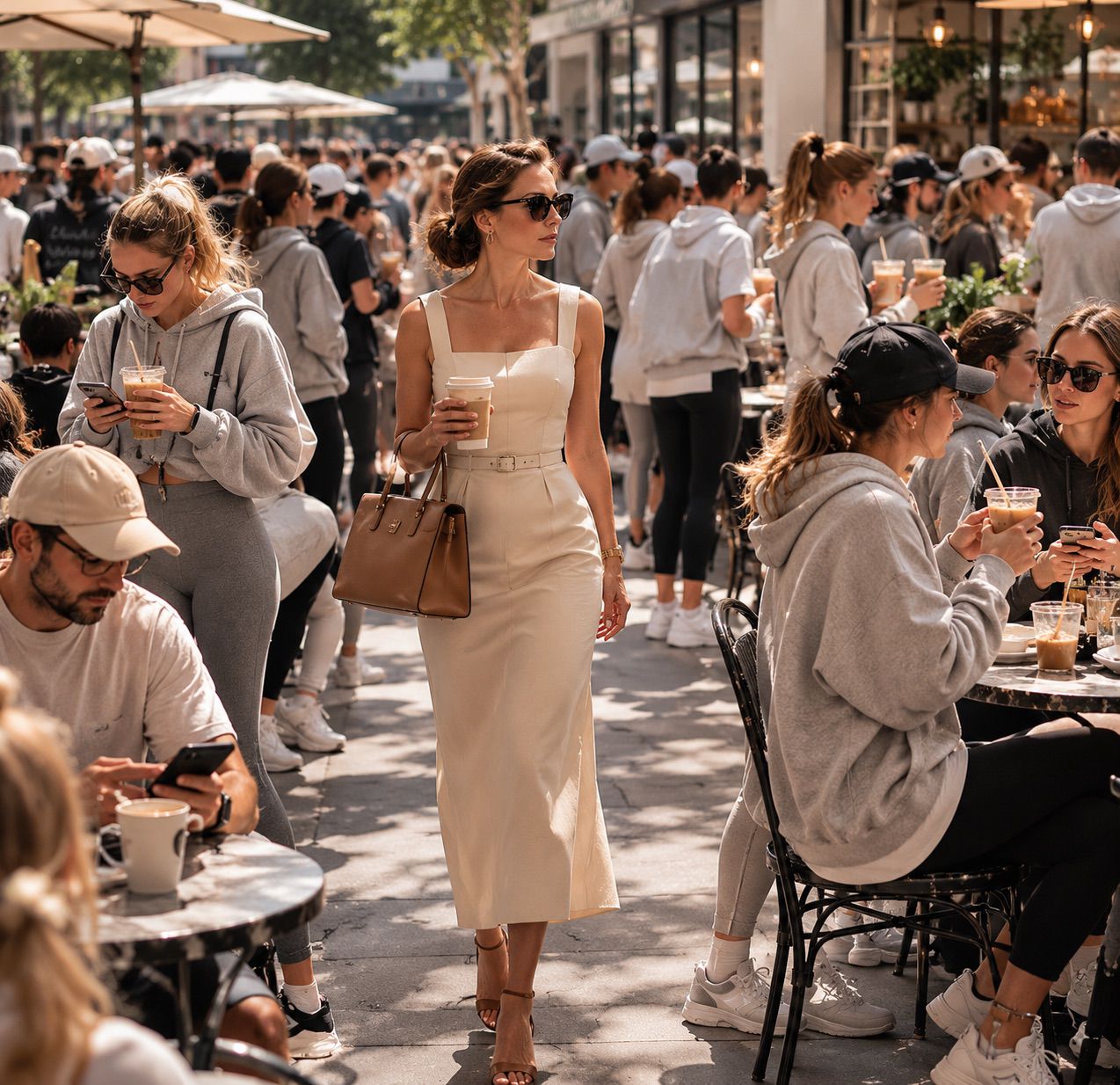
In the sweltering heat of summer, when social calendars are at their most exhausting, it’s easy to succumb to the promise of comfort and ease that athleisure wear purports to offer. The industry has convinced us that trading tailored trousers for leggings and oversized sweatshirts is some revolutionary act of self-care. But as I observe the crowds shuffling through farmers’ markets and brunch lines, it’s clear that this trend has devolved into a lazy uniformity.
At first glance, athleisure wear appears to be a harmless indulgence. A pair of Lululemon leggings or a Champion sweatshirt seems like a reasonable choice for a casual summer evening with friends. But as the weeks pass and the same outfit is repeated ad nauseam, it becomes increasingly clear that this trend has less to do with actual athleticism and more to do with our collective lack of imagination.
Consider the woman who shows up to a dinner party wearing yoga pants and a faded graphic t-shirt. She isn’t coming from a Pilates class or returning from a hike; she has simply adopted athleisure wear as her default mode of dress. Her attire is less about comfort and more about surrendering to the lowest common denominator of fashion. The irony, of course, is that this look is often celebrated as “effortless,” when in reality, it requires no effort at all.
The same can be said for men who wear athleisure as a status symbol. A pair of $100 sweatpants or a technical jacket packed with unnecessary features, like built-in UPF protection, is often less about actual athletic pursuits and more about broadcasting disposable income. It becomes a shorthand for saying, I’m fit or I’m successful, when in reality it simply says, I have too much money and not enough imagination.
As the summer months wear on, our collective reliance on athleisure begins to affect our social interactions. We start to notice that everyone looks the same — a sea of neutral colors and technical fabrics more suited to a gym floor than a dinner party. Conversations themselves begin to feel oddly stilted, as though we’re all participating in some bizarre, passive-aggressive competition over who can appear the most relaxed. It’s as if we’ve forgotten how to engage with one another beyond surface appearances.
Of course, there are those who argue that athleisure is liberating, freeing us from the constraints of traditional fashion. But I would counter that this trend represents a profound lack of imagination and creativity. When everyone dresses alike, we begin losing our sense of individuality and community. We forget how to dress for ourselves rather than for some vague notion of “comfort” or “convenience.”
As someone who values discipline and restraint in all aspects of life, I find it puzzling that so many people have abandoned their standards when it comes to fashion. Where is the elegance? The sophistication? The subtle nuances of a thoughtfully assembled outfit? Athleisure may be comfortable, but it’s also lazy — a cop-out for those unwilling to put in the effort required to look polished and intentional.
In an era where burnout and exhaustion have become increasingly common, perhaps it’s time to reexamine our relationship with athleisure wear. Rather than relying on this tired trend as a crutch, perhaps we should focus on finding ways to genuinely recharge and recalibrate. That might involve pursuing actual athletic activities — running, swimming, hiking — rather than merely dressing the part. It could also mean adopting a more thoughtful approach to fashion, one that prioritizes elegance and sophistication over mere comfort.
As I watch crowds shuffle through city streets this summer, clad in yoga pants and technical jackets, I’m reminded of a simple truth: the only thing we truly control is our own standards. If we settle for mediocrity in one area of life — even something as seemingly trivial as fashion — it often spills into others. It’s time to reclaim our individuality and creativity through the way we dress. Anything less feels like surrender.
The woman who arrives at a dinner party wearing leggings and a sweatshirt may be comfortable, but she is also making a statement — one that suggests she is too tired or uninspired to bother with anything more. As for me, I’ll take the elegance of a well-tailored dress any day.
The irony is that this trend has created a culture where people believe they’re making a bold statement by dressing down when, in reality, it’s become the safest and most unremarkable choice possible. Athleisure has become so ubiquitous that showing up to social events looking like you just rolled out of bed is now considered acceptable.
And yet, we still fetishize the idea of “effortless chic,” as if throwing on leggings and a hoodie somehow captures the elegance of a perfectly composed French woman. Newsflash: it doesn’t. Effortlessness requires sophistication and refinement — qualities athleisure simply cannot provide.
Furthermore, the rise of athleisure has altered our broader cultural relationship with fashion. We’re no longer encouraged to dress up for special occasions or take pride in personal style. Instead, we’re told it’s perfectly acceptable to show up looking as though we just left the gym — even when we haven’t.
This trend also reflects a larger societal issue: our collective obsession with convenience and instant gratification. We want everything to be easier, faster, and more comfortable — including our clothing choices. In doing so, however, we sacrifice the very things that enrich life: beauty, creativity, and self-expression.
Perhaps it’s time to step back and reevaluate our priorities. Do we truly value comfort above all else? Or do we want to reclaim a sense of style and individuality? The answer lies in our willingness to put in the effort to dress well — not just for special occasions, but for everyday life.
As I look out across the sea of athleisure-clad bodies, I’m reminded of something my grandmother used to say: Dress for the life you want, not the life you have.
It’s time to start dressing with intention, creativity, and purpose. Anything less is simply settling for mediocrity.