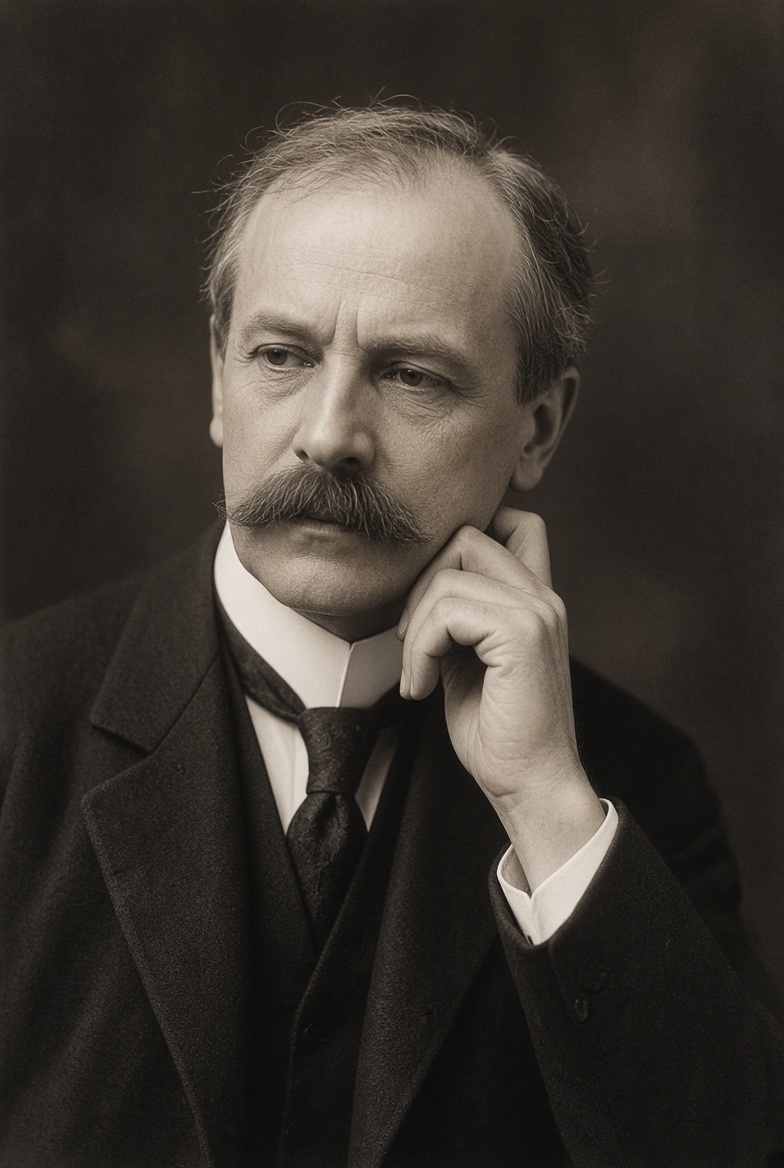
I’ve been thinking a lot about A.E. Housman lately, trying to figure out why his life resonates with me. Maybe it’s the way he struggled to find his place in the world, or perhaps it’s the intensity of his emotions that he poured into his poetry. Whatever it is, I keep coming back to him like a magnet.
As a young adult myself, Housman’s story feels eerily familiar. He grew up in Worcestershire, England, and spent most of his life studying at universities in Oxford and Cambridge. Sounds idyllic, right? But from what I’ve read, he felt suffocated by the expectations placed on him – to marry well, settle down, and follow a traditional path. Instead, he poured all his energy into his writing, which became an escape, a way to process the emotions he couldn’t express in other ways.
I can relate to feeling trapped by societal norms. After graduating from college, I found myself stuck between wanting to pursue my passion for writing and appeasing my family’s expectations that I get a “stable” job. It’s funny how we think we’re making choices when really, we’re just following the path of least resistance.
Housman’s struggles with identity also resonate with me. As an outsider in academia, he felt like a misfit among his fellow scholars and poets. His love for classical literature and folk songs set him apart, but it was also what brought him comfort. I’ve always been drawn to writing about the margins – the people who don’t fit into neat categories or societal norms.
One of Housman’s most famous poems is “To an Athlete Dying Young,” which speaks directly to me on a deep level. The poem’s themes of mortality, regret, and the fleeting nature of youth are hauntingly beautiful. I’ve always been drawn to the idea that life is short, and we should make the most of it – but what does that even mean? Should we take risks, push boundaries, or play it safe?
Housman’s own story shows how he grappled with these questions. He was openly gay in a time when being LGBTQ+ was punishable by law. I can only imagine the fear and anxiety he must have felt living as an outcast. And yet, his poetry is full of vulnerability, love, and a deep sense of longing.
I wonder if Housman ever found a sense of peace or acceptance in his life. Did he find solace in his writing, or did it only amplify the pain? I feel like we often romanticize artists as tortured souls, but what about the moments when they found joy, connection, and happiness?
As I write this, I’m not sure if I’ve made any progress in understanding Housman’s allure. Maybe it’s because he was a human being with flaws and contradictions – just like me. His life is full of paradoxes: the love-hate relationship between his academic pursuits and artistic expression; the tension between his desire for stability and his need to break free.
I’ll keep returning to Housman’s story, searching for answers that may never come. But in doing so, I’m reminded that it’s okay not to have all the answers – sometimes, it’s just about being present with our complexities and contradictions.
The more I delve into Housman’s life, the more I find myself oscillating between fascination and discomfort. His struggles with identity, his fear of rejection, and his ultimate decision to leave academia for a quieter life in the countryside – it all feels so deeply personal, like he’s laying bare his soul for me to examine.
As a writer, I’m drawn to the idea that Housman’s poetry is an extension of himself, a way to process his emotions and find meaning in the world. But what about when writing becomes an escape? Does it become a cop-out, a way to avoid dealing with the hard realities of life? I’ve often wondered if my own writing has been a means of evasion, a way to sidestep the complexities of adulthood.
Housman’s love for classical literature and folk songs is something that resonates deeply with me. There’s something about the way he weaves together disparate threads – mythology, history, and personal experience – that speaks to my own fascination with storytelling. But what I’m also struck by is his willingness to confront the darker aspects of life, to explore the shadowy corners of human existence.
In his poem “The End,” Housman writes about death as a welcome respite from the pain and sorrow of life. It’s a perspective that both repels and attracts me – the idea that death can be a kind of liberation, a release from the burdens of living. I’ve always struggled with mortality, feeling like it looms over me like a specter, waiting to pounce.
One of the things that draws me to Housman’s poetry is its intimacy, its willingness to confront the smallest, most personal moments in life. His words feel like they’re whispered directly into my ear, addressing me with a quiet urgency that I find both comforting and unnerving. It’s as if he’s saying, “I see you, I understand you,” but also, “I’m still trying to figure out this thing called life.”
As I continue to read Housman’s poetry, I’m struck by the ways in which it challenges my own assumptions about art, identity, and mortality. His work is a reminder that there are no easy answers, only complexities and contradictions waiting to be unraveled. And maybe that’s what draws me to him – not just his poetry, but the person he was, with all his flaws and paradoxes.
I find myself lost in Housman’s world, where the boundaries between reality and fantasy blur. His poems are like doorways to other dimensions, where I can enter and explore the depths of human emotion. As a writer, I’m drawn to this ability to tap into the collective unconscious, to access emotions that lie just beneath the surface.
But what I’m also beginning to realize is that Housman’s poetry isn’t just about him; it’s about all of us who feel like outsiders, misfits, and rebels. His words are a testament to the power of art to transcend our individual struggles and connect with something greater than ourselves. It’s a reminder that we’re not alone in our fears, doubts, and insecurities.
As I delve deeper into Housman’s life and work, I’m struck by the ways in which he embodies the tension between creativity and conventionality. He was a scholar who rejected the trappings of academia, an artist who refused to be bound by traditional forms and expectations. And yet, his poetry is also deeply rooted in classical literature and folklore – a testament to the enduring power of tradition.
I find myself wondering if Housman’s struggles with identity were fueled by a desire for authenticity, for being true to himself. Was he seeking to break free from the constraints of societal norms, or was he simply trying to find his place in the world? As I reflect on my own journey as a writer and an individual, I realize that I’m still grappling with these same questions.
Housman’s poetry is like a mirror held up to me, reflecting back all my fears, doubts, and insecurities. It’s both comforting and unnerving – a reminder that I’m not alone in this struggle for identity and self-expression. And yet, it also challenges me to confront the contradictions within myself, to acknowledge the tensions between creativity and conventionality.
As I continue to explore Housman’s world, I’m beginning to see him as more than just a poet or an artist – he’s a human being with all his flaws and paradoxes. His life is a testament to the complexity of human experience, a reminder that we’re all struggling to find our place in the world, to make sense of our emotions, and to create something meaningful from our struggles.
One thing that continues to fascinate me about Housman’s poetry is its ability to evoke a sense of nostalgia for a past time, a bygone era that I can only imagine. His love for classical literature and folk songs speaks to a desire to connect with something timeless, something that transcends the mundane concerns of everyday life. And yet, at the same time, his work is also deeply rooted in the present moment, grappling with the complexities and contradictions of human experience.
As a writer, I’m drawn to this tension between nostalgia and contemporary relevance. How do we balance our desire for connection with the past with our need to engage with the world as it exists today? For Housman, this seems to have been a lifelong struggle – he was both a scholar of ancient texts and a poet of modern sensibilities.
I find myself wondering if Housman’s love for classical literature was also a way of avoiding the present moment. Did he retreat into the past in order to escape the turmoil of his own life? Or did he see it as a way of connecting with something deeper, something that spoke to the human condition across time and space?
For me, this is a question that resonates deeply. As a writer, I often find myself drawn to the past – not just for its historical significance or literary merit, but because it offers a sense of refuge from the complexities of modern life. And yet, at the same time, I know that this can be a cop-out, a way of avoiding the messy realities of the present moment.
Housman’s poetry is full of paradoxes – he’s both a scholar and an outsider, a man of tradition and a rebel against convention. And it’s this tension between these opposing forces that continues to fascinate me. How do we reconcile our desire for connection with the past with our need to engage with the world as it exists today?
As I continue to explore Housman’s work, I’m struck by the ways in which he embodies this tension. His poetry is both a product of its time and a reflection on the timeless nature of human experience. And it’s this that makes him so compelling – not just as a poet or an artist, but as a human being who grappled with the same complexities and contradictions that we face today.
I think what I’m beginning to realize is that Housman’s life and work are less about answers and more about questions. His poetry doesn’t offer a solution to the problems of identity, creativity, or mortality – it simply presents them in all their complexity and beauty. And it’s this that continues to draw me back to his work, like a magnet to steel.
In many ways, Housman’s story is one of perpetual questioning – he was always seeking answers, but never quite finding them. And it’s this uncertainty that I find so compelling, because it reflects the same doubts and insecurities that I face in my own life as a writer and an individual.
As I close this chapter on Housman’s work, I’m left with more questions than answers. What does it mean to be true to oneself? How do we reconcile our desire for connection with the past with our need to engage with the world as it exists today? And what lies at the heart of creativity and identity – is it a quest for authenticity or a search for meaning in a chaotic world?
These are questions that I’ll continue to grapple with, both in my writing and in my life. And it’s Housman’s poetry that will remain with me, like a guiding light on the path ahead.
As I reflect on Housman’s legacy, I’m struck by the ways in which his poetry continues to resonate with me. His words are like a gentle breeze on a summer day, carrying whispers of hope and despair that seem to speak directly to my soul. And yet, as I delve deeper into his work, I’m also confronted with the harsh realities of his life – the loneliness, the isolation, the unrequited love.
It’s as if Housman’s poetry is a map, leading me through the twisting corridors of his own mind and heart. He writes about the fragility of human existence, the impermanence of all things, and the longing for connection that lies at the core of our being. His words are like a mirror, reflecting back my own fears and doubts, my own search for meaning in a chaotic world.
One of the things that I find most compelling about Housman’s poetry is its ability to capture the essence of melancholy – that bittersweet mix of sadness and beauty that lies at the heart of human experience. His words are like a lament, a mournful cry into the void that seems to echo through eternity.
As I read his poems, I’m struck by the ways in which he weaves together disparate threads – myth, history, literature, and personal experience. It’s as if he’s spinning a tapestry of interconnected narratives, each one revealing a different aspect of human nature. And it’s this that makes his poetry so rich and complex, so full of depth and nuance.
But what I’m also beginning to realize is that Housman’s poetry isn’t just about him – it’s about all of us who feel like outsiders, misfits, and rebels. His words are a testament to the power of art to transcend our individual struggles and connect with something greater than ourselves. It’s a reminder that we’re not alone in our fears, doubts, and insecurities.
As I continue to explore Housman’s work, I’m struck by the ways in which he embodies the tension between creativity and conventionality. He was a scholar who rejected the trappings of academia, an artist who refused to be bound by traditional forms and expectations. And yet, his poetry is also deeply rooted in classical literature and folklore – a testament to the enduring power of tradition.
I find myself wondering if Housman’s struggles with identity were fueled by a desire for authenticity, for being true to himself. Was he seeking to break free from the constraints of societal norms, or was he simply trying to find his place in the world? As I reflect on my own journey as a writer and an individual, I realize that I’m still grappling with these same questions.
Housman’s poetry is like a mirror held up to me, reflecting back all my fears, doubts, and insecurities. It’s both comforting and unnerving – a reminder that I’m not alone in this struggle for identity and self-expression. And yet, it also challenges me to confront the contradictions within myself, to acknowledge the tensions between creativity and conventionality.
As I close this reflection on Housman’s work, I’m left with more questions than answers. What lies at the heart of creativity and identity – is it a quest for authenticity or a search for meaning in a chaotic world? How do we reconcile our desire for connection with the past with our need to engage with the world as it exists today?
These are questions that I’ll continue to grapple with, both in my writing and in my life. And it’s Housman’s poetry that will remain with me, like a guiding light on the path ahead.