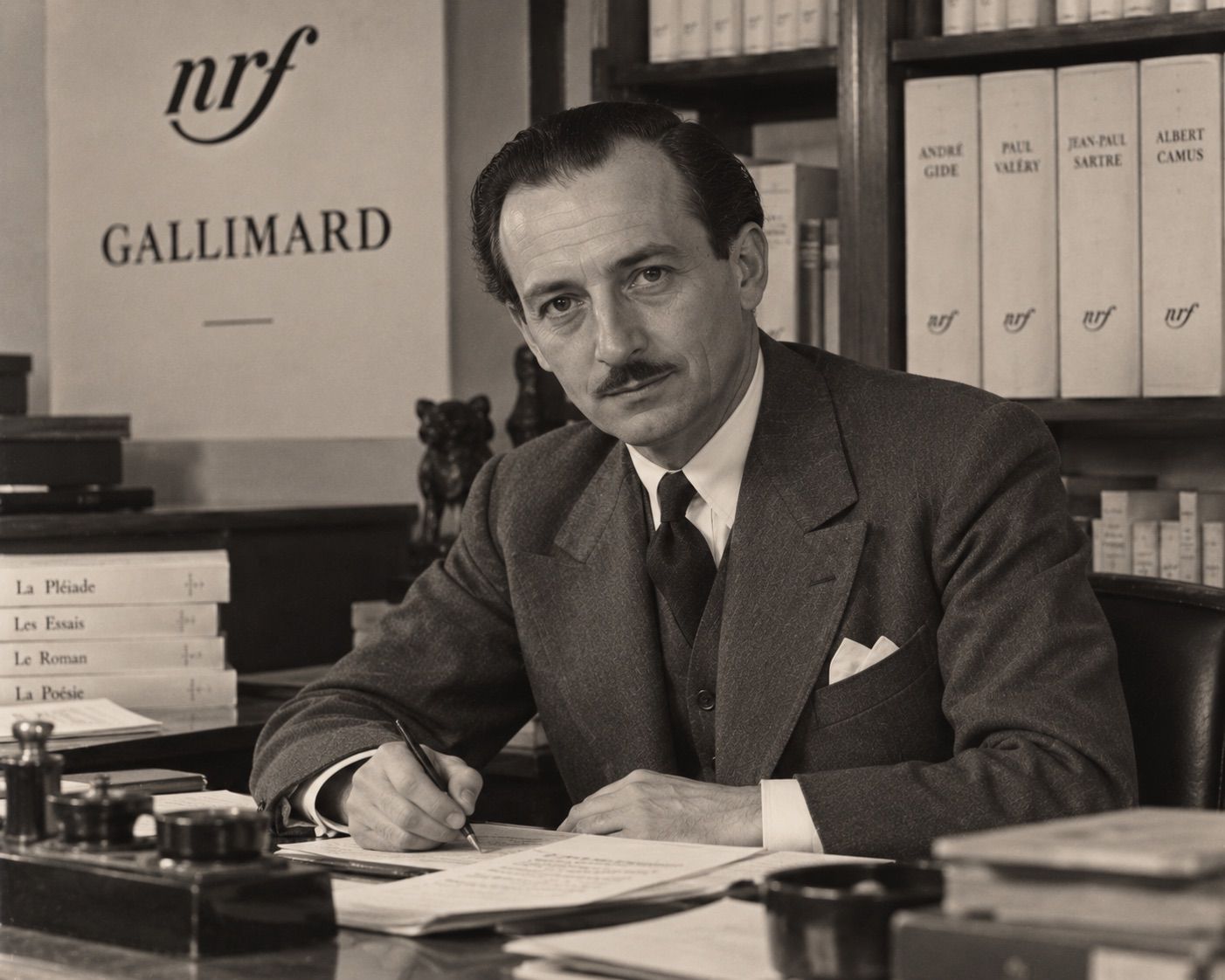
I’ve been thinking about Gaston Gallimard a lot lately, not because I’m an expert on French publishing history or anything like that, but because he’s just so… complicated to me. I mean, who is this guy? A publisher, yes, but also a writer, a politician, and seemingly a master manipulator of the literary world.
I think what really drew me in was his connection to James Joyce – specifically, the infamous contract dispute between the two men. I’ve always been fascinated by Joyce’s writing style, which often feels both impossibly complex and deceptively simple at the same time. Gallimard’s handling of Joyce’s work during this period seems almost… callous? No, that’s too strong a word. But it does make me wonder: what is the role of a publisher in shaping an author’s legacy?
As I’ve read more about Gallimard’s life and career, I keep coming back to this question. He was known for his aggressive marketing tactics, often using charm and intimidation to get writers to sign contracts that benefited him more than them. And yet, he also saw himself as a champion of the avant-garde – someone who was willing to take risks on unproven authors like André Gide or Jean Cocteau.
But what does it mean to be a champion of something when you’re simultaneously profiting off of it? Is Gallimard’s influence on French literature really a positive one, or is it more of a complex web of power and patronage? I find myself getting caught up in the same debates that Joyce did – about art vs. commerce, individual expression vs. marketability.
I’ve been trying to write about this stuff for weeks now, but every time I sit down with my thoughts, they just get jumbled together. Gallimard’s life seems like a series of calculated moves, each one designed to advance his own interests while shaping the literary landscape in his image. And yet… and yet, there’s something undeniably charismatic about him.
Maybe it’s because I see a bit of myself in him – not in terms of his publishing empire or his machinations, but in the way he seems to be driven by this insatiable curiosity. He’s always pushing the boundaries of what’s possible, whether that means taking risks on new authors or using his connections to further his own career.
I don’t know if I’m entirely comfortable with the parallels between Gallimard and myself, though. On one hand, it’s nice to see someone else navigating the complexities of ambition and creative expression. But on the other hand… well, let’s just say that I’ve got a bit of a reputation for being stubborn and opinionated in my own right.
Perhaps what really draws me to Gallimard is the same thing that drew me to writing in the first place – this sense of ongoing questioning, of never quite knowing where the next step will take me. And maybe, just maybe, that’s exactly why I’m still grappling with his legacy after all these weeks: because he represents a kind of mirror image of my own artistic anxieties and contradictions.
I’m not sure if I’ll ever fully untangle this knot in my head – or even if it’s worth trying to. For now, though, Gallimard remains this enigmatic figure on the periphery of my thoughts, always just out of reach.
The more I think about Gaston Gallimard, the more I’m struck by his contradictions. On one hand, he’s this master manipulator who uses his charm and influence to get what he wants – whether that means convincing Joyce to sign a contract or pushing avant-garde authors into the mainstream. And yet, at the same time, there’s something almost… vulnerable about him.
I think it’s because he’s so deeply invested in his own vision for literature, even if that vision doesn’t always align with what’s best for the writers themselves. It’s like he sees himself as a conductor leading an orchestra, but instead of musicians, he’s got authors and their works at his command. And just as a conductor has to make tough decisions about tempo and tone, Gallimard has to decide which authors to promote and which ones to let fade into obscurity.
It’s a weird kind of power dynamic, one that makes me uncomfortable on behalf of the writers he’s working with. But at the same time, I can see why Gallimard would be so drawn to it – after all, who wouldn’t want to shape the course of literary history?
As a writer myself, I’m constantly grappling with these kinds of questions: how much control do I really have over my own work? How much am I willing to compromise in order to get published or gain recognition? Gallimard’s example makes me realize that even the most seemingly altruistic goals can be tainted by self-interest – and vice versa.
It’s a bit disconcerting, actually. I mean, I’ve always prided myself on being someone who writes from the heart, who lets my emotions guide my words. But what if that’s just a way of avoiding the hard questions about ambition and marketability? What if Gallimard is right, and the best art is the kind that’s willing to take risks and push boundaries – even if that means sacrificing a bit of authenticity along the way?
Ugh, I don’t know. My brain hurts just thinking about it all. Maybe what I need to do is just keep writing, see where these thoughts take me. After all, that’s what Gallimard did – he kept pushing forward, no matter how complicated things got. And who knows? Maybe one day I’ll be able to untangle this knot in my head and emerge with a clearer sense of purpose… or maybe I’ll just end up lost in the same web of contradictions as Gallimard himself.
As I ponder the complexities of Gaston Gallimard’s legacy, I find myself returning to the concept of vulnerability. It seems almost oxymoronic when applied to someone like Gallimard, who was known for his calculating and manipulative tactics. And yet, as I read about his life and career, I keep coming across hints of a more fragile individual beneath the surface.
Maybe it’s because he was a product of his time – a member of the French bourgeoisie who felt pressure to maintain appearances, both personally and professionally. Or perhaps it’s simply that, despite his tough exterior, Gallimard was human after all, with his own fears and doubts.
I think about how I’ve always prided myself on being honest in my writing, on laying bare my emotions and vulnerabilities for the reader to see. But what if that’s just a way of avoiding the hard questions about ambition and self-preservation? What if Gallimard is right, and the best art is the kind that’s willing to take risks and push boundaries – even if it means sacrificing a bit of authenticity along the way?
The more I think about it, the more I realize how little I actually know about what drives Gallimard. Was he truly passionate about literature, or was it just a means to an end? Did he genuinely believe in the authors he championed, or were they simply pawns in his game of literary manipulation?
And what does it even mean to be “passionate” about something, anyway? Is it possible to be genuinely invested in a cause without also being driven by personal ambition or ego? I don’t know – but I do know that Gallimard’s example has left me with more questions than answers.
As I sit here, staring at my notes and scribbled thoughts, I feel like I’m stuck in this endless loop of self-doubt and uncertainty. Maybe that’s what happens when you try to grapple with someone as complex and multifaceted as Gaston Gallimard. Or maybe it’s just a reflection of my own inner turmoil – the constant struggle between creative expression and commercial viability, authenticity and compromise.
Whatever the case, I know one thing for sure: I’ll keep writing about this stuff until I can untangle the knot in my head. And even then, who knows? Maybe Gallimard will still be there, lurking on the periphery of my thoughts, a constant reminder that the line between art and commerce is always blurred – and that sometimes, it’s hard to tell what’s driving us forward: passion or ambition.
I find myself getting lost in the intricacies of Gallimard’s life, trying to tease out the threads of his motivations and desires. It’s like trying to unravel a tangled ball of yarn – every time I think I’ve found a clear path, it leads me down a rabbit hole of contradictions and paradoxes.
One thing that keeps popping up in my research is the concept of “la découverte” – the idea that a good publisher should be able to uncover hidden gems, introduce readers to new authors and styles. It’s a notion that resonates with me as a writer, because I’ve always been drawn to the idea of discovering fresh perspectives and voices.
But when I look at Gallimard’s record, I’m not so sure. He was known for his aggressive marketing tactics, his willingness to manipulate authors into doing what he wanted. And yet, at the same time, he also championed some truly innovative and groundbreaking writers – people like André Gide and Jean Cocteau, who were pushing the boundaries of French literature in bold new ways.
It’s hard to reconcile those two sides of Gallimard, to see him as both a ruthless businessman and a passionate advocate for artistic innovation. And yet… I think that’s what makes him so fascinating. He’s a reminder that even the most seemingly black-and-white choices can be tinged with shades of gray – that the line between right and wrong is often blurry, and that sometimes the only way to move forward is to take a risk.
As I continue to grapple with Gallimard’s legacy, I find myself thinking about my own writing process. How much do I rely on instinct and intuition, versus careful planning and calculation? Am I more like Gallimard, pushing the boundaries of what’s possible in order to make a name for myself – or am I more like Joyce, doggedly pursuing my artistic vision no matter where it leads?
I don’t know. And maybe that’s the point. Maybe the only way to truly understand someone like Gaston Gallimard is to acknowledge our own complicity in his contradictions – to recognize that we’re all messy, multifaceted human beings, driven by a complex mix of passions and desires.
As I sit here, staring at my notes and scribbled thoughts, I feel like I’m starting to see Gallimard in a new light. He’s not just a figure from the past – he’s a mirror held up to our own present-day anxieties and doubts. And maybe, just maybe, that’s what makes him so compelling – because in the end, it’s not about him at all. It’s about us, and the choices we make as writers, artists, and human beings.
I think I’ve been trying to pin down Gallimard’s legacy through a lens of morality, as if his actions can be neatly categorized as good or bad. But what if that’s not how it works? What if the complexities of his life are more akin to a rich tapestry, woven from threads of different textures and colors?
I’m starting to see him as a kind of literary provocateur, someone who pushed boundaries and challenged the status quo in order to create something new. And I have to admit, there’s a part of me that envies his audacity – his willingness to take risks and defy convention.
But at the same time, I also see the harm he caused, the writers he exploited or manipulated for his own gain. It’s like trying to reconcile two opposing forces within myself: my desire for creative freedom, versus my need for security and stability.
Gallimard’s life is a reminder that art and commerce are forever entwined, like two threads inextricably linked. And as a writer, I’m constantly grappling with the tension between these two competing forces – how to stay true to my artistic vision while also making a living from my work.
I think back to Joyce, and the contract dispute that drove him crazy. Was Gallimard’s behavior towards him simply a manifestation of his own ambition and ego? Or was there something more at play – a desire to shape the course of literary history in his image?
The more I think about it, the more I realize how little I actually know about what drives people like Gallimard. Is he a hero or a villain? A visionary or a manipulator? The truth is, it’s probably a mix of all these things – and that’s what makes him so fascinating.
As I sit here, scribbling away in my notebook, I feel like I’m just scratching the surface of Gallimard’s legacy. There are still so many questions to ask, so much more to explore. But for now, at least, I’ve found a sense of comfort in his complexities – and a reminder that, as writers, we’re all struggling with our own demons, trying to make sense of the world through our words.
I think about my own writing process, and how it’s changed over time. When I first started out, I was all about experimentation and innovation – pushing the boundaries of what was possible in my work. But as I got older, I began to feel pressure from external forces – agents, editors, readers who expected me to produce a certain kind of content.
It’s like Gallimard’s legacy is mirroring mine own inner conflict – the tension between staying true to myself and appeasing others. And maybe that’s why I’m so drawn to him – because he represents a kind of mirror image of my own creative anxieties and doubts.
As I look back on our conversation, I realize that Gallimard’s legacy is still very much alive in me. His contradictions continue to haunt me, pushing me to think about the role of art and commerce in shaping the world around us.
But what if it’s not just about Gallimard – or even about writing at all? What if his story is really a metaphor for our own struggles as humans – the constant push-and-pull between our desires and our responsibilities, our passions and our obligations?
I’m not sure where this line of thinking will take me. But for now, I’m content to keep exploring – to see where these questions lead me, and what kind of insights I might uncover along the way.