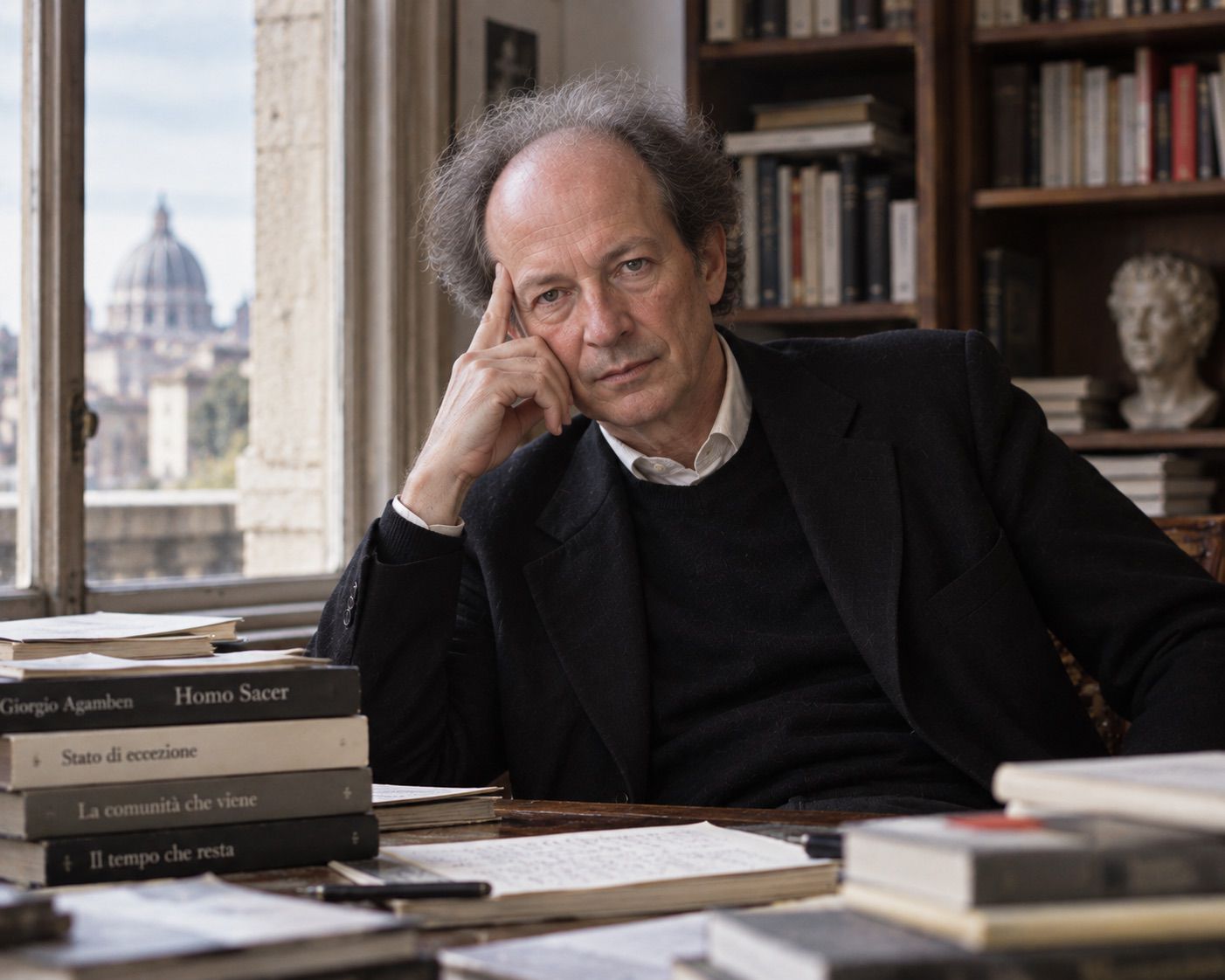
I’ve been reading Giorgio Agamben for months now, and I still can’t quite shake the feeling that he’s speaking directly to me. Or rather, that his words are echoing through my mind long after I close his books. It started with “The Open,” where he talks about the state of exception – this liminal space where the law is suspended, but not necessarily in a way that makes sense. I felt like I was reading about my own life.
I finished college just a few months ago, and as I stepped out into the world, I couldn’t help but feel like I was living in one of those states of exception. Everything seemed uncertain – my job prospects, my relationships, even my own sense of purpose. It’s like Agamben said: “The state of exception is not only a juridical concept, but also a biopolitical and anthropological one.” In other words, it’s not just about the law; it’s about how we live, how we interact with each other.
As I read through his work, I kept thinking about my own experiences in college. The constant pressure to perform, to produce something that would make me stand out in a crowded field of students – it was exhausting. And yet, at the same time, I felt like I was constantly being told that I wasn’t doing enough. That I needed to be more, to achieve more, to make a name for myself.
It’s funny – when I was in college, I used to write all the time. It was my way of processing everything that was going on around me. But as I got closer to graduation, I started to feel like I was losing touch with that part of myself. Like I was being pulled into this world where words didn’t matter as much as they once did.
Agamben’s concept of “bare life” really resonated with me during this time. It’s the idea that we’ve become so accustomed to living in a state of exception, where our lives are constantly subject to the whims of power and authority, that we’ve forgotten what it means to truly live. We’re reduced to mere biological existence – fed, sheltered, entertained, but not really alive.
I think about my own relationships during college – how they were often superficial, focused on surface-level connections rather than any real depth or intimacy. It was like we were all just going through the motions, pretending to be friends or lovers when really we were just existing in this state of suspended animation.
But here’s the thing: Agamben’s ideas aren’t just about critique; they’re also about hope. He talks about the possibility of “form-of-life,” a way of living that transcends the state of exception and instead creates its own rules, its own sense of community and belonging.
It’s a tantalizing idea – the notion that we can create our own lives, outside of the frameworks set by power and authority. But it also feels terrifyingly daunting. What would it mean to live in this way? To truly be free?
As I continue to read Agamben’s work, I’m struck by how his ideas keep shifting and morphing in my mind. They’re like a puzzle that I’m still trying to solve – sometimes I feel like I’m getting closer to the truth, but other times it feels like I’ve only made things more complicated.
I guess that’s what draws me to Agamben – he’s not offering easy answers or solutions. He’s just asking questions, probing at the edges of our understanding and inviting us to think differently about the world around us.
And maybe that’s the real value of his work: it encourages me to keep questioning, to keep seeking out new perspectives and ways of being in the world. Even when it feels uncomfortable or uncertain – even when I’m not sure what I believe or where I’m going – Agamben reminds me that there’s always a choice, always a possibility for living differently.
I don’t know if I’ll ever fully grasp his ideas or understand their implications. But as I continue to read and reflect on his work, I feel like I’m slowly starting to see the world in a new light – one where the boundaries between life and death are blurry at best, and where the only real question is how we choose to live in this state of exception.
As I delve deeper into Agamben’s work, I find myself returning to his concept of “homo sacer” – a figure who exists outside of the law, yet is still subject to its power. It’s a paradoxical idea that resonates with me on a deeply personal level.
Growing up, I always felt like an outsider in my own family. My parents were immigrants, and our cultural traditions often clashed with the mainstream values of our community. As a result, I often found myself caught between two worlds – struggling to navigate the expectations placed upon me by my family’s heritage, while also trying to fit in with my peers.
In many ways, I felt like a “homo sacer” – a figure without a clear place or status in society. My existence was tolerated, but not fully accepted; I was seen as an anomaly, a disruption to the normal order of things.
Agamben’s work on homo sacer speaks directly to this feeling of liminality. He argues that this figure is not simply a product of power and oppression, but rather a result of our own desire for freedom and autonomy. In other words, we create these outsiders as a way of maintaining our own sense of identity and control.
This idea makes me uncomfortable, because it suggests that I’m complicit in my own exclusion – that I’ve internalized the norms and expectations that have pushed me to the margins. But at the same time, it’s a liberating thought, because it implies that I have the power to redefine myself, to create new possibilities for living outside of the categories imposed upon me.
As I continue to grapple with Agamben’s ideas, I’m struck by how they blur the lines between philosophy and autobiography. His work is not just about abstract concepts or theoretical frameworks; it’s about lived experience, about the ways in which power and identity intersect in our everyday lives.
I think back to my own experiences in college, where I often felt like a “homo sacer” – caught between the expectations of my peers and the demands of my own desires. But I also remember the moments when I found freedom, when I broke free from the constraints that had been placed upon me.
Those moments were not without struggle or uncertainty; they required me to confront my own fears and doubts, to challenge the norms and expectations that had defined my life for so long. But in retrospect, they were also moments of great beauty and possibility – times when I felt truly alive, when I knew that I was capable of creating my own form-of-life.
As I reflect on these experiences, I’m struck by how Agamben’s ideas continue to resonate with me, even as I question and complicate them. His work is not a source of answers or solutions; it’s a reminder that our lives are always in flux, always subject to the forces of power and history.
And yet, it’s also a testament to the human capacity for creativity and resistance – a recognition that we have the power to shape our own lives, to create new possibilities and forms-of-life outside of the categories imposed upon us.
I’ve been reading Agamben’s work on “homo sacer” in conjunction with his ideas on form-of-life, and I’m starting to see a connection between these two concepts that feels both profound and unsettling. If we’re created as outsiders, as anomalies, does that mean that our existence is inherently liminal? And if so, can we ever truly escape this state of exception?
I think about my own experiences growing up, feeling like an outsider in my family and community. Was I always going to be a “homo sacer,” forever relegated to the margins? Or was there something within me that could resist this fate, that could create its own form-of-life despite the constraints placed upon me?
Agamben’s work suggests that it’s not just about individual agency or resistance; it’s also about the ways in which we’re socialized to conform. We learn to recognize ourselves as exceptions, as outsiders, and this recognition becomes a kind of self-fulfilling prophecy.
I’m starting to see that my experiences in college were part of this larger process. The pressure to perform, the constant need to prove myself – it was all designed to keep me in line, to make sure I didn’t disrupt the status quo. And yet, it’s also possible that these experiences were a kind of training ground for my own form-of-life.
I think about the moments when I felt most alive, most free, and realize that they often involved some kind of transgression or risk-taking. Whether it was writing outside the margins of academic expectations or forming relationships with people who didn’t conform to traditional norms, these experiences were all about creating new possibilities for living.
But what does it mean to create one’s own form-of-life in a world that seems determined to reduce us to bare life? Is it even possible to resist the forces of power and history that shape our lives?
As I continue to grapple with Agamben’s ideas, I’m struck by how they raise more questions than answers. And yet, it’s precisely this uncertainty that feels most alive, most true to my own experiences as a young adult navigating the complexities of the world.
I guess what I’m starting to realize is that form-of-life isn’t just something we create; it’s also something that creates us. It’s a process of self-fashioning and self-discovery, one that requires us to confront our own fears and doubts head-on.
In many ways, this feels like the most daunting and exhilarating prospect – the possibility of creating my own life outside the frameworks set by power and authority. But it also feels like the only truly meaningful choice I can make as an individual.
As I continue to explore Agamben’s work, I’m left with more questions than answers. What does it mean to create one’s own form-of-life in a world that seems determined to reduce us to bare life? Can we ever truly escape the state of exception? And what role do power and history play in shaping our lives?
These are just some of the questions I’m still trying to answer as I continue to read Agamben’s work. But even if I never find definitive answers, the process of questioning itself feels like a kind of form-of-life – a way of living that’s always in flux, always subject to the forces of power and history, yet also forever open to new possibilities and ways of being in the world.
As I ponder these questions, I find myself returning to Agamben’s concept of “the Anthropocene” – a term he uses to describe our current era, where human activity has become the dominant force shaping the planet. It’s a notion that resonates deeply with me, as I think about the ways in which my own life is impacted by the environmental and economic systems that govern our world.
I’m struck by how Agamben’s work on the Anthropocene highlights the ways in which human existence has become increasingly abstracted from nature. We live in a world where the natural world is often seen as mere background, a resource to be exploited for human gain rather than a living, breathing system that sustains us.
This abstraction feels deeply personal to me, as I think about my own relationship with nature. Growing up, I was always fascinated by the natural world – spending hours exploring the woods behind my house, watching birds and rabbits in their habitats. But as I got older, I started to feel a sense of disconnection from the land, like I was just a consumer rather than a participant.
Agamben’s work suggests that this disconnection is not just an individual problem, but a fundamental aspect of our societal structure. We live in a world where profit and efficiency are prioritized over sustainability and well-being – a world that sees humans as separate from nature, rather than part of it.
This realization feels both terrifying and liberating to me. On the one hand, it’s a stark reminder of how much work needs to be done to create a more sustainable future. But on the other hand, it’s also a call to action – an invitation to reimagine our relationship with nature, and to find new ways of living that prioritize life over profit.
As I continue to grapple with Agamben’s ideas, I’m struck by how they challenge my own assumptions about identity and community. For so long, I’ve seen myself as an individual, separate from the world around me. But Agamben’s work suggests that this individualism is a product of power and history – that we’re all interconnected in ways that go far beyond our personal relationships.
This realization feels both exhilarating and unsettling to me. On the one hand, it’s a recognition that I’m part of something larger than myself, something that transcends my own ego and desires. But on the other hand, it also means confronting the ways in which power and history have shaped my identity – acknowledging the ways in which I’ve been socialized to conform, and challenging those norms head-on.
As I ponder these questions, I’m left with more uncertainty than clarity. What does it mean to live in a world where human activity is the dominant force shaping the planet? Can we ever truly escape the state of exception that Agamben describes? And what role do power and history play in shaping our lives?
These are just some of the questions I’m still trying to answer as I continue to read Agamben’s work. But even if I never find definitive answers, the process of questioning itself feels like a kind of form-of-life – a way of living that’s always in flux, always subject to the forces of power and history, yet also forever open to new possibilities and ways of being in the world.