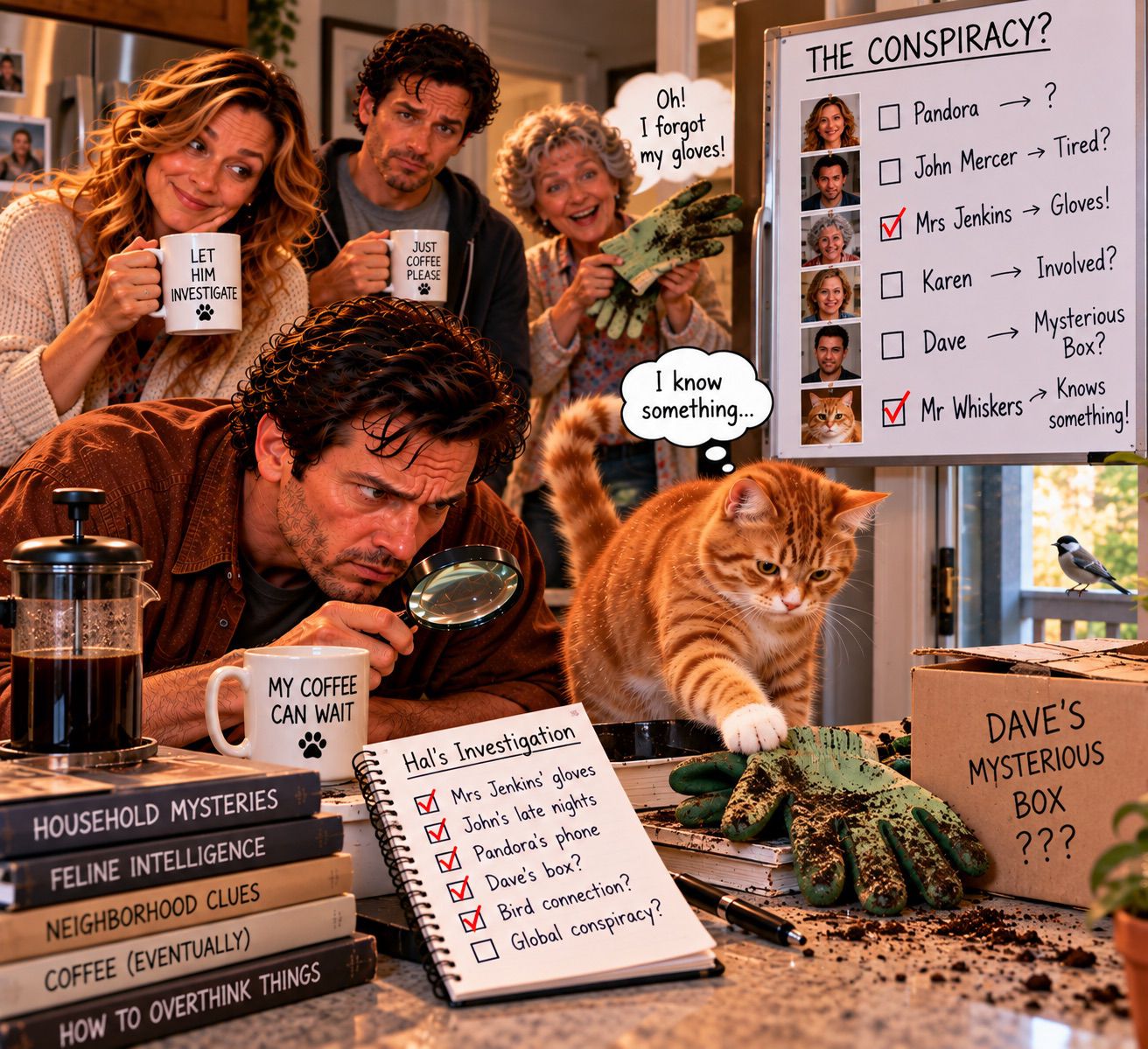
I’m standing in the kitchen making my morning coffee when I notice Mrs Jenkins’ gardening gloves sitting on the counter. This is unusual for several reasons, beginning with the fact that Mrs Jenkins does not live here and generally takes her gardening equipment home when she finishes using it. The gloves are green, slightly muddy, and positioned beside the sink as though someone deliberately placed them there rather than accidentally dropping them. Pandora is still asleep, John Mercer has just wandered into the kitchen looking like a man who spent the night negotiating with his pillow and lost, and Mr Whiskers is sitting near the back door staring at something I cannot see. I have a French press full of freshly brewed coffee in front of me, but I haven’t poured a cup yet because the gloves have introduced a question that requires clarification. I ask John whether he knows why Mrs Jenkins’ gardening gloves are on our counter. He looks at them, looks at me, and says, “Because she left them here?” I tell him that is an observation, not an explanation. He opens the refrigerator and says, “Then I have nothing.”
John has been unusually tired all week, which is another detail I have been meaning to investigate. He has been staying up late working on something in his room, and whenever I ask what he is doing, he gives me answers like “stuff” or “trying to finish something.” I don’t consider either response particularly informative. This morning he looks especially exhausted, and when I mention it, he tells me he was awake until almost two. I ask whether that has anything to do with Mrs Jenkins’ gloves. He stops pouring milk into his cereal and stares at me. “Why would it?” I explain that I am trying to establish whether there is a connection between his recent late nights and the unexplained presence of gardening equipment in our kitchen. John considers this for a moment before saying, “Hal, I was working on my computer. I wasn’t gardening.” I point out that people can participate in activities without personally performing every component. He tells me he is going back to bed. Unfortunately, this means the first potential witness has withdrawn before I can establish a complete timeline.
Mr Whiskers remains beside the back door, occasionally meowing and looking toward the kitchen counter. Under ordinary circumstances I would assume he wants breakfast, but he has already eaten, and yesterday’s coffee-canister incident demonstrated that his behavior can sometimes reflect knowledge the rest of us do not possess. In that case, he remembered where Pandora had hidden a package of salmon treats and spent an entire day attempting to communicate their location. I am therefore reluctant to dismiss his current interest as meaningless. I crouch beside him and ask what he is looking at. He turns his head toward the door, meows, and then walks toward the counter where the gloves are sitting. I follow him. He sniffs the air, looks up at the gloves, and sits down. I examine them more carefully. There is a little dirt on the fingertips and what appears to be a small piece of dried grass caught near one of the seams. Nothing particularly unusual, but the cat has now independently directed my attention toward the same objects I was already investigating. I tell him that while I appreciate his cooperation, he needs to provide more specific information if he expects me to draw a conclusion.
Pandora eventually comes downstairs and finds me examining Mrs Jenkins’ gloves while Mr Whiskers watches from the floor. She takes one look at the scene and asks, “What are you doing?” I tell her I’m trying to determine why the gloves are here. She says Mrs Jenkins stopped by yesterday afternoon and must have forgotten them. I ask why Mrs Jenkins was wearing gardening gloves inside our kitchen. Pandora explains that she had been working outside and came over to ask whether we had a small screwdriver she could borrow. Apparently something on her garden hose attachment had come loose, and she thought John might have a tool that would fit. John found a screwdriver, Mrs Jenkins borrowed it, and everyone went about their business. I ask why nobody mentioned this to me. Pandora says, “Because you were at work, and it was a screwdriver.” I explain that the size of an object does not determine whether an event involving it is relevant. She looks at the French press, which is still sitting untouched on the counter, and asks whether I intend to drink my coffee before it gets cold. I tell her the coffee can wait. She says, “Of course it can,” in a tone suggesting she has already accepted that the morning is going to be longer than necessary.
This explanation should resolve the gloves, but it introduces another question. If Mrs Jenkins borrowed a screwdriver yesterday, why are her gloves still here this morning? I ask Pandora whether she returned the screwdriver. She says she doesn’t know because John handled it. I ask whether Mrs Jenkins came back after borrowing it. Pandora thinks for a moment and says she might have, but she was on the phone at the time and wasn’t paying attention. This is not an ideal level of witness reliability. I look toward the hallway where John disappeared, then at the gloves, then at Mr Whiskers, who has resumed staring toward the back door. I begin to suspect that the incident may not have concluded when everyone assumed it did. Pandora tells me that Mrs Jenkins probably just forgot the gloves. I agree that this is possible, but I also point out that people generally notice when they are no longer wearing gardening gloves. Pandora says, “Not when they take them off.” I consider this response. Technically, she has identified a weakness in my reasoning, although I don’t think she needed to look quite so pleased about it.
At work, I decide to obtain an independent opinion from Karen and Dave. I explain that a neighbor borrowed a screwdriver, left her gardening gloves in our kitchen, and apparently never returned to collect them. Karen asks whether the neighbor has forgotten them. I tell her that is the prevailing theory, but I’m concerned about several inconsistencies. Dave asks what the inconsistencies are. I explain that John has been staying up late, Mr Whiskers has been meowing near the back door, and Pandora was distracted when Mrs Jenkins borrowed the tool. Dave listens carefully before asking whether I believe the screwdriver is connected to John being tired. I tell him I haven’t ruled it out. Karen asks whether I have considered asking Mrs Jenkins why she left the gloves. I explain that doing so before reconstructing the events could influence her recollection. Dave says, “Or she could tell you she forgot them.” Karen laughs, and I realize I have once again selected two people who are unwilling to approach an otherwise straightforward investigation with the seriousness it deserves.
When I return home that afternoon, I find John sitting at the kitchen table with his laptop open and a cup of coffee beside him. He looks considerably more awake than he did this morning, which I attribute to either improved rest or caffeine. I ask whether he returned Mrs Jenkins’ screwdriver. He says no, because she still has it. I ask why she still has it. He says she hasn’t brought it back. I ask whether he knows what she was fixing. He says something on her hose. I ask whether he helped her. He says no. Then he looks at me and asks why I am so interested in the screwdriver. I explain that the gloves remain unaccounted for in the sequence of events. John says, “They’re on the counter.” I tell him that is precisely the problem. He looks toward the counter, where the gloves are still sitting, and says, “Then give them back to her.” I remind him that Mrs Jenkins is currently in possession of one of our screwdrivers, which means the exchange is not quite as simple as returning a forgotten personal item. John closes his laptop and says, “You are making a screwdriver sound like an international incident.”
A few minutes later, Mrs Jenkins knocks on the door. I open it and find her holding the screwdriver in one hand and a small plastic bag in the other. She smiles and says she came to return the tool and collect her gloves. I invite her into the kitchen, where she immediately spots them on the counter. She explains that she removed them yesterday because they were muddy and she didn’t want to get dirt on anything while borrowing the screwdriver. Then she became distracted talking to Pandora and forgot to pick them up before leaving. This accounts for their presence in the kitchen, but I still want to know why she needed the screwdriver in the first place. Mrs Jenkins explains that the hose attachment outside had been leaking, and she was trying to tighten a small fitting. The screwdriver helped her remove a cover, but the fitting itself needed a replacement washer, which she picked up at the hardware store this morning. I ask whether the repair was successful. She says it was, although she got rather wet testing it. Then she holds up the plastic bag. Inside is the old washer, which she apparently brought along because she thought John might be interested in seeing why it failed. John looks at the bag and says, “I’m good, thanks.”
This should be the end of the matter, except Mr Whiskers suddenly becomes extremely interested in Mrs Jenkins’ shoes. He walks over, sniffs them, and begins meowing with the same urgency he displayed this morning. Mrs Jenkins laughs and tells him he is being a very curious boy. I ask whether she has been carrying salmon treats. She says no. I ask whether she gave him any yesterday. Again, no. Then she remembers that while she was working outside, she had seen a small bird hopping around near the garden hose and had stopped to watch it. Mr Whiskers had been sitting at the window staring at the bird for several minutes. She says he became particularly animated when the bird hopped close to the door. I look at Mr Whiskers, who is now sitting beside the same door and watching Mrs Jenkins as though he expects her to produce something. It occurs to me that he may have associated her presence, her gardening gloves, and the back door with the possibility of another bird appearing outside. Pandora says, “Or he just likes Mrs Jenkins.” I tell her the two explanations are not mutually exclusive.
Mrs Jenkins retrieves her gloves, thanks us for lending her the screwdriver, and heads back across the hall. Mr Whiskers follows her as far as the doorway before sitting down and watching her leave. I close the door and return to the kitchen, where Pandora is finally pouring herself a fresh cup of coffee. She asks whether I am satisfied now. I tell her that the gardening gloves have been accounted for, the screwdriver has been returned, Mrs Jenkins’ hose has been repaired, and the cat’s behavior appears consistent with his interest in the bird he saw yesterday. John says, “So nothing happened.” I explain that several things happened, but none of them appear to have been connected in the way I initially suspected. John says that sounds suspiciously like another way of saying nothing happened. I tell him the distinction matters. He asks whether I have considered that perhaps I should spend less time investigating household objects and more time drinking my coffee. I look at the French press, which has been sitting on the counter since this morning. I had forgotten about it entirely.
I pour myself a cup and take a sip. It is cold, bitter, and considerably less satisfying than it would have been several hours earlier. Pandora watches me make a face and says, “You could have made another pot.” I explain that doing so would have interrupted the investigation. She points out that the investigation is over. I tell her that is precisely why I am finally drinking the coffee. John laughs and returns to his room, where I hear him resume whatever work has been keeping him awake at night. Mr Whiskers settles beside the back door, apparently satisfied that the morning’s excitement has concluded. I stand in the kitchen considering the events of the day. Mrs Jenkins forgot her gloves because she borrowed a screwdriver. John was tired because he had been working late. Pandora was distracted because she had been on the phone. Mr Whiskers was interested in the garden because he had seen a bird. Every suspicious detail has a perfectly ordinary explanation, and I have spent most of the day trying to connect things that were never connected in the first place.
Then I hear a scratching sound from the back door.
Mr Whiskers immediately sits upright, ears forward, tail twitching. I look toward the door and see a small shadow move across the glass. A bird lands on the outside ledge, pecks at something, and flies away. Mr Whiskers follows it with his eyes, then looks directly at me as though he expects an acknowledgment of his observational abilities. I tell him I saw it. He meows once and returns to watching the window. Pandora comes into the kitchen and asks what happened. I tell her the cat was right about the bird. She looks outside, sees nothing, and says, “Of course he was. He’s a cat.” I explain that his interest in Mrs Jenkins’ gardening gloves may have been a response to a specific environmental association rather than random curiosity. Pandora takes a sip of coffee and says, “Hal, the cat saw a bird.” I tell her that is an unnecessarily simplistic interpretation of the evidence. She smiles and walks away.
I look down at Mr Whiskers, who is still watching the door. I have to admit that his ability to detect small changes in his environment continues to impress me. Yesterday he remembered where his treats were hidden. Today he recognized a location associated with a bird he wanted to watch. These are not extraordinary accomplishments for a cat, but they do suggest a level of situational awareness that deserves recognition. I tell him that while I appreciate his contributions, I would prefer if he could provide more specific information before I abandon my coffee to investigate another household mystery. He looks up at me, blinks slowly, and then turns back toward the window. I take another sip of my cold coffee and consider the possibility that he understands exactly what I’m saying. Then I remember that he has successfully convinced three adults to retrieve hidden treats, investigate kitchen appliances, and spend an entire morning discussing gardening gloves. I’m beginning to think the problem isn’t that Mr Whiskers knows something I don’t. The problem is that he knows exactly how to get me to do the investigating for him.