I’m making coffee when I notice Mr Whiskers’ food bowl is empty. This would normally trigger an immediate response because Mr Whiskers has developed a sophisticated notification system for an empty food bowl consisting primarily of standing beside it and screaming until someone corrects the situation. Today, however, the bowl is empty and Mr Whiskers is asleep on the couch. Not waiting beside the bowl. Not following me through the kitchen. Not weaving between my ankles in a manner that makes preparing coffee unnecessarily dangerous. Asleep. Completely relaxed. I stand in the kitchen looking at the empty bowl, then toward the living room where one orange paw is hanging over the edge of the couch. Yesterday I concluded that Mr Whiskers had now demonstrated an interest in two separate breakfast-related investigations. Today, apparently, breakfast has come to him.
I should establish immediately that an empty bowl does not necessarily mean an unfed cat. I understand this. Food can be consumed. In fact, consumption is generally the intended outcome of putting food in the bowl. The problem is that I fed Mr Whiskers this morning. I remember doing it because he woke me by standing on my chest and staring directly into my face, which is difficult to forget. That was at approximately 6:20, twenty-five minutes before Pandora’s alarm went off at 6:45. I fed him, he ate, and I went back upstairs. By the time I came down again, Pandora was making coffee and Mr Whiskers was sitting beside his bowl looking at her. I didn’t think anything of it at the time because sitting near his bowl is one of his primary recreational activities. Now I’m looking at an empty bowl and a cat who appears to have absolutely no nutritional concerns.
Pandora comes into the kitchen while I’m examining the situation. She takes one look at me, follows my line of sight to the bowl, and says, “What?” I ask whether she fed Mr Whiskers this morning. “Of course I fed him,” she says. I put down my coffee. “When?” She tells me around 6:50, after she started the coffee. I ask how much. Pandora gives me the look. “The normal amount, Hal.” I tell her I had already fed him at 6:20. She looks toward the living room. Mr Whiskers remains asleep. Pandora looks back at me. “He acted hungry.” I tell her he always acts hungry. She says she knows that now. This means that before seven o’clock this morning, Mr Whiskers had eaten two breakfasts.
John walks into the kitchen while we’re discussing this and reaches for the coffee. I ask him a simple question before he can pour it. “Did you feed Mr Whiskers this morning?” John stops with his hand around the coffee pot. There is a pause. Not a long pause, but long enough to become evidentiary. “Maybe,” he says. Pandora turns toward him. I ask what maybe means in the context of feeding a cat. John explains that he got up around seven-thirty, came downstairs, and Mr Whiskers was sitting beside the empty bowl meowing. Since neither Pandora nor I was in the kitchen, John assumed nobody had fed him. “So I gave him a little,” John says. I ask him to define a little. John pours his coffee and says, “Food, Hal. I gave the cat food. I didn’t weigh it.”
I look toward the couch again. Mr Whiskers has now consumed three breakfasts.
This explains the nap.
Pandora starts laughing, but I don’t think she appreciates what we’ve uncovered. This is not simply a feeding mistake. A feeding mistake happens when two people independently feed the cat because neither knows the other person already did it. Three people requires participation from the cat. Mr Whiskers approached me at 6:20 and presented himself as hungry. After eating, he approached Pandora at 6:50 and presented himself as hungry. After eating again, he approached John around 7:30 and presented himself as hungry for a third time. At no point did Mr Whiskers disclose his previous meals. I tell Pandora this. She says, “He’s a cat.” I remind her that she used exactly the same defense two days ago when we discovered Mr Whiskers could obtain food by initiating affection. She says we did not “discover” anything; the cat rubbed against my leg and I fed him. I tell her subsequent events suggest that interaction may have been more significant than we realized.
John sits at the table with his coffee and tells me I’m accusing a cat of running a breakfast scam. I tell him I’m not accusing anyone. I’m establishing the sequence of events. At 6:20, Mr Whiskers convinced me he hadn’t eaten. At 6:50, he convinced Pandora he hadn’t eaten. At 7:30, he convinced John he hadn’t eaten. That’s not three feeding mistakes. That’s one cat presenting the same claim to three different household members without allowing any of them to compare information. John points out that Mr Whiskers cannot speak. I tell him that actually makes the operation more impressive.
The more I think about it, the more previous events begin to make sense. Mr Whiskers is always extremely interested when someone enters the kitchen. He routinely appears when the refrigerator opens. He has developed separate approaches for each of us. With Pandora, he sits beside the bowl and looks pathetic. With John, he meows because John responds to direct complaints. With me, he uses physical affection because apparently I’m vulnerable to positive reinforcement. Two days ago I thought Karen had discovered how to get people to do things by being nice to them. Yesterday I thought Mr Whiskers was interested in Pandora’s clean breakfast plate because he had some unexplained interest in breakfast-related evidence. I now realize I may have been looking at the situation backward. Mr Whiskers wasn’t investigating the plate. He was checking whether there was anything left on it.
This is the first genuinely useful conclusion I’ve reached all week.
At work, I make the mistake of telling Karen about it. I don’t give her the entire investigative history because she has actual work to do, but I mention that Mr Whiskers managed to get three breakfasts from three different people before anyone realized what was happening. Karen laughs and says, “Smart cat.” I tell her intelligence is not the issue. Deception is the issue. Karen asks whether Mr Whiskers ever actually claimed he hadn’t been fed. I explain that he sat beside an empty bowl and meowed. She says, “So no.” I tell her communication does not require language. Karen asks whether I’m planning to interrogate the cat. I tell her interrogation would be pointless because he has already demonstrated an unwillingness to cooperate.
When I get home, Mrs Jenkins is in the hallway and asks how Mr Whiskers is doing. Under ordinary circumstances, this would be a harmless question from a neighbor who likes our cat. Today it requires clarification. I ask why she wants to know. Mrs Jenkins says she saw him sitting in the window earlier and thought he looked particularly pleased with himself. I tell her he had three breakfasts. She laughs. Then she says, “That explains why he didn’t want the treats.” I stop walking. “What treats?” Mrs Jenkins freezes for approximately half a second, which is more than enough. She explains that yesterday afternoon Mr Whiskers slipped into the hallway when John opened the door, wandered over to her apartment, and she gave him two of his favorite salmon treats before bringing him back.
Now we have an expanded timeline.
I thank Mrs Jenkins for the information and go inside. Mr Whiskers is awake now, sitting in the living room with Pandora and John as though nothing has happened. I explain the additional discovery. Pandora immediately points out that yesterday’s treats have nothing to do with today’s three breakfasts. Technically, she’s correct, but I tell her they establish a pattern. Mr Whiskers has learned that different people possess different food resources and, more importantly, that those people are not routinely exchanging feeding information. John says, “You make it sound like he’s exploiting gaps in our intelligence network.” I look at him. “That is exactly what he’s doing.” John laughs, but I notice he doesn’t offer an alternative explanation.
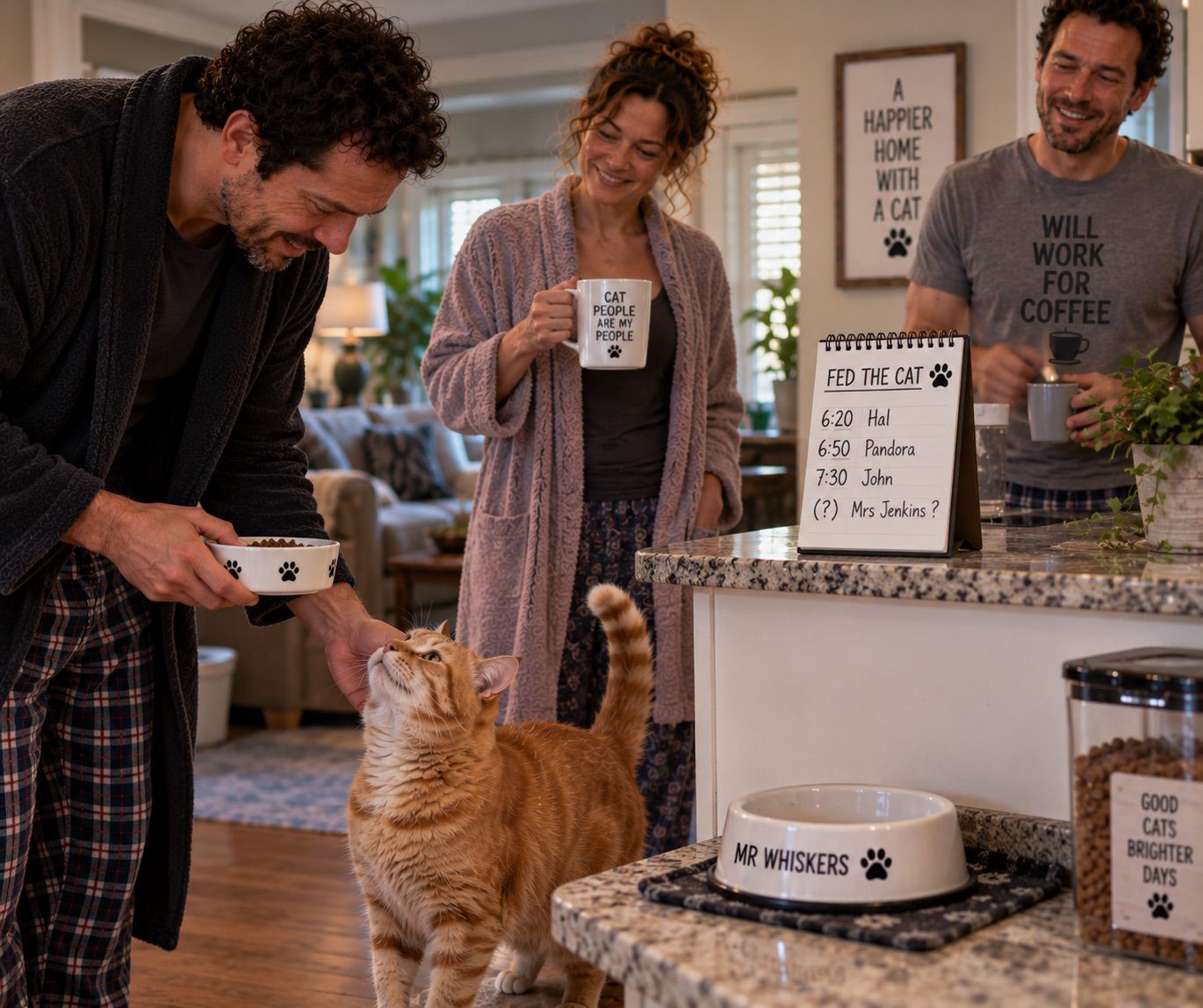
We decide to institute a system. Nothing elaborate. Pandora puts a small notepad beside the food container with the words FED THE CAT at the top. Whoever feeds Mr Whiskers writes down the time. John thinks this is ridiculous. I remind him that he was responsible for breakfast number three. He says that’s fair. Pandora says the system will also prevent us from accidentally overfeeding him, which is the sensible reason for doing it. My reason is that Mr Whiskers has demonstrated an ability to exploit informational asymmetry within the household, but apparently that phrasing makes everyone uncomfortable.
The next morning, I come downstairs and find Pandora’s handwriting on the pad: 6:47 — fed him. Good. The system works. Mr Whiskers is sitting beside the bowl looking at me. I point at the notepad. “I know,” I tell him. He meows. I pour my coffee. He meows again, louder this time, then rubs against my leg. I look down at him. “Not happening.” He stares at me for several seconds before walking away.
I feel extremely satisfied.
Then John comes downstairs.
Mr Whiskers immediately turns around, trots toward him, and starts meowing.
I hold up the notepad before John can even reach the kitchen. “Don’t believe him.”
John reads Pandora’s note and starts laughing. Mr Whiskers looks from John to me, realizes this avenue has been compromised, and walks away with his tail held high. I watch him disappear into the living room and feel, for perhaps the first time in several days, that an investigation has produced a concrete improvement in household operations.
About ten minutes later, I hear the front door open.
Mrs Jenkins says, “Well, good morning, handsome.”
There is a pause.
Then I hear the unmistakable sound of a treat bag opening.
I put down my coffee.
The system needs expanding.