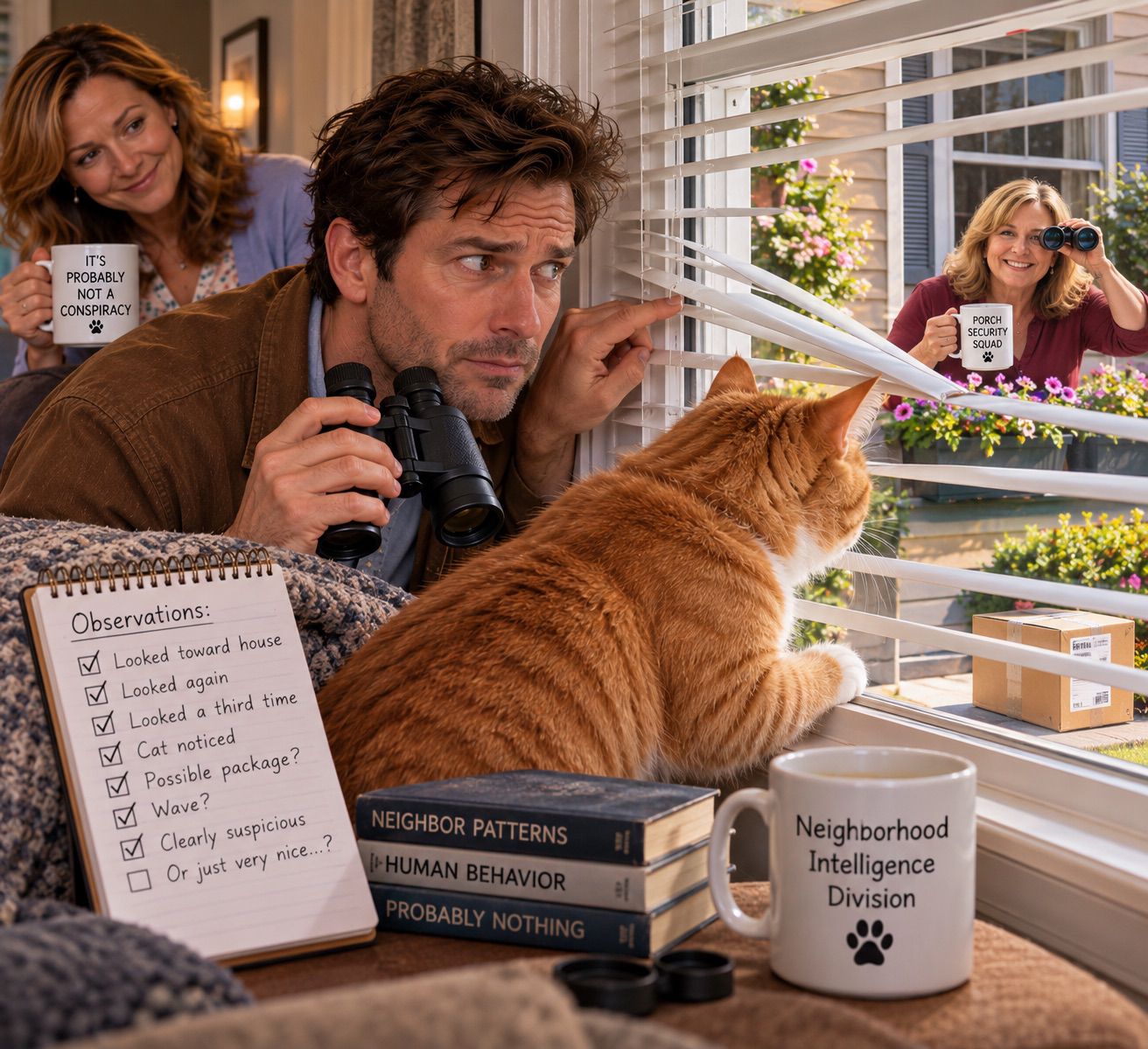
I’m sitting in the living room trying to read when I notice Pandora checking her phone for what has to be the fifth time in ten minutes. Normally I wouldn’t assign significance to that, especially after what happened with the pharmacy calls, because apparently people are allowed to look at their phones repeatedly without it constituting an event. Still, five times in ten minutes feels statistically noticeable. John walks through the room carrying a bowl of cereal, says something to Pandora that I don’t quite catch, and keeps going toward his room when she doesn’t answer. He doesn’t seem concerned, which concerns me slightly, although I recognize that this is not a particularly strong evidentiary standard. Then Mr Whiskers jumps onto the back of the couch, stares toward the front window, and lets out one long, irritated meow. That’s when I look outside and see Mrs Jenkins standing near her window across the way, looking directly toward our house.
I don’t immediately assume she’s spying on me. That would be irresponsible. Instead, I observe her for approximately thirty seconds in order to determine whether she is observing me, which is completely different. She looks away, then looks back. I shift slightly to the left. A few seconds later, she shifts slightly too. “Pandora,” I say, keeping my eyes on the window, “Mrs Jenkins is watching the house.” Pandora doesn’t look up from her phone. “She lives over there, Hal.” I explain that I’m aware of where Mrs Jenkins lives and that geography isn’t the issue. The issue is that she has now looked toward our window three separate times. Pandora finally glances outside, sees Mrs Jenkins, and shrugs. “Maybe she’s looking outside.” Technically possible, but suspiciously broad.
Mr Whiskers begins pawing at the curtain, which I consider independent corroboration until Pandora reminds me that there’s a bird feeder outside the window. I look down and, sure enough, there are two sparrows hopping around beneath it. That explains the cat, but not Mrs Jenkins. John comes back through the room for more cereal, notices me standing beside the curtain, and asks what I’m doing. “Nothing,” I tell him. He looks at Pandora. Pandora says, “He thinks Mrs Jenkins is spying on him.” I correct her immediately. “I think Mrs Jenkins may be monitoring activity associated with this residence.” John pours more cereal into his bowl without responding. I ask whether he’s noticed Mrs Jenkins watching the house lately. “She’s our neighbor,” he says. “She looks over here sometimes.” I ask how often. John stares at me for a moment, puts the cereal box away, and says, “I’m going back to my room.” That isn’t an answer, but I decide not to treat it as one.
At work the next day, I mention the situation to Karen and Dave because they provide a useful external perspective and, more importantly, neither of them lives near Mrs Jenkins. Karen asks what Mrs Jenkins was actually doing. I explain that she was standing at her window and looking toward our house repeatedly. “Was she using binoculars?” Karen asks. No. “Taking pictures?” Dave asks. No. “Writing anything down?” No. Karen leans back in her chair. “So your evidence is that your neighbor looked out her window.” I tell her that reducing evidence to its simplest description is a well-known way of making perfectly legitimate concerns sound ridiculous. Dave asks what Mrs Jenkins could possibly be monitoring. I admit I haven’t established motive yet. Karen says, “Maybe establish an activity before you establish a motive.” I write that down because, despite her tone, it’s actually a reasonable methodological improvement.
When I get home, Mrs Jenkins is outside near the sidewalk. I decide the mature thing to do is ask her directly rather than constructing a theory from behind a curtain, which I consider personal growth. “Mrs Jenkins,” I say, “were you watching our house yesterday?” She looks surprised for about half a second and then says, “Oh, yes.” I wasn’t expecting the immediate confession, so I have to mentally reorganize several questions. “You were?” She nods. “I was waiting for your package.” Apparently a delivery truck had stopped in front of our house while Pandora and I were both out the previous afternoon, and Mrs Jenkins had seen the driver leave a large box near the front door. She was worried someone might take it, so she had been periodically checking the porch from her window until one of us brought it inside. “I texted Pandora about it,” she says. “Didn’t she tell you?”
I go inside and find Pandora in the kitchen. “Mrs Jenkins says she was watching the house because of a package.” Pandora looks up from her phone and says, “Yes.” I wait for additional information. None arrives. “And she says she texted you.” Pandora holds up her phone. “That’s what I was checking this morning.” I remind her that she could have mentioned this when I specifically pointed out that Mrs Jenkins appeared to be watching the house. Pandora reminds me that I did not ask why Mrs Jenkins was watching the house. I said Mrs Jenkins was spying on me. I explain that this is a semantic distinction because surveillance of the house necessarily includes surveillance of its occupants. Pandora says, “She was protecting your package, Hal.” I ask what was in the package. “The replacement filters you ordered.” This is admittedly less interesting than I had hoped.
John comes into the kitchen while I’m explaining that my original observation was nevertheless accurate. Mrs Jenkins was watching the house. My interpretation of the purpose may have required adjustment, but the underlying observation remains intact. John opens the refrigerator and says, “So you caught the neighbor protecting your air filters.” I tell him that’s an unnecessarily dismissive summary of the investigation. “There was no investigation,” Pandora says. “Exactly,” I reply. “I was observing.” John takes out the milk and gives Pandora a look. Pandora gives him one back. I notice this exchange immediately but choose not to pursue it because I have learned something about restraint.
Later that evening, I’m sitting on the couch when Mr Whiskers climbs onto the back cushion and starts staring toward Mrs Jenkins’ house again. I follow his gaze. Mrs Jenkins is standing at her window. She sees me looking and gives me a little wave. I wave back. Then she points toward our front porch. I look outside and see another package sitting beside the door. When I turn around, Mr Whiskers is still staring at her. “It’s fine,” I tell him. “We know what she’s doing now.” He flicks his tail and keeps watching. I’m not saying Mrs Jenkins is spying on us. I’m just saying she has now established a documented pattern of monitoring our front porch, and apparently the cat has joined neighborhood security.