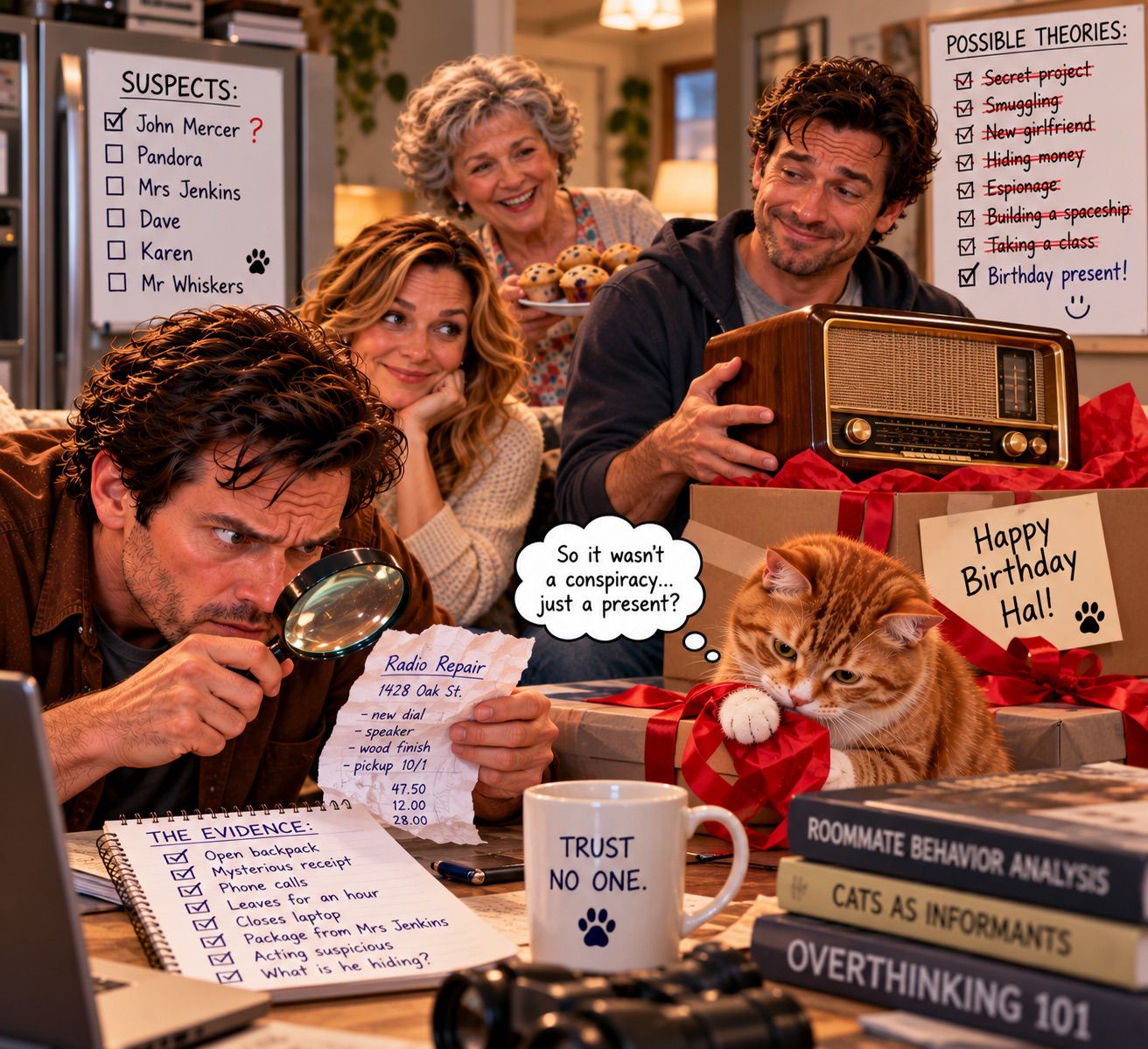
I’m standing in the kitchen waiting for Pandora to finish making breakfast when I notice John Mercer’s backpack lying open on the floor beside one of the chairs. This would not normally concern me because John’s approach to personal belongings is considerably more relaxed than mine, but the backpack isn’t simply open. Several things are sticking out of it, including a charging cable, a notebook, and what appears to be the corner of a cardboard box. There is also a crumpled receipt on the counter beside it with several numbers written on the back. John himself is nowhere in sight. Pandora is humming while she chops vegetables for an omelet, and Mr Whiskers is sitting on a stool watching a fly with the focused intensity of an animal who has never paid a utility bill. I ask Pandora where John is. “In his room, I think,” she says. I look at the backpack again. “Then why is his backpack in the kitchen?” Pandora stops chopping long enough to look at me. “Because he left it there?” I tell her that is certainly one interpretation.
The receipt bothers me more than the backpack. I don’t touch it because there is a meaningful distinction between observing something someone left in a common area and actively searching through another person’s belongings, and I would like that distinction preserved for the record. From where I’m standing, however, I can see several handwritten numbers and what looks like part of an address. I ask Pandora whether John has mentioned going anywhere unusual lately. She says no. I ask whether he has received any strange packages. She says she doesn’t know. I ask whether he has been behaving differently. Pandora puts down the knife. “You’ve asked me three questions about John’s backpack in less than a minute.” I tell her I’m asking about John, not the backpack. “You’re staring at the backpack.” That is technically true, but only because the backpack is currently providing more information than John.
As if summoned by the investigation, John comes into the kitchen a few minutes later and immediately notices me looking toward the floor. His reaction is subtle, but I catch it. He looks at the backpack, looks at me, then walks over and closes it. “Morning,” he says. I return the greeting and wait. John picks up the backpack. I continue waiting. Finally, he asks, “What?” I tell him nothing. He says, “Okay,” and starts toward his room. That is when I ask about the receipt. He stops. There is a pause—not a particularly long pause, but long enough to establish that a pause occurred—before he says, “What receipt?” I point toward the counter. John picks it up, folds it in half, and puts it into his pocket. “Just something I need later.” Then he walks back to his room carrying the backpack. I slowly turn toward Pandora. She doesn’t even look at me. “No.” I tell her I haven’t said anything. “You were about to.” I admit this is possible.
The situation becomes more interesting over the next two days. John receives a phone call and takes it in his room. He leaves the apartment one evening carrying the backpack and returns about an hour later without explaining where he went. The cardboard box disappears from inside the bag. Then, on Thursday morning, I walk into the kitchen and John immediately closes a browser window on his laptop. Any one of these things could be ordinary. Together, they create what I would describe as an informational deficit. I mention this to Pandora, who describes it as “John having a life.” I remind her that John lives with us and therefore changes in his behavior can reasonably be noticed by other members of the household. “Noticed, yes,” she says. “Investigated, no.” I tell her nobody is investigating anything. Mr Whiskers chooses that moment to walk over and sniff John’s backpack. I point at him. “See?” Pandora says, “The cat smelling something is not a search warrant.”
At work, I make the mistake of mentioning the situation to Karen. I don’t give her every detail because I’m interested in an independent assessment rather than contaminating the analysis, so I simply ask what she would think if someone she lived with suddenly started receiving packages, writing down addresses, taking private phone calls, disappearing for an hour at a time, and closing browser windows whenever anyone approached. Karen says, “I’d think they were buying me a present.” I hadn’t considered this. Dave, who has unfortunately heard the question, says, “Or they’re planning a surprise.” This is worse because it introduces a second benign explanation before I’ve finished evaluating the first. I ask why everyone assumes generosity instead of concealment. Karen says, “Because normal people sometimes surprise each other.” Dave adds, “Also because if John were running an international smuggling operation, I doubt he’d leave the receipt on your kitchen counter.” I never mentioned smuggling. I make a note of that.
When I get home, Mrs Jenkins is talking to John in the hallway. The conversation stops when she sees me. John is holding the backpack. Mrs Jenkins is holding a small cardboard box. Neither of them explains anything. I say hello. Mrs Jenkins smiles much too pleasantly and says, “Hello, Hal.” John takes the box from her and immediately carries it inside. I wait until Mrs Jenkins goes back into her apartment, then follow John into ours and ask what she gave him. “Nothing,” he says. I point out that I personally observed the transfer of a physical object, making “nothing” an unusually weak description. John sighs and says, “It’s just something she was holding for me.” I ask why Mrs Jenkins was holding it. “Because I asked her to.” I ask why. John looks toward the living room, where Pandora is sitting on the couch, then back at me. “Can you just leave this alone for another day?” That is the moment everything changes, because John has now explicitly confirmed that there is something I am not supposed to know.
I spend the rest of the evening making a deliberate effort not to investigate. This is significantly harder than investigating. The backpack remains in John’s room, the receipt remains in his pocket, and the mysterious box is nowhere visible. I don’t ask Pandora any more questions because she has begun answering them before I finish. At one point I walk into the kitchen and she says, “Still no,” even though I was only going to get water. Mr Whiskers, however, has become intensely interested in John’s bedroom door. He sits outside it for nearly twenty minutes, occasionally sniffing underneath. I crouch beside him and ask what he smells. Pandora walks past and says, “If you start interrogating the cat, I’m going to bed.” I explain that I’m not interrogating him. I’m observing his response to environmental stimuli. Mr Whiskers scratches once at John’s door. I tell Pandora that this is now technically unsolicited testimony.
The next morning I wake up to the smell of coffee and something sweet. When I walk into the kitchen, Pandora is already there, John is standing beside the table, and Mrs Jenkins is in the doorway holding a plate of muffins. On the table is the cardboard box. John tells me to sit down. I don’t, because sitting down before you understand the circumstances places you at an informational disadvantage. He opens the box anyway. Inside is an old-fashioned tabletop radio, beautifully restored, almost identical to one I had pointed out months earlier at a secondhand shop. I had mentioned that my grandfather used to have one like it and that I regretted not buying it when I saw it. John apparently remembered. The address on the receipt belonged to a repair shop. The numbers were measurements for replacement components. The private phone calls were with the repair technician. The hour-long trips were to drop off and pick up the radio. Mrs Jenkins had accepted the package because John knew I would notice it if it arrived while I was home. The closed browser window had been a page showing replacement knobs. “Happy birthday,” John says.
There are several problems with this explanation, the largest being that my birthday isn’t until next week. John says that was the point of giving it to me early: I had become so suspicious that Pandora was afraid I would discover it before then. I look at Pandora. She says, “You spent two days analyzing a receipt.” Mrs Jenkins adds that I nearly caught her with the package twice. John reminds me that I asked Karen for an independent behavioral assessment. I don’t know how he knows about that until Pandora admits I told her about the conversation myself. This significantly weakens several portions of my evidentiary chain. Still, I point out that my original conclusion was technically correct. John was hiding something from me. “A birthday present,” Pandora says. I tell her the nature of the concealed object does not change the fact of concealment. John says, “You’re welcome, Hal.”
I thank him because the radio really is beautiful, and I admit that the amount of effort he put into finding and restoring it means more to me than I expected. John looks pleased, Pandora kisses my cheek, and Mrs Jenkins announces that her work is done before returning across the hall. Even Mr Whiskers loses interest once he determines that the box contains no food. For the first time in two days, everything makes sense. I carry the radio into the living room, set it carefully on the shelf, and turn around just in time to see John quickly pick something up from the kitchen counter and put it behind his back. I stop. He stops. Pandora closes her eyes. “What was that?” I ask. John says, “Nothing.” I remind him that we have already established the evidentiary weakness of that particular answer. He starts laughing and shows me what he’s holding. It’s a roll of wrapping paper. Apparently he had planned to wrap the radio before I forced an accelerated disclosure. I accept this explanation. Mostly. The important thing is that I was right: my roommate was hiding something from me. I was simply wrong about everything after that.