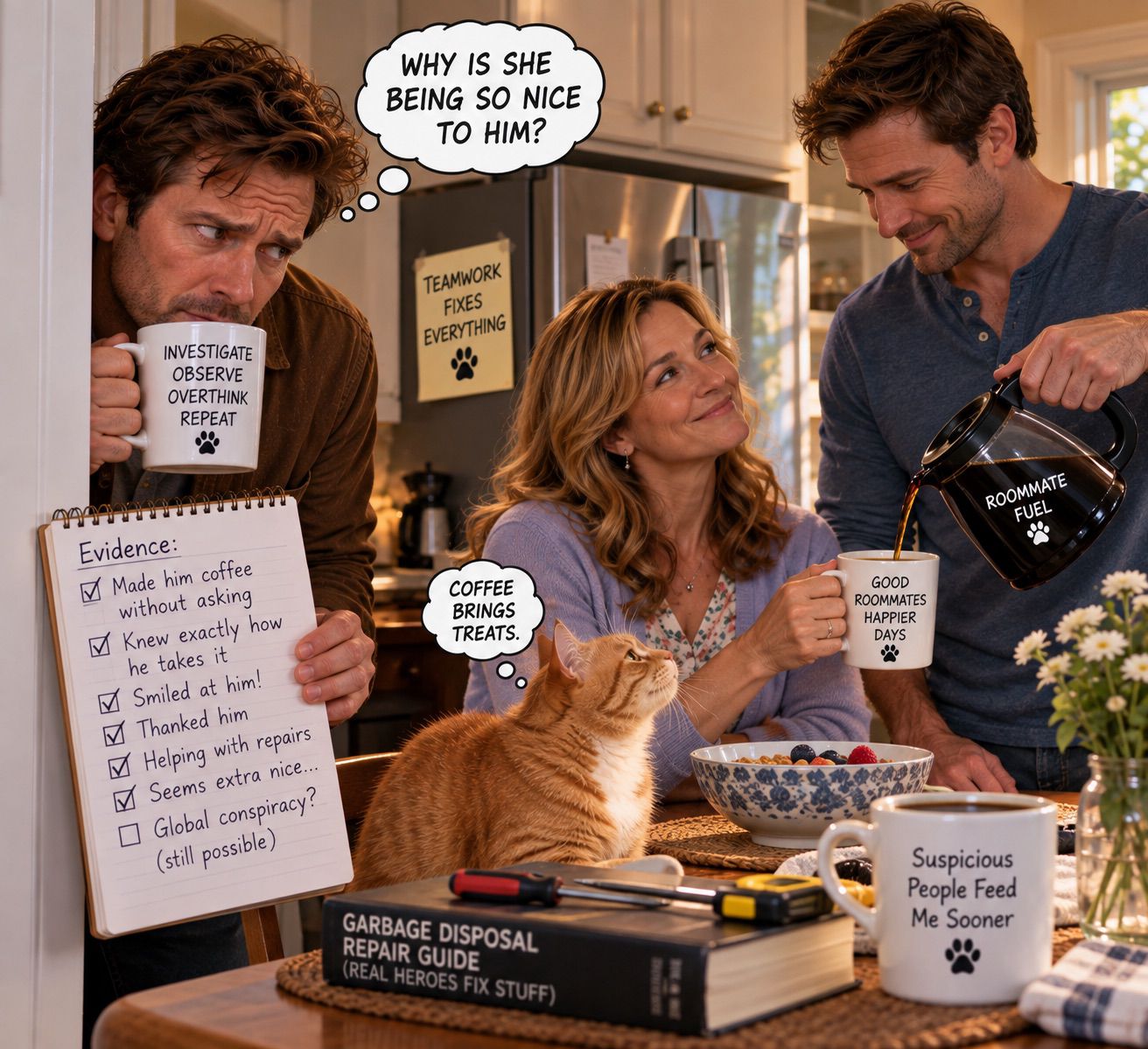
I’m making toast when Pandora walks into the kitchen, pours herself a bowl of cereal, and sits down without saying good morning. This by itself is unusual but not unprecedented. Pandora occasionally requires several minutes of consciousness before she becomes conversational, and I have learned that attempting to accelerate this process is rarely beneficial. I’m spreading butter on my toast when John comes out of his room looking like he has been awake for approximately fourteen seconds. His hair is sticking up on one side, his eyes are barely open, and he’s wearing the expression of a man who has not yet been informed what day it is. Pandora takes one look at him, gets up from the table, pours a cup of coffee, adds a little cream, and hands it to him. “Here,” she says. John looks at the mug, looks at Pandora, says, “Thanks,” and walks back toward his room. I stand there holding the butter knife because something about the exchange bothers me immediately.
It takes me a few seconds to identify the problem. Pandora didn’t ask John whether he wanted coffee. She didn’t ask how he takes it. She simply made it correctly and handed it to him. More importantly, she did all of this while I was standing three feet away holding dry toast and receiving absolutely no beverage-related assistance whatsoever. “That was nice,” I say. Pandora looks at me over her cereal. “What was?” I tell her I’m referring to the unsolicited coffee service she just provided John. She shrugs. “He looked tired.” I point out that I also look tired. “You already have coffee,” she says. I look beside me and discover that this is true. There is a mug sitting near the toaster that I apparently made several minutes ago. This weakens one part of my argument, but it does nothing to address the larger issue, which is that Pandora somehow knew precisely how John wanted his coffee without consulting him.
I ask her how she knew how much cream to put in it. Pandora stops eating and gives me the look she normally reserves for questions that have technically valid answers but should not have required asking. “Hal, John lives here.” I tell her I’m aware of the residential arrangement. “We’ve watched him make coffee hundreds of times.” That is also true, although I don’t appreciate how quickly the available evidence is turning against me. At that moment John reappears, takes a sip, and says, “Perfect.” This does not help. I ask him whether Pandora routinely makes his coffee. “No.” I ask whether she has recently begun doing other unsolicited favors for him. John lowers the mug. “What?” Pandora closes her eyes. I clarify that I am merely establishing whether this morning represents an isolated act of generosity or part of a broader behavioral pattern. “She made me coffee, Hal.” John takes another sip. “I wouldn’t form a task force yet.”
Mr Whiskers walks into the kitchen and immediately rubs against Pandora’s ankle. She reaches down and scratches his head without interrupting breakfast. He then walks directly to John, who scratches him behind the ears while drinking his coffee. I watch this exchange carefully. Yesterday I might have considered the cat’s movement potentially relevant, but recent experience has demonstrated that Mr Whiskers is willing to distribute affection across multiple household members whenever doing so increases his probability of receiving food. I therefore exclude him from the analysis. This is methodological growth. Pandora notices me watching the cat and says, “Don’t.” I tell her I haven’t said anything. “You were about to.” I ask how she knows that. She points her spoon at me and says, “Because I live here too.”
At work, I decide to obtain an independent assessment. I explain to Karen and Dave that Pandora made John coffee that morning without being asked. Karen waits for the rest of the story. There isn’t any. “That’s it?” she asks. I explain that she also prepared it correctly without requesting specifications. Dave asks how long Pandora and John have lived in the same house. I tell him that’s not the point. Karen says it seems very much like the point. I explain that the unusual element isn’t Pandora knowing how John takes his coffee; it’s the sudden unsolicited act of service. Dave asks whether John did anything for Pandora recently. I tell him I don’t know. Karen says, “Then maybe you should find that out before you decide they’re running a coffee-based operation.” I hadn’t used the word operation, but now that she has introduced it, I admit it describes the organizational aspect of my concern fairly well.
When I get home, John is in the kitchen replacing the loose handle on one of the cabinet doors. Pandora is holding a flashlight while he tightens the screws. I stand in the doorway for several seconds before either of them notices me. “Interesting,” I say. Pandora looks over. “What’s interesting?” I tell her I’m observing a continuation of the morning’s cooperative behavior. John stops turning the screwdriver and stares at me. “I’m fixing a cabinet.” I ask whether this repair was requested. “No.” I look at Pandora. She immediately understands what I’m thinking, which is becoming increasingly inconvenient. “There,” I say. “Another unsolicited favor.” Pandora puts the flashlight on the counter. “John fixed the garbage disposal last night.” I wasn’t aware the garbage disposal needed fixing. Apparently it had started making a grinding noise while I was upstairs. John took it apart, found a small piece of glass, removed it, cleaned everything out, and put it back together. Pandora had been standing there for nearly forty minutes helping him. “He was up late because of it,” she says. “That’s why I made him coffee this morning.”
This is a perfectly reasonable explanation, which I find disappointing mostly because of how quickly it resolves the matter. Pandora wasn’t fawning over John. She was thanking him for spending part of the previous evening repairing something in the kitchen. I ask why nobody told me about the garbage disposal. John says, “You were upstairs.” I ask why nobody told me afterward. Pandora says, “It was fixed.” I point out that a household appliance undergoing emergency repair seems like information that should be circulated among all residents. John asks whether I would like him to begin issuing maintenance reports. I tell him that wouldn’t be necessary, although a shared log for significant repairs might have some value. Pandora says, “No logs.” I remind her that the FED THE CAT system worked extremely well. “That’s because the cat was scamming three people for breakfast,” she says. From the doorway, Mr Whiskers meows. John points at him. “He’s probably filing an appeal.”
The next morning I walk into the kitchen and find John already there making coffee. Pandora is sitting at the table looking exhausted. Without asking, John pours a second cup, adds a little cream, and puts it in front of her. “Thanks,” she says. I stop in the doorway. Neither of them notices me at first. I consider yesterday’s evidence, the garbage disposal, the cabinet handle, the reciprocal coffee, and the fact that three adults who live together occasionally do nice things for one another without formally negotiating the transaction beforehand. It all fits. There is no mystery. I am about to leave it alone when Mr Whiskers walks into the kitchen, rubs against John’s leg, crosses the room, rubs against Pandora’s leg, and then comes directly to me. I look down at him. “Don’t even try it,” I say. He meows and walks toward his food bowl. Pandora takes a sip of coffee and smiles. “He’s being nice to you, Hal.” I watch Mr Whiskers look back at me from beside the bowl. “No,” I say. “We’ve already established what that means.”