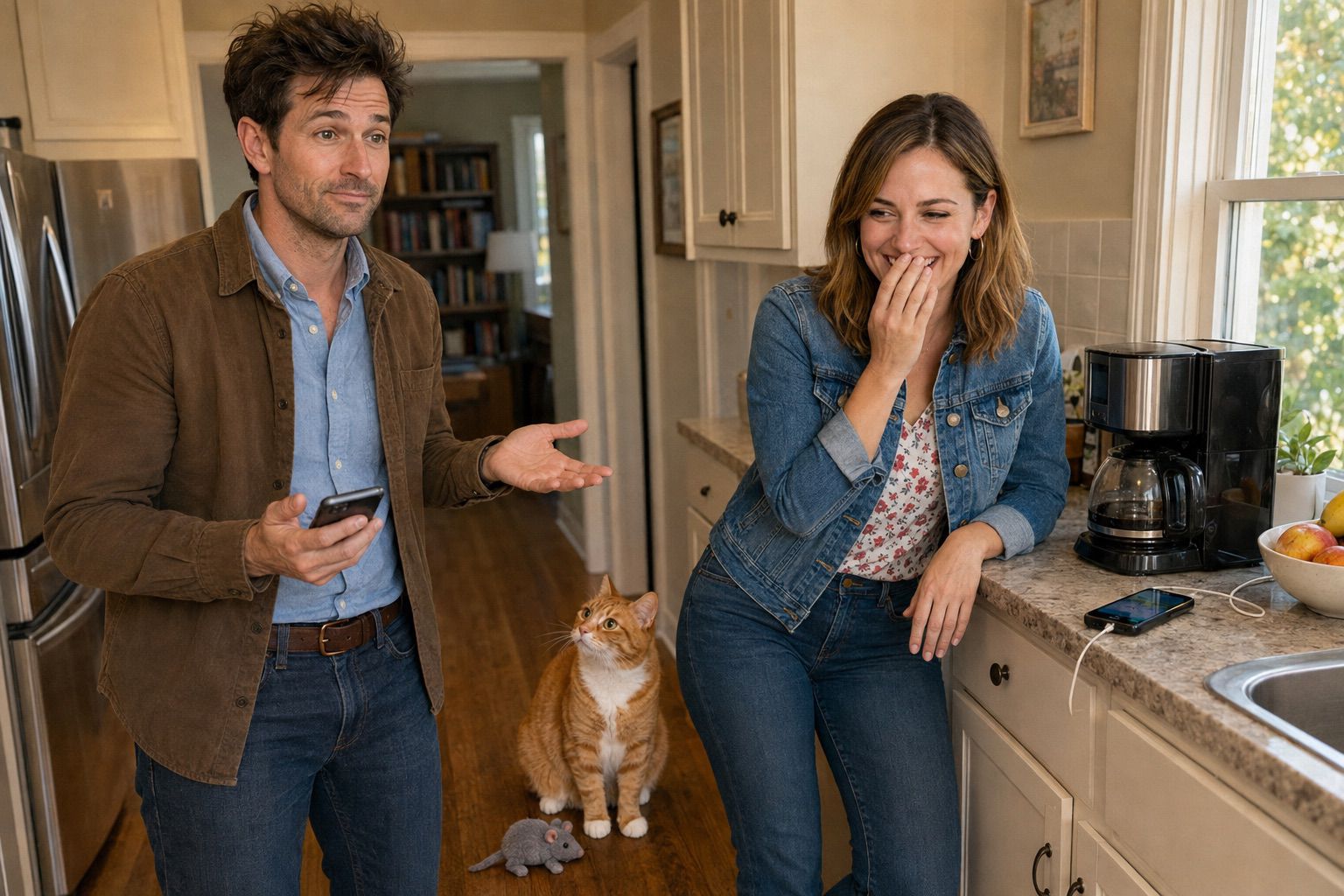
I was standing in the kitchen drinking coffee when I noticed Pandora’s phone sitting on the counter beside the fruit bowl. It had been there since she left that morning, which was unusual enough to get my attention but not unusual enough to mean anything. People forget their phones. I understand this. I once spent ten minutes looking for mine while using it as a flashlight. Still, Pandora is normally very good about keeping track of hers, and after nearly an hour it seemed strange that she hadn’t come back for it. I told myself she was probably already too far away when she noticed. That was reasonable. Unfortunately, my mind was already occupied by something considerably less reasonable: the argument I had witnessed between Karen and Dave at work yesterday. I hadn’t heard the entire argument, and that was important. I had been walking past the break room when I heard Karen say, “You had no right to change it without asking me,” followed by Dave saying, “I didn’t think it was that big of a deal.” Karen disagreed. Strongly. I continued walking because standing outside a break room listening to your coworkers argue is generally considered poor workplace etiquette, but I heard enough to establish that Dave had changed something, Karen had discovered it, and whatever he had changed mattered considerably more to Karen than it did to Dave. Neither of them mentioned it afterward. Karen spent the rest of the afternoon looking irritated. Dave behaved as though nothing had happened. I went home without asking questions because their disagreement was none of my business. I was actually rather proud of myself for this.
Then Pandora left her phone on the counter. These two events were almost certainly unrelated. I knew that. Pandora doesn’t work with Karen or Dave. Karen and Dave don’t live near us. As far as I knew, neither of them had spoken to Pandora recently. There was no logical reason to connect an office argument yesterday with a forgotten phone this morning. The fact that both events occurred within approximately eighteen hours of each other was merely chronological proximity, and chronological proximity is not evidence. I repeated this to myself while staring at Pandora’s phone. Mr Whiskers meowed from the kitchen doorway. “Don’t.” He meowed again. “This has nothing to do with you.” Mr Whiskers stared at me, then turned his head toward the hallway. “Your food is in the kitchen.” Another meow. I took a sip of coffee and ignored him. This was progress. A week ago, I might have interpreted his behavior as evidence that he sensed something unusual. Recent experience had taught me that Mr Whiskers generally senses one of four things: food, insects, objects he has lost underneath furniture, or opportunities to inconvenience me. I therefore excluded him from the available evidence.
My phone rang and I nearly spilled my coffee. The number was unfamiliar. I answered, and Pandora’s voice came through the speaker. I immediately asked where she was calling from. “A phone.” I told her I understood that much. “I borrowed somebody’s phone.” I looked at Pandora’s phone on the counter and pointed out that she had forgotten it. “I know.” I reminded her that it was here. “I know, Hal. That’s why I’m calling.” That was fair. Pandora explained that she had realized she’d forgotten it after she was already too far away to come back without making herself late. She asked me to plug it in because the battery was low and said she would get it when she came home. I asked if everything was okay. She said yes. I told her she sounded distracted. “I’m busy.” I asked what she was busy with. There was a pause before she answered, “Work.” This was a completely adequate answer. It did not feel like one. Before I could ask anything else, Pandora said she had to go and hung up. I stared at my phone for several seconds. There was nothing suspicious about the conversation. She had forgotten her phone, borrowed another one, called me, and asked me to charge it. Every component of the event had been explained. Yet something about the timing bothered me, and I couldn’t identify why.
Mr Whiskers meowed again. I turned toward him and asked what he wanted. He walked into the hallway. I told him no. He came back, meowed, and walked away again. I followed him. This should not be interpreted as surrender. At some point, refusing to investigate persistent cat behavior becomes less rational than spending thirty seconds determining what the animal wants. Mr Whiskers led me to the shoe rack, sat down, and stared underneath it. I crouched and found his stuffed mouse wedged against the wall. I pulled it out. He grabbed it from my hand and ran away. Problem solved. No feline warning system. No secret message. Just a mouse. I returned to the kitchen feeling considerably better about my analytical discipline.
That was when John knocked on the door. He had stopped by to return a travel mug he had borrowed, which apparently had become an ongoing administrative process between us. I let him in, and he followed me into the kitchen while I poured him coffee. He noticed Pandora’s phone charging on the counter but said nothing about it. This was because Pandora’s phone sitting on a counter means nothing to a normal person. I handed him the coffee and asked if I could ask him something. John looked at me over the mug and wanted to know whether this was going to become an investigation. I assured him it would not. “Do you think someone changing something without asking another person necessarily means there’s a larger problem?” John lowered the mug and asked what I was talking about. I said anything, generally. He informed me that this was not really a question. I told him it was structurally a question. He stared at me, so I decided context might help.
I explained that two people at work had an argument yesterday. Karen and Dave. John continued staring at me. “You don’t know them,” I added. He confirmed that he did not. I reminded him that I had mentioned them before. “I’m sure you have.” That response was less helpful than I had hoped. I explained that Karen and Dave were coworkers and that I had overheard Karen accusing Dave of changing something without asking her. John asked what Dave had changed. I said I didn’t know. He asked what they were arguing about. I didn’t know that either. He asked whether it was work-related. Presumably. “Then why are you asking me?” This was a surprisingly difficult question. I told him I was obtaining an outside perspective. “On an argument between two people I’ve never met about something you didn’t hear?” When he put it that way, the methodology sounded weaker. I told him yes anyway. John drank his coffee and suggested that I ask Karen. That was annoyingly sensible.
I told him there was another factor. Pandora had forgotten her phone. John slowly lowered the mug again and asked what that had to do with Karen and Dave. I said probably nothing. He wanted to know why I had told him, then. “Because it happened this morning.” John pointed out that things happen every morning. I clarified that it happened after the argument. “So?” I stared at him. He was looking at the events individually rather than considering the possibility of interaction between them. “Hal,” he said, “does Pandora work with Karen and Dave?” No. “Does she know Dave?” Not really. “Does she know Karen?” I told him she knew of Karen because I had talked about work. “That wasn’t what I asked.” Fine. No. John nodded and asked why Pandora forgetting her phone would have anything to do with two people at my office arguing. I opened my mouth, but nothing immediately came out. John nodded again. “That’s what I thought.” I disliked how quickly he had reached that conclusion.
John left shortly afterward, taking his travel mug with him this time, which I considered useful because it reduced the likelihood of another visit involving the same mug tomorrow. I returned to my desk and attempted to work. For nearly an hour, I succeeded. I did not think about Karen. I did not think about Dave. I did not think about Pandora’s phone charging in the kitchen. I certainly did not think about whether Dave changing something without Karen’s permission could have consequences beyond the office. There was no reason to. John had been correct about one thing: Pandora had no connection to either of them. I was the only person connecting these events, which meant the connection existed entirely through me. This was not evidence of anything except the fact that I knew several people.
Around lunchtime, I received a message from Karen. It said, If Dave asks, tell him everyone hates the new coffee. I stared at it. There are messages that clarify situations, and there are messages that create entirely new categories of questions. This was somehow both. I read it again. If Dave asks, tell him everyone hates the new coffee. Suddenly I had an object. Dave had changed something. Karen was angry about it. Whatever he changed affected other people. I typed back, What new coffee? Karen responded almost immediately. Exactly. This was not an answer. I asked what Dave had changed. Three dots appeared. Disappeared. Appeared again. Finally she replied that Dave had placed the office supply order and accidentally switched the usual medium roast to dark roast. Karen hated dark roast. Apparently she had told him to fix the order, Dave had said it wasn’t worth the trouble, and this had produced the argument I overheard.
I sat there staring at the message. Coffee. They had been arguing about coffee. Not budgets. Not schedules. Not some major workplace dispute. Not something personal. Coffee. Specifically, the degree to which coffee beans had been roasted. Karen’s declaration that Dave had “no right to change it without asking” had referred to a box on an office supply order. Dave’s claim that it wasn’t a big deal had been his assessment of dark roast. The entire disagreement that had occupied part of my brain since yesterday could have been resolved by walking into the break room and looking at the coffee machine. I wrote back asking whether everything was okay between them. Karen responded, Yes. Dave just has terrible taste in coffee. Then, approximately thirty seconds later, another message appeared. And tell him I said that.
That should have ended the matter. In fact, it did end the matter. Karen and Dave’s argument had been explained completely. More importantly, it had absolutely nothing to do with Pandora. I had known from the beginning that it probably didn’t, but knowing something probably isn’t the same as proving it conclusively. Now I had proof. I returned to the kitchen, poured out the remainder of my coffee, and looked at Pandora’s phone charging peacefully beside the fruit bowl. Two unrelated events had occurred within eighteen hours of each other. That was all. I had successfully avoided turning them into something larger, apart from the brief period during which I had asked John to analyze an argument between two strangers he had never met.
Pandora came home that afternoon and walked straight into the kitchen. “Phone?” she asked. I pointed toward the counter. She picked it up, checked the battery, and thanked me for charging it. I asked how work had been. Busy. I asked whether anything unusual had happened. She looked at me suspiciously and said no. I nodded. No follow-up. This seemed to surprise her. She put the phone into her purse. “That’s it?” I told her that was it. Pandora studied me for a moment as though she suspected a trap. I found this insulting. Then she asked why John had texted her earlier asking whether I was “investigating two people he doesn’t know.”
I had not anticipated that.
I explained the situation. Karen and Dave had argued. I overheard part of it. Pandora forgot her phone the next morning. I had briefly considered whether there might be some larger issue before recognizing that the two events were unrelated. John happened to stop by during this process, so I had asked for an independent perspective. Pandora listened without interrupting, which should have concerned me more than it did. When I finished, she asked what Karen and Dave had actually been arguing about. “Coffee.” Pandora stared at me. “Coffee?” I explained the medium-roast-versus-dark-roast situation. Her mouth started moving. “Don’t.” She covered it with her hand. “Pandora.” Her shoulders began shaking. “It was an incomplete information problem.” That did not help. She leaned against the counter laughing.
Mr Whiskers entered carrying his stuffed mouse in his mouth. He dropped it at Pandora’s feet. She looked down at him, then at me, and somehow started laughing harder. I objected because the cat had nothing whatsoever to do with the situation. Pandora agreed, which only seemed to make things worse. I explained that this was actually an example of improved analytical discipline because I had successfully identified his meowing as an unrelated event and resolved it independently. Pandora wiped her eyes and said she was proud of me. I could not determine whether she meant it.
Eventually she stopped laughing and went upstairs to change. Mr Whiskers remained in the kitchen with me. I looked down at him. He looked at me. Then he looked toward the coffee maker.
“No.”
His tail moved.
“Absolutely not.”
He sat down.
I looked at the coffee maker.
There was still one thing bothering me. Karen had said everyone hated the new coffee. That was a broad claim. I personally hadn’t been asked. If Dave had changed the office coffee without consulting anyone, and Karen was now recruiting coworkers to establish opposition to it, then technically the original argument had expanded beyond the two of them. Not into anything serious, obviously. But potentially into factions.
I took out my phone.
Pandora called from upstairs. “Hal.”
I froze.
I hadn’t made a sound.
“What?”
“Leave Karen and Dave alone.”
I looked toward the ceiling.
Then at Mr Whiskers.
Then back at my phone.
I slowly put it down.
Fine. Karen and Dave had argued about coffee. Pandora had forgotten her phone. John knew neither of them. Mrs Jenkins knew nothing about any of it. Mr Whiskers had wanted his stuffed mouse. Every event had been explained, and none of them were connected.
Still, Pandora had somehow known exactly what I was about to do from an entirely different floor of the house.
I looked at Mr Whiskers.
He looked toward the stairs.
I wasn’t saying that meant anything.
But I noticed it.