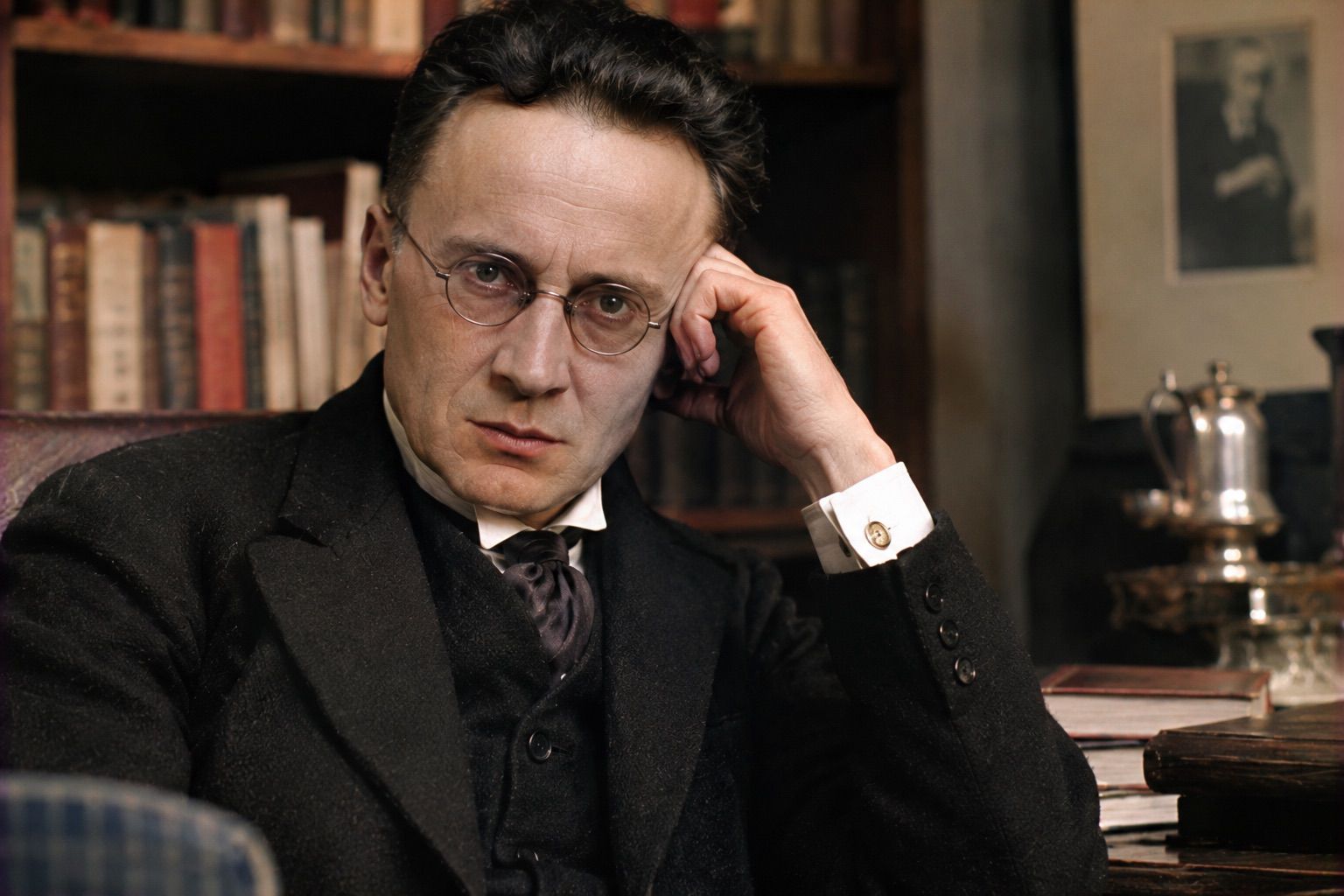
I’ve been thinking a lot about Karl Kraus lately, and I’m not entirely sure why he holds my attention the way he does. Maybe it’s because his writing is like nothing I’ve ever read before – simultaneously beautiful and scathing, elegant and brutal. Or maybe it’s because he was a man of strong convictions who refused to back down from anyone or anything.
I first came across Kraus in an undergraduate course on modernist literature, where we spent weeks dissecting his infamous magazine, Die Fackel (The Torch). The professor described him as a “proud and cantankerous” figure, someone who railed against the superficiality of modern life. I remember being struck by his ferocity – the way he attacked the vacuity of mainstream culture with language that was both poetic and caustic.
What draws me to Kraus is his apparent discomfort with ambiguity. He seems to have been a man who knew exactly what he believed in, even when it put him at odds with nearly everyone else. His critiques of modern society are biting and uncompromising, yet there’s something almost elegiac about the way he mourns the loss of traditional values.
At times, his writing feels like a form of performative outrage – a calculated attempt to shock and provoke rather than genuinely engage with the complexities at hand. But when it works, it’s incredibly powerful. His essay on the role of the writer in society is particularly compelling, if also deeply unsettling. It’s as if he’s daring us to confront our own complicity in the very systems we pretend to critique.
I find myself wondering what kind of person Kraus was outside of his writing – whether he was capable of vulnerability or empathy. Did he ever feel uncertain or hesitant? The portraits I’ve read suggest a man who was intensely focused and driven, someone who saw himself as a visionary rather than a mere observer. It’s both admirable and intimidating.
One aspect that fascinates me is Kraus’s complicated relationship with his contemporaries – figures like Sigmund Freud and Franz Kafka. He seemed to admire their work, yet also felt compelled to critique it from a perspective that was simultaneously avant-garde and reactionary. I can relate to this kind of tension, having grown up surrounded by conflicting expectations about what it means to be a “good” writer.
There’s something alluring about Kraus’s commitment to his own vision, even when it meant alienating himself from others. His writing has an almost hypnotic quality, drawing me in with its rhythmic cadence and biting intelligence. And yet, the more I engage with his ideas, the more I begin to feel uneasy – as if I’m staring into a funhouse mirror that distorts my own perceptions.
What does it mean to be a writer who is unapologetically oneself? Is this kind of authenticity admirable or troubling? Kraus’s example challenges me to confront these questions in my own work, but also makes me nervous about embracing uncertainty and contradiction.
As I delve deeper into Kraus’s writings, I find myself oscillating between admiration and discomfort. His unwavering commitment to his convictions is both inspiring and intimidating. I admire how he refuses to compromise on his artistic vision, even when it means facing opposition from his peers. But at the same time, I worry about the rigidity that comes with such a stance – the way it can lead to an us-vs-them mentality that shuts down meaningful dialogue.
I think about my own writing and how often I’ve struggled with the desire to please others versus staying true to myself. It’s a delicate balance, one that Kraus seems to have navigated with ease, but also at great personal cost. His writing is like a sledgehammer – it shatters pretenses and conventions, but can also leave scars.
One of the things I find most compelling about Kraus is his ability to weave together seemingly disparate threads into a cohesive narrative. He moves effortlessly between philosophy, literature, politics, and culture, creating a rich tapestry that rewards close reading and reflection. But what’s striking to me is how he often critiques the very same aspects of modern society that I’m tempted to romanticize.
For instance, his rants against the rise of mass media and consumerism resonate deeply with my own discomfort about social media and its impact on our collective attention span. Yet, when Kraus rails against the “emptiness” of popular culture, I wonder if he’s not simply reinforcing a kind of elitist snobbery that ignores the complexities of human experience.
It’s as if Kraus is simultaneously critiquing and mirroring the very excesses he deplores – like a funhouse mirror reflecting my own ambivalence towards modernity. This dissonance makes me question whether his writing is ever truly critical, or merely a form of self-validation that masquerades as critique.
I’m torn between feeling grateful for Kraus’s provocative style and recognizing its limitations as a mode of engagement. His work can be like a firehose – it douses us with conviction, but also risks drowning out nuance and subtlety.
As I continue to grapple with Kraus’s ideas, I find myself returning to the concept of “authenticity” that he seems to hold dear. On one hand, his unwavering commitment to his artistic vision is a powerful testament to the importance of staying true to oneself. But on the other hand, it also raises questions about the value of compromise and collaboration in creative work.
I think back to my own experiences as a writer, where I’ve often struggled with the desire to please others versus staying true to my own voice. It’s a delicate balance that requires constant negotiation and self-reflection. Kraus’s writing may be beautiful and scathing, but it also feels intensely personal – like he’s laying bare his own soul for all to see.
But what if I’m not ready to do that? What if I’m still figuring out who I am as a writer, or what kind of message I want to convey through my work? Kraus’s example can feel both inspiring and intimidating – it’s as if he’s daring me to be more bold, more authentic, but also more willing to take risks and face criticism.
I wonder if this is where the concept of “performative outrage” comes in. Is Kraus’s writing sometimes a form of performance art, designed to shock and provoke rather than genuinely engage with complex issues? Or is it something deeper – a genuine attempt to grapple with the contradictions and paradoxes of modern life?
As I continue to read his work, I find myself oscillating between these two interpretations. On one hand, his writing can feel like a masterclass in how to craft a compelling narrative that challenges readers to think critically about the world around them. But on the other hand, it also feels like a form of rhetorical showmanship – a way of using language to create a spectacle rather than genuinely engage with the issues at hand.
I’m not sure which interpretation is more accurate, but I do know that Kraus’s writing has changed me in some fundamental way. It’s forced me to confront my own ambivalence towards modernity, and to question whether I truly value authenticity over compromise and collaboration. As a writer, I want to strive for something more nuanced – a balance between conviction and empathy, between critique and creativity.
But as I look back at Kraus’s work, I realize that this is also a question he himself grappled with throughout his life. His writing is full of contradictions and paradoxes – moments of profound insight alongside eruptions of anger and frustration. It’s as if he’s constantly pushing against the limits of language, trying to capture the complexity of human experience in all its messy, contradictory glory.
In that sense, Kraus may be more than just a provocative writer or a cultural critic – he may be a kind of mirror held up to our own ambivalence and uncertainty. His work challenges me to confront my own contradictions, to grapple with the paradoxes of modern life, and to find a way forward that balances conviction with empathy, critique with creativity.
As I reflect on Kraus’s writing, I’m struck by how his ambivalence towards modernity resonates with my own experiences as a young adult. Like him, I feel pulled in different directions – between the desire to conform to societal expectations and the need to assert my individuality. His writing captures this sense of disorientation, this feeling of being suspended between two worlds that seem irreconcilable.
One of the things that’s fascinating to me is how Kraus uses language to navigate these contradictions. He’s a master of paradox and irony, able to turn seemingly opposing ideas on their head with a single sentence or phrase. It’s as if he’s constantly subverting our expectations, forcing us to rethink our assumptions about the world.
But what I find most compelling is how this subversive impulse is linked to his own sense of identity. Kraus was an Austrian Jewish writer living in Vienna during a time of great social and cultural upheaval. His experiences as a minority must have been deeply formative, shaping his worldview and informing his writing in profound ways.
I wonder if there’s a similar dynamic at play for me – how my own experiences as a young adult from a mixed background (my mom is Latinx, my dad is white) shape my perspective on the world. Am I drawn to Kraus’s writing because it reflects my own sense of dislocation and ambiguity? Or am I simply responding to its intellectual rigor and cultural relevance?
It’s hard for me to say, but what’s clear is that Kraus’s work has given me a new lens through which to view myself – as someone who exists at the intersection of multiple cultures and identities. His writing challenges me to see the world from different perspectives, to question my own assumptions about identity and belonging.
As I continue to engage with his ideas, I find myself thinking more critically about the role of language in shaping our perceptions. Kraus’s use of language is always deliberate and strategic – he knows exactly how to wield words to create a particular effect or provoke a certain response.
This makes me wonder about my own writing style – am I using language in a way that’s authentic and true to myself, or am I falling into the same traps as Kraus – those of performative outrage or rhetorical showmanship? Do I have the courage to be vulnerable and honest in my writing, or do I default to safer, more familiar modes of expression?
Kraus’s work is a constant reminder that language is both powerful and limited – that it can shape our perceptions but also constrain them. As a writer, I want to harness this power for good, using words to illuminate the complexities of human experience rather than simply reinforcing my own biases or assumptions.
But as I look at Kraus’s writing, I realize that this is also a lifelong journey – one that requires constant self-reflection and growth. His work may be beautiful and scathing, but it’s also a reminder that authenticity is never fixed or static – it’s always in flux, subject to the whims of language, culture, and context.
I wonder if this is where the concept of “uncertainty” comes in – as a necessary condition for true creativity and growth. Kraus’s writing may be unwavering in its conviction, but it’s also deeply uncertain about the nature of truth itself. He knows that language can never fully capture reality, only gesture towards it imperfectly.
As I continue to grapple with these ideas, I feel a sense of kinship with Kraus – a recognition that we’re both navigating the same ambiguities and contradictions as writers. His work may be more provocative or incendiary than mine will ever be, but in its own way, it’s also a testament to the power of language to shape our perceptions and challenge our assumptions.
Ultimately, I’m drawn to Kraus because he embodies the contradictions that I see in myself – the desire for authenticity versus the need for compromise; the urge to conform to societal expectations versus the drive to assert my individuality. His writing is like a mirror held up to these contradictions, forcing me to confront them head-on and grapple with their implications.
As I look back at his work, I realize that this is also what I’m trying to do in my own writing – to capture the complexities of human experience in all its messy, contradictory glory. Kraus may be a provocative writer or a cultural critic, but he’s also a kindred spirit – someone who understands the power and limitations of language, and is willing to push against them to create something new and true.