Latest Articles

The Demon King Who Commands Storms, Topples Empires, and Reveals Hidden Truths

Dave

There are demons in grimoires who whisper, demons who tempt, demons who deceive, and then there are those whose presence feels less like a secret and more like a natural disaster. Vine belongs firmly to the latter category. Among the seventy-two spirits cataloged in the Ars Goetia, Vine stands apart not merely because of rank—though he is counted among kings and earls—but because of what he represents. Vine is not subtle corruption or quiet manipulation. Vine is upheaval. Vine is force. Vine is revelation delivered with thunder rather than suggestion.

To understand Vine is to step into the worldview of medieval demonology itself, where spiritual entities were believed to influence the physical world directly. These spirits were not abstract metaphors to those who recorded them; they were intelligences capable of reshaping fate, altering perception, and even influencing war and weather. Vine’s domain reflects this belief perfectly. He is described as commanding storms, discovering hidden things, destroying walls, and revealing enemies—powers that blur the boundary between supernatural insight and catastrophic intervention.

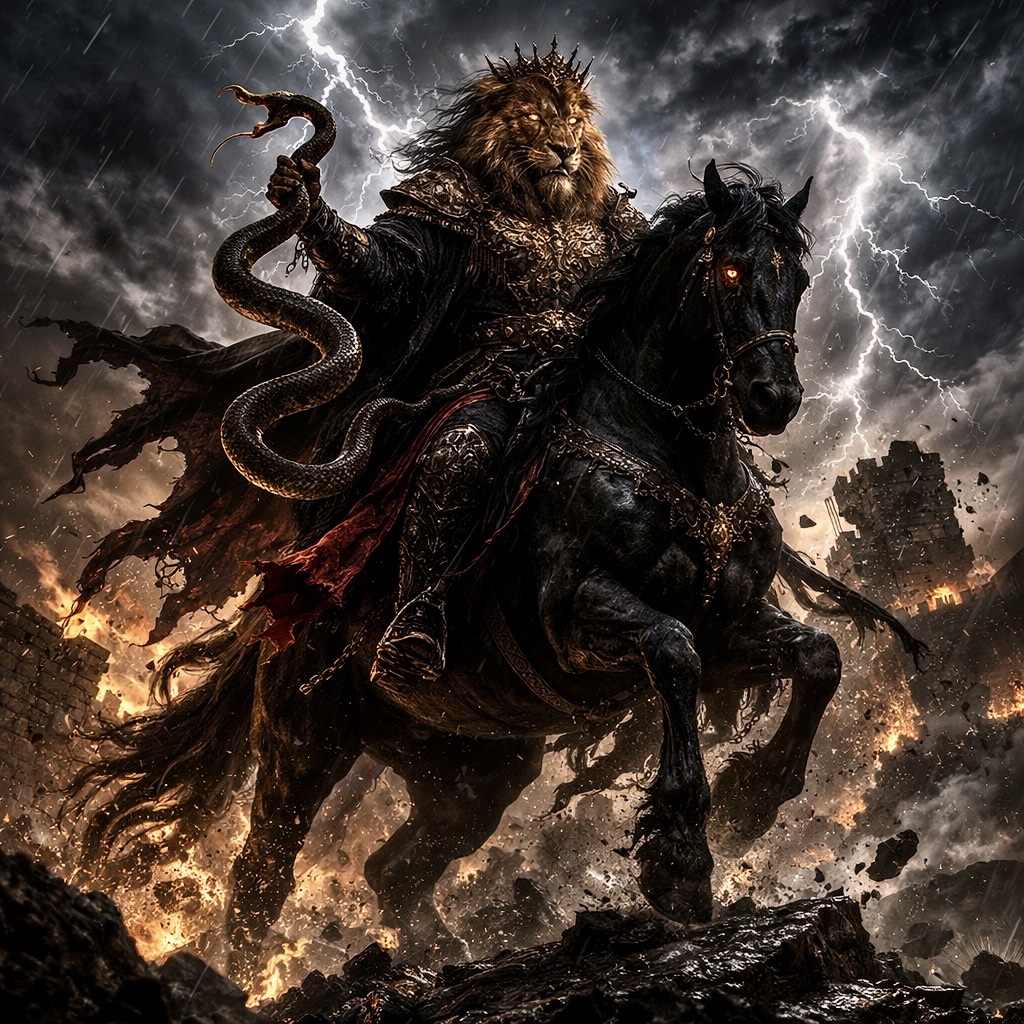
In traditional descriptions drawn from seventeenth-century occult manuscripts, Vine appears as a lion riding upon a black horse while holding a serpent in his hand. The imagery is striking and deliberate. Every element communicates authority and danger. The lion symbolizes dominance and sovereignty, the black horse evokes unstoppable momentum, and the serpent suggests knowledge—particularly knowledge that coils beneath appearances waiting to strike. Vine is not chaos for chaos’s sake. He represents controlled devastation, destruction guided by awareness.

The grimoires classify him as both King and Earl of Hell, commanding thirty-six legions of spirits. Titles in demonology were never ornamental. They reflected hierarchy modeled after earthly monarchies, suggesting that infernal realms mirrored human political structures. Kings commanded strategy. Earls oversaw execution. Vine therefore occupies a fascinating dual role: planner and enforcer, intelligence gatherer and battlefield commander. His abilities reinforce this interpretation. He reveals hidden things, exposes sorcerers, uncovers secrets, and protects or destroys fortifications depending on the will of the summoner.

What makes Vine especially compelling is how closely his mythology aligns with humanity’s ancient fear of unseen threats. Across history, civilizations have worried less about visible enemies than concealed ones—betrayal, espionage, conspiracy, hidden intentions. Vine becomes the supernatural answer to paranoia. Invoke him, the texts promise, and concealed truths will surface. Lies crumble. Enemies reveal themselves. The invisible becomes undeniable.

This association with revelation explains why Vine appears repeatedly in occult traditions concerned with knowledge rather than temptation. Unlike demons linked to pleasure or wealth, Vine’s power revolves around exposure. He forces reality into the open. In many ways, he resembles a cosmic investigator, albeit one whose methods involve storms and shattered defenses.

Storm imagery surrounding Vine deserves particular attention. Medieval thinkers viewed weather not as random but as morally or spiritually influenced. Tempests were interpreted as divine punishment or supernatural warfare. Vine’s ability to command storms therefore symbolized dominion over instability itself. Lightning and thunder represented sudden truth—the moment illusion ends. A storm strips away comfort. It reveals structural weakness. Roofs collapse, defenses fail, and what once seemed permanent proves fragile.

Psychologically, Vine embodies moments in human life when certainty collapses. Entire belief systems can crumble overnight under new information. Relationships dissolve after hidden truths emerge. Nations fall when secrets surface. Vine’s mythology reflects this universal experience: revelation often arrives violently.

The serpent he carries deepens this symbolism. In Western tradition, serpents occupy an ambiguous role—agents of wisdom and danger simultaneously. Knowledge liberates, but it also destroys innocence. Vine’s serpent suggests mastery over forbidden understanding. Those who sought him were rarely looking for pleasant truths. They wanted answers regardless of consequence.

Historical practitioners of ceremonial magic approached spirits like Vine with elaborate ritual protections. Circles were drawn, divine names invoked, and strict procedures followed. These rituals reveal something important about how Vine was perceived. He was not considered easily controlled. Summoners believed that without authority grounded in sacred power, the spirit’s destructive nature could overwhelm the operator. This fear underscores Vine’s character as a force rather than merely an entity.

Interestingly, Vine is also described as capable of building towers as well as destroying them. This duality mirrors the broader demonological principle that infernal powers reflect human intention. The same force that demolishes can construct. Storms devastate landscapes yet renew ecosystems. Fire destroys forests yet enables regrowth. Vine represents transformational energy—the breaking down required before rebuilding becomes possible.

Modern interpretations often frame such figures psychologically rather than literally. From this perspective, Vine becomes an archetype of disruptive awareness. Every person encounters moments when denial becomes impossible. Evidence accumulates. Truth intrudes. Internal defenses collapse much like the walls Vine is said to tear down. The experience can feel catastrophic, yet it frequently precedes growth.

Carl Jung’s exploration of shadow integration resonates strongly here. The shadow contains truths individuals avoid acknowledging about themselves. Encountering it is rarely gentle. It dismantles identity structures constructed around illusion. Vine’s mythology parallels this process almost perfectly: revelation, destruction of false defenses, emergence of hidden reality.

Even outside psychological interpretation, Vine’s legend speaks to humanity’s enduring fascination with power over uncertainty. Weather, war, betrayal, and secrecy remain among the most destabilizing aspects of existence. The promise of commanding such forces—even symbolically—holds immense appeal. Medieval magicians lived in unpredictable worlds shaped by disease, invasion, and political intrigue. A spirit capable of exposing enemies or controlling storms represented security in an insecure age.

Descriptions of Vine’s temperament vary, but many sources emphasize obedience when properly constrained. This reinforces the ritual worldview in which authority determines outcome. Power itself is neutral; intention shapes its manifestation. Vine does not inherently deceive or corrupt. He executes.

That neutrality distinguishes him from more manipulative demons. Vine does not seduce; he reveals. He does not persuade; he acts. The fear surrounding him arises from consequence rather than trickery. Truth uncovered cannot easily be hidden again.

The lion imagery reinforces regal inevitability. Lions do not negotiate dominance—they embody it. A lion riding a horse creates layered symbolism: raw strength directing momentum. The black horse often signifies death, war, or unstoppable advance in European symbolism. Together they portray authority moving forward with irreversible force.

One can imagine why Renaissance occultists found Vine compelling. Europe during this period experienced religious upheaval, scientific discovery, and political revolution. Old certainties shattered rapidly. Figures like Vine symbolized both terror and empowerment amid transformation. Knowledge expanded faster than tradition could contain it. Entire worldviews were under siege.

Interestingly, Vine’s powers include discovering witches and sorcerers. This reflects anxieties of the era when accusations of hidden magical influence were widespread. The idea of a spirit revealing secret practitioners mirrors societal obsession with identifying concealed threats. Demonology often acted as a mirror reflecting collective fears rather than inventing them.

In contemporary culture, Vine’s symbolism remains surprisingly relevant. Modern societies grapple with misinformation, concealed agendas, and unseen systems shaping daily life. Data breaches, hidden algorithms, intelligence operations—all echo ancient fears of invisible influence. Vine becomes an archetype of exposure within an information age defined by secrecy and revelation.

The destructive aspect of his mythology also carries philosophical weight. Structures—whether psychological, social, or political—often resist change until external pressure forces collapse. Vine represents that pressure. He is the storm that arrives when stagnation persists too long.

Some occult traditions suggest that working with Vine required clarity of purpose above all else. Ambiguous intent could produce unintended outcomes. This aligns with broader magical philosophy emphasizing alignment between desire and action. To summon revelation without readiness for truth invites chaos.

The enduring fascination with figures like Vine reveals something deeply human. People simultaneously crave truth and fear it. We seek clarity yet construct elaborate defenses against uncomfortable realities. Vine’s legend dramatizes this tension. He is both liberator and destroyer because truth itself holds both qualities.

Stories surrounding Vine often emphasize dramatic manifestation—violent winds, sudden insight, overwhelming presence. Whether literal or symbolic, these descriptions capture how transformative realization feels. Life rarely changes gradually at moments of profound understanding. Instead, perception shifts abruptly, like thunder breaking silence.

Across centuries, demonology has functioned as a language for grappling with forces beyond control. Vine’s association with storms situates him among humanity’s oldest fears. Before meteorology, storms represented divine or infernal will. Their unpredictability mirrored existence itself. By personifying storms in a being like Vine, people imposed narrative upon chaos.

Yet Vine is not merely destruction incarnate. His ability to build suggests mastery over transition. Creation frequently follows collapse. Old walls must fall before new structures rise. In this sense, Vine embodies necessary endings—the difficult transformations enabling renewal.

Artists and occult scholars continue to reinterpret Vine through modern lenses, depicting him as a sovereign of revelation rather than a monster. This shift reflects changing attitudes toward darkness and knowledge. What earlier ages feared as demonic disruption may now be understood as confrontation with truth.

Even skeptics can appreciate the symbolic richness of Vine’s mythology. Whether viewed as literal spirit, psychological archetype, or cultural artifact, he encapsulates a universal experience: the moment when hidden reality breaks through illusion and demands acknowledgment.

Perhaps that explains why Vine persists in occult imagination while lesser spirits fade into obscurity. He represents something fundamental. Empires collapse when truths emerge. Personal identities transform when denial ends. Storms arrive regardless of preparation.

And when they pass, the landscape—internal or external—is never quite the same.

Vine stands therefore not simply as a demon king of infernal hierarchy, but as a narrative embodiment of revelation itself. He reminds humanity that knowledge carries consequence, that power disrupts stability, and that truth rarely arrives quietly. In mythic form, he asks an unsettling question: if every hidden thing were revealed, what structures in our lives would survive the storm?

The answer, as generations of occultists suspected, may be both terrifying and liberating.

Related Posts

Margaret Mead: The Unsettling Truth About Being True to Myself (Mostly)

Penelope

Margaret Mead. I’ve always been fascinated by her, but not for the reasons you’d expect. It’s not her groundbreaking research on adolescence, though that does get a nod of respect from me. As someone who’s still figuring out this whole “adulting” thing, I appreciate that she didn’t shy away from exploring the complexities of growing up.

What really draws me to Mead is her willingness to challenge the status quo, especially when it came to societal expectations around women. Her work in Samoa, for example, showed that the girls there weren’t as bound by traditional feminine norms as Western society led us to believe. It’s a concept I’ve grappled with personally – the idea that our paths are determined by what others think we should be doing.

I remember reading about Mead’s experiences on the island and feeling a pang of discomfort. Not because she was critiquing the Samoa culture (she was, but in a way that respected their traditions), but because I saw echoes of her struggles in my own life. The pressure to conform to certain expectations, the weight of “shoulds” – it’s exhausting trying to navigate those expectations while still being true to myself.

Mead’s relationship with her mentor, Ruth Benedict, also sparked some curiosity in me. Their professional partnership was unconventional for its time, and I find myself wondering what that meant for their personal dynamics. Were they supportive friends? Did their differing perspectives lead to creative tension or frustration?

What I love about Mead is that she didn’t shy away from her own uncertainties. She admitted when she was wrong, like in her initial assessment of the Arapesh people, which later led to a reevaluation of her research methods. That willingness to revise and improve resonates with me as someone who’s still figuring out my place in the world.

Sometimes I wonder if Mead’s confidence (some might call it arrogance) was a coping mechanism for the scrutiny she faced as a woman in academia. Did she have to be bold, even brash, to be taken seriously? I think about my own life and how often I’ve had to find ways to assert myself in order to be heard.

Mead’s legacy is complex – some see her as a trailblazer, while others view her work as flawed or even problematic. As someone who’s still learning, I’m drawn to the gray areas she inhabited. Her story reminds me that there’s no one-size-fits-all approach to making a difference in the world. Sometimes it means challenging existing power structures, other times it means acknowledging and respecting those same systems.

I don’t think I’ll ever fully understand Mead’s inner workings or the intricacies of her relationships. But what I do know is that she pushed boundaries and asked hard questions – often at great personal cost. As someone who’s still trying to find my own voice, Margaret Mead’s story serves as a reminder that growth often requires discomfort and uncertainty.

As I delve deeper into Mead’s life, I’m struck by the ways in which she navigated the tension between her desire for intellectual freedom and the societal expectations placed upon her as a woman. She was a product of her time, yet she refused to be defined by it. Her experiences with Ruth Benedict, in particular, have me wondering about the intricacies of their professional partnership.

I imagine that Benedict’s more traditional approach to anthropology might have clashed with Mead’s more progressive ideas, but instead of dismissing each other’s perspectives, they seemed to feed off each other’s energy. I find myself admiring their ability to maintain a sense of respect and curiosity in the face of disagreement. It’s a quality I aspire to, especially when working on group projects or collaborating with peers who hold different opinions.

Mead’s willingness to take risks and challenge her own assumptions also resonates with me. As someone who’s struggled with imposter syndrome, it’s reassuring to know that even someone as accomplished as Mead had doubts about her abilities. Her story serves as a reminder that growth often requires embracing uncertainty and taking calculated leaps into the unknown.

One of the things that continues to fascinate me about Mead is the way she balanced her intellectual pursuits with her personal life. She was married twice, but both relationships seemed to be shaped by her career ambitions. I wonder if this tension between love and work was a source of stress for her, or if it allowed her to maintain a sense of independence and focus.

As I continue to learn about Mead’s life, I’m struck by the ways in which she embodied the complexities of being a woman in a male-dominated field. Her struggles with sexism and misogyny are well-documented, but what I find most compelling is her refusal to be defined solely by those experiences. Instead, she used them as fuel for her research and activism, pushing against the boundaries of what was considered acceptable for women at the time.

I don’t think I’ll ever fully grasp the intricacies of Mead’s life or the nuances of her relationships. But what I do know is that she left an indelible mark on anthropology and beyond. Her story serves as a reminder that growth, change, and progress often require us to navigate uncertainty and push against the status quo.

As I delve deeper into Mead’s life, I’m struck by her ability to balance intellectual curiosity with emotional vulnerability. In many of her writings, she shares personal anecdotes and reflections on her own experiences as a woman in academia. It’s as if she’s saying, “I’ve been there too, and this is how it affected me.” That level of self-awareness and willingness to share one’s emotions feels both courageous and relatable.

I think about my own struggles with anxiety and imposter syndrome, and I wonder if Mead ever felt the same way. Did she have moments where she doubted her abilities or felt overwhelmed by the expectations placed upon her? If so, how did she navigate those feelings without letting them define her work?

What’s also fascinating is the way Mead’s relationships with other women in her life influenced her thinking and research. Her friendships with Ruth Benedict and others seem to have been a source of support and inspiration, but also a catalyst for intellectual growth. I find myself drawn to this aspect of her life – the idea that our personal connections can shape our ideas and passions.

I’ve always believed that women’s relationships are just as important as their achievements, yet we often overlook or downplay these aspects in favor of more “important” narratives. Mead’s story offers a refreshing counterpoint to this trend. By highlighting her friendships and partnerships, she shows us that even the most influential thinkers can be deeply human and emotionally complex.

As I continue to explore Mead’s life, I’m struck by the ways in which she embodied the contradictions of being a woman in a patriarchal society. She was both confident and uncertain, bold and vulnerable – all at once. It’s this paradox that makes her story so compelling to me: she’s not just a brilliant anthropologist or a trailblazing feminist; she’s also a multidimensional human being with her own set of struggles and doubts.

Mead’s legacy is complex because it reflects the complexities of her own life. She was a product of her time, but she refused to be defined by its limitations. Her story serves as a reminder that we can’t reduce people or their work to simple labels or categorizations. Instead, we must grapple with the messy realities of human experience and the ways in which our lives intersect and overlap.

I’m not sure where this exploration of Mead’s life will lead me, but I know it’s changing my perspective on what it means to be a woman in academia – or anywhere, for that matter. Her story is a powerful reminder that growth, change, and progress often require us to navigate uncertainty and push against the status quo.

As I reflect on Mead’s life, I’m struck by her willingness to take risks and challenge established norms. It’s not just about being bold or confident; it’s about being willing to be vulnerable and uncertain in order to learn and grow. This resonates deeply with me as someone who’s still figuring out my place in the world.

I think about how Mead’s experiences on Samoa had a profound impact on her thinking, but also on her own personal growth. She wrote about feeling like an outsider among the Samoan people, struggling to understand their culture and customs. Yet, she also found herself drawn to their way of life, admiring their sense of community and cooperation.

I wonder if Mead’s experiences in Samoa helped her develop a greater sense of empathy and understanding for others. Did she learn to see beyond her own biases and assumptions? As someone who’s struggled with my own cultural privilege and biases, I find myself drawn to Mead’s story as a reminder that we all have the capacity to grow and change.

One of the things that continues to fascinate me about Mead is her ability to balance intellectual curiosity with emotional vulnerability. She wasn’t afraid to share her personal thoughts and feelings in her writing, even when they made her seem vulnerable or uncertain. This willingness to be open and honest has a profound impact on how we relate to each other – both personally and professionally.

I think about my own relationships and how I often struggle to balance intellectual curiosity with emotional intimacy. Do I prioritize being right over being understood? Do I value knowledge over connection? Mead’s story serves as a reminder that it’s okay to be vulnerable, to ask questions, and to seek understanding from others.

Mead’s legacy also reminds me of the importance of mentorship and collaboration. Her partnership with Ruth Benedict was built on mutual respect and trust, allowing them to push each other intellectually and creatively. This kind of collaboration is essential in academia and beyond – it allows us to learn from each other, to challenge our assumptions, and to grow as individuals.

As I continue to explore Mead’s life, I’m struck by the ways in which she embodied the complexities of being a woman in a patriarchal society. She was both confident and uncertain, bold and vulnerable – all at once. It’s this paradox that makes her story so compelling to me: she’s not just a brilliant anthropologist or a trailblazing feminist; she’s also a multidimensional human being with her own set of struggles and doubts.

I’m left wondering what Mead’s life would have been like if she had more women around her who shared her values and ambitions. Would she have felt less isolated, less alone in her struggles? Or did her experiences shape her into the person she became – a woman who refused to be defined by societal expectations, but instead forged her own path?

These questions linger in my mind as I reflect on Mead’s life, leaving me with more questions than answers. But that’s what makes her story so compelling – it’s a reminder that growth, change, and progress often require us to navigate uncertainty and push against the status quo.

As I continue to grapple with Margaret Mead’s complexities, I find myself thinking about the role of privilege in shaping her experiences. She was a white, middle-class woman from a wealthy family, which undoubtedly influenced her access to education and opportunities. Did this privilege shape her perspective on the cultures she studied? Did it make it easier for her to navigate the male-dominated world of academia?

These questions are difficult to answer, but they’re essential in understanding Mead’s legacy. Her work often centered around marginalized communities, and yet, she was a product of her own privileged upbringing. It’s a tension that I’m still trying to reconcile – how can we celebrate someone’s contributions while also acknowledging the power dynamics at play?

Mead’s relationship with her husband, Luther Cressman, is another area that interests me. He was a professor and an anthropologist in his own right, but their marriage seems to have been marked by tension and criticism. Mead’s biographers suggest that she often felt stifled by Cressman’s more traditional views on women’s roles, while he struggled with her independence and ambition.

It’s a dynamic that feels eerily familiar to me – the push-and-pull between individual desires and societal expectations. As someone who’s still figuring out their own relationships and career path, I’m drawn to Mead’s struggles as a way of navigating my own uncertainty.

One thing that strikes me is how Mead’s experiences with relationships and mentorship influenced her research. Her work on Samoa, for example, was heavily influenced by her friendships with Samoan women who became close confidantes during her time on the island. These relationships not only informed her understanding of Samoan culture but also challenged her own assumptions about femininity and identity.

This blurring of personal and professional boundaries is something that I find myself drawn to – the idea that our relationships can shape our perspectives, our research, and ultimately, our understanding of the world around us. It’s a delicate balance between intimacy and objectivity, one that Mead navigated with remarkable nuance in her work.

As I reflect on Mead’s life, I’m reminded that growth often requires embracing uncertainty and taking risks. Her willingness to challenge established norms, to question her own assumptions, and to seek out new experiences has a profound impact on how we think about learning, relationships, and personal growth.

It’s a message that resonates deeply with me – the idea that our lives are not fixed or predetermined but rather shaped by the choices we make and the relationships we cultivate. Mead’s story is a powerful reminder of this possibility, one that encourages us to be brave, to take risks, and to push against the status quo in order to create meaningful change.

And yet, as I continue to explore Mead’s life, I’m also reminded of the complexities and contradictions that make her so compelling. She was a woman of great privilege, yet she used her platform to advocate for marginalized communities. She was confident and bold, but also uncertain and vulnerable – all at once.

It’s this paradox that makes her story so fascinating, one that challenges me to think more critically about my own assumptions and biases. Mead’s legacy is not simply a reflection of her accomplishments or her flaws; it’s a reminder that we are complex, multifaceted beings with our own set of struggles and doubts – and that it’s in embracing these complexities that we find true growth and transformation.

Related Posts

Bifrons the Demon: Grave-Walker of the Dead, Master of Astrology, and Keeper of Forbidden Knowledge

Dave

Bifrons is a demon whose power is inseparable from memory, place, and what lingers after life has moved on. In the Ars Goetia, he is named as an Earl of Hell, commanding legions and appearing first as a monstrous figure before assuming a human form. Yet the descriptions of his appearance matter far less than the territories he governs. Bifrons rules over cemeteries, tombs, and the knowledge bound to the dead. He moves bodies from one grave to another, lights phantom candles over burial grounds, and teaches astrology, geometry, and the sciences with an authority that suggests long familiarity with time itself. Bifrons is not a demon of death. He is a demon of what death leaves behind.

To understand Bifrons, one must understand the significance of the grave in human consciousness. Graves are not merely places of disposal. They are markers of memory, respect, fear, and unfinished business. Bifrons inhabits this space with ease. He governs the transition between being remembered and being forgotten. His power does not lie in killing, but in repositioning what has already ended.

One of the most striking aspects of Bifrons is his association with moving the dead. In demonological texts, he is said to shift bodies from one place to another and light candles over graves. This is not mindless desecration. It is recontextualization. To move a body is to change its story, its ownership, its meaning. Bifrons understands that where something rests determines how it is interpreted. Graves are narratives carved into earth.

The candles Bifrons lights are deeply symbolic. Light in darkness has always represented awareness, remembrance, and the refusal of oblivion. These are not comforting lights. They do not guide the living safely home. They illuminate what people prefer not to see. Under Bifrons, the dead are not silent. They are present.

Bifrons is also a teacher of sciences, particularly astrology and geometry. This pairing is deliberate. Geometry defines space. Astrology defines time and influence. Together, they create structure. Bifrons understands that death is not random. It occupies coordinates. It occurs within systems. He teaches how to read those systems without sentimentality.

Unlike demons who manipulate desire or fear, Bifrons manipulates context. He alters how events are situated in memory. He teaches that meaning is not fixed, even after death. This makes him deeply unsettling. People take comfort in the idea that the dead are settled, that their stories are complete. Bifrons denies that comfort.

When Bifrons assumes human form, he is described as knowledgeable, composed, and authoritative. There is no frenzy in his presence. He does not mourn. He does not celebrate. He catalogues. He understands that death is not the end of influence. It is the beginning of a different kind of impact.

As an Earl, Bifrons holds authority over territories rather than doctrines. His domain is physical and symbolic ground. Cemeteries, borders between past and present, places where time layers upon itself. He does not rule people directly. He rules what they remember and how they remember it.

Psychologically, Bifrons represents the human inability to fully let go. He is the demon of unresolved memory, of history that refuses to stay buried. He appears wherever the past intrudes upon the present with unanswered questions, unacknowledged truths, or inconvenient facts.

Bifrons’ knowledge of astrology reinforces this role. The stars, like the dead, are distant yet influential. They are not active participants in daily life, yet their patterns shape interpretation. Bifrons understands long arcs, slow movements, and delayed consequences. He teaches how the past continues to exert pressure long after its origin is forgotten.

The act of moving bodies under Bifrons can also be understood metaphorically. He relocates ideas, narratives, and identities once thought settled. Under Bifrons, nothing stays where it was placed simply because it was placed there. This makes him a demon of revision, not erasure.

Unlike demons associated with cruelty, Bifrons is emotionally neutral. He does not torment the dead. He repositions them. He does not frighten the living directly. He unsettles them by reminding them that closure is often an illusion.

In modern symbolic terms, Bifrons feels like historical revision, forensic archaeology, and the reopening of cold cases. He is present wherever remains are exhumed, records reexamined, and accepted stories challenged. Bifrons does not invent new facts. He changes their placement.

His lighting of candles is especially evocative. Candles burn slowly, deliberately, and visibly. They require attention. Under Bifrons, memory demands energy. If you ignore it, it still burns. If you confront it, it still burns. There is no neutral position.

Bifrons also teaches geometry, suggesting an obsession with boundaries, dimensions, and orientation. Graves are geometric. They are measured, aligned, and ordered. Bifrons understands how order is imposed on chaos, and how easily that order can be rearranged.

There is an implicit warning in Bifrons’ lore. What is buried without understanding will resurface without permission. Moving something does not remove its weight. It merely changes where that weight is felt. Bifrons enforces this truth relentlessly.

In demonology, Bifrons is not described as treacherous or violent. He is described as effective. He does what he governs thoroughly. He does not forget. He does not abandon tasks halfway. This makes him more terrifying than demons of impulse.

Bifrons endures because memory endures. Every society builds monuments, cemeteries, archives, and histories. Over time, these structures crack. Bifrons governs what emerges from those cracks.

To engage with Bifrons symbolically is to accept that the past is not inert. It shifts, reasserts itself, and demands reevaluation. He does not allow history to rest comfortably.

Bifrons is the demon of illuminated graves, of knowledge retrieved from silence, of truths that refuse to remain where they were placed.

Related Posts

Alan Turing’s Face Haunts Me, But Does It Haunt Him Too?

Penelope

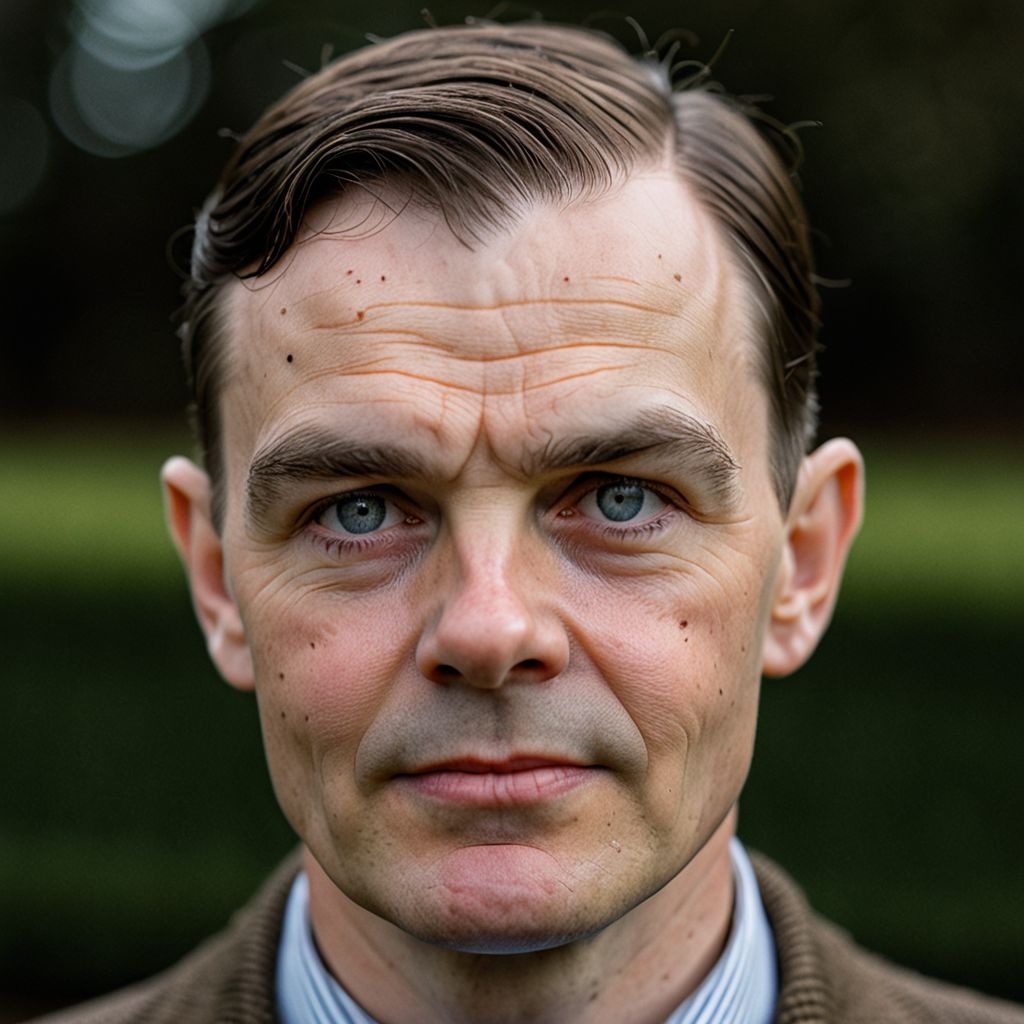
Alan Turing’s face haunts me. I’ve seen it on a worn-out T-shirt my friend wore to class, and again on the Wikipedia page that I must have stumbled upon during a late-night research session for a paper. The first time I saw him was probably in an image of his later years, gaunt and bespectacled, with a faint sense of sadness etched into his features. What is it about this man that draws me to him?

I think back to my computer science courses in college, where Turing’s name kept popping up – the father of artificial intelligence, the codebreaker who cracked the Enigma code during WWII. The stories of his work were fascinating, but they didn’t quite connect with me on a deeper level. It wasn’t until I delved into his personal life that I began to grasp why he resonates with me.

I’ve always been drawn to outsiders and misfits – people who don’t quite fit the mold of what society expects from them. Turing’s struggles with his sexuality, his persecution by the British government for being gay, and eventually, his tragic fate all speak to a sense of isolation that I can only imagine experiencing.

Reading about his relationship with Christopher Morcom, a fellow mathematician who died young, made me feel like I was reading about my own lost relationships. There’s something poignant in seeing someone else grapple with the same feelings of longing and disconnection that I’ve experienced. It makes Turing more than just a historical figure – it makes him human.

I also find myself drawn to his work on artificial intelligence. His 1950 paper “Computing Machinery and Intelligence” proposed the Turing Test, which challenges machines to exhibit intelligent behavior equivalent to, or indistinguishable from, that of a human. It’s this concept that really gets me thinking – what does it mean for humans when we create beings that can mimic our thoughts and actions?

Sometimes I wonder if I’m drawn to Turing because he’s a symbol of the outsider in me. The introverted college student who struggles with anxiety, the one who writes as a way to process her emotions, the person who feels like they don’t quite fit in – it’s this sense of not belonging that connects us.

But what unsettles me is how I can see myself in Turing without fully understanding his experiences. Can I truly empathize with someone who lived through a different era, whose struggles were so deeply tied to the societal norms of his time? Does my connection to him come from some fundamental human similarity, or is it just a superficial identification?

I’m left wondering if I’m trivializing his life by drawing parallels between us. Am I diminishing the magnitude of what he went through simply because I see myself in him? The more I learn about Turing, the more complex and multifaceted he becomes – and the more uncertain I feel about my own place within this narrative.

For now, I’ll continue to explore the intersections between his life and mine. It’s a journey that feels both illuminating and disorienting, like walking through a maze with no clear exit in sight.

As I delve deeper into Turing’s life, I find myself increasingly fascinated by the tension between his intellectual brilliance and his emotional vulnerability. His work on artificial intelligence is a testament to his boundless curiosity and innovative spirit, yet it’s also tempered by his own struggles with identity and acceptance.

I’m struck by how his experiences as an outsider have influenced my own perceptions of what it means to be intelligent or creative. Growing up, I was always told that being smart meant being assertive and confident – qualities that didn’t exactly come naturally to me. But Turing’s story suggests that intelligence can take many forms, from the quiet introspection of a codebreaker to the bold experimentation of an artificial intelligence pioneer.

I’ve also begun to see parallels between Turing’s work on the Enigma code and my own attempts to decipher the complexities of human relationships. Both involve cracking seemingly impenetrable codes – in his case, the Germans’ encrypted messages, and in mine, the subtleties of social interactions that often leave me feeling lost or uncertain.

But what if I’m misinterpreting these parallels? What if I’m projecting my own insecurities onto Turing’s experiences, rather than truly understanding his story? This nagging doubt has been with me since I started writing about him – a fear that I’ll reduce his life to a series of superficial connections, rather than genuinely engaging with the complexities of his legacy.

One thing that keeps drawing me back is his passion for learning and discovery. Turing’s work was characterized by a relentless pursuit of knowledge, even in the face of overwhelming obstacles. He saw the world as a puzzle to be solved, and he dedicated himself to uncovering its secrets – whether through mathematics, computer science, or cryptography.

This drive to understand resonates deeply with me, particularly during my own struggles in college. When anxiety threatened to overwhelm me, it was often the act of writing that helped me regain my footing. The process of putting thoughts into words allowed me to clarify my ideas and make sense of the world around me – just as Turing’s work did for him.

But what I find most captivating about Turing is how he embodied this drive to understand without ever fully resolving his own contradictions. He was both a brilliant mathematician and a deeply human being, with all the flaws and vulnerabilities that come with it. His story suggests that even in the face of adversity, we can choose to hold onto our passions and our curiosity – rather than allowing them to be extinguished by fear or expectation.

This realization has left me feeling both inspired and unsettled. As I continue to explore Turing’s life, I’m forced to confront my own doubts and insecurities head-on. What does it mean for me to see myself in him, when his experiences are so vastly different from mine? Can I truly learn from someone who lived through a bygone era, without diminishing the significance of what he went through?

For now, these questions remain, hovering at the periphery of my thoughts like unspoken words waiting to be written.

As I delve deeper into Turing’s life, I’m struck by the parallels between his experiences and those of other outsiders who have come before him – people like Virginia Woolf, who struggled with mental illness and found solace in her writing; or Frida Kahlo, whose art was a testament to her resilience in the face of physical and emotional pain. These women, like Turing, were all pioneers in their own ways, pushing boundaries and challenging societal norms despite the obstacles they faced.

But what sets Turing apart is his unique blend of intellectual curiosity and emotional vulnerability. He’s both a brilliant mathematician and a deeply human being, with all the complexities and contradictions that come with it. This duality fascinates me – it makes him feel more relatable, more accessible, than other historical figures I’ve studied.

I’m also drawn to his writing style, which is often described as clear and concise yet still somehow lyrical. His words have a way of cutting through the noise, getting straight to the heart of the matter. It’s something that I aspire to in my own writing – the ability to convey complex ideas with simplicity and elegance.

As I continue to explore Turing’s life, I’m beginning to see him as more than just a historical figure or a symbol of outsider-ness. He’s a person who lived through incredible highs and lows, someone who struggled to find his place in the world despite his many talents and achievements. And it’s this sense of fragility that makes me feel less alone – like I’m not the only one who’s ever felt lost or uncertain.

I wonder if Turing’s struggles with identity and acceptance are something that I can learn from, something that might help me navigate my own relationships and sense of self. His experiences were shaped by a different time and place, but his emotions and doubts remain relatable – they’re a reminder that we’re all searching for connection, for understanding, in our own ways.

As I write this, I’m aware that I’m still grappling with the complexities of Turing’s legacy. I’m not sure if I’ve fully understood his story or if I’ve simply superimposed my own experiences onto his. But what I do know is that exploring his life has been a journey of self-discovery for me – one that’s forced me to confront my own doubts and insecurities in new ways.

In the end, it’s not about reducing Turing’s life to simple parallels or superficial connections. It’s about embracing the complexities of human experience, the messy and beautiful contradictions that make us who we are. And if I’m lucky, maybe I’ll find a way to honor his legacy by doing the same – by writing my own story with honesty and vulnerability, just as he did.

As I continue to explore Turing’s life, I’m struck by the ways in which his work on artificial intelligence continues to resonate with me. It’s not just the ideas themselves that fascinate me, but also the process of thinking through them – the way he grappled with the implications of creating machines that could think and learn like humans.

I find myself wondering what it would be like to have a conversation with Turing about his work on the Turing Test. Would I be able to keep up with his rapid-fire thoughts, or would I get lost in the complexity of his ideas? Would he see me as a worthy interlocutor, or would I feel intimidated by my own limitations?

I also think about how Turing’s work on artificial intelligence has influenced the world we live in today. We take for granted the fact that we can interact with machines that can understand and respond to our language, but it’s easy to forget the pioneering work that made this possible.

As I delve deeper into Turing’s life, I’m starting to see parallels between his experiences as a queer man living in a society that didn’t accept him and my own feelings of not quite belonging. It’s strange to think about how both of us have been outsiders in our own ways – he for being gay, me for being introverted and anxious.

But what if this sense of disconnection is what makes Turing’s story so compelling? What if it’s his willingness to be vulnerable, to expose himself to the world despite its potential rejection, that has made him such an enduring figure?

I think about how I’ve always struggled with feeling like I don’t fit in – whether it’s in a social situation or in my own relationships. And I wonder if Turing’s story is somehow trying to tell me something about this sense of disconnection – that it’s not something to be ashamed of, but rather something to be explored and understood.

As I write this, I’m aware that I’m still grappling with the complexities of Turing’s legacy. I’m not sure if I’ve fully understood his story or if I’ve simply superimposed my own experiences onto his. But what I do know is that exploring his life has been a journey of self-discovery for me – one that’s forced me to confront my own doubts and insecurities in new ways.

And it’s this sense of uncertainty that feels most true to Turing’s spirit, I think. He was a man who lived with contradictions, who struggled with his own identity and acceptance, but who still managed to make groundbreaking contributions to the world. His story is a reminder that we’re all complex and multifaceted beings, full of contradictions and paradoxes.

As I continue to explore Turing’s life, I’m left wondering what it means to be human – not just in terms of our capacity for intelligence or creativity, but also in terms of our vulnerabilities and fragilities. And I think that’s what makes Turing’s story so compelling – it’s a reminder that we’re all searching for connection, for understanding, in our own ways.

Related Posts

Uvall (Vual): The Diplomatic Demon Who Bends Loyalties, Forges Alliances, and Makes Enemies Speak as Friends

Dave

Uvall, also known as Vual, is not a demon of violence, spectacle, or terror. He is far more dangerous than that. He is a demon of agreement. In the Ars Goetia, Uvall is named as a Great Duke of Hell, commanding legions and appearing first as a mighty dromedary before assuming human form. This is not an intimidating image in the conventional sense, and that is precisely the point. Uvall does not conquer through fear. He conquers through conversation.

The camel form attributed to Uvall is deeply symbolic. Camels are creatures of endurance, trade, and long-distance survival. They move slowly but relentlessly, carrying valuable goods across hostile terrain. Uvall embodies this same principle in social and political space. He governs negotiation, persuasion, and the slow reshaping of relationships over time. His power is not immediate, but it is persistent.

Uvall is best known for his ability to procure the love and friendship of both allies and enemies. This ability is often misunderstood as charm or manipulation, but it is something subtler. Uvall does not overwrite free will. He redirects it. He understands what people want to hear, what they fear losing, and what they hope to gain. He speaks to incentives rather than emotions.

In demonology, Uvall is said to reveal the thoughts of enemies and bring about reconciliation, even between opposing sides. This makes him one of the most politically potent demons in the Goetia. He does not need to destroy an enemy if he can neutralize them through understanding or alliance. Under Uvall, conflict becomes conversation, and conversation becomes leverage.

When Uvall takes human form, he is described as persuasive, articulate, and socially adept. There is nothing monstrous about him. That normality is part of his threat. Uvall does not stand out in a room. He blends in, listens carefully, and speaks at exactly the right moment. His influence often goes unnoticed until outcomes are already decided.

Psychologically, Uvall represents the power of social intelligence. He is the demon of reading the room, of sensing shifts in tone, of understanding when to press and when to yield. He does not dominate discussions. He guides them. This makes him especially effective in environments where open force would fail.

Uvall’s domain over friendship is not sentimental. Friendship under Uvall is strategic. It is alliance. It is mutual benefit disguised as goodwill. This does not mean it is false. It means it is conditional. Uvall understands that most human relationships are transactional at some level, whether acknowledged or not.

One of Uvall’s most unsettling attributes is his ability to make enemies friendly without erasing their memory of conflict. He does not rewrite history. He reframes it. Under Uvall, former enemies do not forget why they opposed each other. They simply decide that cooperation is now more advantageous than hostility.

In occult warnings, Uvall is not described as treacherous, but he is described as influential. This distinction matters. He does not betray agreements lightly. He constructs them carefully. Once bonds are formed under Uvall, breaking them carries consequences, not because of punishment, but because of exposure. Uvall knows what everyone promised.

The dromedary symbolism also reinforces patience. Uvall is not the demon of quick deals or impulsive alliances. He understands that trust takes time to build and moments to destroy. His influence grows slowly, often invisibly, until it becomes structural.

In modern symbolic terms, Uvall feels strikingly contemporary. He resembles diplomats, negotiators, lobbyists, and power brokers who shape outcomes without appearing on the battlefield. He is the demon of soft power, of influence exercised through relationships rather than force.

Uvall’s rank as a Duke suggests authority over regions rather than empires. He governs zones of interaction: borders, trade routes, alliances, and negotiations. He does not rule absolutely. He coordinates.

Unlike demons associated with deception, Uvall does not rely on lies. He relies on selective truth. He knows which facts to emphasize and which to leave unsaid. This is not dishonesty in the crude sense. It is framing. And framing is often more powerful than falsehood.

Uvall also understands reputation. He knows how individuals are perceived and how those perceptions can be adjusted subtly. A rumor softened here, a compliment placed there, a concession remembered at the right moment. Under Uvall, social capital becomes currency.

There is a quiet danger in Uvall’s gifts. When conflicts are smoothed over too efficiently, underlying issues can remain unresolved. Uvall does not guarantee harmony. He guarantees cooperation. These are not the same thing.

Psychologically, Uvall represents the human desire to avoid open conflict, even when conflict might be necessary. He is the voice that says, “Let’s find common ground,” sometimes wisely, sometimes at the cost of truth. Uvall does not judge which outcome occurs.

Uvall endures in demonology because societies depend on agreement to function. Laws, alliances, and institutions all rest on negotiated consent. Uvall personifies the force that keeps those negotiations moving.

To engage with Uvall symbolically is to accept that power often flows through relationships rather than weapons. He teaches that influence does not need to be loud to be effective.

Uvall is not the demon of peace. He is the demon of accord. And accord, once achieved, can reshape the world without ever drawing blood.

Related Posts