Latest Articles

Decarabia: The Star-Shaped Marquis Who Reveals Secrets Through Stones and Wings

Dave

Decarabia is one of those infernal figures whose reputation is built less on fear and more on curiosity. In the old demonological texts, he is not described as a roaring tyrant or a punisher of souls, but as a keeper of hidden knowledge, a quiet revealer of truths that already exist but remain unseen. His power does not come from destruction or temptation, but from interpretation. Decarabia governs the secret language of stones, herbs, birds, and gems, translating the natural world into meaning for those who know how to ask. In this way, he occupies a strange and fascinating space within the Ars Goetia, somewhere between demon, scholar, and natural philosopher.

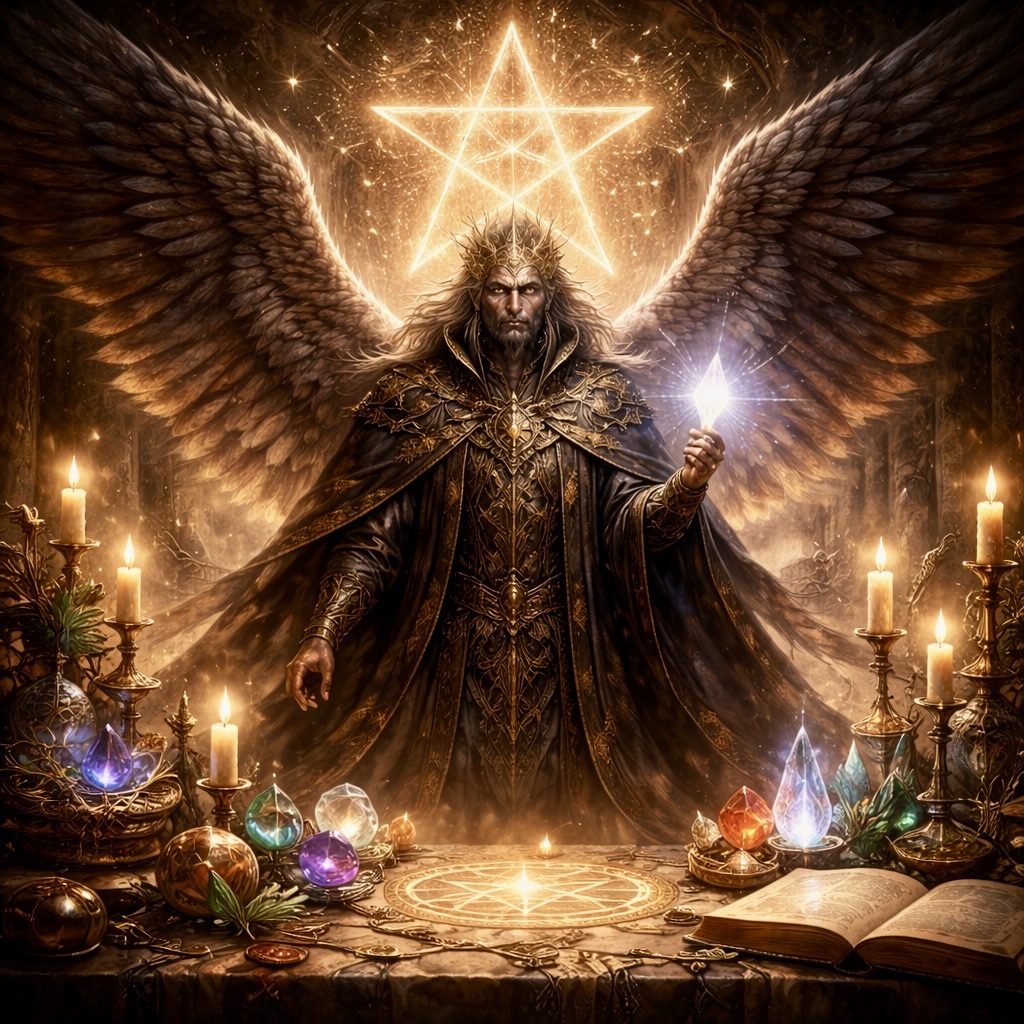
According to the grimoires, Decarabia appears initially in the form of a pentagram, a five-pointed star suspended in the air. Only after being commanded does he take on a more recognizable shape, often described as a man with wings or a birdlike form. This transformation is deeply symbolic. The pentagram has long represented hidden order, balance, and the structure underlying apparent chaos. To encounter Decarabia first as a symbol rather than a body suggests that his essence is abstract before it is physical. He is knowledge before he is form.

Decarabia’s rank is that of a Marquis of Hell, a title that implies authority without absolute dominion. A marquis governs borderlands, territories at the edge of kingdoms. This fits Decarabia perfectly. His domain lies at the border between the human and the natural, the spoken and the unspoken, the observed and the interpreted. He does not create secrets; he reveals them. He teaches the virtues of stones and herbs, the qualities hidden within gems, and the meanings carried by the flight and calls of birds.

In medieval and early modern Europe, this kind of knowledge was not trivial. Stones and herbs were believed to carry inherent properties that could heal, harm, protect, or curse. Birds were omens, their movements read as messages from beyond human understanding. To know the true nature of these things was to possess power, not the loud power of conquest, but the quiet power of insight. Decarabia embodies this belief, serving as a supernatural librarian of the natural world.

What makes Decarabia particularly intriguing is his relationship with truth. Unlike demons associated with deception, Decarabia is described as truthful when properly constrained. He reveals what is already there. This does not make him safe, however. Knowledge without context can be dangerous, and understanding without wisdom can lead to ruin. Decarabia does not decide how his revelations will be used. He provides information, and the consequences belong to the one who asked.

The pentagram form attributed to Decarabia has been the subject of much interpretation. In many traditions, the five-pointed star represents the elements: earth, air, fire, water, and spirit. Decarabia’s connection to stones, herbs, and birds aligns neatly with this symbolism. He is a unifier of elements, a reminder that the natural world speaks a coherent language if one knows how to listen. His star-shaped appearance reinforces the idea that knowledge itself has structure, even when it seems mysterious.

Birds play a central role in Decarabia’s mythology. He is said to understand their songs and the meanings behind their movements. This places him in a long tradition of augury, the ancient practice of divination through observing birds. To ancient and medieval observers, birds were messengers between worlds, creatures that moved freely between earth and sky. Decarabia’s command over their language suggests mastery over liminal spaces, those places where boundaries blur and insight emerges.

Stones and gems, too, are central to Decarabia’s influence. In an era when gemstones were believed to hold specific virtues, knowing their true nature was invaluable. A stone could protect a traveler, enhance memory, or ward off illness. Decarabia’s teachings would have appealed to alchemists, healers, and scholars seeking to unlock the hidden properties of matter. Even today, the symbolic power of stones persists, suggesting that Decarabia’s appeal is not limited to superstition, but rooted in a deeper human impulse to find meaning in the material world.

Decarabia’s wings are another important symbol. Wings represent freedom, perspective, and transcendence. A winged Decarabia suggests an elevated viewpoint, the ability to see patterns invisible from the ground. This aligns with his role as a revealer of hidden connections. He does not change the world; he changes how it is seen. In doing so, he challenges the assumption that knowledge must come from human reasoning alone. Sometimes, understanding comes from observing what has always been present.

Unlike many demons, Decarabia is not described as hostile or malicious. His danger lies in indifference. He offers truths without concern for how they will be received or applied. This makes him a compelling metaphor for knowledge itself. Information is neutral. It can heal or harm, enlighten or overwhelm. Decarabia embodies this neutrality, standing as a reminder that insight carries responsibility.

In modern interpretations, Decarabia often appears as a figure of esoteric wisdom, a guide through hidden systems rather than a villain to be defeated. He resonates with those drawn to symbolism, natural magic, and the idea that the world is layered with meaning. In this sense, he feels almost contemporary, a patron of pattern-seekers and systems-thinkers in an age obsessed with data and interpretation.

The image of Decarabia as a star transforming into a winged being also speaks to the human experience of understanding. Knowledge often begins as an abstract concept, a symbol or theory, before becoming something lived and embodied. Decarabia’s manifestation mirrors this process. He is an idea that takes shape, a pattern that becomes a presence.

Decarabia’s continued relevance lies in his subtlety. He does not dominate narratives through spectacle. He lingers at the edges, waiting for those who are willing to look closely. His power is patient, observational, and deeply tied to the world as it is, not as we wish it to be. In a culture that often values loud certainty over quiet insight, Decarabia stands as a reminder that some truths are revealed only to those who slow down enough to notice.

Ultimately, Decarabia represents the hidden coherence of the natural world. He is the whisper behind patterns, the logic beneath symbolism, and the reminder that meaning is often already present, waiting to be recognized. Whether approached as a demon of occult lore or as a metaphor for interpretive knowledge, Decarabia endures because he reflects a timeless human desire: to understand the world not just as a collection of objects, but as a network of signs.

To engage with Decarabia is to accept that knowledge is not always comforting. It can unsettle, complicate, and challenge assumptions. But it can also deepen appreciation for the intricate systems that surround us. In this way, Decarabia is less a figure of fear and more a figure of revelation, a star that points not outward, but inward, toward a more attentive way of seeing.

Related Posts

Galileo Galilei: When the Truth Hurts (and Everyone Else Too)

Penelope

I’ve always been drawn to people who challenge the status quo, and Galileo Galilei is one of those figures who has captivated me for a while now. What strikes me about him is his unwavering commitment to observing reality, even when it went against the dominant views of his time.

As I reflect on my own experiences as a young adult, I think about how often we’re encouraged to conform and fit in. In college, I felt pressure to choose a “practical” major or career path, even if it didn’t align with my passions. But Galileo’s story shows that there are consequences for not following the crowd – he faced opposition from the Church and was even put under house arrest.

I have to admit, I’m fascinated by the tension between scientific inquiry and authority. When Galileo discovered new evidence that contradicted Aristotelian views, he didn’t shy away from sharing his findings. He published his observations of the moon’s phases and the imperfections on the sun’s surface, which shook the foundations of geocentrism.

But what I find particularly intriguing is how Galileo navigated the complex web of power and influence in 17th-century Italy. As a member of the Tuscan nobility, he had connections that might have insulated him from criticism. Yet, he chose to speak truth to those in power, risking his reputation and even his freedom.

I wonder if I would have had the courage to do something similar. Would I have stood up for what I believed in, even if it meant going against the prevailing wisdom? Or would I have taken a more cautious approach, trying to avoid conflict and criticism?

Galileo’s case also makes me think about the role of observation and experimentation in shaping our understanding of the world. He used his telescope to observe the night sky, revealing new worlds and challenging existing theories. This resonates with my own experiences as a writer – when I’m stuck on a piece, I often find that taking a step back and observing my thoughts helps me gain clarity.

One thing that still puzzles me is how Galileo’s views evolved over time. Initially, he subscribed to the geocentric model, but later, after his observations with the telescope, he became a vocal proponent of the heliocentric view. This shift makes me question whether we can ever truly change our minds or if we’re stuck in our initial perspectives.

I’m not sure what it says about me that I’m drawn to someone like Galileo – perhaps it’s because his journey is a reminder that growth and self-doubt are integral parts of the learning process. Maybe I see myself in him, struggling to reconcile my own desires with the expectations of others. Whatever the reason, I find myself returning to his story again and again, searching for insights into how we navigate uncertainty and challenge the status quo.

As I delve deeper into Galileo’s life, I’m struck by the nuances of his character. He was a complex figure, driven by a mix of intellectual curiosity and personal ambition. His willingness to take risks and challenge authority is admirable, but it’s also clear that he wasn’t immune to the pressures of his time.

I’ve been thinking about how Galileo’s relationships with others influenced his work. His patronage from the Medici family provided him with financial support and access to resources, but it also meant that he was beholden to their interests. I wonder if this tension between independence and dependence is something that many of us struggle with – do we prioritize our own autonomy or seek out connections that can help us achieve our goals?

Galileo’s relationships with other scientists and thinkers are equally fascinating. His debates with Kepler and his later disagreements with Descartes reveal a mind that was constantly engaged in dialogue and debate. I’m drawn to the idea of this intellectual community, where people were pushing each other to think more deeply and critically about the world.

But what really gets me is Galileo’s writing style – or rather, how he used language to communicate complex ideas to his audience. As a writer myself, I’ve always been interested in the ways that language can be both precise and evocative. Galileo’s use of metaphor and analogy to describe astronomical phenomena is still breathtaking today.

I’m starting to see parallels between Galileo’s approach to science and my own experiences with writing. Both require a willingness to take risks and challenge assumptions – whether it’s questioning established theories or experimenting with new forms of expression. And just as Galileo’s observations were rooted in careful observation, so too do I find that the best writing comes from paying attention to the world around me.

I’m not sure if this is true for everyone, but for me, there’s a connection between observing reality and creating art. Maybe it’s because both require a sense of wonder and awe – Galileo’s observations of the moon and stars were likely met with a mix of amazement and trepidation, just as I feel when I’m trying to capture a particular moment or feeling on paper.

As I continue to explore Galileo’s life, I’m struck by the ways in which he embodied both the scientist and the artist. His work was driven by a desire to understand the world around him, but it was also infused with a sense of beauty and wonder. And that’s what I think draws me to his story – not just the intellectual curiosity or the historical significance, but the way he lived his life as a continuous process of exploration and discovery.

I’ve been thinking about how Galileo’s approach to science was so deeply intertwined with his artistic side. He saw beauty in the patterns and structures of the universe, just as I see it in the cadence and rhythm of language. For him, the study of astronomy wasn’t just about collecting data or proving theories; it was about experiencing the sublime and the mysterious.

I’ve always been fascinated by the concept of the “sublime” – that feeling of awe and wonder that comes from encountering something greater than ourselves. For me, it’s often found in the written word: a perfectly crafted sentence, a powerful metaphor, or a phrase that captures the essence of an emotion. Galileo experienced his own version of this when he gazed up at the night sky, his telescope revealing secrets that had been hidden for centuries.

What strikes me is how similar our experiences are, despite living in different eras and pursuing different passions. Just as I find myself lost in the world of words, Galileo became lost in the universe’s grand tapestry. And just as I seek to capture the essence of human experience through my writing, he sought to understand the workings of the cosmos.

This realization has led me to wonder if our creative pursuits are simply different expressions of a universal desire to explore and comprehend. Are we not all seekers, each in our own way, trying to grasp the intricate web of meaning that underlies our existence? Galileo’s journey teaches me that science and art are not mutually exclusive; they’re two sides of the same coin, both striving to illuminate the world around us.

As I continue to reflect on Galileo’s life, I’m struck by the idea that our obsessions often reveal more about ourselves than we might initially think. For him, it was the pursuit of knowledge and understanding; for me, it’s the quest to craft words into something meaningful. Both are forms of obsession, I suppose – a fixation on something greater than ourselves that drives us to explore, experiment, and push beyond our limits.

And what does this say about our relationship with uncertainty? For Galileo, it was a constant companion, one that forced him to adapt and evolve his theories in response to new observations. Similarly, as a writer, I find myself navigating the unknown territories of language and human experience, often unsure of where my words will lead or what meaning they’ll convey.

Perhaps this is why I’m drawn to Galileo’s story – it reminds me that uncertainty is not something to be feared or avoided; it’s an essential part of the creative process. By embracing the unknown, we open ourselves up to new possibilities and insights, just as Galileo did when he dared to challenge the prevailing views of his time.

I’m not sure where this line of thinking will lead me next – perhaps into a deeper exploration of the role of uncertainty in science and art? Or maybe it’ll take me down a different path altogether. But for now, I’m content to let Galileo’s story guide me on my own journey of discovery, one that’s still unfolding as I write these words.

As I continue to ponder the parallels between Galileo’s scientific pursuits and my own writing endeavors, I find myself thinking about the power of language in shaping our understanding of the world. For Galileo, his observations and experiments were not just about gathering data, but about crafting a narrative that would challenge the dominant views of his time. Similarly, as a writer, I strive to use language in a way that not only conveys information but also evokes emotions and sparks imagination.

I’m struck by how Galileo’s writing style was characterized by its clarity, precision, and elegance. He had a unique ability to distill complex ideas into accessible language, making his work appealing to a broad audience. This is something I aspire to in my own writing – the ability to convey abstract concepts in a way that resonates with readers on an intuitive level.

One of the things that fascinates me about Galileo’s use of language is how he employed metaphor and analogy to describe complex scientific concepts. For example, his description of the moon’s phases as “a silvery crescent” or the sun’s imperfections as “spots” that reveal its true nature. These metaphors not only make the science more relatable but also highlight the beauty and wonder inherent in the natural world.

This got me thinking about how I can apply this approach to my own writing. How can I use metaphor and analogy to convey complex ideas in a way that’s both engaging and accessible? For instance, when describing the nuances of human emotion or the intricacies of social dynamics, can I find creative ways to describe these concepts that make them more relatable and tangible?

Galileo’s emphasis on observation and experimentation as key components of scientific inquiry has also made me think about the role of sensory experience in writing. As a writer, I often rely on my senses – sight, sound, touch, taste, and smell – to evoke emotions and create vivid imagery in my readers’ minds. But how can I take this even further by incorporating more experiential elements into my writing? Can I use descriptive language that not only paints a picture but also invites the reader to engage with the world around them?

As I continue to explore these ideas, I’m reminded of the importance of playfulness and curiosity in both scientific inquiry and creative expression. Galileo’s willingness to challenge conventional wisdom and push the boundaries of what was thought possible is an inspiration to me as a writer – it reminds me that there’s always room for innovation and experimentation, even when exploring familiar themes or ideas.

And so, I find myself drawn into this world of observation, experimentation, and creative expression, where science and art blur together in unexpected ways. It’s a space where the boundaries between disciplines dissolve, and new possibilities emerge from the intersections and overlaps between seemingly disparate fields.

As I close my eyes and imagine Galileo gazing up at the night sky through his telescope, I feel a sense of kinship with this 17th-century astronomer. We’re both seekers, driven by a desire to explore, understand, and create in our own ways – one using the language of science, the other using the tools of writing and imagination. And in that shared pursuit, we find common ground and inspiration for our individual journeys, each of us pushing beyond the limits of what’s possible and illuminating the world around us in our unique ways.

Related Posts

Seere: The Swift Prince of Hell Who Bends Distance, Destiny, and Desire

Dave

Seere is not the kind of demon that announces himself with thunder or terror. His power is quieter, faster, and far more unsettling once you sit with it. In the old grimoires, Seere is described as a Prince of Hell who rides upon a winged horse and moves with impossible speed, carrying messages, altering circumstances, and shaping outcomes before anyone realizes change has occurred. Where other infernal figures rule through fear or temptation, Seere rules through momentum. He is the demon of things already in motion, the force that ensures events arrive exactly where and when they are meant to, whether that arrival is welcomed or dreaded.

The Ars Goetia paints Seere as a paradoxical figure. He is a demon, yet he is often described as good-natured, courteous, and even helpful. This contradiction is not accidental. Seere represents a deeply human tension: the desire for outcomes without consequences, speed without cost, and certainty without struggle. He is invoked for quick results, for bringing distant people or objects closer, for resolving situations before they spiral out of control. In a sense, Seere is the embodiment of impatience given supernatural form.

Descriptions of Seere emphasize motion. He appears riding a winged horse, a symbol that combines freedom, speed, and authority. The horse itself is significant. In myth and symbolism, horses often represent power, travel, and the boundary between worlds. A winged horse suggests transcendence of limits, the ability to cross not just physical distance but emotional and psychological barriers as well. Seere does not walk into your life. He arrives suddenly, already halfway through changing it.

One of Seere’s defining traits is honesty. Unlike many demons who are known for deception or trickery, Seere is said to speak truthfully. This detail has fascinated occult scholars for centuries. Why would a demon be honest? The answer may lie in the nature of his power. Seere does not need lies. His influence comes from acceleration, not distortion. He takes what already exists and pushes it forward, sometimes faster than the human mind can process. Truth, delivered at speed, can be just as disruptive as falsehood.

Seere’s ability to bring things swiftly is not limited to physical objects. He can transport emotions, intentions, and decisions. In matters of love, he is often invoked to reunite estranged partners or hasten romantic outcomes. In matters of conflict, he can bring resolution just as quickly, though resolution does not always mean harmony. Sometimes it means confrontation. Seere does not judge the nature of the destination; he simply ensures arrival.

This neutrality is what makes Seere so compelling and so dangerous. He does not distinguish between good outcomes and bad ones. He responds to intention and momentum. If you ask him to bring something to you quickly, he will—but you may not like the form it takes. In this way, Seere mirrors the real-world consequences of impulsive decisions. The faster you move, the less time you have to reflect, and the more likely you are to collide with something unexpected.

In the hierarchy of Hell, Seere’s rank as a Prince suggests autonomy and authority. Princes are not mere servants; they are rulers of domains. Seere’s domain is transit, transition, and inevitability. He governs the spaces between states of being: here and there, now and then, before and after. This liminal quality places him in a unique position among infernal figures. He is less concerned with possession or corruption and more concerned with completion.

Historically, Seere emerges from a tradition of demonology that sought to categorize and control the unknown. Medieval magicians and scholars did not invent these figures casually. Each demon represented a specific anxiety, a specific human fear or desire. Seere’s presence reflects an obsession with speed and certainty. In a world where travel was slow and communication unreliable, the idea of a spirit who could collapse distance would have been intoxicating.

Yet even in the modern world, Seere remains relevant. Today, we live in an age of instant messaging, same-day delivery, and real-time updates. Distance has been compressed, and patience has become a rare commodity. Seere feels less like a relic of superstition and more like a mythic expression of contemporary life. He is the demon of urgency, the whisper that says, “Why wait?”

Occult texts warn that Seere should be approached with clarity of purpose. Vague requests yield unpredictable results. This caution reflects a deeper truth about speed itself. When things move quickly, small errors are magnified. A misworded desire can become a regretted outcome. Seere does not refine your wish; he executes it. In this sense, he is brutally fair.

The image of Seere riding a winged horse also carries an emotional resonance. It suggests escape, rescue, and sudden change. To someone trapped in a painful situation, Seere might appear as salvation. To someone avoiding responsibility, he might appear as an enabler. This duality makes him one of the most psychologically interesting figures in demonology. He does not create desire; he responds to it.

Seere is also said to bring things from far away, both physically and metaphorically. This ability can be interpreted as the resurfacing of buried memories, unresolved relationships, or long-delayed consequences. What is distant is not always forgotten. Seere reminds us that distance is often an illusion, and that unresolved matters have a way of returning when summoned.

Unlike many demons, Seere is not associated with cruelty or torment. His danger lies in indifference. He does not care whether the outcome benefits you or harms you. He cares only that the path is clear and the destination defined. This makes him a powerful symbol of modern systems and technologies that operate without moral judgment. Algorithms, logistics networks, and automated processes function much like Seere: efficient, relentless, and unconcerned with human nuance.

In popular culture, characters inspired by Seere often appear as messengers, fixers, or catalysts. They arrive unexpectedly, solve problems quickly, and disappear just as fast, leaving behind consequences that others must live with. These portrayals capture the essence of Seere’s myth without naming him directly. He is the unseen hand that accelerates fate.

From a symbolic standpoint, Seere can be read as a warning against haste. His honesty does not protect you from regret. His speed does not guarantee satisfaction. He offers results, not wisdom. In a world that increasingly values efficiency over reflection, Seere’s legend feels almost prophetic. He asks a simple question: if you could have what you want immediately, would you still want it?

Seere’s enduring appeal lies in this question. He tempts not with forbidden pleasures, but with convenience. He promises not power, but immediacy. And in doing so, he exposes a vulnerability that has only grown stronger over time. We are not just afraid of demons who deceive us. We are afraid of demons who give us exactly what we ask for.

To understand Seere is to understand the cost of speed. He is the embodiment of the shortcut, the fast track, the skipped step. Sometimes shortcuts save lives. Sometimes they cut corners that should never have been cut. Seere does not discriminate. He rides, and things happen.

In the end, Seere is less about Hell and more about human nature. He reflects our impatience, our longing for instant resolution, and our belief that problems can be outrun. His winged horse is not just a mode of transport; it is a mirror. It shows us how quickly we are willing to move when desire outweighs caution.

Seere does not force himself into stories. He appears when summoned, when urgency eclipses reflection. And once he arrives, there is no pause button. Things move. Distances close. Outcomes arrive. Whether that is a blessing or a curse depends entirely on the one who called him.

Related Posts

Toni Morrison: Where the Unraveling Begins

Penelope

Toni Morrison’s words are a slow burn, not a sudden flame. I remember the first time I read Beloved, how it took me weeks to get through, my mind piecing together fragments of Sethe’s story like a puzzle that refused to fit neatly into place. The language was rich, dense, and unapologetic, much like Morrison herself.

As a writer, I’m drawn to the complexity of her prose, the way she weaves history and myth together with threads of love and violence. It’s almost as if she’s showing me that even in the darkest moments, there’s always something beautiful to be found – or perhaps created. This is a quality that resonates deeply with me, someone who often finds solace in writing as a way to make sense of the world.

But it’s not just Morrison’s writing that fascinates me; it’s her unwavering commitment to exploring the human condition, particularly when it comes to experiences of trauma and oppression. Her novels aren’t just about the horrors of slavery or racism – they’re about the ways in which these systems continue to shape us long after they’ve been “abolished.” This is a truth I’m still grappling with, one that Morrison’s work has helped me see more clearly.

Sometimes I feel like I’m staring into a mirror when I read her words. Morrison writes about women who are broken and beautiful, often in the same sentence. She shows me how my own fragility can be both a strength and a weakness, how it can make me vulnerable to those around me while also allowing me to tap into a deep well of resilience.

I think this is part of why I find her characters so compelling – they’re not heroes or villains, but rather multidimensional beings with their own contradictions. Take Sethe, for example: she’s both a mother and a killer, capable of both immense love and unfathomable violence. This complexity is both exhilarating and terrifying, because it forces me to confront the ways in which I’m just as messy and multifaceted.

As I read through Morrison’s works, I’ve begun to notice a pattern – she often uses the past to illuminate the present. Her novels aren’t just historical fiction; they’re explorations of how our current moment is rooted in the ones that came before it. This can be uncomfortable to confront, especially when faced with the ways in which our society continues to perpetuate systems of oppression.

Sometimes I feel like Morrison is holding up a mirror to me, forcing me to acknowledge my own complicity in these systems – whether through silence or inaction. But this discomfort is also what makes her work so powerful: it’s a reminder that we all have the capacity for growth and change, even when it feels like we’re stuck in a never-ending cycle of violence.

I’m not sure if I’ll ever be able to fully grasp the scope of Morrison’s vision, but I do know that her words have given me permission to explore my own thoughts and emotions more deeply. She shows me that writing is a form of resistance – not against external forces, but against our own internalized narratives of shame or inadequacy.

As I continue to read and write, I’m left with questions about the power of language to shape our understanding of ourselves and others. Morrison’s work has shown me that words can be both a source of pain and a wellspring of hope – and it’s this tension that I find myself drawn to again and again.

As I ponder the ways in which Morrison’s writing has impacted my own understanding of the world, I’m struck by the notion that her work is not just about exploring the human condition, but also about creating a new language to describe it. Her use of magical realism, for instance, allows her to capture the surreal and often brutal nature of life under slavery and racism in a way that feels both deeply personal and universally relatable.

I’m reminded of my own struggles with finding the right words to express myself, particularly when it comes to experiences that are difficult or traumatic. Morrison’s writing shows me that even in the face of unspeakable horrors, there is still beauty to be found – but also a need for new language, new forms of expression that can capture the complexity and nuance of our experiences.

This is something I’ve grappled with as a writer myself, particularly when trying to convey the emotions and thoughts that arise from reading Morrison’s work. Her writing has a way of cutting through the noise and reaching directly into my heart, forcing me to confront my own biases and assumptions about the world. And yet, in order to process and make sense of these emotions, I need to find new words, new ways of describing them that feel true to my own experience.

It’s this tension between the power of language to shape our understanding of ourselves and others, and the need for new language to capture the complexities of our experiences, that I think is at the heart of Morrison’s work. Her writing shows me that the act of creating is not just about expressing oneself, but also about creating a new world – one that is more just, more equitable, and more compassionate.

As I continue to read and write, I’m drawn back to this question: what kind of language do we need to create in order to truly confront the systems of oppression that have shaped our lives? Morrison’s work suggests that it will require a new vocabulary – one that acknowledges the beauty and complexity of human experience, even in the face of unimaginable horrors. But how do we find the words to describe this? And what kind of writing will emerge from this process of discovery?

I’ve been thinking a lot about Morrison’s use of magical realism as a way to capture the surreal and often brutal nature of life under slavery and racism. It’s as if she’s showing me that even in the most fragmented and disjointed moments, there is still a thread of humanity that runs through everything. And it’s this thread that I’m desperate to hold onto, to find some sense of continuity and connection in a world that often feels like it’s falling apart.

But what does it mean to create a new language, one that can capture the complexity and nuance of our experiences? Is it even possible to find words that can do justice to the atrocities we’ve committed and continue to commit against each other? Morrison’s writing suggests that it’s not about finding the “right” words, but rather about creating a new kind of narrative that acknowledges the messy, imperfect nature of human experience.

I think this is part of why I’m so drawn to her use of imagery and metaphor. She has a way of conjuring up entire worlds with just a few carefully chosen words – like the image of Sethe’s daughter, Denver, who is “born of the dead” and yet somehow manages to thrive in a world that seems determined to destroy her. It’s this kind of language that I’m trying to tap into as a writer, something that can capture the beauty and brutality of life without ever pretending to be objective or detached.

But it’s not just about the words themselves – it’s also about the spaces between them. Morrison’s writing is full of silences and gaps, moments where she leaves the reader to fill in the blanks with their own experiences and emotions. It’s this kind of ambiguity that I find so compelling, because it forces me to confront my own assumptions and biases head-on.

As I think about Morrison’s work, I’m starting to realize that it’s not just about creating a new language – it’s also about reclaiming our stories, our histories, and our experiences. She shows me that even in the face of oppression and erasure, we have the power to create our own narratives, to tell our own truths, and to demand recognition from the world.

But what does this mean for me as a writer? How can I use my words to contribute to this larger conversation about justice, equity, and compassion? Morrison’s work has given me permission to explore these questions, but it’s also left me with more uncertainty than ever before. What kind of writing will emerge from this process of discovery? And what kind of impact can it have on the world around me?

I’ve been thinking a lot about the idea of reclaiming our stories and histories, and how Morrison’s work has given me permission to do so. It’s funny, because as I read through her novels, I often find myself feeling like I’m reading about my own life, or at least the lives of women who look like me. There’s something about Sethe’s struggles with motherhood, or Sula’s complicated relationships with the people around her, that feels both deeply personal and universally relatable.

I think this is part of why Morrison’s work has been so important to me as a writer – it shows me that my experiences, and those of women like me, are worth telling. That our stories deserve to be heard, even when they’re difficult or messy or complicated. And that by sharing these stories, we can begin to create a new narrative about what it means to be human.

But I’m also aware that this is not without its challenges. As a writer, I know that I have the power to shape people’s perceptions of themselves and others – and with that power comes a responsibility to be mindful of how my words might impact others. Morrison’s work has taught me that writing is not just about expressing myself, but also about creating a new world – one that is more just, more equitable, and more compassionate.

I’ve been thinking a lot about the ways in which our language can either perpetuate or challenge these systems of oppression. For example, when I use words like “oppressed” or “vulnerable,” do I risk reinforcing the very stereotypes and power dynamics that Morrison’s work seeks to disrupt? Or can I find new ways to describe these experiences that are both accurate and empowering?

It’s a complex question, one that I’m still grappling with as a writer. But what I do know is that Morrison’s work has given me permission to ask these questions – to explore the nuances of language and its relationship to power. And it’s this exploration that I believe will lead to more nuanced and compassionate writing, writing that seeks to capture the complexity and beauty of human experience.

As I continue to read and write, I’m drawn back to the idea that Morrison’s work is not just about exploring the human condition – but also about creating a new language to describe it. A language that acknowledges our imperfections, our contradictions, and our capacity for growth and change. It’s a language that seeks to capture the beauty and brutality of life, without ever pretending to be objective or detached.

And I think this is what makes Morrison’s writing so powerful – it shows me that even in the darkest moments, there is always hope. Always a chance for redemption, forgiveness, and transformation. As a writer, I’m trying to tap into this sense of hope, to create writing that acknowledges the complexity and nuance of human experience.

But I’m also aware that this is not an easy task – it requires me to confront my own biases and assumptions, to question everything I think I know about the world. Morrison’s work has given me permission to do so, but it’s also left me with more questions than answers. What kind of language will emerge from this process of discovery? And what kind of impact can it have on the world around me?

I don’t have all the answers, and I’m not sure if anyone ever does. But what I do know is that Morrison’s work has given me a sense of direction – a sense of purpose as a writer, and as a human being. It’s a reminder that our words have power, that we can use them to create a new world – one that is more just, more equitable, and more compassionate.

And it’s this thought that I want to hold onto, even when the darkness seems overwhelming. Even when the uncertainty feels like too much to bear. Because in the end, it’s not about finding the “right” words or creating the perfect narrative – it’s about using our language to create a new world, one that is more just and more compassionate for all of us.

Related Posts

Dantalion: The Many-Faced Demon Who Commands Minds, Memories, and Desire

Dave

Dantalion is one of those names that feels as if it has been whispered rather than written, carried forward by ink-stained fingers, candle smoke, and the uneasy fascination humans have always had with the hidden machinery of the mind. To encounter Dantalion in the old grimoires is not to meet a roaring monster or a horned brute thirsting for destruction. Instead, Dantalion appears as something far subtler and, in many ways, far more unsettling: a being whose power lies in thought itself, in the quiet rearranging of emotions, opinions, and memories. He is described as a Duke of Hell, commanding legions, yet his dominion is not over fire or war, but over the invisible architecture of human consciousness.

In the Lesser Key of Solomon, Dantalion is said to appear in many forms at once, bearing countless faces—male and female—upon a single body. This imagery is more than grotesque spectacle. It is symbolic of multiplicity, of empathy twisted into control, of the ability to perceive and manipulate the perspectives of others. Where other demons promise wealth, destruction, or physical power, Dantalion offers something more intimate: access to the inner lives of people. He knows the thoughts of all men and women, understands their secret desires, and can bend their affections at will. To the medieval mind, this was a terrifying ability. To the modern reader, it is disturbingly familiar.

The grimoires describe Dantalion as a master of influence. He can teach all arts and sciences, but his true specialty lies in emotional manipulation. He can change a person’s heart, turning love to hate or indifference to obsession. He can reveal the thoughts of others, making him a prized spirit for those seeking insight into rivals, lovers, or enemies. In a world where survival often depended on social alliances, marriage arrangements, and political favor, such power would have been immensely tempting. Dantalion’s presence in magical texts reflects a timeless human anxiety: the fear that our thoughts are not entirely our own.

What makes Dantalion especially compelling is how closely his mythology aligns with modern understandings of psychology. The idea of a being who can read minds and subtly alter emotions mirrors contemporary concerns about persuasion, propaganda, and psychological influence. Long before neuroscience and cognitive science existed, Dantalion embodied the dread that thoughts could be shaped by unseen forces. In this sense, he is less a monster and more a metaphor, a personification of manipulation itself. He represents the dark side of empathy—the ability to understand others not to help them, but to control them.

Descriptions of Dantalion’s appearance are among the most striking in demonological literature. He is often depicted holding a book in his right hand, a symbol of knowledge and memory. The many faces that cover his body gaze outward in all directions, suggesting omnipresent awareness. These faces are not uniform; they are diverse, reflecting different genders, expressions, and emotions. This multiplicity reinforces his role as a collector and controller of human experience. Each face could be seen as a stolen thought, a borrowed emotion, or a life observed too closely. In art and illustration, Dantalion often appears both regal and disturbing, a reminder that power over the mind is both alluring and dangerous.

Historically, Dantalion belongs to the Ars Goetia, a catalog of seventy-two demons supposedly summoned and constrained by King Solomon. These spirits were not invented as pure fiction; they emerged from a complex blend of folklore, theology, and moral instruction. Medieval and early modern texts often used demons as cautionary figures, embodying specific sins or fears. Dantalion’s association with manipulation and emotional control aligns him closely with anxieties about free will and moral responsibility. If a demon can alter your desires, how accountable are you for your actions? This question haunted theologians and philosophers long before it became a topic for psychologists and ethicists.

In occult practice, Dantalion is often approached for matters of love, influence, and understanding. Practitioners seeking reconciliation, attraction, or insight into another’s thoughts might call upon him, carefully framing their requests. Yet grimoires consistently warn that such dealings come at a cost. To invite a being that manipulates emotions is to risk losing clarity over your own. This warning feels especially relevant in an age dominated by social media algorithms, targeted advertising, and political messaging. Dantalion’s legend reads less like superstition and more like an early allegory for psychological vulnerability.

The demon’s title as a Duke of Hell suggests hierarchy and order within chaos. Hell, in these texts, is not a place of random torment but a structured realm with ranks and responsibilities. Dantalion commands thirty-six legions, emphasizing his authority and reach. This structured infernal bureaucracy mirrors the rigid hierarchies of medieval society, reinforcing the idea that power—whether divine or demonic—operates through systems. Dantalion’s system is the mind, and his soldiers are ideas, emotions, and memories deployed with precision.

Over time, Dantalion has evolved beyond the pages of grimoires and into modern culture. He appears in novels, games, and films, often reimagined as a master manipulator or mind reader. These portrayals retain the core of his myth while adapting it to contemporary fears. In a world obsessed with data, surveillance, and psychological profiling, Dantalion feels less like an ancient demon and more like a timeless archetype. He is the shadow behind influence, the whisper behind persuasion, the fear that someone else might be steering your thoughts.

What truly distinguishes Dantalion from other demonic figures is the intimacy of his power. He does not need brute force. He does not rely on fear alone. Instead, he works quietly, altering perceptions and feelings until the victim believes the change was their own idea. This is perhaps why he endures as a compelling figure. Physical threats are obvious and can be resisted. Psychological influence is subtle, often invisible, and far harder to escape. Dantalion’s legend captures this unsettling truth with remarkable clarity.

From a symbolic perspective, Dantalion can be read as a mirror held up to humanity. His many faces reflect our own complexity, our shifting identities, and our capacity for contradiction. We all contain multitudes, as the saying goes. Dantalion externalizes this truth in monstrous form, reminding us that understanding others carries ethical responsibility. Knowledge without empathy becomes exploitation. Insight without compassion becomes control. In this way, Dantalion is not just a demon to be feared, but a lesson to be learned.

The enduring fascination with Dantalion also speaks to humanity’s complicated relationship with desire. Love, attraction, and approval are among our strongest motivators, yet they are also areas where we feel most vulnerable. To imagine a being who can manipulate these forces is to confront our own insecurities. Are our feelings genuine, or are they shaped by external influences? Dantalion’s myth does not answer this question; it simply insists that the question matters.

In occult symbolism, books often represent hidden knowledge, forbidden truths, or the accumulation of experience. Dantalion’s book is not merely a prop; it is an extension of his power. It suggests that every thought, every emotion, is recorded and accessible. In an era where personal data is tracked, stored, and analyzed, this imagery feels eerily prescient. The demon who knows your thoughts is no longer just a supernatural threat; it is a metaphor for modern anxieties about privacy and autonomy.

Despite his fearsome reputation, Dantalion is not portrayed as chaotic or irrational. He is methodical, articulate, and precise. This rationality makes him more unsettling, not less. He represents the idea that manipulation does not require madness, only understanding. By framing Dantalion as a teacher of arts and sciences, the grimoires acknowledge that knowledge itself is morally neutral. It can enlighten or enslave, depending on how it is used. Dantalion embodies the darker potential of intellect divorced from ethics.

The language used to describe Dantalion in historical texts is often clinical rather than sensational. This tone reinforces his role as a specialist rather than a spectacle. He is summoned for specific purposes, bound by precise rituals, and dismissed with formal words. The ritualistic structure emphasizes control and consent, highlighting the tension between human agency and supernatural influence. Even within the myth, there is an acknowledgment that power over the mind must be carefully negotiated.

Modern interpretations of Dantalion often strip away the explicitly demonic elements and focus on his psychological dimensions. In this form, he becomes less a literal being and more an archetype of manipulation. He appears as a charismatic antagonist, a master strategist, or an uncanny observer who always seems to know what others are thinking. These reinterpretations keep the spirit of the myth alive while translating it into a secular context.

At its core, the story of Dantalion is about boundaries—where one mind ends and another begins. It challenges the assumption that our thoughts are private and inviolable. By personifying the fear of mental intrusion, Dantalion gives shape to an anxiety that has only intensified over time. In a world saturated with information and influence, the idea of a demon who commands minds feels less fantastical and more symbolic.

Ultimately, Dantalion endures because he speaks to something deeply human. We all want to be understood. We all fear being manipulated. We crave connection but dread vulnerability. Dantalion sits at the intersection of these desires and fears, embodying the tension between empathy and control. Whether approached as a figure of occult lore, a psychological metaphor, or a cultural archetype, he remains a powerful symbol of the unseen forces that shape our inner lives.

To read about Dantalion is to confront uncomfortable questions about autonomy, influence, and responsibility. It is to acknowledge that power does not always announce itself with violence or spectacle. Sometimes, it whispers, persuades, and convinces. Sometimes, it wears many faces and calls itself understanding. In that sense, Dantalion is less a relic of medieval superstition and more a timeless reminder: the mind is the most powerful territory of all, and whoever controls it wields the greatest influence.

Related Posts