Latest Articles

When the Wall Came Down: The Night Europe Breathed as One

Elias Rowen

On a cold November night in 1989, a city divided for nearly three decades began to heal. Berlin, once the epicenter of Cold War tension, became the stage for one of humanity’s most euphoric and unifying moments. The fall of the Berlin Wall was not just the crumbling of concrete and barbed wire; it was the collapse of fear, division, and the heavy shadow of ideological confrontation that had gripped Europe since the end of World War II. It was a night when people danced on ruins, when soldiers lowered their guns, and when the impossible finally happened — freedom breached the wall.

For twenty-eight years, the Berlin Wall had stood as the ultimate symbol of division — a scar across the heart of Europe. Built overnight in August 1961 by the German Democratic Republic (GDR), it was intended to stop East Germans from fleeing to the West. Families were torn apart, friendships severed, and the concept of freedom itself became a whispered dream for millions. On one side stood West Berlin, vibrant, capitalist, and culturally alive; on the other, East Berlin, gray and constrained, ruled by suspicion and surveillance. For those who grew up in its shadow, the Wall wasn’t just a barrier — it was a constant reminder that trust and truth had been replaced by watchtowers and propaganda.

Yet, beneath the stillness of oppression, the human spirit never stopped stirring. Through the 1970s and 1980s, resistance took subtle forms — whispers in cafes, smuggled Western radio signals, underground art, and the quiet defiance of those who refused to let the state dictate their thoughts. Across Eastern Europe, movements like Poland’s Solidarity and Hungary’s reformist wave hinted that the Soviet grip was loosening. The Iron Curtain, once unyielding, had begun to rust.

By 1989, winds of change were sweeping across the continent. In Moscow, Mikhail Gorbachev had introduced “glasnost” and “perestroika,” opening cracks in the Soviet edifice. These reforms encouraged transparency and limited reform, but they also sparked something deeper — hope. In East Germany, protests began to swell. What started as small gatherings in Leipzig grew into a roar that filled streets and squares. Each Monday, thousands of East Germans took to the streets chanting “Wir sind das Volk!” — “We are the people!” The regime, which had long relied on fear, found itself facing something it could not shoot or imprison — unity.

On November 9, 1989, confusion within the East German government turned history on its head. A spokesman mistakenly announced that East Germans could travel freely to the West, “effective immediately.” The words, broadcast on television, ignited a stampede of hope. Thousands rushed to the checkpoints, demanding to cross. Overwhelmed border guards, unsure of their orders and unwilling to use force, did the unthinkable — they opened the gates. The Wall, that cold, gray divider, became a bridge. Strangers embraced, champagne bottles popped, and tears flowed as people climbed atop the Wall, hammering at it with anything they could find. History was being rewritten by ordinary hands and joyous hearts.

The scenes that followed became the defining images of a generation. Young men and women chipped away at the Wall with pickaxes, tossing fragments into the air like confetti. Families separated for decades finally embraced under the glow of television lights. East and West Berliners, once divided by politics, found themselves united in song and laughter. Across Europe, people stayed awake that night, watching the impossible unfold live on their television screens. It was as if an entire continent had exhaled after holding its breath for forty years.

The fall of the Berlin Wall marked more than the reunification of Germany — it heralded the reunification of Europe. Within months, communist regimes in Czechoslovakia, Bulgaria, and Romania collapsed. In Poland and Hungary, free elections transformed the political landscape. The Iron Curtain, once stretching from the Baltic to the Adriatic, disintegrated in a wave of freedom. By October 3, 1990, Germany was officially reunified, and Berlin once again became its beating heart.

Yet reunification was not without its challenges. For many East Germans, the joy of freedom was tempered by uncertainty. The transition from a state-controlled system to capitalism brought economic upheaval. Factories closed, unemployment rose, and cultural identities clashed. The reunification of a nation divided for a generation was as much an emotional process as it was political. The scars left by the Wall — physical, economic, and psychological — would take years to heal.

Still, the symbolism of that night in 1989 transcended borders. It was a moment that reminded the world of humanity’s enduring hunger for freedom. The Wall had stood as a monument to fear; its fall became a monument to hope. People who had grown up behind the Iron Curtain now found themselves standing on the threshold of possibility. Students could travel, artists could create, and families could dream together again. The phrase “Ich bin ein Berliner,” once uttered by John F. Kennedy as a show of solidarity, took on new life as millions now truly became free Berliners — citizens of a united world.

Europe’s journey after the Wall’s fall was not simply a political transformation but a moral one. The European Union expanded eastward, integrating nations once locked behind the curtain. NATO grew, and economic ties strengthened. While differences and tensions remained, the continent began to knit itself together through shared values of democracy, cooperation, and peace. Streets once patrolled by soldiers now hosted open-air markets and art festivals. The very ground where tanks once rolled became stages for musicians and protesters calling for global unity.

For those who lived through the Cold War, the night the Wall fell was nothing short of miraculous. They remembered the days when nuclear sirens blared during crises, when schoolchildren practiced hiding under desks, and when the world seemed perpetually poised on the brink of annihilation. The sight of people dancing atop the Wall, once a symbol of everything that kept the world divided, felt like redemption. It was proof that human beings, when driven by courage and collective will, can reshape history.

There was something profoundly poetic about the Wall’s demise. It had been built in darkness and secrecy, yet it was torn down in light and jubilation. It had divided families and lovers, yet its end reunited them. It had symbolized repression, but its destruction embodied freedom. It reminded humanity that no wall, no matter how tall or thick, could outlast the will of people yearning to be free.

In the years that followed, pieces of the Berlin Wall found homes across the globe — in museums, memorials, and public spaces. Each fragment carried a message: that walls may divide, but they can also fall. Visitors to Berlin today can walk along the East Side Gallery, where artists have transformed the remnants into a colorful tapestry of expression. Graffiti once punished as rebellion now serves as art, bearing witness to both suffering and triumph. Among the murals are faces of freedom fighters, words of peace, and vibrant depictions of unity that stretch as far as the eye can see.

The legacy of that November night continues to ripple through generations. For many, it marked the end of an age defined by fear and the beginning of one defined by possibility. It showed that history is not solely written by governments and generals but by the collective actions of ordinary citizens. It demonstrated that truth can survive censorship, that love can outlast propaganda, and that courage can outshine tyranny. It was the rebirth of a continent that had spent too long divided against itself.

And yet, decades later, as new walls — both physical and ideological — rise around the world, the lessons of 1989 remain vital. The Berlin Wall’s fall serves as a warning and a reminder: that unity requires vigilance, and freedom is never guaranteed. The generation that danced on the Wall passes the torch to those facing new barriers — digital, cultural, and political. The spirit of that night calls out still, urging humanity to tear down the walls that divide hearts and nations alike.

When people remember the fall of the Berlin Wall, they often recall the jubilant crowds, the sound of hammers striking stone, and the flood of light across Checkpoint Charlie. But perhaps the true essence of that moment was something quieter — the look in the eyes of those crossing from East to West for the first time. It was disbelief giving way to joy, fear dissolving into laughter. It was the realization that the future, for once, was theirs to shape.

The Berlin Wall fell not because of one leader or one policy but because of millions of small acts of defiance and hope. It was toppled by prayers whispered in churches, by chants echoing through Leipzig streets, by letters smuggled to the West, and by the unbreakable human desire to live free. It was brought down by people who refused to accept that history had already been written for them.

In the end, the story of the Berlin Wall is not just about Germany or even Europe — it is about humanity’s eternal struggle to overcome division. It is about our capacity to change, to forgive, to rebuild. The wall that once split Berlin now stands as a memory, a lesson carved into the heart of history: that when people come together with courage and conviction, no barrier is unbreakable.

And on that November night, as fireworks lit the Berlin sky and strangers became brothers once more, Europe found its heartbeat again. The walls of fear crumbled, and for the first time in decades, the continent — and the world — breathed as one.

Related Posts

The Prison Prophet: Hitler’s Transformation in Landsberg and the Rebirth of a Movement

Elias Rowen

In the shattered aftermath of World War I, Germany was a nation adrift. Its empire dissolved, its economy in ruins, and its people demoralized by defeat and the crushing weight of the Treaty of Versailles, the once-proud nation struggled to find its footing under the fledgling Weimar Republic. Political extremism flourished in this climate of disillusionment, and amid the chaos, a charismatic Austrian veteran named Adolf Hitler began his steady ascent from obscurity to notoriety.

Returning from the Western Front in 1919, Hitler joined the German Workers’ Party (DAP), a tiny nationalist group in Munich. His first duties were mundane — selling pamphlets, attending meetings — but his fiery oratory soon captivated audiences. By 1920, his speeches railing against the Versailles settlement and extolling German unity drew hundreds. The DAP rebranded as the National Socialist German Workers’ Party (NSDAP), and Hitler became its chief propagandist, transforming a marginal movement into a political force.

Germany’s humiliation after the war created fertile ground for his message. Hyperinflation devoured savings, unemployment soared, and food shortages bred desperation. To millions, democracy seemed weak; to Hitler, it was an opportunity. His rhetoric fused nationalism, antisemitism, and calls for vengeance into a potent brew that promised both redemption and revenge.

By 1923, as France occupied the Ruhr Valley and the economy imploded, Hitler believed the time had come to seize power. On November 8, flanked by loyalists Hermann Göring, Ernst Röhm, and Rudolf Hess, he stormed the Bürgerbräukeller beer hall in Munich, interrupting a political meeting with pistol in hand. Declaring a “national revolution,” he tried to force Bavarian officials to join his coup. Chaos erupted in the streets — gunfire, confusion, shouts of betrayal. By the next morning, the Beer Hall Putsch lay in ruins. Sixteen Nazis and four policemen lay dead; the fledgling revolution was crushed within hours.

Hitler fled but was soon arrested. Charged with high treason, he faced what could have been his political end. Yet the trial became his stage. Defiant and eloquent, he cast himself as a patriot betrayed by corrupt politicians. The courtroom turned into a pulpit, his words reaching far beyond Munich. The judges, sympathetic to his nationalism, handed down a lenient sentence — five years in Landsberg Prison — with eligibility for early release.

Behind the walls of Landsberg, Hitler began his metamorphosis. The cell was modest but comfortable; he received visitors, corresponded freely, and enjoyed preferential treatment. Gone was the impulsive street agitator. In his place emerged a man determined to rebuild his movement not by force, but through strategy and persuasion.

It was here, in this quiet confinement, that Hitler began to write Mein Kampf — part autobiography, part manifesto, part prophecy. Dictated to Rudolf Hess, the book outlined his vision of a racially pure, authoritarian Germany united under his leadership. He blamed Jews, communists, and international financiers for the nation’s woes and vowed to restore German greatness through expansion and absolute control. The writing was rambling and repetitive, yet its ideas — virulent, dangerous, and seductive — would soon ignite a political wildfire.

For Hitler, Landsberg became a crucible of reinvention. He concluded that violent uprisings like the Putsch were doomed to fail. Instead, he would exploit democracy itself — using elections, propaganda, and spectacle to gain power legally before dismantling the system from within. This realization marked the birth of the strategy that would eventually carry him to the Chancellorship a decade later.

Released in December 1924 after serving just nine months, Hitler emerged to find his party in disarray. Many dismissed him as a failed revolutionary, yet he was no longer a fringe figure. The publicity of his trial and the publication of Mein Kampf had made him a household name. Across Germany, resentment against the Weimar Republic still simmered. To those craving strong leadership, Hitler now seemed a symbol of defiance and order.

Throughout the late 1920s, he rebuilt the NSDAP with military precision. He cultivated regional leaders like Gregor Strasser and Joseph Goebbels, expanded the SA (Brownshirts) for intimidation, and crafted the Nazi message into a populist appeal promising jobs, pride, and stability. The Great Depression of 1929 would prove his greatest ally. As unemployment soared past six million, desperate Germans flocked to his rallies, mesmerized by his conviction and fury.

By 1930, the transformation was complete. The once-disgraced prisoner of Landsberg now commanded a national movement. The NSDAP surged from obscurity to capture nearly 18 percent of the Reichstag vote — a political earthquake that stunned Germany’s establishment. From this point onward, Hitler’s march to power was unstoppable.

Yet it was within the stone walls of Landsberg that his true revolution began — not with gunfire or chaos, but with pen and paper. The man who entered that cell was a failed insurrectionist; the one who left it was a political architect, armed with an ideology that would engulf Europe in darkness.

History would remember Landsberg not as a place of punishment but as the forge where Adolf Hitler’s destructive vision took shape — and from which a nation’s fate would be rewritten.

Related Posts

How John F. Kennedy Captured the Presidency and Rewrote America’s Story

Elias Rowen

The autumn of 1960 shimmered with anticipation. The United States stood at a crossroads—between the comfortable calm of postwar stability and the restlessness of a new generation ready to redefine what it meant to be American. Factories thrummed, suburbs sprawled, and televisions flickered in nearly every home, each screen a mirror reflecting a country on the verge of transformation. Into this moment strode John Fitzgerald Kennedy, a young senator from Massachusetts whose charm, eloquence, and aura of vitality seemed to embody the nation’s own yearning for renewal. When he was elected President of the United States on November 8, 1960, he did more than win a political race; he awakened a movement and ushered in a new era—the New Frontier.

John F. Kennedy’s path to that moment began decades earlier, born into privilege but also into expectation. The son of Joseph and Rose Kennedy, he grew up surrounded by ambition. The Kennedy family was steeped in politics and public service, and from an early age, John absorbed the lesson that success was both expected and a duty. Despite fragile health, he pursued challenges relentlessly, attending Harvard and later serving heroically in the U.S. Navy during World War II. His command of PT-109 in the Pacific, and his extraordinary actions to save his crew after the boat was destroyed, would later become part of his legend—a living testament to courage under fire. The war made him a hero, but it also gave him perspective. He saw firsthand the fragility of peace and the cost of leadership, lessons that would shape the man who later stood before a divided world as its most visible symbol of hope.

After the war, Kennedy entered politics, first as a congressman, then as a senator. He was intelligent, pragmatic, and uncommonly charismatic, but what set him apart was his belief that America needed to move—forward, always forward. The 1950s, under President Eisenhower, had been a time of prosperity, yet complacency hung in the air. The Cold War had frozen much of the world into fear. Kennedy, however, radiated motion and youth. His campaign for the presidency in 1960 promised not just policy but purpose—a new kind of leadership for a new generation of Americans who had grown up in the shadow of war but were ready to dream again.

The election that pitted Kennedy against Richard Nixon was among the tightest in U.S. history. Nixon, Eisenhower’s vice president, was a seasoned politician, shrewd and experienced. Kennedy, by contrast, was young, seemingly inexperienced, and faced the heavy prejudice of being the first major Catholic candidate. Religion, for many Americans, was no small matter. Would a Catholic president take orders from the Pope? Kennedy confronted the question head-on. In Houston, he delivered a landmark speech to Protestant ministers, declaring, “I am not the Catholic candidate for president. I am the Democratic Party’s candidate for president, who happens also to be a Catholic.” It was a masterstroke of confidence and principle that disarmed many critics and revealed the poise that would later define his presidency.

The 1960 campaign was also the first to truly harness the power of television—a medium that Kennedy understood instinctively. In the televised debates between the two candidates, Kennedy appeared calm, polished, and presidential. Nixon, pale and weary, seemed uncomfortable before the camera’s unforgiving gaze. To those listening on the radio, Nixon seemed the winner, but to millions watching on TV, Kennedy looked like the future. It was a turning point not only for the campaign but for American politics itself. The era of image and media had begun, and Kennedy was its first natural master.

On election night, as ballots were tallied across the nation, the race came down to a few thousand votes in key states. The results see-sawed through the night, America holding its breath as precinct after precinct reported in. Finally, the tide turned. Kennedy had won by the narrowest of margins—less than 0.2 percent of the popular vote—but victory, however slim, was his. The youngest man ever elected to the presidency, and the first Catholic to do so, had achieved what many thought impossible. His victory was not just political; it was generational, cultural, almost spiritual. It felt as though the country had turned a page and was ready to begin again.

For millions of Americans, Kennedy’s election symbolized hope. His speeches spoke not only to intellect but to emotion. He talked about sacrifice, about service, about America’s role as a beacon in a divided world. His phrase “New Frontier” captured the imagination—a frontier not of geography but of possibility, where science, space, civil rights, and diplomacy could be pushed to their limits. He challenged Americans to look beyond comfort and to see themselves as part of something larger. It was a message that resonated deeply with the young, the idealistic, and the restless. In Kennedy, they saw not just a politician but a mirror reflecting their own desire to make the world better.

The world Kennedy inherited was far from simple. The Cold War hung over everything, a dangerous game of chess played with nuclear weapons. The Soviet Union’s launch of Sputnik had ignited fears that America was falling behind in technology and ambition. In the segregated South, civil rights protests were escalating, demanding justice long denied. The economy, while strong, was uneven. Yet Kennedy embraced the challenge. His inaugural address in January 1961 remains one of the most stirring in history, calling not for comfort but for courage: “Ask not what your country can do for you—ask what you can do for your country.” In those words, he redefined patriotism for a new generation.

From the very beginning of his presidency, Kennedy pushed boundaries. He established the Peace Corps, sending young Americans abroad to promote education and development, spreading goodwill and embodying the nation’s ideals. He made bold investments in science and technology, setting the audacious goal of landing a man on the Moon before the decade’s end—a vision that would culminate, tragically after his death, with Apollo 11. He also confronted the most perilous crises of the Cold War. The Bay of Pigs invasion in 1961, a failed attempt to overthrow Fidel Castro, was a humiliating early setback. But Kennedy learned from it, and when the Cuban Missile Crisis erupted the following year, he demonstrated steel and restraint that saved the world from nuclear catastrophe. For thirteen tense days, the world stood on the brink of annihilation, yet Kennedy’s calm diplomacy defused the crisis without war, earning him quiet respect even from his adversaries.

At home, Kennedy began to address the deep moral wound of racial segregation. Though cautious at first, he grew increasingly bold in his support for civil rights. In June 1963, he delivered a powerful address declaring that civil rights were “a moral issue… as old as the scriptures and as clear as the American Constitution.” His words laid the groundwork for the Civil Rights Act, which would be passed after his death. Kennedy’s presidency was becoming a bridge—between old America and new America, between segregation and equality, between the inertia of the past and the idealism of what might be.

But Kennedy’s magic was not just in his policies; it was in his presence. He had an effortless grace, a wit that disarmed even his opponents, and an intellect sharpened by curiosity. His family, too, became symbols of American glamour—the so-called “Camelot” of modern politics. Jacqueline Kennedy’s elegance, his children’s innocence, the family’s public image—all of it reinforced the sense that something fresh and hopeful had taken root in Washington. In a time of tension and anxiety, Kennedy’s optimism was contagious.

And yet, behind the allure, Kennedy’s presidency was shadowed by danger. The pressures of the Cold War were immense, and his health, plagued by chronic pain and illness, was a secret burden. Still, he pushed on, masking his struggles behind that confident smile. His leadership inspired trust not because he was perfect but because he seemed determined, unyielding in the face of challenge. He carried himself with the conviction that America’s best days were ahead, not behind.

When one looks back at Kennedy’s election today, it stands as more than just a milestone; it marks the dawn of a new political era. He redefined what leadership could look like—youthful, articulate, visionary. He proved that inspiration was as essential as policy, that the soul of a nation could be stirred by words and ideals as much as by laws. His presidency, brief as it was, left an indelible mark on the national psyche. It reminded Americans that progress demands courage, that democracy requires participation, and that the future belongs to those willing to imagine it.

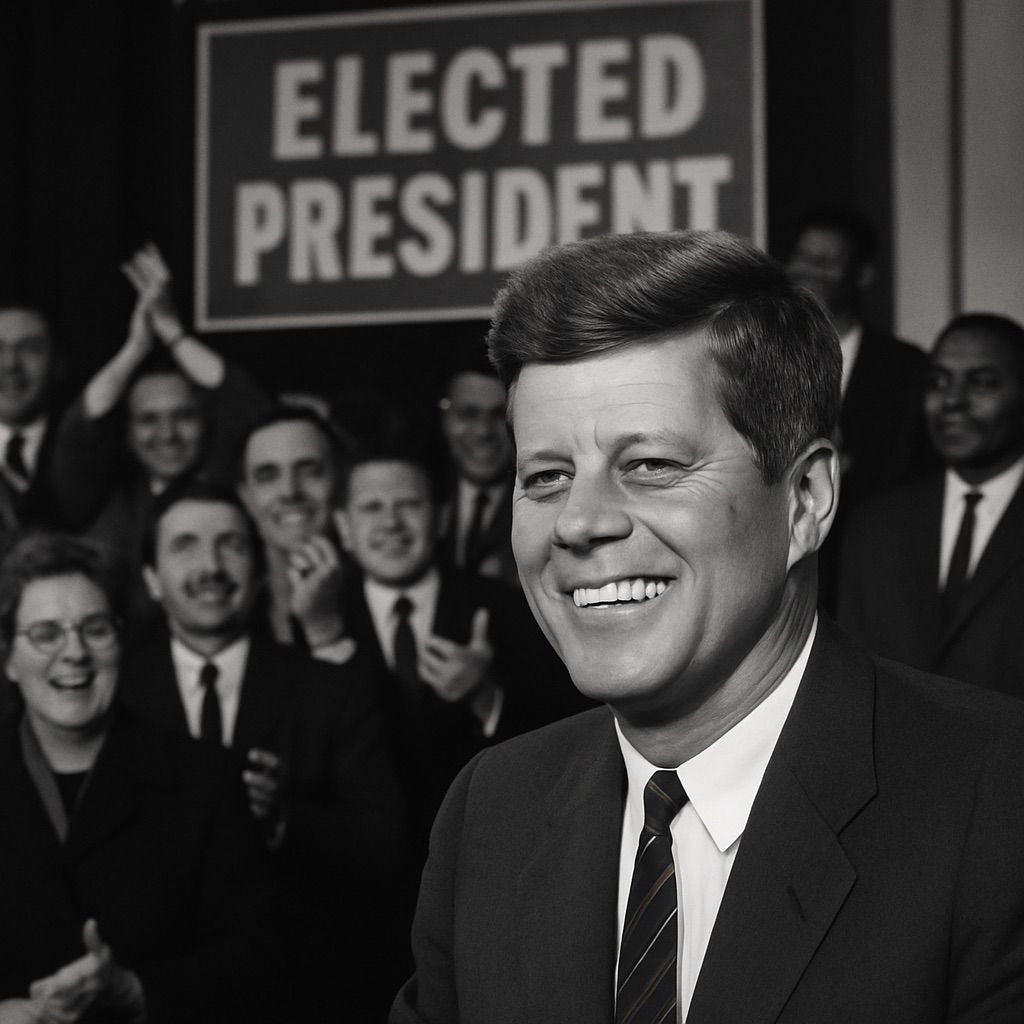
John F. Kennedy’s election was not just a victory for one man or one party. It was a statement of faith—faith in youth, in progress, in the enduring promise of America. In the black-and-white footage of that November night, one can still feel it: the hum of hope, the sense that something extraordinary had just begun. As crowds cheered and the words “ELECTED PRESIDENT” flashed across the television screens, the country seemed to exhale and dream all at once. It was the beginning of a story that would captivate the world—a story of triumph, tragedy, and transformation. Kennedy once said, “We stand today on the edge of a New Frontier… of unknown opportunities and perils.” In electing him, America stepped over that edge, not knowing what lay beyond, but believing that whatever it was, they would face it together.

Related Posts

When Light Revealed the Invisible: Wilhelm Röntgen and the Birth of X-Rays

Elias Rowen

On November 8, 1895, a quiet laboratory at the University of Würzburg became the birthplace of one of humanity’s greatest scientific breakthroughs. That day, Wilhelm Conrad Röntgen discovered X-rays—a form of invisible radiation that would forever change the way we see the world and the human body. In an instant, the opaque became transparent, and medicine, physics, and human understanding would never be the same again.

At the close of the 19th century, physics was on the brink of transformation. Scientists across Europe were enthralled by the mystery of cathode rays, streams of charged particles produced in vacuum tubes when electricity passed through them. Figures such as Heinrich Hertz, Philipp Lenard, and Julius Plücker had experimented with these strange rays, noting their peculiar behavior but failing to fully understand their nature. The stage was set for a revelation that would blur the line between the visible and invisible worlds.

Born on March 27, 1845, in Lennep, Prussia, Wilhelm Conrad Röntgen possessed a natural curiosity that drove him to explore the unknown. His academic path took him from the University of Utrecht to Zurich Polytechnic, where he earned his doctorate. By 1888, he had become a respected professor of physics at the University of Würzburg. Known for his meticulous and methodical approach, Röntgen spent his evenings conducting quiet experiments, often alone, driven more by curiosity than by fame or fortune.

In the fall of 1895, while studying cathode rays using a Crookes tube—an early form of vacuum tube—Röntgen noticed something extraordinary. Nearby, a fluorescent screen coated with barium platinocyanide began to glow, even though it was shielded from direct light. Perplexed, he covered the tube completely and observed that the glow persisted. Something unseen was penetrating the darkness, producing light where none should exist.

He experimented feverishly in the days that followed, testing this mysterious radiation against every material he could find—paper, wood, metal, and even his own hand. To his astonishment, the rays passed through solid objects but revealed the shadows of denser materials. Holding his hand before the screen, he saw the bones within silhouetted like a ghostly photograph. It was a sight both eerie and miraculous—the human skeleton revealed without incision or pain.

Röntgen, ever cautious, named the new phenomenon “X-rays,” using the mathematical symbol for the unknown. He worked in secrecy for weeks, repeating his experiments and documenting his results with careful precision. On November 22, 1895, he produced one of the most iconic images in scientific history: an X-ray of his wife’s hand, showing bones and her wedding ring. When she saw it, she reportedly exclaimed, “I have seen my death!”—a chilling reaction to a discovery that bridged life, science, and mortality itself.

On December 28, 1895, Röntgen published his landmark paper, “Über eine neue Art von Strahlen” (“On a New Kind of Rays”). Within days, his findings electrified the scientific world. Newspapers hailed his discovery as a miracle, while scientists scrambled to replicate his results. In a matter of months, X-rays were being used in hospitals across Europe and America. Surgeons could now see fractures, locate bullets, and diagnose internal injuries—all without a single incision. The modern field of radiology was born almost overnight.

In early 1896, John Hall-Edwards in Birmingham and Walter Konig in Frankfurt became the first physicians to use X-rays for medical diagnosis. For the first time in history, the inside of the human body could be examined without surgery—a development so revolutionary it seemed to border on magic. Patients and doctors alike marveled as the veil of flesh gave way to the clarity of bone.

But Röntgen’s discovery was not limited to medicine. Physicists recognized immediately that X-rays challenged the fundamental understanding of light and matter. The invisible radiation hinted at energies and structures far beyond what classical physics could explain. Within a few years, scientists such as Ernest Rutherford, Marie and Pierre Curie, and Max Planck would build upon this discovery to usher in the atomic age and the birth of quantum theory. Röntgen’s mysterious “unknown rays” had opened a door to the invisible world—and humanity stepped through it into the modern era.

Röntgen’s character was as remarkable as his discovery. He refused to patent X-rays, believing that scientific knowledge belonged to all humanity. When he was awarded the first Nobel Prize in Physics in 1901, he remained humble, donating the entire sum to his university. His dedication to pure science, free from personal ambition, set a standard for integrity that endures to this day.

Beyond his laboratory achievements, Röntgen also stood for progress in the broader sense. He was an advocate for women in science, encouraging their participation in research and mentoring female physicists at a time when academia was still largely closed to them. His quiet support helped open doors for future generations of scientists.

The legacy of Röntgen’s discovery reaches far beyond physics or medicine—it changed how humanity perceives the unseen. X-rays became the foundation for entire branches of technology: CT scans, airport security scanners, industrial imaging, and even astronomy, where X-ray telescopes peer deep into the universe to study black holes and exploding stars. What began as a flickering glow in a small German laboratory became a window into the infinite.

Today, more than a century later, we still live in the shadow of that moment when light revealed the invisible. Röntgen’s discovery stands as a testament to the power of curiosity, patience, and the human drive to understand the unknown. His “X-rays” may have started as an accidental observation, but they became a cornerstone of modern science—a reminder that even the unseen can illuminate the world.

In the annals of history, few discoveries have so profoundly altered human life. Wilhelm Conrad Röntgen’s work not only redefined medicine and physics but also expanded the limits of human perception itself. Through his eyes, the world learned to see within itself—to glimpse the hidden patterns of nature, and in doing so, to better understand what it means to be human.

Related Posts

The Queen Who Shaped an Empire: Elizabeth I and the Dawn of England’s Golden Age

Elias Rowen

The year was 1558, a time of great turmoil and transformation in England. The country had been shaken by years of political and religious upheaval following the short and turbulent reign of King Edward VI, who succumbed to illness at the tender age of fifteen. His death left behind a power vacuum that was soon filled by his half-sister, Mary I. Yet Mary’s own reign proved equally fraught with tension and bloodshed, as she sought to restore Catholicism to a nation that had begun to turn Protestant under Edward’s rule. When Mary died on November 17, 1558, the throne passed to her younger half-sister Elizabeth, then thirty-four years old and Princess of England. Elizabeth’s ascension marked the dawn of a new era—one defined by relative peace, cultural flourishing, and the emergence of England as a major world power.

Elizabeth’s path to the throne had been long, uncertain, and often perilous. Born on September 7, 1533, she was the daughter of King Henry VIII and his second wife, Anne Boleyn. Her early years were overshadowed by tragedy and political intrigue. When she was just two years old, her mother was executed on charges of adultery and treason—an event that deeply affected Elizabeth’s outlook on power, loyalty, and survival. Declared illegitimate and removed from the line of succession, she was nevertheless given a solid education, mastering languages, philosophy, and the arts of rhetoric and statecraft. These skills would later serve her well in navigating the complex and treacherous landscape of Tudor politics.

Following Henry VIII’s death in 1547, Elizabeth’s half-brother Edward VI took the throne and ushered in the “Edwardian Reformation,” a time when Protestantism gained a strong foothold in England. Elizabeth, though raised Protestant, learned early on to temper her beliefs with pragmatism. She skillfully adopted a stance of “Via Media,” or the middle way—avoiding open confrontation with either religious faction and cultivating a reputation for moderation. Her restraint and intelligence helped her survive an age when religious allegiance could mean the difference between power and the scaffold.

The ascension of Mary I in 1553 reversed much of Edward’s Protestant reform and plunged England back into Catholic orthodoxy. As Mary’s half-sister and a Protestant by inclination, Elizabeth found herself in constant danger. Mary’s persecution of Protestants earned her the epithet “Bloody Mary,” and suspicion soon fell on Elizabeth as a potential rallying figure for Protestant opposition. She was briefly imprisoned in the Tower of London on suspicion of treason after being implicated—without evidence—in Wyatt’s Rebellion, a Protestant uprising. The experience was harrowing but formative. Elizabeth emerged from confinement hardened, cautious, and more determined than ever to survive and rule.

When Mary died in 1558 without an heir, the transition of power was smooth, though the nation remained fragile. Elizabeth ascended to the throne with a deep understanding of the dangers of fanaticism and the importance of balance. Her first acts as queen reflected her instinct for conciliation. She issued a proclamation assuring her subjects that she would maintain peace with neighboring nations, including Scotland and France, and she sought to stabilize England internally by restoring confidence in the monarchy. Her speech to Parliament reaffirmed her commitment to the rule of law and the welfare of her people, while carefully invoking divine providence to legitimize her reign.

Elizabeth inherited a kingdom burdened by debt, weakened by years of war, and divided by religious strife. The treasury was nearly empty, the economy unstable, and the people weary of sectarian violence. Yet through her keen intellect and political acumen, Elizabeth began the slow process of restoring national stability. She surrounded herself with capable advisors, most notably William Cecil (later Lord Burghley), whose prudent counsel and administrative skill proved invaluable. Together, they enacted careful fiscal reforms, curbed government waste, and restored the value of England’s currency. These measures helped rebuild public confidence and laid the groundwork for economic recovery.

In matters of religion, Elizabeth adopted a moderate course that would come to define her reign. Her “Elizabethan Religious Settlement,” enacted in 1559, established the Church of England as a Protestant institution while retaining elements of Catholic tradition to appease conservative subjects. This pragmatic compromise helped prevent further civil unrest and ensured a degree of religious peace unprecedented in Tudor England. Her personal motto, Video et taceo (“I see and say nothing”), perfectly captured her approach—watchful, deliberate, and cautious in action.

Elizabeth’s foreign policy was equally shrewd. Recognizing that England lacked the resources to engage in costly continental wars, she pursued a policy of cautious diplomacy. Rather than aligning fully with either Catholic Spain or Protestant German states, she maintained England’s neutrality, strengthening trade ties and focusing on domestic stability. Her willingness to engage with both sides of Europe’s religious divide showcased her skill as a strategist who understood that peace was often more powerful than war.

As England regained its footing, a cultural renaissance began to blossom under Elizabeth’s patronage. Her court became a beacon of sophistication and creativity, attracting poets, musicians, philosophers, and scholars from across Europe. The arts flourished, producing an outpouring of literary and theatrical brilliance that would define an age. Figures such as William Shakespeare, Christopher Marlowe, Edmund Spenser, and Sir Philip Sidney found in Elizabeth’s England an environment ripe for innovation and expression. The queen herself was an educated woman who delighted in music, poetry, and learning, and her encouragement of the arts helped shape English identity and culture for centuries to come.

Elizabeth’s reign also witnessed the dawn of England’s maritime and imperial ambitions. Inspired by the exploits of explorers like Sir Francis Drake, Sir Walter Raleigh, and Martin Frobisher, England began to look outward toward new worlds and new opportunities. Naval expeditions laid the foundation for England’s later global empire, while privateers brought wealth and prestige back to the crown. This expansion of maritime power would prove crucial in establishing England’s dominance at sea.

One of the most defining moments of Elizabeth’s reign came in 1588, when the Spanish Armada set sail to invade England. King Philip II of Spain, once Elizabeth’s suitor and later her bitter enemy, sought to overthrow the Protestant queen and restore Catholic rule. Against overwhelming odds, the English navy, bolstered by clever tactics and favorable winds, defeated the mighty Armada. The victory was not only a military triumph but also a symbolic one—it solidified England’s independence, boosted national pride, and marked the beginning of its rise as a formidable naval power. For Elizabeth, it was the crowning moment of her reign, forever immortalizing her in the hearts of her subjects as the monarch who stood firm in defense of her realm.

The queen’s leadership during this crisis revealed her greatest strength: her ability to inspire unity through words and presence. Her famous speech at Tilbury, delivered to her troops as they prepared to repel the invasion, remains one of the most stirring declarations in English history. “I know I have the body of a weak and feeble woman,” she declared, “but I have the heart and stomach of a king, and of a king of England too.” These words embodied her reign—a delicate balance of grace and authority, femininity and power.

Yet Elizabeth’s long rule was not without internal challenges. Chief among them was the threat posed by her cousin, Mary, Queen of Scots. A devout Catholic with a legitimate claim to the English throne, Mary became the focal point of numerous plots against Elizabeth. For nearly two decades, Elizabeth wrestled with the dilemma of how to deal with her imprisoned cousin. Though reluctant to execute an anointed monarch, she ultimately sanctioned Mary’s death in 1587 after evidence emerged linking her to the Babington Plot—a conspiracy to assassinate Elizabeth and place Mary on the throne. The execution was a grim necessity, one that eliminated a persistent threat but haunted Elizabeth for the rest of her life.

Despite these trials, Elizabeth’s reign was marked by an extraordinary ability to maintain stability in an age defined by uncertainty. Her combination of intelligence, charisma, and restraint earned her the loyalty of her people and the admiration of foreign observers. She proved adept at managing her image, cultivating the persona of the “Virgin Queen”—a ruler married only to her nation. This image not only reinforced her authority in a patriarchal society but also transformed her into a symbol of national unity and purity. Through calculated pageantry and symbolism, Elizabeth turned monarchy into art, elevating herself into a near-mythic figure in English consciousness.

As the years passed, however, the burdens of rule grew heavier. England’s economy faced renewed strain, and court factions began to compete for influence as the aging queen refused to name a successor. Elizabeth’s once-vibrant court grew somber as many of her closest advisors and friends, including Robert Dudley, Earl of Leicester, and William Cecil, passed away. The queen herself became increasingly withdrawn, haunted by memories of those she had lost and the weight of decisions made in the name of sovereignty. Her final years were marked by melancholy and introspection, yet she remained steadfast in her devotion to her people and her crown.

Elizabeth I died on March 24, 1603, at the age of sixty-nine, after more than forty-four years on the throne. With her passing ended the Tudor dynasty, and her cousin James VI of Scotland ascended as James I of England, uniting the two crowns. Her death marked the close of one of the most remarkable reigns in English history, yet her legacy endured, shaping the identity of a nation for centuries to come.

Elizabeth’s reign transformed England from a fractured and uncertain realm into a confident and flourishing power. Her policies brought stability after decades of religious conflict, her diplomacy secured England’s place in the European order, and her patronage of the arts ushered in a golden age of creativity that defined the English Renaissance. More than a monarch, she was a stateswoman, a strategist, and a symbol of endurance in an age of turmoil. Her ability to balance strength with grace, and caution with vision, remains a model of effective leadership even today.

Her legacy continues to resonate across time. The Elizabethan era laid the foundation for England’s later expansion into a global empire and set in motion cultural and political developments that would define the modern world. In her life and reign, Elizabeth I embodied the essence of the Renaissance—curious, courageous, and endlessly complex. She was the queen who saw England through danger to greatness, leaving behind a legacy of brilliance, resilience, and transformation that endures to this day.

Related Posts