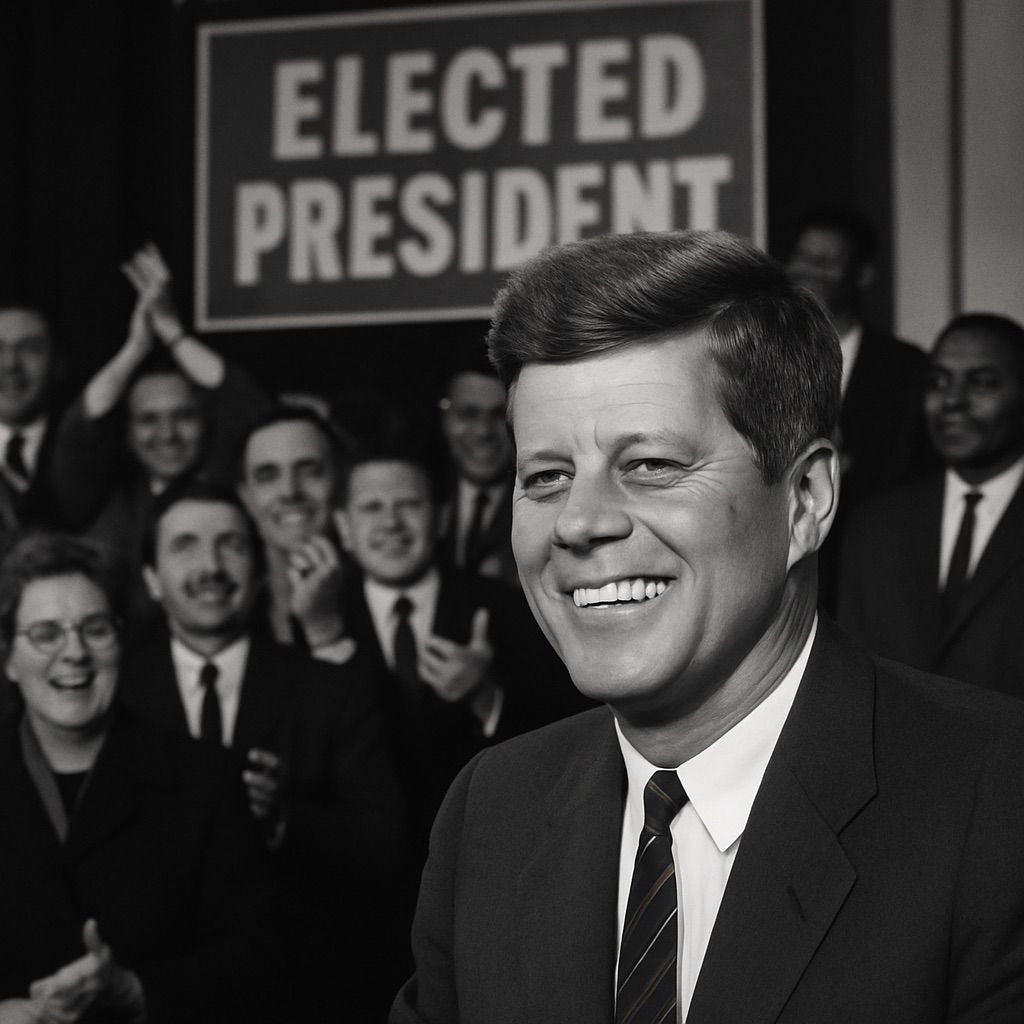
The autumn of 1960 shimmered with anticipation. The United States stood at a crossroads—between the comfortable calm of postwar stability and the restlessness of a new generation ready to redefine what it meant to be American. Factories thrummed, suburbs sprawled, and televisions flickered in nearly every home, each screen a mirror reflecting a country on the verge of transformation. Into this moment strode John Fitzgerald Kennedy, a young senator from Massachusetts whose charm, eloquence, and aura of vitality seemed to embody the nation’s own yearning for renewal. When he was elected President of the United States on November 8, 1960, he did more than win a political race; he awakened a movement and ushered in a new era—the New Frontier.
John F. Kennedy’s path to that moment began decades earlier, born into privilege but also into expectation. The son of Joseph and Rose Kennedy, he grew up surrounded by ambition. The Kennedy family was steeped in politics and public service, and from an early age, John absorbed the lesson that success was both expected and a duty. Despite fragile health, he pursued challenges relentlessly, attending Harvard and later serving heroically in the U.S. Navy during World War II. His command of PT-109 in the Pacific, and his extraordinary actions to save his crew after the boat was destroyed, would later become part of his legend—a living testament to courage under fire. The war made him a hero, but it also gave him perspective. He saw firsthand the fragility of peace and the cost of leadership, lessons that would shape the man who later stood before a divided world as its most visible symbol of hope.
After the war, Kennedy entered politics, first as a congressman, then as a senator. He was intelligent, pragmatic, and uncommonly charismatic, but what set him apart was his belief that America needed to move—forward, always forward. The 1950s, under President Eisenhower, had been a time of prosperity, yet complacency hung in the air. The Cold War had frozen much of the world into fear. Kennedy, however, radiated motion and youth. His campaign for the presidency in 1960 promised not just policy but purpose—a new kind of leadership for a new generation of Americans who had grown up in the shadow of war but were ready to dream again.
The election that pitted Kennedy against Richard Nixon was among the tightest in U.S. history. Nixon, Eisenhower’s vice president, was a seasoned politician, shrewd and experienced. Kennedy, by contrast, was young, seemingly inexperienced, and faced the heavy prejudice of being the first major Catholic candidate. Religion, for many Americans, was no small matter. Would a Catholic president take orders from the Pope? Kennedy confronted the question head-on. In Houston, he delivered a landmark speech to Protestant ministers, declaring, “I am not the Catholic candidate for president. I am the Democratic Party’s candidate for president, who happens also to be a Catholic.” It was a masterstroke of confidence and principle that disarmed many critics and revealed the poise that would later define his presidency.
The 1960 campaign was also the first to truly harness the power of television—a medium that Kennedy understood instinctively. In the televised debates between the two candidates, Kennedy appeared calm, polished, and presidential. Nixon, pale and weary, seemed uncomfortable before the camera’s unforgiving gaze. To those listening on the radio, Nixon seemed the winner, but to millions watching on TV, Kennedy looked like the future. It was a turning point not only for the campaign but for American politics itself. The era of image and media had begun, and Kennedy was its first natural master.
On election night, as ballots were tallied across the nation, the race came down to a few thousand votes in key states. The results see-sawed through the night, America holding its breath as precinct after precinct reported in. Finally, the tide turned. Kennedy had won by the narrowest of margins—less than 0.2 percent of the popular vote—but victory, however slim, was his. The youngest man ever elected to the presidency, and the first Catholic to do so, had achieved what many thought impossible. His victory was not just political; it was generational, cultural, almost spiritual. It felt as though the country had turned a page and was ready to begin again.
For millions of Americans, Kennedy’s election symbolized hope. His speeches spoke not only to intellect but to emotion. He talked about sacrifice, about service, about America’s role as a beacon in a divided world. His phrase “New Frontier” captured the imagination—a frontier not of geography but of possibility, where science, space, civil rights, and diplomacy could be pushed to their limits. He challenged Americans to look beyond comfort and to see themselves as part of something larger. It was a message that resonated deeply with the young, the idealistic, and the restless. In Kennedy, they saw not just a politician but a mirror reflecting their own desire to make the world better.
The world Kennedy inherited was far from simple. The Cold War hung over everything, a dangerous game of chess played with nuclear weapons. The Soviet Union’s launch of Sputnik had ignited fears that America was falling behind in technology and ambition. In the segregated South, civil rights protests were escalating, demanding justice long denied. The economy, while strong, was uneven. Yet Kennedy embraced the challenge. His inaugural address in January 1961 remains one of the most stirring in history, calling not for comfort but for courage: “Ask not what your country can do for you—ask what you can do for your country.” In those words, he redefined patriotism for a new generation.
From the very beginning of his presidency, Kennedy pushed boundaries. He established the Peace Corps, sending young Americans abroad to promote education and development, spreading goodwill and embodying the nation’s ideals. He made bold investments in science and technology, setting the audacious goal of landing a man on the Moon before the decade’s end—a vision that would culminate, tragically after his death, with Apollo 11. He also confronted the most perilous crises of the Cold War. The Bay of Pigs invasion in 1961, a failed attempt to overthrow Fidel Castro, was a humiliating early setback. But Kennedy learned from it, and when the Cuban Missile Crisis erupted the following year, he demonstrated steel and restraint that saved the world from nuclear catastrophe. For thirteen tense days, the world stood on the brink of annihilation, yet Kennedy’s calm diplomacy defused the crisis without war, earning him quiet respect even from his adversaries.
At home, Kennedy began to address the deep moral wound of racial segregation. Though cautious at first, he grew increasingly bold in his support for civil rights. In June 1963, he delivered a powerful address declaring that civil rights were “a moral issue… as old as the scriptures and as clear as the American Constitution.” His words laid the groundwork for the Civil Rights Act, which would be passed after his death. Kennedy’s presidency was becoming a bridge—between old America and new America, between segregation and equality, between the inertia of the past and the idealism of what might be.
But Kennedy’s magic was not just in his policies; it was in his presence. He had an effortless grace, a wit that disarmed even his opponents, and an intellect sharpened by curiosity. His family, too, became symbols of American glamour—the so-called “Camelot” of modern politics. Jacqueline Kennedy’s elegance, his children’s innocence, the family’s public image—all of it reinforced the sense that something fresh and hopeful had taken root in Washington. In a time of tension and anxiety, Kennedy’s optimism was contagious.
And yet, behind the allure, Kennedy’s presidency was shadowed by danger. The pressures of the Cold War were immense, and his health, plagued by chronic pain and illness, was a secret burden. Still, he pushed on, masking his struggles behind that confident smile. His leadership inspired trust not because he was perfect but because he seemed determined, unyielding in the face of challenge. He carried himself with the conviction that America’s best days were ahead, not behind.
When one looks back at Kennedy’s election today, it stands as more than just a milestone; it marks the dawn of a new political era. He redefined what leadership could look like—youthful, articulate, visionary. He proved that inspiration was as essential as policy, that the soul of a nation could be stirred by words and ideals as much as by laws. His presidency, brief as it was, left an indelible mark on the national psyche. It reminded Americans that progress demands courage, that democracy requires participation, and that the future belongs to those willing to imagine it.
John F. Kennedy’s election was not just a victory for one man or one party. It was a statement of faith—faith in youth, in progress, in the enduring promise of America. In the black-and-white footage of that November night, one can still feel it: the hum of hope, the sense that something extraordinary had just begun. As crowds cheered and the words “ELECTED PRESIDENT” flashed across the television screens, the country seemed to exhale and dream all at once. It was the beginning of a story that would captivate the world—a story of triumph, tragedy, and transformation. Kennedy once said, “We stand today on the edge of a New Frontier… of unknown opportunities and perils.” In electing him, America stepped over that edge, not knowing what lay beyond, but believing that whatever it was, they would face it together.