Day: September 6, 2025

Waves of Confidence: Finding Yourself in Swimwear

Dave

For as long as fashion has existed, few items of clothing have carried as much weight — emotional, cultural, even historical — as swimwear. The bikini, the one-piece, the tankini, the high-waisted retro set, even the humble cover-up, all come with layers of meaning far beyond fabric and thread. Swimwear is not just about the beach or the pool; it is about exposure, about vulnerability, about standing in front of the world without the usual armor of jeans and jackets and sweaters. And because of that, it is also one of the most powerful pieces of clothing when it comes to confidence. To wear swimwear is to stand in the light of sun and self-acceptance, to say, “This is me, exactly as I am.” But for many, that road to confidence is a winding one, filled with doubts, comparisons, and quiet battles. Yet the beauty of it is this: confidence in swimwear is not about the body at all. It’s about how you choose to see yourself.

Most of us have a memory of that awkward moment, maybe in adolescence, maybe later, when stepping out in a swimsuit felt like stepping onto a stage under a spotlight. The water glimmered invitingly, friends laughed easily, but inside, there was hesitation. Too pale, too curvy, too skinny, too tall, too short — the list of “too much” and “not enough” seemed endless. These thoughts weren’t born within us but pressed upon us by decades of glossy magazine covers, advertising campaigns, and social scripts that dictated what a “beach body” was supposed to look like. The myth of the perfect body in the perfect bikini became a cage that kept countless people from ever feeling the sand between their toes without self-consciousness.

But here’s the truth: every body is a beach body. The phrase “beach body” is nothing more than a marketing invention designed to sell diets, gym memberships, and swimsuits themselves. The beach itself does not care. The waves don’t crash differently depending on the size of your hips, the tide doesn’t pause to measure the flatness of your stomach. Confidence in swimwear begins when you realize that nature does not judge you, and neither should you. The ocean accepts every single body that dares to dive in.

What’s more, swimwear has always been about rebellion and liberation. In 1946, when the bikini first appeared, it was considered scandalous, a challenge to modesty and tradition. But women wore it anyway, claiming their right to dress as they pleased. That spirit of defiance still lingers in every bikini strap and one-piece silhouette. To put on swimwear is to participate in a long tradition of saying, “I will not hide.” Confidence, then, is not about how you look but about embracing your freedom.

Finding confidence in swimwear is also about fit, not size. There is magic in the right swimsuit — one that hugs you in all the right places, that flatters without constraining, that makes you want to move rather than hide. For some, that’s a bold bikini in neon or animal print. For others, it’s a sleek one-piece with clean lines. High-waisted retro styles give some a sense of vintage glamor, while sporty two-pieces empower others with strength and ease. The point is not the category of swimsuit but the way it makes you feel. When you slip into swimwear that feels like an extension of yourself, confidence follows naturally.

Accessories play a role too. A breezy sarong tied around the waist, a wide-brimmed straw hat, oversized sunglasses, or a sheer kaftan can add flair and comfort. They create not just an outfit but an experience, a vibe. These layers are not about hiding; they’re about style, about creating a look that feels intentional rather than fearful. Confidence often comes when we feel we are presenting ourselves in a way that matches who we are. Swimwear is no different.

Of course, confidence in swimwear is not just about the fabric but about mindset. The critical voice that whispers in your head is not truth — it’s noise. It’s the echo of years of cultural conditioning that told you to shrink, to compare, to cover up. One of the most radical acts of self-love you can perform is to drown out that voice with your own: “I belong here. I deserve this sunlight. My body is mine, and it is enough.” The people who shine the brightest on the beach are never the ones with so-called “perfect” proportions. They are the ones laughing freely, splashing in the waves, eating ice cream with sticky hands, living fully in the moment. That is what confidence looks like.

The journey to swimwear confidence also means redefining beauty. Media images have long celebrated narrow standards, but the reality is that beauty lives in diversity. Stretch marks are stories written on skin. Cellulite is as natural as freckles. Scars are reminders of survival. Freckles, curves, angular frames, softness, strength — all are forms of beauty when seen without comparison. Swimwear lays the body bare, yes, but in doing so, it reveals truths that are far richer than airbrushed perfection. Confidence means allowing those truths to exist unapologetically.

There’s also a practical element: practice makes powerful. Confidence is a muscle, and like any muscle, it strengthens with use. The first time you wear a swimsuit after months or years of avoidance, it may feel uncomfortable. But each time you step onto the sand, each time you slip into the pool, each time you let yourself be photographed without covering up, you build resilience. Confidence doesn’t arrive all at once. It grows in moments — when you choose to say yes to joy rather than no out of fear. When you choose to join the beach volleyball game instead of sitting out. When you let yourself float in the water without worrying what you look like from the shore. These choices accumulate, and slowly, they form a new reality where swimwear becomes second nature rather than a battlefield.

Confidence in swimwear also comes from community. There is something transformative about surrounding yourself with people who uplift rather than judge. Go to the beach with friends who celebrate you, who cheer you on, who remind you that life is too short to sit in the shade wrapped in insecurity. Social media, too, has become a surprising ally in this journey. The rise of body-positive influencers showing unedited, joyful photos in all kinds of swimwear has given millions the courage to reimagine what is possible. Representation matters. To see someone who looks like you thriving in swimwear is to realize that you can thrive too.

And then there is the deeper truth: swimwear confidence is about joy. It’s about reclaiming the simple pleasures of life without self-consciousness. It’s about running into the ocean without tugging at your straps, lying on a towel without worrying about rolls or angles, dancing at a beach party without checking yourself every five seconds. Joy is the fuel of confidence. When you allow yourself to feel joy, confidence follows naturally. Swimwear becomes not a test, but a ticket to freedom.

The ultimate irony is that nobody is looking at you as closely as you think. Most people at the beach are too wrapped up in their own moments — their children building sandcastles, their partners napping in the sun, their own insecurities whispering in their ears — to scrutinize you. The only gaze that truly matters is your own, and when you soften it, when you treat yourself with the same compassion you would give to a friend, you unlock the freedom to live fully.

So finding confidence in swimwear is not about transforming your body. It is about transforming your perspective. It is about shifting from “how do I look?” to “how do I feel?” It is about remembering that the ocean doesn’t care about size tags or cellulite, that the sun shines on every body equally, that joy is infinitely more attractive than perfection. Confidence is not about the bikini. It’s about you, standing tall, smiling freely, and allowing yourself to be seen.

The next time you put on swimwear, think of it not as exposure but as liberation. You are not displaying yourself for judgment. You are claiming your right to experience the world fully — the warmth of the sun, the coolness of the waves, the laughter of friends, the taste of salt on your lips. Swimwear is simply the costume of that freedom, and confidence is the performance you give not to others, but to yourself. You don’t need to wait until you’ve changed anything about your body. The time to step into confidence is now, exactly as you are, because the beach is waiting, the waves are calling, and life is too short to sit out of the water.
Related Posts

A Handshake and a Hidden Gun: Shots in Buffalo

Elias Rowen

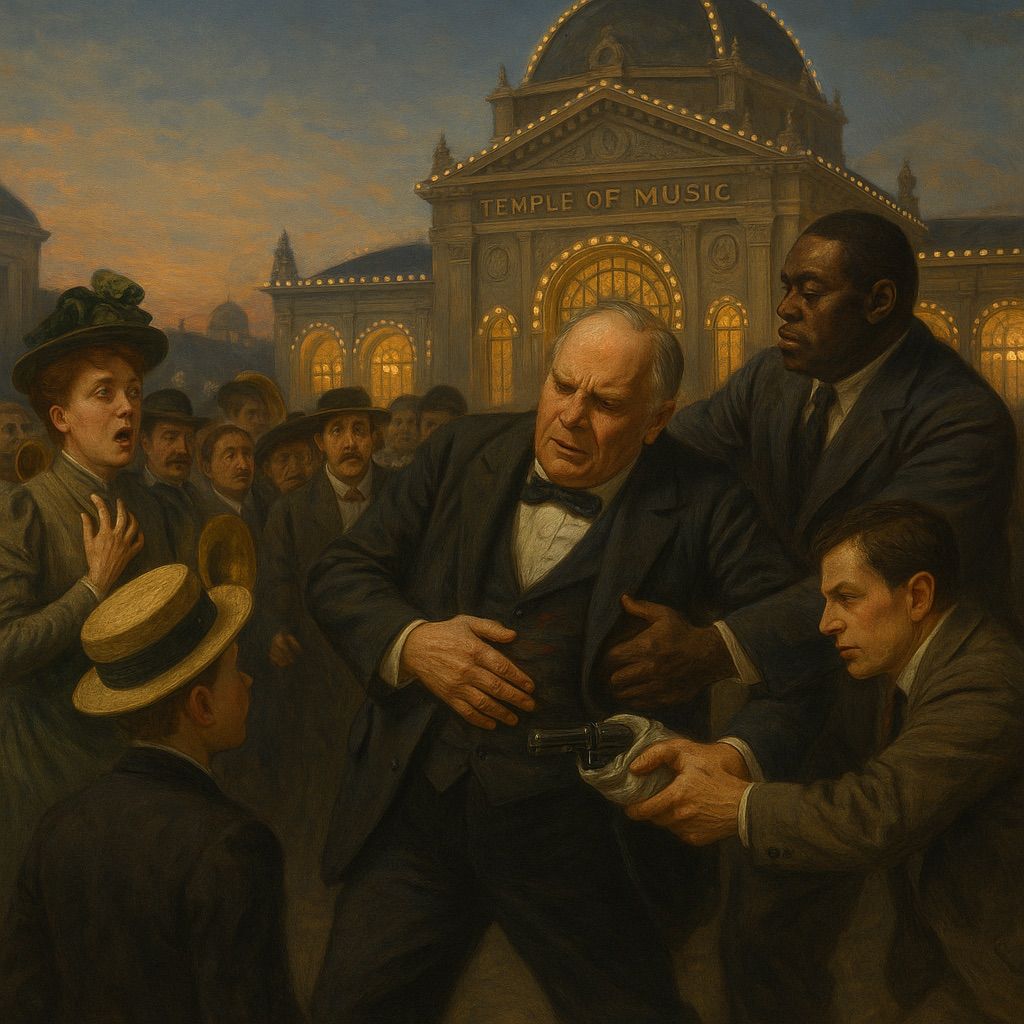
It was meant to be a day for handshakes, not headlines. Buffalo wore its Pan-American Exposition like a crown—electric lights strung along fairgrounds that looked like a city invented by hope, gondolas sliding across a man-made lake, pavilions named for progress and promise. On September 6, 1901, President William McKinley, a veteran with a calm smile and a habit of leaning in to hear people better, scheduled the kind of public meet-and-greet that turned politicians into neighbors. The venue, the Temple of Music, might as well have been a cathedral to the idea that modern life, bathed in current and convenience, could be conducted in the key of civility. A line formed: workers in their Sunday coats, mothers with children boosted to see better, merchants who had traveled by rail just to say “Mr. President.” The band played. The air held the comfortable noise of a nation that believed its future was a solved equation. Then a man with a bandaged hand stepped forward, and the answer changed.

Leon Czolgosz did not look like a hinge on which history would swing. He was small, pale, a factory hand who drifted through the loose archipelago of American anarchism and came away with a single sentence lodged like shrapnel: the state is a cruelty disguised as order. He wrapped a revolver in a handkerchief and then wrapped the handkerchief in another, so necessity could pose as injury. McKinley, who had greeted thousands that afternoon, saw what everyone else saw—an ordinary citizen with an ordinary wound—and made the generous mistake at the heart of democracy: he offered trust. The first shot grazed, the second entered the President’s abdomen under the right ribs, tore through stomach, and vanished into the body—a trajectory surgeons would hunt for later in a rush of sweat and poor light. In the second between sound and comprehension, the crowd swayed between astonishment and rage. An African-American bystander named James Parker lunged and drove the gunman down; others joined; McKinley, bleeding, did the most Presidential thing a man can do when pain becomes a room that fills with noise: he told the people to stop. “Don’t let them hurt him,” he reportedly said. That sentence is the thread we should never cut when we tell this story.

The President was carried to a small exposition hospital whose white sheets and well-meaning staff could not hide its lack of preparation for the most serious surgery in the land. The new century promised medical miracles; the building promised good intentions. Dr. Matthew Mann led the team, a gynecologist drafted by urgency into abdominal trauma. Ether. Knife. Hands in the body of a nation. They found one perforation in the stomach and sutured it; they could not find the bullet; they cleaned the wound as best they could without the antiseptic rigor that would be standard later. There was an X-ray apparatus on the fairgrounds—novel, temperamental—but it wasn’t effectively used that night; electricity’s marvels hummed just out of reach while infection silently plotted its slow arithmetic. McKinley was then moved to the home of John Milburn, president of the Exposition, where curtains were drawn and the bedside manners of a republic were practiced: Cabinet secretaries standing in corridors; Vice President Theodore Roosevelt hurrying in and out of telegrams; a wife, Ida, gently ushered to calm by aides who knew that managing grief can be a form of service.

For a handful of days, the country learned a new way to read the weather. Newspapers ran hourly bulletins; editors discovered a modern register for breaking news—anxious, factual, repetitive, hopeful. “The President is resting comfortably,” Americans were told so often that the phrase turned into a spell. Outside the Milburn house, a crowd developed the rituals humans invent when they have no agency left: craning for a glimpse, passing rumors like canteens, offering soft prayers that assumed a God who keeps office hours. In Buffalo parlors and Georgia farm kitchens and San Francisco boardinghouses, people argued about the meaning of a bandage and a handshake, about whether too much openness is a virtue that tempts its own undoing, about whether this young century, not quite one year old, had already revealed its character.

McKinley himself did not traffic in drama. From bed, his thoughts drifted to Ida—frail, prone to seizures, the axis on which his private world had always balanced—and then to policy: the tariff, the currency, the war just won, the empire inherited by accident. He was not a man of thunderous sentences. His power came from steadiness: a veteran of Antietam who had learned in one afternoon that the best thing you can do for frightened men is to be ordinary and calm. He rallied, briefly. Temperature stabilized. A nation exhaled. Then, deep in tissues no surgeon could see, infection spoke its quiet, devastating grammar. Gangrene. Toxins. The slide from “resting comfortably” to “grave” is always two inches long and a mile deep. On September 14, he died, and an oath placed a Rough Rider in the White House.

The assassination traveled through the culture like a shock that decides to stay. Czolgosz would be tried quickly, convicted, and executed within weeks; the speed says more about early-century America than any philosophy seminar could. The larger response was institutional. The Secret Service, which had guarded Presidents in a patchwork way, became indispensable. The handshake—symbol and habit—was reevaluated in a nation built on the idea that you can walk up to power and introduce yourself. Public life would remain public, but its choreography changed: more space between stage and audience, more eyes trained on the gap. The Pan-American Exposition’s incandescent dream dimmed; the Temple of Music, once built for applause, became a landmark mapped by grief. Buffalo would keep its civic pride, but always with a shadow that afternoon had cast.

To understand why the day still unsettles, you have to see it at human scale. The band in the rotunda had rehearsed “The Star-Spangled Banner” with a tempo chosen for joy; in an instant, the song became connective tissue for strangers who felt something break inside them at the same time. The woman in a hat with a complicated ribbon, who had waited two hours in line, never made it to the front; for the rest of her life, when anyone mentioned presidents, she shook her head and said she had seen one smile and then stop. A boy on his father’s shoulders, who had practiced saying “Good afternoon, sir,” learned that the future can exit the room in a single sound; he would later work in a factory and tell his own children that he once saw history change its mind. James Parker, whose sudden courage prevented a third shot, went home with bruised ribs and a new understanding of how quickly a body can become a wall.

It is tempting to frame the story as a parable about ideology. Czolgosz read speeches and decided that killing a representative of the state would cause the state to wobble, perhaps fall. But assassinations rarely produce the change their authors fantasize about; they produce the opposite—consolidation, reform, the invention of new rituals that make the attacked office more resilient. If McKinley’s death shifted policy, it did so by the force of personality that replaced him: Theodore Roosevelt’s impatience with lethargy, his appetite for action. The economy did not shudder because one man fell; the Progressive Era found a bolder stride because a younger man moved into the center of the room. Czolgosz had wanted to puncture a system; in practice he strengthened it by reminding citizens that institutions must be guarded not only by laws but by habits of care.

Yet we should be careful not to let political analysis evacuate the people who loved William McKinley. Ida McKinley survived him by less than six years, inhabiting widowhood with the manners of a woman who believed grief should be folded and put away after use. The soldiers who had marched with Captain McKinley at Antietam cried in private, because the Civil War had taught them to perform stoicism in public. His Cabinet moved on because that is what Cabinets do; his friends tried to remember his laugh and not the way the room smelled on the last day. In Canton, Ohio, the town that fitted the life to the man and then the man to the town, children learned to lower their voices when they passed the house where the curtains stayed closed.

We call the moment the “McKinley assassination,” which is a concise label that hides the rectangle of life behind it. Think instead of a single handshake line as a poem. Each person carries to the front of that line their own America: a dirt under the nails kind, a patent in the pocket kind, a long train ride kind, a letter for a son in the Navy kind. The President’s job in that ritual is not to fix all lives in three seconds; it is to honor them by looking as if he might. A republic is a series of brief, sincere transactions between a person with disproportionate power and many people with ordinary power. For such a system to work, trust must be the default setting. On September 6, trust met its natural predator—bad faith with a prop—and lost. The response cannot be to exile trust. The response must be to make its practice smarter and safer.

Consider how technologies kept appearing at the edges of the story, like stagehands who want a line. Electric light turned the Exposition into a dream of the future. The Roosevelt-era security state would generate paperwork as a new kind of armor. The X-ray machine, a marvel only six years old, sat nearby while doctors performed work with nineteenth-century tools; it is as if the twentieth century knocked politely on the door and was told to try again later. Today we would wheel in a CT, flood the wound with antibiotics, and monitor every chemical whisper a body makes. That is not a criticism of 1901 so much as a reminder that progress is a race against old ways of dying. McKinley lost that race by inches.

The funeral, with its slow horses and drumbeats, was the choreography of a nation teaching itself to grieve efficiently. The black crepe, the orations, the lines of men who adjusted their hats on the exact beat to signal respect—these are the habits a republic keeps on a shelf for the worst days. They dignify loss; they also convert shock into narrative, which is one way to prevent damage from spilling into the weeks ahead. When Theodore Roosevelt took the oath at the Ansley Wilcox House in Buffalo, he asked to borrow the steadiness of the man he replaced. Even Roosevelt—quick, loud, allergic to smallness—chose a quiet room for the transfer. It is good to remember that the United States, which performs most things at stadium volume, does its continuity work with indoor voices.

Why does the story still want to be told? Because it is one of the few episodes that let us watch the American promise in x-ray: openness and risk on the same frame, optimism and its shadow, technology and the stubborn limits of luck. It also holds a personal lesson that travels well beyond politics: every day we line up for our own Temple of Music moments—places where we assume the best and extend a hand. We cannot stop doing so without becoming a country unworthy of itself. What we can do is build railings where there were none, ask better questions about entrances and exits, invite guardianship that is alert without becoming paranoid, and keep teaching the sentence McKinley said as he bled: do not harm him. The nation he addressed in that moment was not just the crowd; it was the nation we might become if fury gets to steer.

If we could open a window over that afternoon and look again: the band’s conductor will drop his hands mid-measure and look to the door; a woman will grab a stranger’s wrist and squeeze hard enough to leave thumbprint moons; a boy will forget to breathe for three full seconds and then take a breath that contains, in miniature, the whole twentieth century; James Parker will do something brave that will not erase the harm but will keep it from multiplying; a doctor will choose; a knife will enter; stitches will hold because hands willed them to; a machine will hum on a nearby table and not be invited to speak; a letter will start to form in a man’s mind to a woman he has always loved first; a nation will learn that trust is priceless precisely because it can be broken by cloth wrapped around a lie. That is not a reason to stop trusting. It is a reason to carry trust more carefully, like a bowl filled to the brim.

Related Posts