
Day: September 18, 2025

Grills, Waves, and Good Vibes: The Ultimate Guide to a Summer BBQ at the Beach

Dave

Few things capture the essence of summer quite like a barbecue at the beach. The combination of sizzling food, salty air, golden sunsets, and laughter echoing over the sound of waves is nothing short of magical. A beach BBQ is more than just a meal; it’s an event, a sensory celebration where every detail matters. The crackle of charcoal, the glow of a portable grill, the smell of marinades mingling with ocean breeze—it all weaves together into an experience that feels both carefree and unforgettable. But to make it truly work, preparation is everything. You can’t just toss a few burgers into a bag and hope for the best. You need a checklist, a strategy, and above all, the right spirit to transform an ordinary cookout into a memory everyone talks about for years. So let’s dive into exactly what you should bring to make your summer BBQ at the beach the kind of story that spreads like sunshine.

It starts with the centerpiece: the grill. Portable is the keyword here. Whether you prefer a small charcoal grill that gives food that authentic smoky flavor or a propane version that fires up instantly, it needs to be compact enough to carry yet powerful enough to feed a hungry crowd. Don’t forget fuel—extra charcoal, lighter fluid, or a backup gas canister—because nothing kills the vibe faster than a grill that sputters out halfway through the fun. Tongs, spatulas, and a sturdy grill brush are your best friends; without them, you’ll be flipping burgers with plastic forks, and trust me, nobody wants to watch that happen.

Now for the star of the show: the food. Burgers and hot dogs are classics, reliable and crowd-pleasing, but a beach BBQ gives you room to get creative. Marinated chicken skewers, shrimp kabobs brushed with garlic butter, or even foil-wrapped salmon with lemon slices all cook beautifully by the sea. Vegetables deserve their moment too—grilled corn on the cob, zucchini strips, bell pepper skewers, or portobello mushrooms make vegetarians happy and add color to the spread. Don’t overlook snacks to keep everyone satisfied while the grill does its magic: chips and salsa, fruit skewers, pasta salads, or a platter of cheese and crackers that pairs perfectly with an afternoon drink. And speaking of drinks, hydration matters just as much as indulgence. A cooler packed with ice-cold water, lemonade, sparkling sodas, and maybe a few beach-friendly cocktails keeps the group refreshed all day.

But food and drinks are just part of the story—comfort and practicality make or break the experience. Chairs, blankets, or beach mats create a gathering spot, while a canopy or umbrella provides much-needed shade in the midday sun. A folding table helps keep food out of the sand, and extra coolers double as seats when the guest list grows. Utensils, cups, plates, and napkins might sound obvious, but they’re easy to forget in the rush to pack, and there’s nothing worse than having grilled chicken ready with no fork in sight. Go the eco-friendly route with reusable or compostable options, and bring a roll of paper towels and wet wipes for quick cleanups. Trash bags are non-negotiable; part of the beauty of a beach BBQ is leaving the sand as pristine as you found it.

Entertainment is another essential ingredient. A waterproof Bluetooth speaker sets the soundtrack of the day, whether it’s mellow acoustic strumming during the afternoon or upbeat anthems once the sun starts to dip. Frisbees, footballs, paddleball sets, or even a beach volleyball net keep energy levels high between meals. For a slower pace, card games or a simple deck of Uno create laughter that flows just as easily as the drinks. And let’s not forget the magic of timing. A beach BBQ isn’t just about the food; it’s about the rhythm of the day. Start early enough to enjoy swimming, tanning, and games, then let the grill heat up as the afternoon cools. As the sun sets, the glow of the barbecue mingles with the fading light, creating an atmosphere so perfect it feels staged.

Music and lighting add that final layer of magic. As night approaches, string lights powered by portable batteries or lanterns create a cozy glow. If bonfires are allowed, roasting marshmallows and making s’mores is the ultimate grand finale, one that makes even adults feel like kids again. A playlist curated in advance—mixing everyone’s favorite summer songs—keeps the vibe consistent. There’s something about hearing a beloved track with sand under your feet and stars above your head that sticks with you long after the trip is over.

Preparation also means thinking about the little things that elevate the experience. Sunscreen is obvious, but aloe vera for after-sun care is a lifesaver. Bug spray becomes a necessity as dusk falls. Extra towels and blankets ensure no one gets chilly once the breeze picks up. A portable fan can even make those sweltering moments bearable. And don’t underestimate the power of presentation: a well-packed cooler with labeled drinks, fruit salads served in hollowed-out pineapples, or skewers displayed like works of art all add to the aesthetic. People eat with their eyes first, and a beautifully arranged spread makes the day feel like something out of a magazine.

But beyond the lists and logistics, the heart of a beach BBQ is the people. It’s the way friends gather around the grill, each offering “expert” advice while one person sweats it out flipping burgers. It’s the sound of kids laughing as they dart in and out of the surf, their faces smeared with watermelon juice. It’s the friend who always brings too much food, the one who insists on taking group selfies every twenty minutes, and the one who DJs the afternoon with way too much enthusiasm. These quirks are what turn a simple meal by the sea into a story you’ll tell for years. The ultimate checklist is about ensuring nothing gets in the way of those moments.

Because in the end, a summer BBQ at the beach isn’t about the grill or the skewers or even the playlist—it’s about connection. It’s about gathering with people you love in a place that already feels like paradise and adding your own flavors, sounds, and laughter to it. It’s about eating with your hands, toes in the sand, and realizing that the best meals don’t happen in restaurants but in the open air, with smoke rising to meet the sky and waves applauding from the shore. The food will be eaten, the drinks finished, the sun gone, but the feeling? That lingers. It clings like salt to your skin, something you’ll carry with you long after you’ve shaken the sand from your shoes.

So pack the grill, load the cooler, grab the speaker, and don’t forget the sunscreen. Because the ultimate summer BBQ at the beach isn’t waiting—it’s calling. And the only thing better than hearing the waves crash is hearing them while you bite into the best burger of your life, surrounded by people who make the world brighter. That’s summer, bottled in a moment. That’s the BBQ you’ll never forget.
Related Posts

All the News That’s Fit to Print: The Day The New York Times First Hit the Streets

Elias Rowen

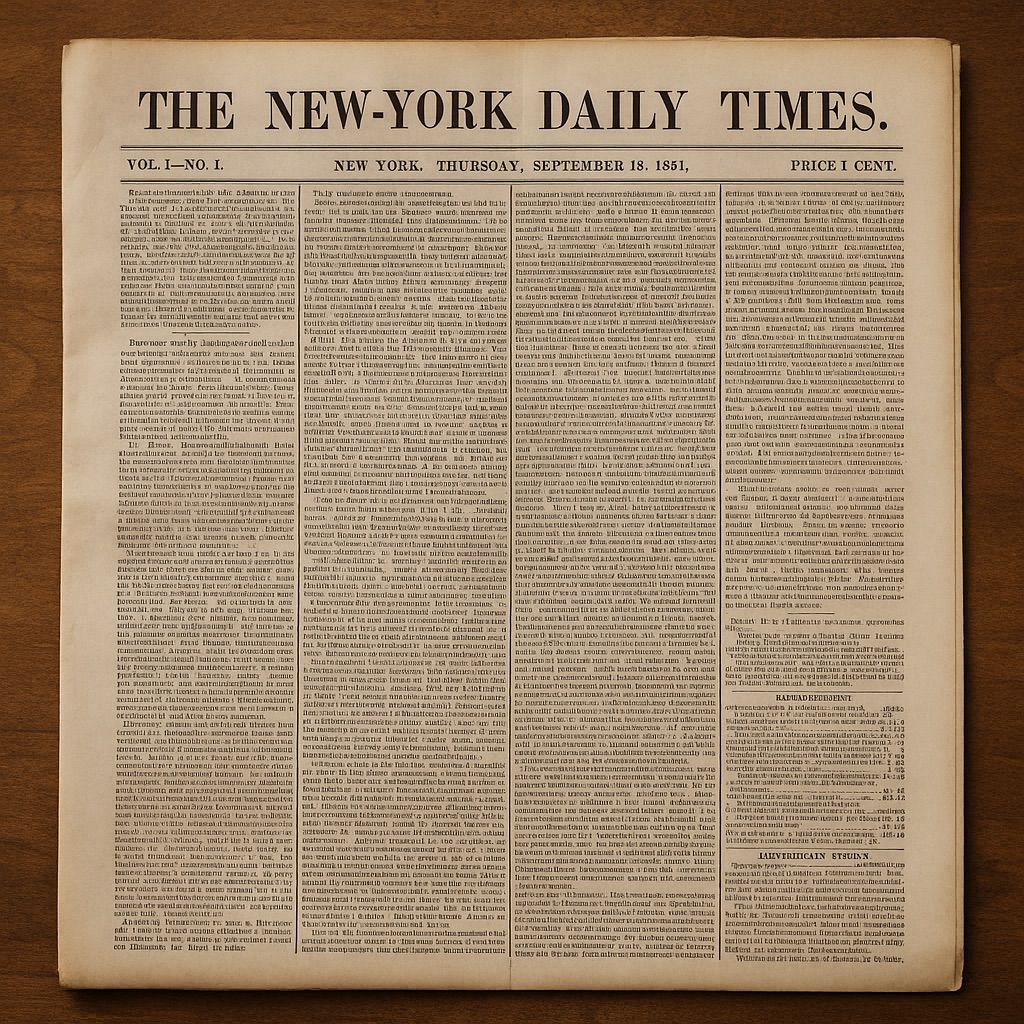
On September 18, 1851, the streets of New York City awoke to a new voice. Amid the clatter of horse-drawn carriages, the cries of newsboys hawking papers, and the hum of a city that was rapidly becoming the beating heart of America, a four-page newspaper rolled off a printing press for the very first time. Its name was The New-York Daily Times, a modest publication that cost just one cent. Few who glanced at that first issue could have imagined that this newspaper would grow into The New York Times, one of the most influential publications in the world, a journalistic institution synonymous with credibility, depth, and the famous motto it would later adopt: “All the News That’s Fit to Print.” That morning in 1851 marked the birth of a paper that would chronicle wars, revolutions, scandals, triumphs, and tragedies, shaping the way millions of people understood the world around them.

The mid-19th century was a turbulent, electric time for journalism. Newspapers were everywhere, competing for attention in a city already thick with rival publications. Many of them were sensationalist, filled with lurid stories, gossip, and outright fabrications. Others were fiercely partisan, serving as mouthpieces for political parties rather than independent outlets for the public. Into this noisy, chaotic media landscape stepped Henry Jarvis Raymond, a journalist and politician, and George Jones, a banker. Together, they founded the New-York Daily Times with a mission that seemed both bold and old-fashioned: to publish a newspaper that valued accuracy over sensation, balance over bias, and depth over triviality. They believed that readers deserved not only information but trustworthy information — a radical concept in an age of yellow journalism and partisan warfare.

That first issue set the tone. It included coverage of politics, business, foreign affairs, and cultural life, written with a clarity and restraint that distinguished it from its competitors. It did not scream for attention with wild headlines or exaggerated stories. Instead, it presented itself as serious, respectable, and thoughtful. Raymond and Jones envisioned a newspaper for readers who craved more than scandal and spectacle, for those who wanted to understand the complexities of the nation and the world. It was, in its way, a rebellion against the dominant media culture of its time. And slowly, it began to build a reputation for integrity.

The Times would go on to play a pivotal role in shaping the American public sphere. Through the Civil War, it reported from the frontlines, offering readers not just battlefield updates but sober analysis of the conflict that was tearing the nation apart. During Reconstruction, it covered the challenges of reunification and the struggles for civil rights. As the nation industrialized, the Times chronicled labor strikes, economic booms, and social upheavals. In the 20th century, it became the paper of record for a nation that was itself becoming a global power. Its correspondents filed reports from Europe during two world wars, from Asia during conflicts and revolutions, from Washington during political scandals, and from cities across the globe as the modern world unfolded. Each headline was more than ink on paper. It was a lens through which millions saw history happening in real time.

What made the Times endure was not just its reach, but its ethos. The motto “All the News That’s Fit to Print,” first used in 1897, encapsulated its philosophy. In an era when newspapers often printed anything to sell copies, the Times promised discernment. It would print not everything, but everything worth knowing. That philosophy became a trust between the paper and its readers, a trust that elevated it from just another publication to an institution. Over time, its front page became something more than newsprint. It became a national stage, where the events of the world were given weight, context, and permanence.

Of course, the Times has not been without controversy. Over its long history, it has faced criticism, lawsuits, and scandals. It has been accused of bias, of errors, of failures in judgment. It has sometimes struggled with the balance between objectivity and advocacy, between timeliness and accuracy. Yet part of its endurance lies in its willingness to confront those challenges, to correct mistakes, to adapt to new technologies and new demands. From the telegraph to the internet, the Times has continually reinvented itself while holding to its central promise of credibility. In doing so, it has become not only a chronicler of history but a part of history itself.

When we think about September 18, 1851, we see more than the launch of a newspaper. We see the beginning of a tradition that has shaped democracy. Journalism, at its best, is not just about reporting facts. It is about holding power accountable, about informing citizens, about giving voice to truth even when it is uncomfortable. The New York Times, born in that moment, became one of the most enduring examples of that principle. Its pages have been the battleground for debates about freedom of the press, the source of revelations that toppled governments, and the chronicler of everyday life in all its complexity. From the Pentagon Papers to Watergate, from 9/11 to the digital revolution, the Times has been there, shaping and reflecting the way we understand the world.

The story of its birth is also the story of America’s own coming of age. In 1851, the United States was still young, still finding its place in the world, still wrestling with contradictions of liberty and slavery, expansion and division. The launch of a newspaper dedicated to accuracy and fairness was, in its way, a reflection of the nation’s aspirations: to be serious, to be respected, to be informed. And just as the country grew, faltered, and rose again, so too did the Times evolve, stumble, and rise again. The parallels are striking because both the nation and its newspaper share the same project: the constant, imperfect pursuit of truth.

Looking back now, more than 170 years later, that modest first issue of the New-York Daily Times feels almost quaint. Its typeface was simple, its columns dense, its circulation limited. But within those pages was the spark of something enduring. On that September morning, Henry Raymond and George Jones could not have foreseen the digital age, the global reach, or the Pulitzer Prizes their paper would one day win. But they believed in something timeless: that truth matters, that words matter, that journalism matters. And because they believed, a newspaper was born that continues to shape the world today.

So when we remember September 18, 1851, we are not just remembering the launch of a newspaper. We are remembering the launch of an idea: that information should be accurate, that truth should be told, that the public deserves more than noise and spectacle. That idea, embodied in the New York Times, remains as vital now as it was then. For all the news that’s fit to print — and all the stories still to come — it began on that day, with a small paper sold for a penny, and a dream that truth, once printed, could change the world.

Related Posts