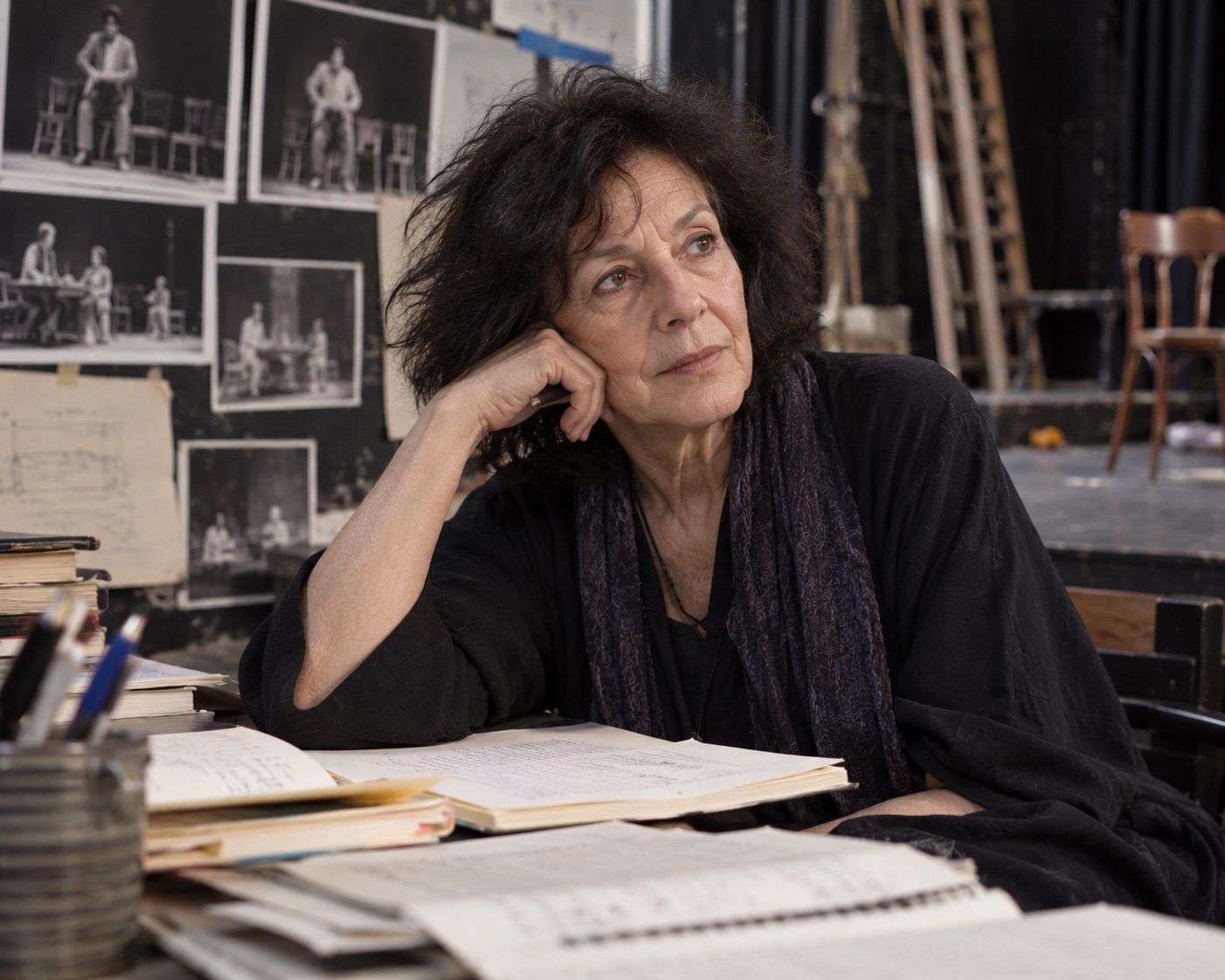
I’ve been drawn to Maria Irene Fornes for a while now, but it’s only recently that I’ve started to grasp why her work speaks to me on such a deep level. As a writer myself, I’m fascinated by the way she used her craft to explore the complexities of human experience – and often, the struggles of being a woman in a patriarchal world.
Fornes’ play “The End of Days” has been a particular source of fascination for me. On its surface, it’s a story about a group of women living together in an apartment building, dealing with their own personal demons and societal expectations. But as I delve deeper into the script, I realize that Fornes is actually probing at something far more fundamental: the ways in which we construct our identities and relationships.
It’s this idea of identity, specifically, that has me hooked. Growing up, I often felt like I was caught between different worlds – my family’s expectations for me versus my own desires for creative expression. Fornes’ characters, with their contradictions and paradoxes, feel like an extension of myself in some way.
I’ve always been drawn to writers who capture the messy complexity of human experience, but there’s something about Fornes that resonates particularly deeply. Maybe it’s because she doesn’t shy away from the difficult stuff – the feelings of isolation, the struggles with power dynamics, the quiet desperation that can come with trying to navigate a world that often seems stacked against you.
When I think about Fornes’ work, I’m reminded of my own experiences as a young woman trying to find her voice in a crowded room. It’s like she’s taking all these disparate threads – the societal expectations, the personal fears, the creative longings – and weaving them into this intricate tapestry that feels both deeply personal and universally relatable.
I’ve read a lot of critics who praise Fornes for her innovative use of language, her bold exploration of themes. But for me, it’s not just about technical skill or intellectual curiosity – although those things are certainly present in abundance. It’s about the way she captures the inner lives of women, and the ways in which we’re all struggling to make sense of our place in the world.
As I sit here with Fornes’ words scattered across my desk, I’m struck by how little I truly understand her. She was a Cuban-American woman who defied categorization, who refused to be bound by any single label or identity. Her work is a testament to this spirit of nonconformity – but it’s also a reminder that there are still so many mysteries at play.
I find myself wondering about Fornes’ personal life, her relationships and experiences outside of the theatre world. Was she ever lonely? Did she struggle with self-doubt, or did she have an unwavering confidence in her artistic vision? I know these are questions I’ll never fully answer, but that’s what draws me to her work – the sense that there’s still so much unknown, so much yet to explore.
As a writer myself, I’m constantly grappling with the same questions Fornes’ work raises. Who am I, really? What does it mean to be a woman in this world? How can I use my words to capture the complexities of human experience?
It’s funny – when I started exploring Fornes’ work, I thought I’d find answers to these questions. But what I’ve discovered instead is that she’s simply raised more questions for me, like so many echoes of her own inner turmoil. And in this, I think I’ve found a deeper connection to her than I ever could have anticipated – not just as a fellow writer, but as someone who’s also wrestling with the same fundamental questions about identity and belonging.
As I continue to delve into Fornes’ work, I’m left with more uncertainty than clarity. But that’s what draws me in – the sense that there’s still so much yet to explore, so many mysteries waiting to be unraveled.
I find myself returning to “The Moored Sailors” again and again, mesmerized by the way Fornes’ characters drift through the narrative like sailors lost at sea. The play’s exploration of desire, power, and identity is so deeply resonant for me that I feel like I’m confronting my own fears and longings with every reading.
One of the things that strikes me about Fornes’ work is the way she subverts traditional notions of storytelling. Her plays are often fragmented, non-linear, and full of contradictions – much like real life, but also unlike anything I’ve ever read before. It’s as if she’s deliberately dismantling the comfortable narratives we’re used to telling ourselves, forcing us to confront the messy, complicated truth.
This is particularly evident in “The Moored Sailors,” where the characters’ experiences are presented in a way that’s both fragmented and associative. We see snatches of conversation, flashes of memory, and moments of intense emotional connection – but we never get the full picture. It’s like Fornes is mirroring the way our minds work, with all their attendant leaps and contradictions.
I’m reminded of my own writing process, where I often feel like I’m chasing a thread that’s constantly unraveling before me. Fornes’ work makes me realize that this isn’t just a quirk of mine – it’s a fundamental aspect of human experience itself. We’re all trying to make sense of the world around us, even as we’re hurtling through it at breakneck speed.
As I continue to explore Fornes’ plays, I’m struck by the way they challenge me to question my own assumptions about identity and belonging. What does it mean to be a woman in this world? Is it possible to escape the constraints of societal expectations? How do we create our own narratives, especially when those around us are trying to impose their own stories on us?
These questions swirl through my mind like a maelstrom as I read Fornes’ work. But what’s most striking is that she doesn’t offer any easy answers – in fact, her plays often suggest that the search for identity and belonging is a lifelong process, full of detours and dead ends.
It’s this sense of uncertainty that draws me to Fornes’ work, I think. As a writer, I’m constantly grappling with the same questions she raises – who am I, really? What does it mean to be a woman in this world? How can I use my words to capture the complexities of human experience?
And yet, even as I struggle with these questions, I feel a sense of solidarity with Fornes. We’re both trying to navigate this treacherous landscape, one that’s marked by power dynamics and social expectations. But we’re also both searching for something more – a deeper understanding of ourselves, our place in the world, and the ways in which we can connect with others.
In Fornes’ work, I see a reflection of my own search for meaning – but I also see something far more profound. I see a testament to the power of human imagination, and the ways in which it can transcend even the most daunting obstacles.
As I continue to explore Fornes’ plays, I’m struck by the way she captures the fragility of human connection. Her characters are always on the cusp of something – a moment of intimacy, a burst of passion, or a catastrophic failure of understanding. It’s as if she’s frozen time itself, holding up a mirror to the messy, imperfect ways in which we relate to each other.
I think about my own relationships, and how they’re often marked by moments of tenderness and moments of hurt. Fornes’ work makes me realize that this is a fundamental aspect of human experience – that our connections with others are always precarious, always at risk of unraveling.
It’s this sense of fragility that I find so compelling about Fornes’ work. She doesn’t shy away from the difficult stuff – the moments of pain and disappointment, the struggles to communicate and connect. Instead, she leans into them, exploring their complexities with a fierce curiosity.
As I read her plays, I feel like I’m witnessing a kind of emotional archaeology – a digging up of the hidden recesses of human experience. Fornes is not interested in presenting easy answers or tidy resolutions; instead, she’s more concerned with exposing the messy, imperfect truth of our lives.
This is particularly evident in “The Two Parties,” where the characters’ relationships are presented as a series of fragile, easily broken connections. There’s no grand narrative arc here – just a series of moments, each one precariously balanced on the edge of collapse.
I’m reminded of my own writing process, where I often feel like I’m trying to capture the fleeting moments of connection between people. Fornes’ work makes me realize that this is not just a quirk of mine – it’s a fundamental aspect of human experience itself.
We’re all struggling to connect with each other, even as we’re hurtling through life at breakneck speed. We’re all trying to navigate the complexities of our own relationships, even as we’re bombarded by the demands and expectations of the world around us.
Fornes’ work is a testament to this struggle – but it’s also a reminder that connection is always possible, no matter how fragile or precarious it may seem. Her plays are not just explorations of human experience; they’re also invitations to connect with others on a deeper level – to see ourselves reflected in the struggles and triumphs of her characters.
As I sit here, surrounded by Fornes’ words, I feel like I’m part of a larger conversation – one that’s been going on for decades, but still feels intensely relevant today. Her work is not just a reflection of our shared human experience; it’s also a call to action – a reminder that we have the power to create our own connections, our own relationships, and our own narratives.
And yet, even as I feel this sense of solidarity with Fornes, I’m aware that there are still so many questions unanswered. Who am I, really? What does it mean to be a woman in this world? How can I use my words to capture the complexities of human experience?
Fornes’ work may not offer easy answers – but it does offer something far more valuable: a sense of company on this journey through life.
As I delve deeper into Fornes’ work, I’m struck by the way she subverts traditional notions of storytelling. Her plays are often fragmented, non-linear, and full of contradictions – much like real life, but also unlike anything I’ve ever read before. It’s as if she’s deliberately dismantling the comfortable narratives we’re used to telling ourselves, forcing us to confront the messy, complicated truth.
I think about my own writing process, where I often feel like I’m chasing a thread that’s constantly unraveling before me. Fornes’ work makes me realize that this isn’t just a quirk of mine – it’s a fundamental aspect of human experience itself. We’re all trying to make sense of the world around us, even as we’re hurtling through it at breakneck speed.
One of the things that strikes me about Fornes’ work is the way she uses language to capture the nuances of human emotion. Her writing is like a slow-burning fire – it creeps up on you, and before you know it, you’re fully immersed in the world she’s created. It’s not just about the words themselves; it’s about the spaces between them, the silences that speak louder than any phrase.
I’ve always been drawn to writers who capture the subtleties of human emotion – Fornes is one of those rare writers who can convey a depth of feeling without ever resorting to sentimentality. Her characters are like us – messy, complicated, and often contradictory. They’re not cardboard cutouts or archetypes; they’re fully fleshed-out people with their own unique struggles and triumphs.
As I read Fornes’ work, I’m struck by the way she explores the intersection of politics and personal relationships. Her plays are not just about individual characters; they’re also about the ways in which we’re all connected to one another – the ways in which our personal struggles are always intertwined with the larger social context.
I think about my own life, and how I’ve often struggled to balance my personal desires with the demands of the world around me. Fornes’ work makes me realize that this is a universal struggle – one that we all face, no matter where we come from or what our circumstances may be.
It’s this sense of universality that draws me to Fornes’ work. She’s not just writing about specific experiences or situations; she’s capturing the essence of human experience itself. Her plays are like a mirror held up to our collective soul – a reflection of our hopes, fears, and struggles.
As I continue to explore Fornes’ work, I’m struck by the way she challenges me to question my own assumptions about identity and belonging. What does it mean to be a woman in this world? Is it possible to escape the constraints of societal expectations? How do we create our own narratives, especially when those around us are trying to impose their own stories on us?
These questions swirl through my mind like a maelstrom as I read Fornes’ work. But what’s most striking is that she doesn’t offer any easy answers – in fact, her plays often suggest that the search for identity and belonging is a lifelong process, full of detours and dead ends.
It’s this sense of uncertainty that draws me to Fornes’ work, I think. As a writer, I’m constantly grappling with the same questions she raises – who am I, really? What does it mean to be a woman in this world? How can I use my words to capture the complexities of human experience?
And yet, even as I struggle with these questions, I feel a sense of solidarity with Fornes. We’re both trying to navigate this treacherous landscape, one that’s marked by power dynamics and social expectations. But we’re also both searching for something more – a deeper understanding of ourselves, our place in the world, and the ways in which we can connect with others.
As I sit here, surrounded by Fornes’ words, I feel like I’m part of a larger conversation – one that’s been going on for decades, but still feels intensely relevant today. Her work is not just a reflection of our shared human experience; it’s also a call to action – a reminder that we have the power to create our own connections, our own relationships, and our own narratives.
But what if I’m wrong? What if Fornes’ work isn’t about connection at all? What if it’s actually about the fragility of human existence – the way in which we’re all just barely holding on, trying not to fall into the abyss?
This is a thought that haunts me as I read Fornes’ plays. It’s a reminder that our connections with others are always precarious, always at risk of unraveling. And yet, even as I acknowledge this fragility, I’m drawn back to the work – because in its depths, I see a glimmer of hope, a sense that we might just be able to find a way through the darkness.