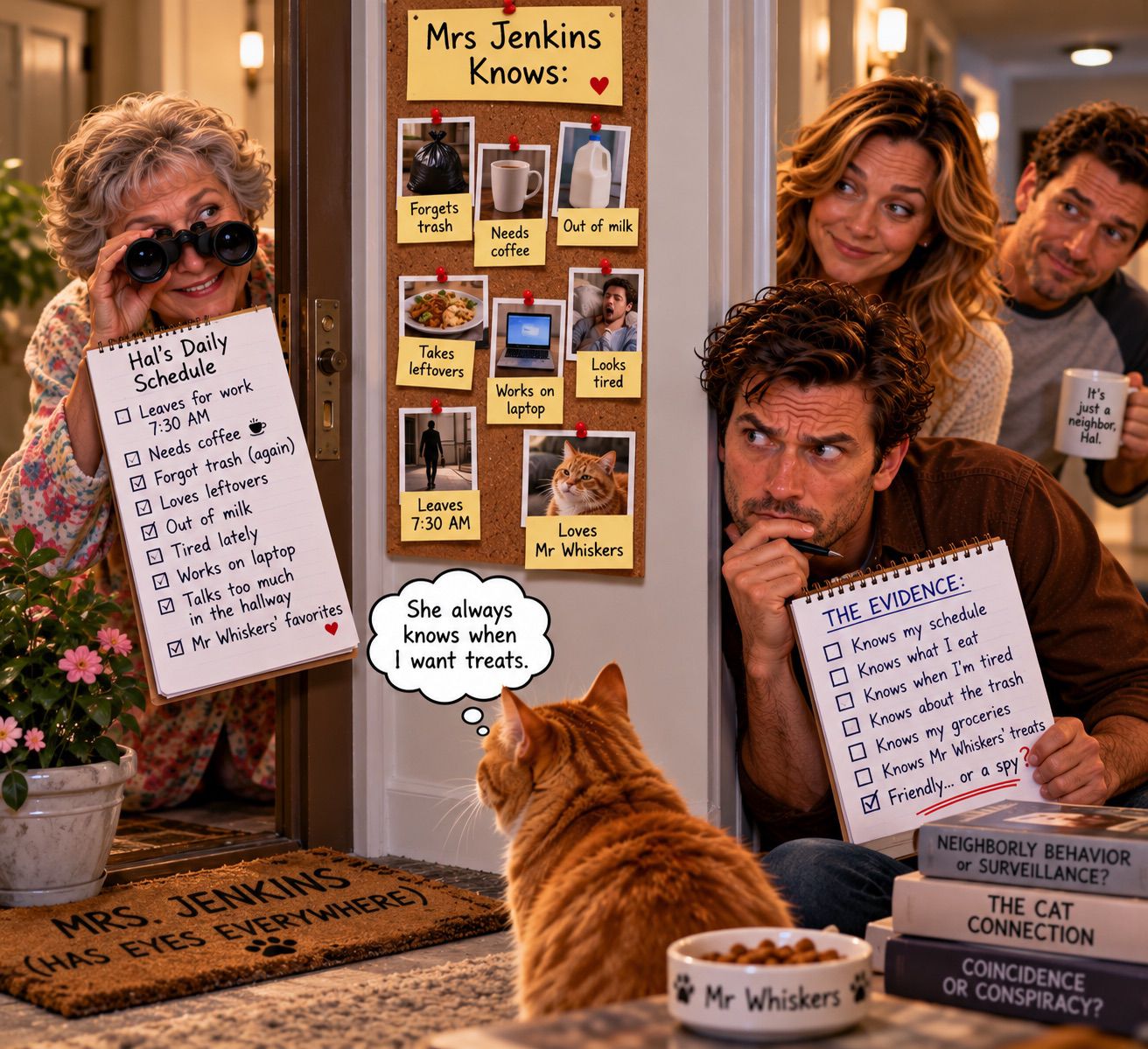
I’m sitting at the kitchen table trying to concentrate on my laptop, but concentration becomes difficult when you discover that your neighbor may possess a more comprehensive understanding of your daily routine than you do. This started last night when Pandora casually mentioned that Mrs Jenkins thought I looked tired. There was nothing particularly alarming about the statement until I asked when Mrs Jenkins had seen me. Pandora said she wasn’t sure. Apparently Mrs Jenkins had simply mentioned it while they were talking in the hallway. That should have been the end of it, except this morning John Mercer came into the kitchen and told me there was fresh coffee because Mrs Jenkins had suggested I might need an extra cup. I stopped typing. “Why does Mrs Jenkins think I need extra coffee?” John shrugged and said, “Probably because you always look half dead before eight.” I told him that wasn’t an explanation. It was corroboration.
Pandora was standing at the counter making toast, so I asked exactly how much Mrs Jenkins knew about my morning routine. She looked at me in the way she does when she already suspects the direction of the conversation and wishes she could redirect it before I arrive there. “She lives across the hall, Hal.” I explained that proximity does not automatically produce knowledge. Mrs Jenkins apparently knows what time I leave for work, what time I usually get home, that I drink coffee in the morning, that I occasionally forget to take the trash out, and that I have recently been tired. Pandora pointed out that Mrs Jenkins knows when I leave because she can hear our front door, knows when I come home because she sometimes sees me in the hallway, knows about the trash because I have left it beside the door more than once, and knows I drink coffee because I frequently stand in the hallway holding a coffee cup while talking to her. These were reasonable explanations individually. Collectively, they demonstrated an uncomfortable level of observational coverage.
John made the situation worse by opening the refrigerator and asking whether I wanted the leftover pasta for lunch. Before I could answer, he said, “Actually, Mrs Jenkins said you probably would.” I slowly turned toward him. “Why was Mrs Jenkins discussing my lunch?” John explained that she had stopped him in the hallway that morning, asked whether we had finished the pasta from the night before, and said I always seemed to take leftovers to work. I closed the laptop because whatever I had been trying to accomplish was no longer the most important matter in front of me. Pandora told me not to start. I told her I hadn’t started anything; Mrs Jenkins apparently had. “She asked about pasta,” Pandora said. “Today it’s pasta,” I replied. “Yesterday it was fatigue. Last week she knew I’d forgotten the trash. At what point does neighborly awareness become data collection?” John said probably considerably later than pasta.
I tried to put the matter aside when I went to work, but that lasted until Karen asked why I kept looking toward the office door every time someone walked past. I explained that I had recently discovered Mrs Jenkins maintained what appeared to be an informal awareness of my movements, eating habits, sleep condition, and waste-disposal schedule. Karen stared at me for a few seconds before asking, “Your neighbor knows when you leave the house?” I told her that was an oversimplification. Dave overheard enough of the conversation to ask what Mrs Jenkins had actually done. I gave him the evidence. He listened carefully and then said, “So she talks to you guys.” I explained that communication and intelligence gathering are not mutually exclusive activities. Karen asked whether Mrs Jenkins had ever used any of this information against me. I admitted she had not. Dave asked whether she had ever concealed the fact that she knew these things. Again, no. Karen said, “That might be the worst spy I’ve ever heard of.” I told her effectiveness should not be judged solely by adherence to traditional espionage practices.
When I got home, Mrs Jenkins was standing in the hallway watering a plant outside her door. I said hello and attempted to continue into the apartment without providing any unnecessary information, but she looked at the grocery bag in my hand and said, “You finally remembered milk.” I stopped. There are moments when instinct overrides methodology. “How did you know I needed milk?” I asked. Mrs Jenkins looked confused. She reminded me that the previous evening I had opened the refrigerator while she was returning Pandora’s container and said, out loud, “We’re almost out of milk.” I had no memory of saying this, but Pandora, who had opened our door while we were talking, confirmed that I had. Mrs Jenkins smiled and said, “You also said you needed coffee filters.” I looked down at the grocery bag. I had forgotten the coffee filters. Mrs Jenkins went back into her apartment while Pandora stood in our doorway trying very hard not to laugh.
This should have weakened my theory, but instead it introduced a different concern. Mrs Jenkins wasn’t secretly gathering information about me. I was apparently broadcasting it. Over the next hour, Pandora helped reconstruct several other incidents. Mrs Jenkins knew I was tired because I had told her I hadn’t slept well. She knew I kept forgetting the trash because she had watched me open the door twice, see the bag, say something I won’t repeat, and go back inside to get it. She knew I took leftovers to work because I had once explained this while returning one of her containers. She knew when I usually left in the morning because we had crossed paths repeatedly. She even knew I had been having trouble with my laptop because I had spent ten minutes complaining about it while she was checking her mail. “So basically,” Pandora said, “Mrs Jenkins knows things about you because you keep telling Mrs Jenkins things about you.” I told her that phrasing made the situation sound unnecessarily self-inflicted.
John was enjoying this far more than necessary. He pointed out that Mrs Jenkins probably knew things about all of us because she is retired, friendly, observant, and spends more time in the building than we do. That was when Mr Whiskers wandered into the kitchen and sat beside the front door. A few seconds later there was a knock. Mrs Jenkins stood outside holding a small bag of cat treats. “I bought the salmon ones he likes,” she said. Mr Whiskers immediately walked toward her. I looked at the cat, then at Mrs Jenkins, then at the treats. “How did you know those were his favorite?” I asked. She said Pandora had told her. Pandora confirmed this. Mrs Jenkins gave Mr Whiskers one treat, scratched his head, and returned across the hall. Mr Whiskers remained beside the door staring after her. I told Pandora this was exactly how informal information networks develop. She told me it was exactly how cats get snacks.
Later that evening I finally returned to my laptop, satisfied that I had identified the actual mechanism. Mrs Jenkins was not conducting surveillance. She was simply paying attention while the rest of us voluntarily supplied her with information, which I’ll admit is significantly less sinister but arguably more efficient. I explained this conclusion to Pandora, who said, “So Mrs Jenkins isn’t behind anything?” I told her I wouldn’t phrase it that way. She is still clearly a central node in the building’s information environment; she just doesn’t appear to be using that position maliciously. Pandora rolled her eyes and went back to reading. A few minutes later, I heard Mrs Jenkins’ door open across the hall. Mr Whiskers immediately jumped down from the couch, walked to our front door, and sat there waiting. I looked at him. He looked at the door. Then, from the hallway, I heard Mrs Jenkins say, “I know you’re in there, handsome.” Mr Whiskers meowed once and looked at me. I’m willing to accept that Mrs Jenkins isn’t running a surveillance operation. I’m considerably less certain that she hasn’t established an informant.