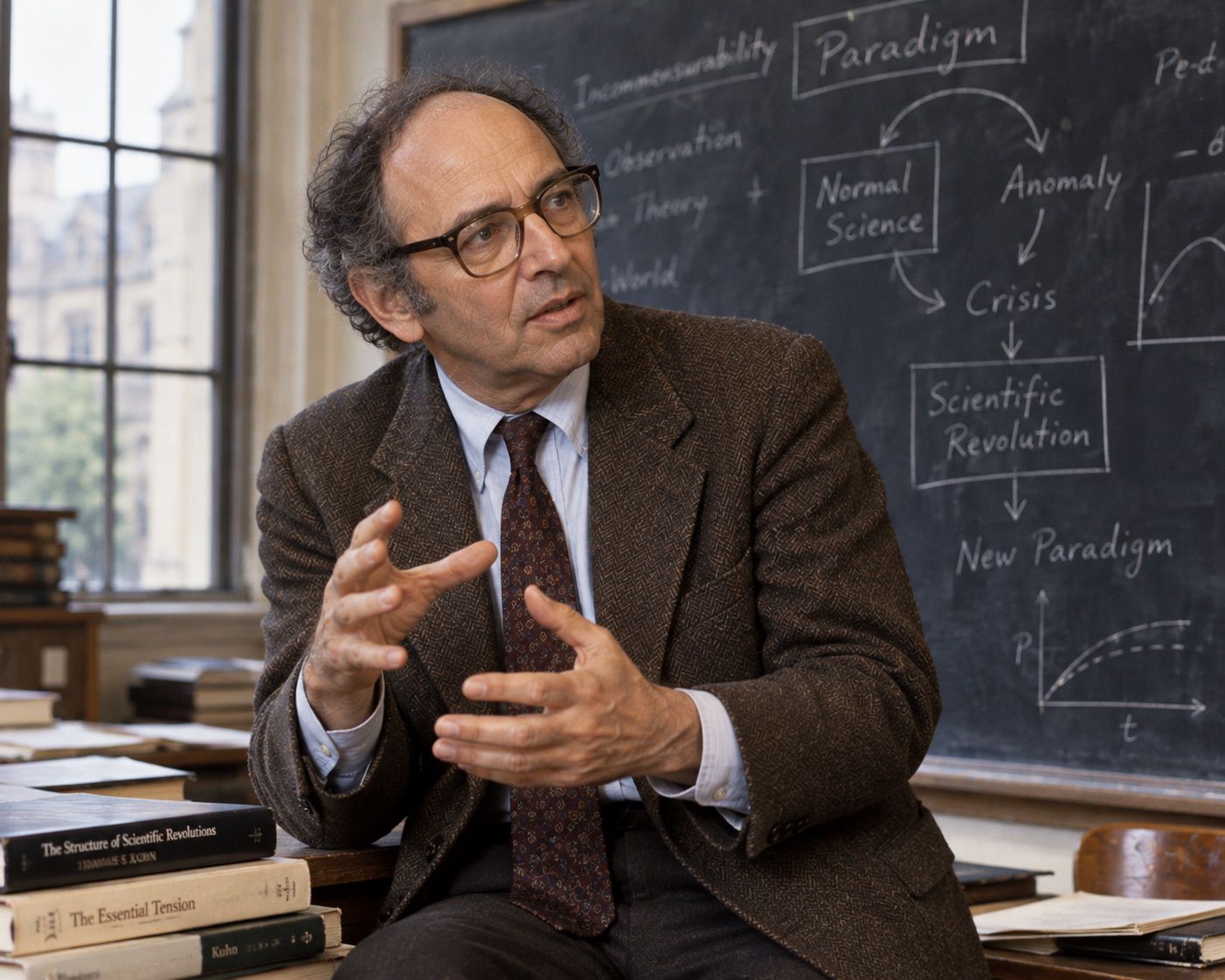
Thomas Kuhn’s name keeps popping up in my philosophy of science class, and I have to admit, it’s been a bit disorienting. At first, I thought I was familiar with him – the “paradigm shift” phrase is ubiquitous enough, after all. But as we delved deeper into his ideas, I realized that I had never actually read any of his work or really understood what he was getting at.
I suppose that’s part of why Kuhn fascinates me: he challenges my assumptions about knowledge and how it’s acquired. As someone who’s spent years in academia, I’ve always assumed that progress is linear – that we build upon the discoveries of those who came before us, refining our understanding of the world incrementally. But Kuhn argues that scientific progress is more like a series of revolutions, where one paradigm (or way of thinking) gives way to another.
I find this idea unsettling because it implies that my entire education has been based on a flawed assumption. What if everything I thought I knew about physics or biology or literature was just a product of the dominant paradigm at the time? It’s like realizing that the language I’ve spent years mastering is actually a form of mental conditioning, designed to keep me in line with the status quo.
Kuhn’s concept of “incommensurability” – the idea that different paradigms are mutually unintelligible and can’t be compared directly – has been particularly tricky for me to wrap my head around. It implies that there’s no objective truth, just a series of subjective perspectives that are forever at odds with one another. I’ve always prided myself on being able to see multiple sides of an argument, but Kuhn’s ideas have made me wonder if that’s just a form of relativism – a way of avoiding the possibility that some perspectives might be inherently better than others.
Sometimes I feel like I’m trapped in a never-ending feedback loop: the more I learn about Kuhn’s ideas, the more I realize how little I actually understand. It’s like trying to grasp a fistful of sand – the harder I squeeze, the more it slips through my fingers. I’ve started to wonder if this is what it feels like to be a scientist in the midst of a paradigm shift: a sense of disorientation and upheaval as the old certainties are turned on their head.
One thing that’s intrigued me about Kuhn is his own intellectual journey. He was a physicist by training, but he ended up becoming a philosopher of science because he felt stifled by the limitations of traditional scientific inquiry. I identify with this sense of frustration – feeling like there must be more to life than the narrow scope of my field or department. But what does it mean to “follow your passion” when that passion might lead you down a path that’s completely uncharted?
As I continue to grapple with Kuhn’s ideas, I’m starting to realize just how much they’re challenging me to think about my own place in the world. Am I just a cog in a larger machine, churning out knowledge according to the dominant paradigm? Or can I find ways to subvert or disrupt that system from within? It’s a scary and exhilarating prospect, like standing on the edge of a precipice with no safety net below.
I’m not sure where this is all leading – or if it will ever lead anywhere. But for now, Kuhn’s ideas have become a kind of intellectual virus that I’m still trying to fight off. It’s not comfortable, but it’s also strangely liberating: the more I question my assumptions, the more I feel like I might just be able to see the world in a whole new way.
As I navigate the unsettling terrain of Kuhn’s ideas, I find myself drawn to his notion of “normal science” – the process by which scientists within a dominant paradigm incrementally refine and expand its boundaries without ever fundamentally challenging it. It sounds like a recipe for complacency, but Kuhn argues that normal science is actually a crucial part of scientific progress, allowing for the accumulation of knowledge and the development of new techniques.
But what about those who can’t or won’t conform to the dominant paradigm? What about the outliers, the dissenters, and the revolutionaries who challenge the status quo from within or without? Kuhn doesn’t really address this question directly, but I’ve started to wonder if these individuals might be more than just anomalies – if they might actually be harbingers of change.
Take, for example, Galileo Galilei, who defied the Aristotelian orthodoxy of his time and laid the groundwork for modern physics. Or consider Rachel Carson, who challenged the chemical industry’s assertions about the safety of pesticides in her groundbreaking book Silent Spring. These individuals, among many others, embody a kind of scientific subversion – using their knowledge to disrupt the dominant paradigm and create new paths forward.
As I reflect on my own experiences within academia, I realize that I’ve often felt stifled by the limitations of normal science. My research projects have been driven by a desire to make incremental contributions to my field, but what if those contributions were just maintaining the status quo rather than challenging it? What if I’m perpetuating the very system that Kuhn argues is flawed?
This realization has left me feeling both empowered and terrified. On one hand, I feel like I have the freedom to challenge the dominant paradigm and forge a new path – but on the other hand, I’m aware of the risks involved in doing so. What if I fail? What if my ideas are rejected or ridiculed?
As I ponder these questions, I find myself turning back to Kuhn’s own story. He spent years teaching physics at Harvard before eventually becoming disillusioned with the limitations of traditional scientific inquiry and shifting his focus to philosophy. It’s a testament to the power of intellectual curiosity – and also a reminder that even the most esteemed scholars can experience a crisis of faith.
For me, Kuhn’s ideas have become a kind of mirror held up to my own desires and fears. Am I content to remain within the familiar boundaries of normal science, or do I want to take risks and challenge the status quo? The answer is far from clear, but one thing is certain: as I continue to grapple with Kuhn’s ideas, I’m being forced to confront the very foundations of my own intellectual pursuits.
As I reflect on the concept of normal science, I find myself wondering about the role of institutional pressures in shaping scientific inquiry. Kuhn mentions that scientists within a dominant paradigm are often rewarded for their incremental contributions, but what if those rewards come at the cost of stifling genuine innovation? What if the pressure to conform to established norms and expectations actually discourages scientists from taking risks or challenging the status quo?
I think about my own experiences with research projects and papers. I’ve always felt like I need to produce a certain type of output, one that’s carefully formatted and neatly packaged for peer review. But what if that’s not enough? What if I’m just perpetuating a system that values superficial conformity over genuine intellectual curiosity?
Kuhn’s ideas have made me realize that the pursuit of knowledge is often deeply tied to social and cultural contexts. In his time, scientists like Galileo were persecuted for their ideas – a stark reminder that scientific progress can be hindered by societal norms and expectations. Similarly, I think about how my own field has struggled with issues of diversity and inclusion, and how those struggles have impacted the types of questions we ask and the kinds of knowledge we produce.
It’s funny – as I grapple with Kuhn’s ideas, I feel like I’m being forced to confront a whole new level of responsibility. As a scientist, I thought my job was simply to discover and describe the world around me. But Kuhn’s ideas have made me realize that science is also a social practice, one that involves making choices about what questions to ask and how to answer them.
I’m not sure where this leaves me – but I do know that I feel a sense of unease when I think about the power dynamics at play in scientific inquiry. Who gets to decide what counts as “good” science? How do we balance the need for incremental progress with the desire for radical innovation?
As I struggle to make sense of these questions, I find myself thinking about Kuhn’s concept of “revolutionary science.” He argues that revolutionary scientists are those who challenge the dominant paradigm and create new ways of thinking – often by drawing on insights from outside their own field. What if I’m one of those scientists? What if my own interests and passions can lead me to create something truly new and innovative?
The thought sends a shiver down my spine. It’s exhilarating, but also terrifying – like standing at the edge of a cliff with no safety net below. And yet…I feel a sense of liberation too, like I’m finally free to explore the questions that have been nagging me for so long.
As I write this, I realize that Kuhn’s ideas are still percolating in my mind, refusing to be pinned down or dismissed. They’ve become a kind of intellectual itch, one that I need to scratch in order to make sense of myself and my place in the world. It’s not an easy process – but it’s one that feels essential to who I am as a thinker and a scientist.
I find myself drawn back to Kuhn’s notion of revolutionary science, wondering if there are ways for me to tap into that kind of thinking within my own work. It’s not just about challenging the dominant paradigm, but also about finding new paths forward, ones that might lead to unexpected breakthroughs.
As I reflect on my own research projects, I realize that I’ve often been driven by a desire to answer specific questions or solve particular problems. But what if those questions are themselves products of the dominant paradigm? What if they’re not actually getting at the heart of the matter?
Kuhn’s ideas have made me think about the importance of questioning my own assumptions and biases. As a scientist, I’m trained to be objective and detached, but that can sometimes lead to a kind of intellectual laziness – a failure to truly engage with the complexities of the world.
I think about the way that scientists often frame their questions in terms of what’s “objectively” true or false. But Kuhn argues that these kinds of distinctions are always relative to the dominant paradigm, and that true objectivity is often an illusion. This has made me realize just how much my own research projects have been influenced by the cultural and social contexts in which I’m working.
As I grapple with these ideas, I find myself feeling a sense of disorientation – like I’m navigating a maze without a map. But it’s also exhilarating, because for the first time in my life as a scientist, I feel like I’m truly thinking about the nature of knowledge and how it’s acquired.
Kuhn’s ideas have made me question whether science can ever be truly “pure” or objective. Is there always some element of subjectivity or cultural bias at play? And if so, what does that mean for our understanding of scientific truth?
I think about the way that scientists often talk about their work as if it’s separate from themselves – as if they’re somehow observing the world from outside, untouched by their own experiences and emotions. But Kuhn argues that science is always a deeply personal endeavor, one that involves making choices and commitments based on our own values and beliefs.
This has made me realize just how much my own research projects have been influenced by my own personal history and experiences. I think about the way that growing up in a certain cultural or social context can shape our assumptions about the world – and how those assumptions can sometimes lead us astray.
As I reflect on these ideas, I feel like I’m being forced to confront the limits of my own knowledge and understanding. It’s a scary thought, but also a liberating one – because it suggests that there’s always more to learn, more to discover, and more to explore.
I’m not sure where this journey will lead me, but I do know that Kuhn’s ideas have become a kind of compass for me – guiding me toward new questions and new possibilities. And as I continue to grapple with his ideas, I feel like I’m finally starting to see the world in a whole new way.