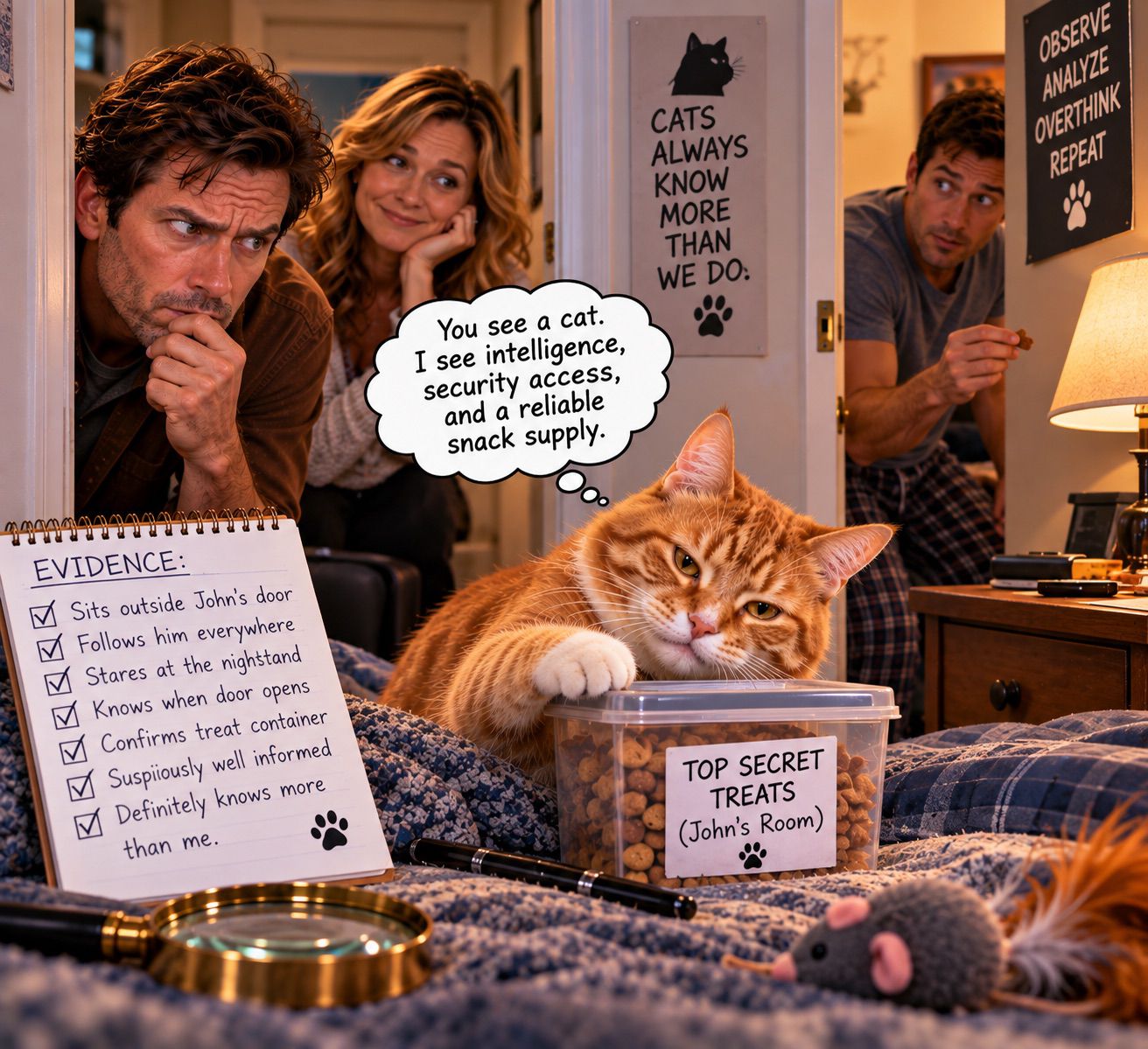
I walked into the kitchen that morning and immediately noticed Pandora’s coffee mug sitting on the counter. There were maybe three sips left in the bottom, which ordinarily wouldn’t have meant anything because Pandora has been known to abandon coffee in virtually every room of the house, but this particular mug was sitting beside her phone. That was unusual. She normally charged her phone in the living room or took it upstairs with her, and yet there it was, plugged into the kitchen outlet as if it had spent the night there. I stood there looking at the mug, then the phone, then the mug again, trying to decide whether two unusual objects in close proximity constituted a pattern. Behind me, John Mercer was snoring loudly enough from his room that I could hear him through the hallway, while Mr Whiskers was curled up on his cushion by the window looking completely unconcerned. Everything seemed normal, which, after the last few weeks, somehow made me suspicious.
I poured myself some coffee and tried to approach the situation rationally. Pandora had probably left her phone in the kitchen because the battery was low. She had probably left the coffee because she was in a hurry. John was probably sleeping late because he had stayed up too late doing whatever John does in his room when the rest of us have gone to bed. These were all perfectly reasonable explanations, and I was actually feeling pretty good about my ability to accept them when Mr Whiskers woke up, stretched, walked straight past me, and disappeared down the hallway toward John’s bedroom. I followed him far enough to observe—not investigate—that he stopped directly outside John’s closed door, sat down, and stared at it. He didn’t scratch. He didn’t meow. He just sat there looking at the door with the kind of patience normally associated with someone who knows exactly what is going to happen next. “What do you know?” I whispered. Mr Whiskers looked at me, then looked back at the door. That was not an answer, but it wasn’t exactly reassuring either.
Pandora came downstairs a few minutes later and found me standing in the hallway with a cup of coffee while Mr Whiskers maintained his position outside John’s room. She stopped when she saw us. “No,” she said. I hadn’t asked anything yet, which bothered me immediately. I told her that saying no before I had presented a question suggested she already knew what the question was going to be. She said it suggested she had lived with me long enough to recognize the beginning of an investigation. I corrected her and explained that I was conducting an observation concerning a recent change in Mr Whiskers’ sleeping habits. For the last several nights, I had noticed him spending an unusual amount of time near John’s door, and Mrs Jenkins had mentioned the same thing when she saw him sitting there yesterday. Pandora took her phone from the kitchen counter, unplugged it, and said, “Maybe he likes sitting there.” I told her that cats do not repeatedly select the same observation post without a reason. “It’s a hallway, Hal.” “Exactly,” I said. “A strategically important hallway.”
John finally emerged about twenty minutes later looking like someone who had lost an argument with sleep. Mr Whiskers immediately stood up and followed him into the kitchen. That got my attention. John opened the refrigerator, took out some orange juice, and poured himself a glass while the cat sat approximately six inches from his left foot staring upward. I asked John whether anything unusual had happened in his room recently. He looked at me for several seconds and said, “Define unusual.” I told him that his request for clarification was itself interesting. Pandora, who was making toast, told me it wasn’t. I asked John whether Mr Whiskers had been entering his room at night. John said sometimes. I asked whether he had encouraged this behavior. He said he hadn’t thought about it. I asked whether anything had changed in the room that might explain the cat’s increased interest. John shrugged and said, “Not really.” Mr Whiskers continued staring at him. I wrote down “not really” because qualifiers matter.
By the time I got to work, I had developed three possible explanations, although only two were plausible and the third involved Mr Whiskers detecting some subtle environmental change that humans were incapable of perceiving. I mentioned the situation to Karen, carefully limiting my description to observable facts: the repeated positioning outside John’s door, the immediate following behavior when John emerged, and John’s suspicious use of the phrase “not really.” Karen listened for a moment before asking the obvious question. “Does John feed him?” I explained that we had already instituted a household feeding log precisely because Mr Whiskers had previously exploited informational asymmetry to obtain multiple breakfasts. Dave looked over from his desk and said, “Maybe John has food in his room.” I told him John knew better than to leave food where Mr Whiskers could reach it. Dave said, “I didn’t say he left it where the cat could reach it.” That distinction bothered me for the rest of the afternoon.
When I got home, Mr Whiskers was once again stationed outside John’s bedroom. This time I decided to conduct a controlled observation. I sat in the living room where I could see the hallway and waited. Pandora asked what I was doing, and I told her I was reading. She pointed out that I wasn’t holding a book. I told her I was thinking about reading. Approximately eleven minutes later, John came downstairs carrying a laundry basket. Mr Whiskers immediately stood and followed him. John went into the laundry room, and the cat stopped at the doorway. John came back out, and the cat followed him into the kitchen. John opened a cabinet, and Mr Whiskers sat down. John closed the cabinet without taking anything out, and the cat remained seated. Then John walked toward the stairs, and Mr Whiskers followed him again. At that point I felt the evidence had become difficult to dismiss. “He’s tracking you,” I told John. John looked down at the cat and said, “Apparently.” Pandora told me that following a person around the house was fairly standard cat behavior. I agreed, but pointed out that standard behavior can still have a specific motivation.
The breakthrough came after dinner. John went upstairs, and within seconds Mr Whiskers followed him. I waited long enough that nobody could accuse me of immediately pursuing them, then walked upstairs for an unrelated reason that I had not yet determined. John’s bedroom door was open. He was standing beside his desk while Mr Whiskers had his front paws on the edge of the bed, staring intensely at the nightstand. That was when I saw it: a small plastic container sitting beside John’s lamp. “What’s in that?” I asked. John looked at the container, then at me. “Cat treats.” I stared at him. Pandora, who had apparently followed me because she recognized the sound of a developing situation, leaned against the doorway and started laughing. John explained that a few nights earlier he had brought a bag of treats upstairs because Mr Whiskers had followed him into the room. He had given him two, put the rest in the container, and forgotten about them. Since then, Mr Whiskers had apparently concluded that John’s bedroom was now a secondary food distribution center.
I looked down at Mr Whiskers, who was still staring at the container with absolute concentration, and suddenly several days of evidence reorganized itself into a much less interesting but considerably more coherent explanation. He wasn’t monitoring John. He wasn’t sensing changes in his behavior. He wasn’t guarding the hallway or detecting something the rest of us couldn’t perceive. He knew there were treats in John’s room. More importantly, he knew exactly which human had put them there. “So he did know something,” I said. Pandora sighed. “Hal.” I held up one hand because this distinction mattered. “My interpretation was wrong. The underlying observation was completely accurate.” John gave Mr Whiskers one treat, then carried the container downstairs and put it with the rest of the cat food. Mr Whiskers followed him the entire way.
That night, I was sitting on the couch when Mr Whiskers climbed onto my lap, circled twice, and settled down as if the matter had been resolved to his satisfaction. I scratched behind his ears and considered what I had learned. For several days, that cat had possessed information I did not have. He knew there were treats upstairs. He knew John controlled access to them. He knew exactly where they were stored, and rather than sharing any of this information with the rest of the household, he had simply positioned himself where he believed it would produce the best outcome. Pandora says this proves he’s a normal cat. I think it proves the title of this story was accurate from the beginning. Mr Whiskers knew more than me. The only part I got wrong was what he knew.