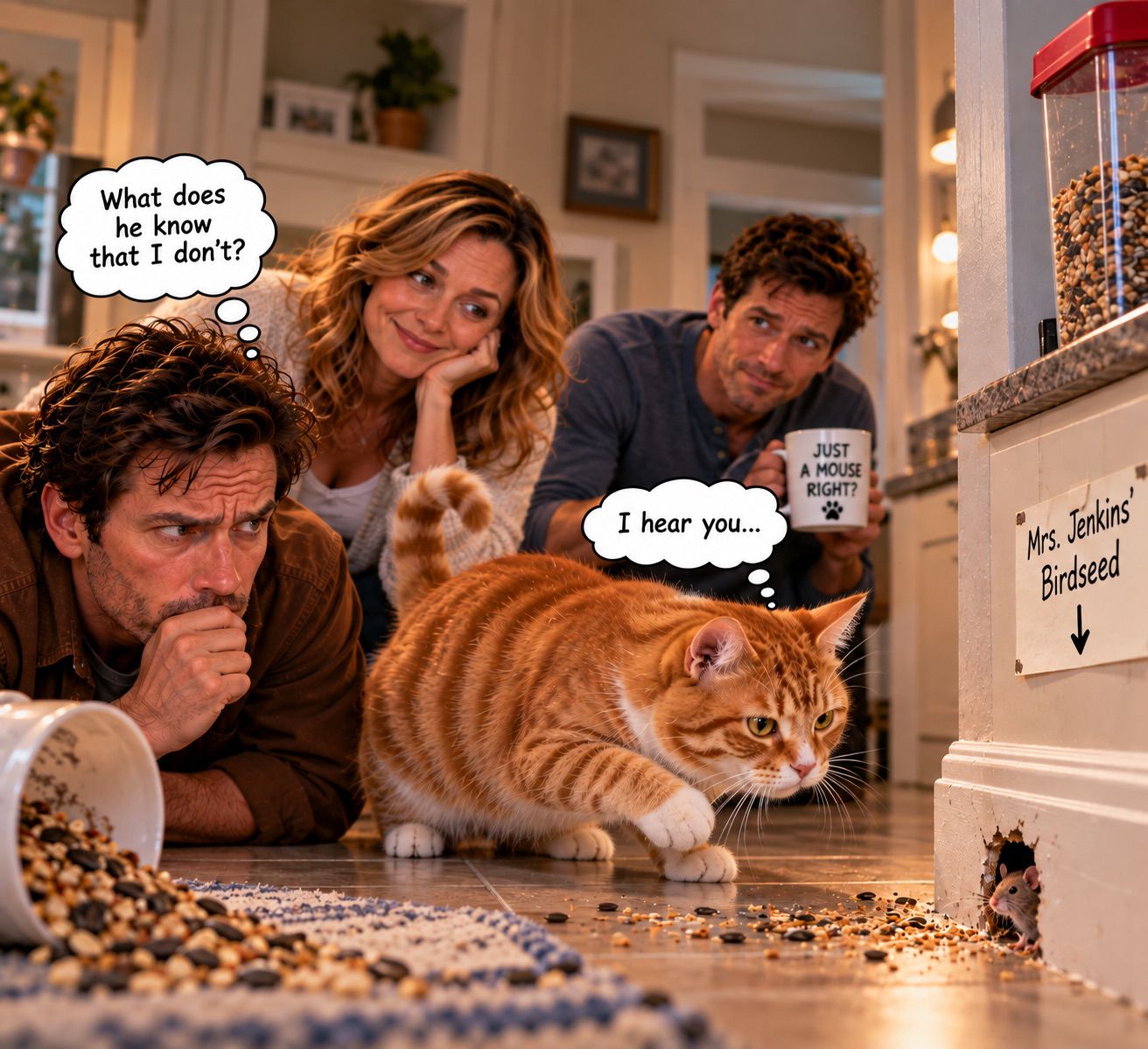
I’m trying to get ready for work, but Mr Whiskers has apparently decided that whatever I have planned for the morning is less important than whatever is happening near the kitchen wall. Every time I reach for the coffee, he meows at me, paws at my leg, then walks toward the far end of the kitchen and looks back to make sure I’m following him. I am not following him, obviously, because I have responsibilities and because following a cat around your own house at six-thirty in the morning is how you surrender authority. Still, after the fourth trip, I notice he isn’t actually looking at me anymore. He’s staring at the wall beside the cabinet, ears forward, completely motionless. Then he looks at me, meows once, and looks back at the wall. I stop pouring coffee. “What?” I ask. Mr Whiskers stares at the wall. “That is not an answer.”
Pandora walks into the kitchen a few minutes later, still half asleep, and finds me standing beside the counter with my coffee while Mr Whiskers sits approximately three feet away staring at the baseboard. She looks at him, looks at me, and says, “No.” I haven’t said anything yet, which bothers me more than it should. “I was only going to ask whether you’ve noticed him doing this,” I tell her. She pours herself some coffee and says she has noticed because he has been doing it since sometime before dawn. That changes things. A single incident is cat behavior. Repeated behavior over several hours is a pattern. Pandora says it is still cat behavior. I ask whether she heard anything unusual during the night, smelled anything unusual, or noticed any structural changes to the wall. She slowly lowers her coffee. “Hal, do not dismantle the kitchen.” I tell her nobody said anything about dismantling anything. Mr Whiskers meows again. Pandora points at him and says, “Neither did he.”
John Mercer comes out of his room while I’m crouched near the baseboard conducting what I would describe as a preliminary visual inspection. He steps around me, opens the refrigerator, and asks what I’m doing. I explain that Mr Whiskers has demonstrated sustained interest in a specific section of wall for several hours and that I’m attempting to determine why. John takes out the milk, looks at the cat, then looks at the wall. “Mouse,” he says. I tell him there is currently no evidence of a mouse. He asks what evidence I currently have, and I point to Mr Whiskers. John looks at the cat again. “That’s pretty good evidence of a mouse.” I explain that Mr Whiskers has previously demonstrated sustained interest in an empty grocery bag, a sock, a reflection from Pandora’s watch, and a piece of toast, so his evidentiary reliability is mixed. John pours milk into a glass and asks, “Then why are you on the floor?” This is a fair question, but I don’t appreciate the timing.
The strange part is that Mr Whiskers doesn’t lose interest after breakfast. Usually whatever occupies his attention eventually gets replaced by food, sleep, a patch of sunlight, or the opportunity to sit directly on something I’m using, but this time he keeps returning to the same spot. He eats, disappears for twenty minutes, comes back, and resumes surveillance. At one point he puts his nose against the baseboard and makes a small chirping sound. I have heard him make that sound at birds before, which introduces a new possibility. Mrs Jenkins keeps birdseed next door for the feeders outside her window, and our kitchens share a wall. I mention this to Pandora, who is putting dishes into the dishwasher. “So?” she asks. “So Mr Whiskers may be detecting activity associated with the birdseed.” Pandora closes the dishwasher and says, “You mean a mouse.” I tell her I’m not prepared to narrow the investigation prematurely.
I leave for work with the matter unresolved, which proves surprisingly difficult. Halfway through the morning, Karen asks why I keep staring at the same paragraph on my screen, so I tell her there may be an unexplained situation involving Mr Whiskers, a shared wall, and Mrs Jenkins’ birdseed. Karen waits several seconds before asking, “Mouse?” I tell her John reached the same conclusion but that two people independently making the same assumption does not transform an assumption into evidence. “Three,” she says. When I ask what she means, she explains that she also thinks it’s a mouse. I decide not to discuss it further because consensus can create methodological bias. Unfortunately, Karen tells Dave, who walks past my desk later and makes a squeaking noise without stopping. Neither of them contributes anything useful after that.
When I get home, Mr Whiskers is waiting near the kitchen wall, except this time John is standing there too, which initially concerns me until he explains that he heard scratching. Pandora comes in behind me and says, “Mouse,” before I can even put my bag down. I ask everyone to stop reaching conclusions before we establish the facts, at which point there is a knock at the door. Mrs Jenkins is standing in the hallway holding a plastic container with a chewed corner and looking annoyed. “Do any of you happen to have a mousetrap?” she asks. There is a brief silence as John looks at me, Pandora looks at me, and I look at Mr Whiskers. Mrs Jenkins explains that she found birdseed scattered across her kitchen floor that morning and heard something scratching behind the cabinet. Apparently she had moved the birdseed indoors a few days earlier because squirrels kept getting into it outside. “I think I have a mouse,” she says. Pandora makes the mistake of smiling.
This presents me with an uncomfortable evidentiary development because Mr Whiskers had, in fact, detected something none of us had noticed. He identified the general location several hours before John heard the scratching, before Mrs Jenkins discovered the damaged container, and before I had sufficient evidence to establish even the existence of a mouse. Pandora seems much too pleased about this. “So the cat knew something you didn’t,” she says. I explain that Mr Whiskers possesses auditory and olfactory capabilities significantly different from mine, which makes direct comparison inappropriate. John says, “The cat beat you.” I tell him this isn’t a competition. He asks why I look disappointed, and I explain that I’m not disappointed; I’m reassessing the methodology. Pandora says that sounds remarkably similar to being disappointed, but I decide there is no benefit in pursuing that particular line of discussion.
Mrs Jenkins borrows a humane trap, and by that evening everything has returned to normal. Pandora is reading on the couch, John is in his room, and I’m trying to enjoy television without thinking about the fact that Mr Whiskers identified an actual household anomaly before I did. He jumps onto the couch beside me, circles twice, and settles against my leg, so I scratch behind his ears and explain that although his contribution was useful, one successful observation does not establish him as a reliable investigative partner. He purrs as though he understands this, and for several minutes I begin to feel that the matter has been satisfactorily resolved. Then his ears suddenly turn toward the ceiling. The purring stops. He lifts his head and stares upward. I follow his gaze, then look back at him. “No,” I say. Mr Whiskers ignores me and continues staring at the ceiling. I’m not saying there’s something up there. I’m just saying that after the mouse situation, I’m no longer comfortable ignoring him.