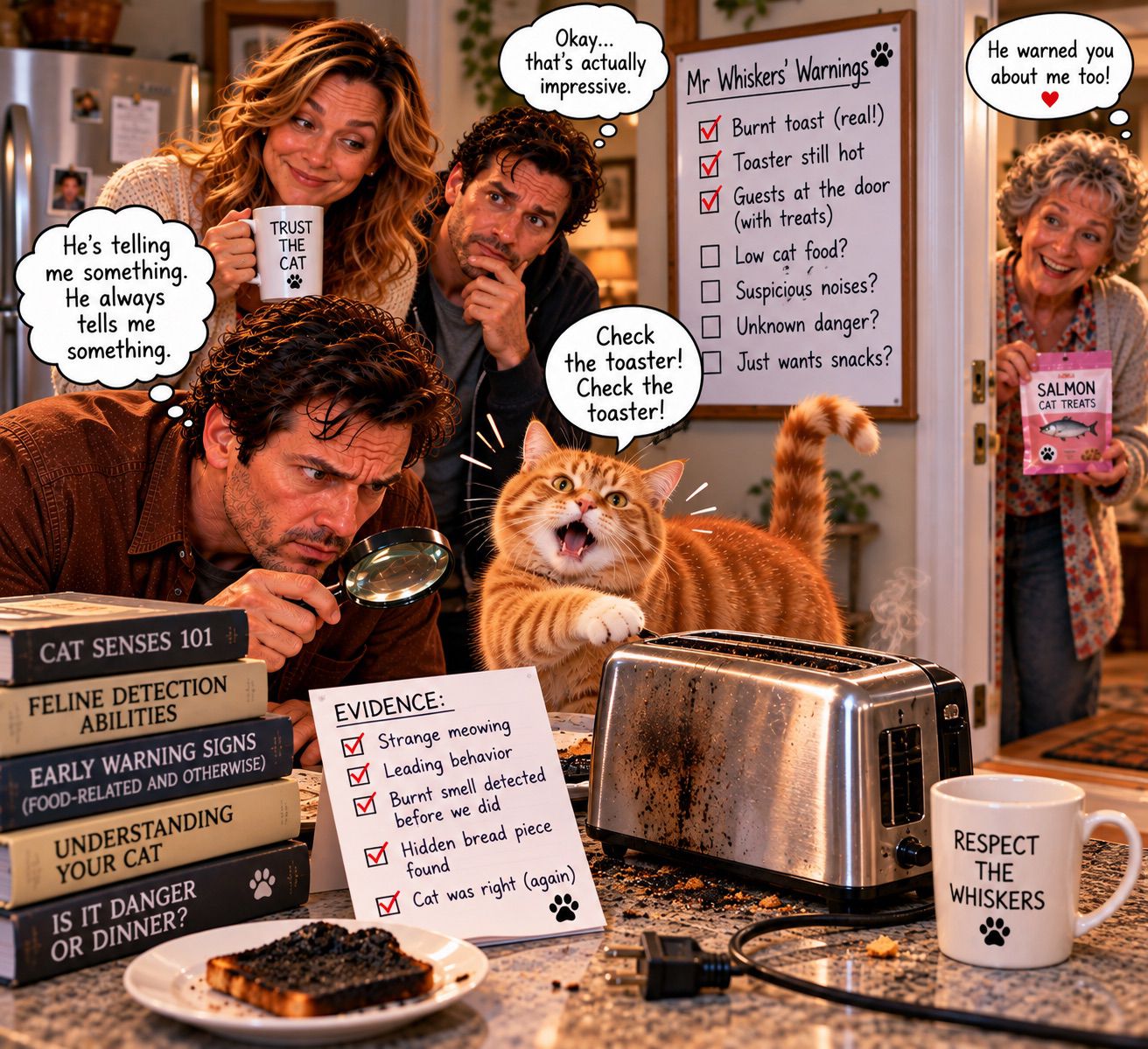
I’m sitting in the living room trying to focus on my laptop when I notice Mr Whiskers behaving strangely. Pandora has just walked out of the kitchen with a cup of coffee and is standing near the window, staring toward the wall beside it. Mr Whiskers walks over to her, looks up, and meows. Pandora doesn’t respond. He meows again, louder this time, then turns toward me as though I’m somehow responsible for her failure to acknowledge him. John Mercer pokes his head out of the hallway and asks whether everything is okay. Pandora says, “Fine,” without looking away from the wall. John looks at me. I look at Pandora. Mr Whiskers looks at all three of us. Then John says, “Okay,” in the careful tone of someone who has decided that whatever is happening can continue without his participation, and disappears back toward his room. Under ordinary circumstances I would agree with him, except Mr Whiskers is now pacing between Pandora and the kitchen with increasing urgency. Something is clearly bothering him.
There is also still a faint smell of burnt toast in the house from breakfast, which I initially dismiss because the toast incident has already been explained. John put bread in the toaster, became distracted, and produced something with the approximate structural properties of roofing material. We opened the kitchen window, disposed of the evidence, and moved on. At least I thought we had. Mr Whiskers apparently has not. He walks toward the kitchen, stops, looks back at me, and meows again. “What?” I ask. He takes three more steps toward the kitchen. I stay where I am. He returns, sits directly in front of me, and meows. Pandora finally looks away from the wall. “I think he wants you.” I tell her I had already reached that conclusion. What I haven’t established is why. “Probably food,” she says. I remind her that he ate less than an hour ago. Mr Whiskers immediately walks toward the kitchen again. Pandora takes a drink of coffee. “Then go see what he wants.” I don’t appreciate how casually she says this. Following a cat because he tells you to sets a precedent.
I eventually get up, primarily because the meowing is interfering with my concentration. Mr Whiskers leads me into the kitchen, walks past his food bowl, and stops near the counter. This is important because it eliminates hunger as the primary motive. I look at the counter. Nothing appears unusual. The toaster is where it always is. The coffee maker is off. The sugar container has its lid firmly attached, which I check because recent events have made that worth confirming. Mr Whiskers looks up at the counter and meows. I ask what he is trying to show me. He looks toward the toaster. I look at the toaster. He looks at me. I look back at him. There is an uncomfortable amount of communication occurring considering that only one of us speaks English. I unplug the toaster. Mr Whiskers continues meowing. Apparently that was not sufficient.
Pandora joins us and asks what I’m doing. I tell her Mr Whiskers appears to be directing my attention toward the toaster. She looks at the cat, then at the toaster, and says, “Maybe he smells the burnt bread.” That is plausible but incomplete. The bread has been gone for hours. I lean closer to the toaster and notice that the burnt smell is stronger than it should be. Pandora notices it too. I lift the toaster carefully and look underneath. Several black crumbs fall onto the counter. This explains some of the smell but not Mr Whiskers’ persistence. Then John returns, sees the three of us standing around the toaster, and asks why we’re having a meeting with an appliance. I explain that Mr Whiskers has identified a possible anomaly. John says, “You mean the burnt toast?” I tell him we already know about the burnt toast. “Then what’s the anomaly?” I admit that portion remains under investigation.
At work later that morning, I mention the incident to Karen because I want an independent opinion on whether cats can detect residual electrical or burning odors before humans notice them. Karen says they probably can because their sense of smell is much better than ours. This is unexpectedly supportive. Dave, unfortunately, hears enough of the conversation to ask whether my cat has become a fire inspector. I tell him nobody said anything about fire. Dave asks why I’m talking about electrical smells. I explain the toaster, the repeated meowing, the pacing, and Mr Whiskers’ deliberate effort to lead me into the kitchen. Karen says, “Maybe something was still burning in the toaster.” I tell her the toaster was unplugged by the time I inspected it. Dave asks the obvious question: “Was it unplugged before the cat started warning you?” I don’t know. That bothers me considerably more than I expect.
When I get home, the first thing I do is inspect the toaster again. It is still unplugged. Mr Whiskers is asleep on the couch and shows no interest in it whatsoever. This behavioral change is significant. I plug the toaster back in without putting bread inside and wait. Nothing happens. Mr Whiskers continues sleeping. I tell myself this is reassuring. About thirty seconds later, he raises his head. His ears rotate toward the kitchen. Then he jumps down from the couch, walks into the kitchen, and meows. I immediately unplug the toaster. Pandora, who has been watching this experiment from the dining table, says, “Okay, that’s actually interesting.” This is the first time all day she has acknowledged that the situation may contain legitimate investigative value, and I make sure not to appear overly satisfied.
John comes downstairs when he hears us talking, and together we examine the toaster more carefully. There is nothing visibly wrong with the cord, but when John lifts it and turns it over, a surprising quantity of burnt crumbs falls from the bottom. Mixed in with them is a small piece of bread that has somehow become wedged near one of the heating elements. It is completely black. Pandora says that is probably what Mr Whiskers was smelling. John says it must have been left from breakfast. I point out that the cat reacted after the toaster had been plugged in and stopped reacting after I unplugged it. John says, “So the cat smelled something burning before we did.” I look at Mr Whiskers. He is sitting several feet away watching us. For once, nobody is laughing. I’m not accustomed to this level of institutional support.
We clean the toaster thoroughly, remove the trapped piece of bread, and plug it back in. Mr Whiskers sniffs the air, looks toward the kitchen, and then walks away without comment. I repeat the test twice because a single trial is insufficient to establish reliability. On both occasions he remains completely uninterested. Pandora finally takes the toaster away from me and says, “I think we’re done testing the cat.” I tell her technically I was testing the toaster. “You were watching the cat while testing the toaster.” I explain that he was functioning as the detection instrument. John starts laughing. I don’t see why. The instrument successfully identified a condition the rest of us failed to detect. If anything, Mr Whiskers has earned a degree of professional recognition.
Mrs Jenkins knocks later that evening to return a container, and Pandora tells her what happened. Mrs Jenkins immediately crouches down and tells Mr Whiskers what a clever boy he is. This results in a salmon treat, which introduces a potential problem with future testing because the subject has now been rewarded for alert behavior. I explain this to Mrs Jenkins. She tells me, “Hal, he’s a cat, not a smoke detector.” I agree that the distinction is obvious. Smoke detectors generally provide less ambiguous feedback. Mrs Jenkins gives Mr Whiskers another treat anyway. He looks directly at me while eating it. I’m beginning to suspect he understands the incentive structure better than any of us.
That night I’m back on the couch with my laptop, satisfied that the situation has been resolved. The burnt smell is gone, the toaster has been cleaned, and Mr Whiskers has returned to his normal activities. I tell Pandora that while I don’t intend to overstate the significance of one incident, the available evidence suggests Mr Whiskers may occasionally detect environmental changes before we do. She says, “You mean he has a nose.” I tell her that is an unnecessarily reductive description of his capabilities. John calls from his room that he agrees with Pandora. I decide not to respond. Mr Whiskers is lying beside me, purring, apparently satisfied with the outcome.
Then he stops purring.
His head comes up. His ears turn toward the hallway. He stares at me for several seconds, jumps off the couch, and walks directly to the front door. He sits down and looks back at me. I look at Pandora. She looks at the cat. Nobody says anything. A few seconds later there is a knock. I open the door. Mrs Jenkins is standing there holding the bag of salmon treats. “I forgot to give him one for later,” she says. Mr Whiskers walks past me and sits at her feet.
Pandora starts laughing.
I look down at him. “That wasn’t a warning.”
Mr Whiskers meows.
Mrs Jenkins gives him the treat.
I close the door and return to the couch while he follows behind me chewing. Pandora asks whether this changes my assessment of his detection capabilities. I tell her not necessarily. He successfully detected an approaching event before any of us did. The fact that the event was Mrs Jenkins carrying salmon does not invalidate the observation. It does, however, suggest that before I start treating Mr Whiskers as an early-warning system, I may need to establish exactly what he considers an emergency.