The morning after Thanksgiving, I made the questionable decision to get up early and exercise. Somewhere between my second set of exercises and the realization that I’d eaten enough stuffing yesterday to insulate a small house, I began reconsidering my relationship with physical fitness. By the time I settled onto the couch with a cup of coffee, my legs were sore, my shoulders were complaining, and I had developed a renewed appreciation for furniture. John Mercer was still asleep in his bedroom, which suggested he’d made considerably better decisions than I had. Pandora, meanwhile, was getting ready for work, although she seemed more preoccupied than usual. She’d walked past me twice without commenting on the fact that I was sitting in my workout clothes looking like I’d just returned from a particularly unsuccessful expedition.
Pandora had a job interview coming up, something she’d mentioned earlier in the week, and I knew she’d been thinking about it quite a bit. She’d received a couple of calls about the position and had been spending some of her evenings preparing. I wanted to be supportive, but I wasn’t entirely sure what that involved beyond telling her she’d do wonderfully and resisting the temptation to offer advice she hadn’t requested. Unfortunately, resisting that temptation has never been one of my strengths. I watched her stand in front of the hallway mirror, adjusting her hair and quietly repeating something to herself. When she noticed me looking, she stopped. I asked whether everything was all right, and she said she was just practicing. Naturally, I wanted to know what she was practicing.
Before she could answer, Mr Whiskers wandered into the living room and settled himself on the opposite end of the couch. He tucked all four paws underneath his body until he resembled a particularly judgmental loaf of bread. I couldn’t help wondering whether yesterday’s Thanksgiving dinner had affected him as much as it had affected me. He’d certainly shown considerable enthusiasm for the turkey, although his attempt to help himself directly from the serving platter hadn’t gone according to plan. Pandora scratched him behind the ears as she passed, and he barely acknowledged her. Apparently, he was conserving his energy. Given how much effort I’d put into exercising that morning, I was beginning to think the cat had a more sensible approach to recovering from Thanksgiving.
I got up to refill my coffee and glanced through the window toward Mrs Jenkins’ garden. The flowerbeds were covered with fallen leaves, the plants had mostly surrendered to the colder weather, and the motion-activated sprinkler responsible for soaking me two days earlier was nowhere to be seen. I was pleased about that last detail. Mrs Jenkins was outside gathering a few branches that had fallen near the fence, wearing a thick coat and gardening gloves. She noticed me at the window and waved. I waved back, grateful that our interactions could once again take place without anyone requiring a change of clothes. When I turned around, Pandora was standing near the kitchen counter, quietly speaking into her phone.
“Yes, I think that would be a good example,” she said. There was a pause, followed by a laugh. “No, I’m definitely not going to tell them that.”
Now, I recognize that listening to only one side of a telephone conversation is a terrible way to understand what’s happening. Unfortunately, it’s an excellent way to become curious about what’s happening. I occupied myself with pouring coffee while trying not to look as though I was listening. Pandora finished her call, slipped her phone into her bag, and asked whether I’d seen her notebook. I found it beneath a magazine on the coffee table and handed it to her. She thanked me, kissed me on the cheek, and headed toward the door. Before leaving, she mentioned that she might want some help practicing interview questions later. I told her I’d be delighted. She paused with her hand on the doorknob and said, “Just normal interview questions, Hal.” I found the qualification unnecessary, but I agreed.
John emerged from his bedroom about an hour later, wearing sweatpants and looking thoroughly pleased with his decision to sleep in. He opened the refrigerator, examined the Thanksgiving leftovers, and announced that he was having pie for breakfast. I pointed out that pie wasn’t generally considered breakfast food. He looked at my coffee and asked whether I’d eaten anything yet. I hadn’t. Within five minutes, we were both eating pumpkin pie at the kitchen table, and I was quietly abandoning several of the principles that had motivated my morning workout. I mentioned Pandora’s interview and told him she’d asked me to help her prepare. John stopped halfway through a bite and looked at me. “Did she specifically ask you to help, or did you volunteer?” I explained that she’d mentioned wanting help. He nodded slowly. “Well, try not to make it weird.”
I wasn’t entirely sure why everyone seemed so concerned about my ability to conduct a practice interview. I’ve attended interviews myself. I understand the importance of preparation, professional communication, and presenting one’s experience in a positive light. By lunchtime, I’d put together a respectable collection of questions in a notebook. I started with the usual ones about strengths, weaknesses, and handling difficult situations, but the more I thought about it, the more I felt that ordinary questions wouldn’t adequately prepare Pandora for unexpected circumstances. What if the interviewer asked something unusual? What if she encountered a particularly difficult personality? Surely, the whole point of practicing was to prepare for things she wouldn’t necessarily anticipate. I added a few more questions. Then a few more. Eventually, John wandered past, glanced at the notebook, and asked whether I was preparing her for a job interview or a congressional hearing.
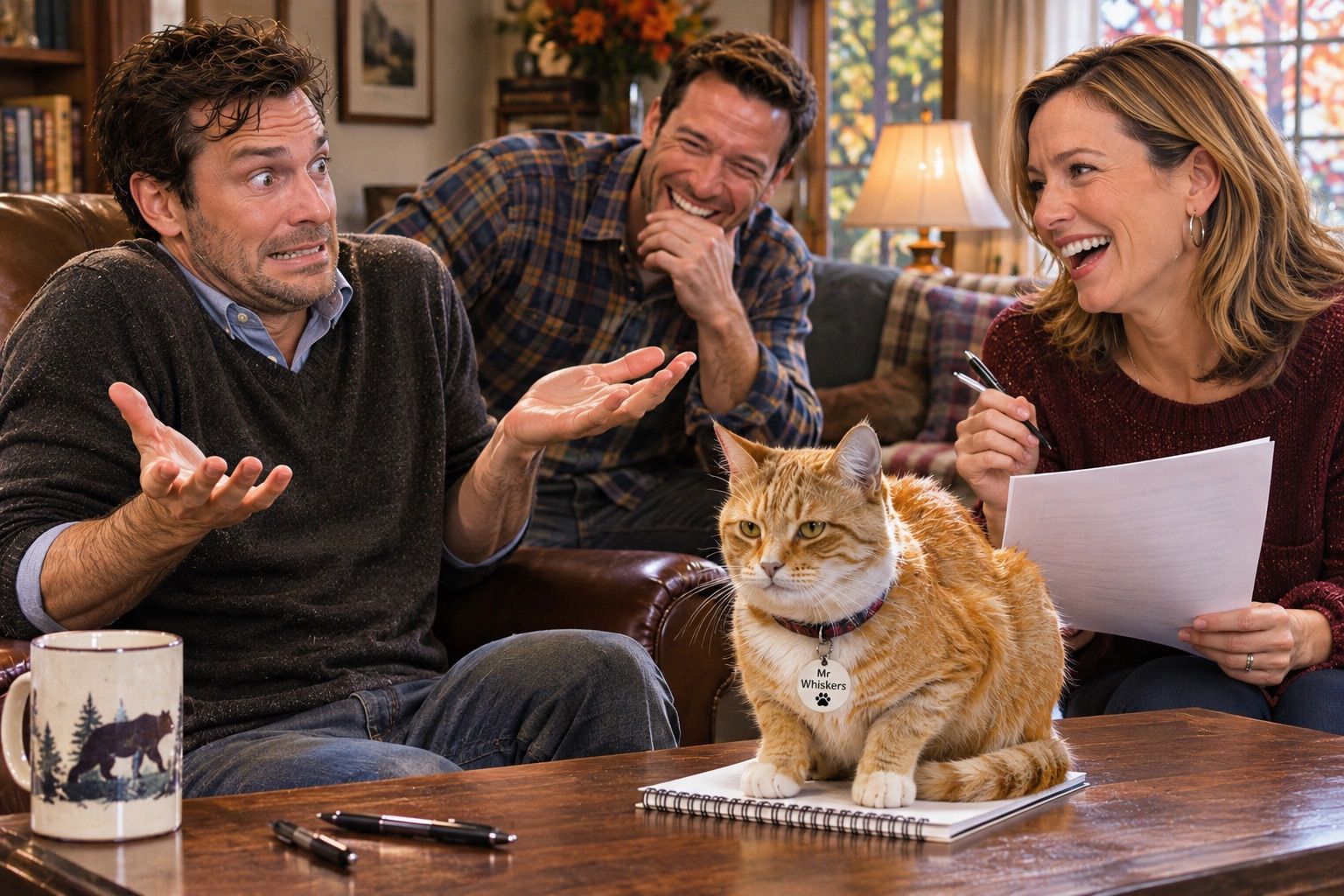
When Pandora arrived home that afternoon, I had everything ready. I’d arranged two chairs opposite each other in the living room, placed my notebook on a small table, and found a pen that made a particularly satisfying clicking sound. John was sitting nearby with a cup of coffee, apparently unwilling to miss whatever was about to happen. Pandora took one look at the arrangement and started laughing. “You’ve made an interview room?” she asked. I explained that recreating the environment would help make the experience more realistic. She took off her coat, sat down opposite me, and agreed to give it a try. Mr Whiskers immediately jumped onto the empty space beside my notebook, sniffed the pen, and settled himself down. I decided he could remain there provided he didn’t interrupt.
The first few questions went surprisingly well. Pandora explained her strengths, described how she approached difficult situations, and gave thoughtful answers about working with other people. I made a few notes, nodded professionally, and tried to maintain the sort of neutral expression I imagined an experienced interviewer might use. Then I asked how she handled unexpected challenges in a team environment. Without missing a beat, she said, “Well, I live with two men and a cat, so I have quite a bit of practical experience.” John nearly spilled his coffee. I reminded her that she was supposed to provide a professional example. She smiled and said she could provide one if I preferred, although she felt her original answer demonstrated considerable adaptability. I wrote something in my notebook, mostly because I needed a moment to recover.
Things began deteriorating when I reached the questions I’d added myself. I asked Pandora what she would do if she discovered that an established procedure was being followed incorrectly, but everyone around her insisted it was fine. She gave a perfectly reasonable answer about gathering information and discussing the issue constructively. Encouraged, I presented a hypothetical situation involving conflicting instructions, an unreliable colleague, and a missing piece of equipment. She listened patiently before asking whether the missing equipment was her coffee mug. John started laughing again. I assured her that the scenario had nothing to do with our household. “What about the unreliable colleague?” she asked. I told her that was irrelevant. John raised his hand and volunteered to be the unreliable colleague, provided it didn’t involve any additional responsibilities.
Pandora eventually reached into her bag and pulled out her notebook. She explained that she’d already been practicing with someone over the phone and had a list of questions she wanted to work through. That explained the conversations I’d overheard and the reason she’d been repeating things in front of the mirror. There was nothing mysterious about it. She simply wanted to feel comfortable discussing her experience without sounding as though she’d memorized a script. I felt a little embarrassed that I’d spent so much time preparing my own elaborate interview when she’d already known exactly what she needed. She thanked me for making the effort, though, and suggested we use her questions for the remainder of the session. I agreed, and for the next twenty minutes, we actually accomplished something useful.
Then Pandora decided we should switch roles.
She took my notebook, moved into my chair, and suggested that answering a few questions myself might help demonstrate how an interview should flow. I wasn’t particularly concerned. After all, I’d written most of the questions, so I ought to have been reasonably well prepared. I sat opposite her, straightened my shirt, and waited. John put down his coffee and leaned forward. Pandora looked at the notebook with an admirably serious expression before asking, “Can you describe a recent situation in which you received clear instructions but chose to disregard them?” I immediately realized that I’d made a terrible mistake by agreeing to this arrangement. John was already smiling. Pandora waited patiently while I considered whether there was any possible answer that didn’t involve Mrs Jenkins’ sprinkler.
“I prefer to think of that as an independent assessment,” I said.
Pandora made a note and continued. “Can you provide an example of a time when you identified a problem, investigated it thoroughly, and discovered that you were responsible for it?”
John covered his face with both hands. I could hear him laughing behind them. I told Pandora that the question seemed unnecessarily specific. She assured me that she was simply exploring my problem-solving abilities. Before I could formulate a respectable answer, she asked how I handled situations involving difficult personalities. At that exact moment, Mr Whiskers stood up, walked across the notebook, and sat directly on top of it. Pandora looked down at him, then back at me. I pointed toward the cat and said, “There’s your answer.” John laughed so hard that Mr Whiskers turned around to see what was wrong with him.
By the time we finished, Pandora was noticeably more relaxed about her upcoming interview. She’d had a chance to practice her answers, we’d talked through a few things she was concerned about, and she’d apparently discovered that interviewing me was an effective way to relieve stress. I was genuinely pleased that I’d been able to help, even if my contribution hadn’t taken quite the form I’d originally intended. We put the chairs back where they belonged and headed into the kitchen to organize some Thanksgiving leftovers for dinner. John suggested that Pandora keep my notebook in case she ever needed additional examples of workplace challenges. I told him that I’d appreciate it if my personal experiences weren’t used as professional training material.
Later that evening, Pandora thanked me again and said she felt much better prepared. I told her I was confident she’d do well, and I meant it. She’s intelligent, capable, and considerably better at thinking on her feet than she sometimes gives herself credit for. She smiled, kissed me, and handed back my notebook. I opened it to see whether she’d made any useful observations during my interview. Beneath the questions about following instructions, problem-solving, and handling difficult personalities, she’d written a short assessment of my performance.
“Enthusiastic. Highly imaginative. Requires supervision.”
Underneath that, in John’s handwriting, were the words, “Do not assign gardening equipment.”
I closed the notebook and looked at Mr Whiskers, who was comfortably asleep on the couch. Nobody had assessed his qualifications, questioned his judgment, or suggested that he required supervision.
Then again, he hadn’t volunteered to conduct an interview.
I’m beginning to understand why the cat gets through life with considerably less trouble than I do.