I was standing in the kitchen this morning, waiting for the coffee maker to finish doing whatever it does that takes so long, when I heard John Mercer talking upstairs. Not just talking, either. He was using that particular voice people adopt during video conferences, where every sentence sounds like they’re presenting evidence before a congressional committee. I could hear him saying things like, “Absolutely, I think that’s a reasonable approach,” and “We should probably revisit that before moving forward.” Now, I’ve lived with John long enough to recognize his normal speaking voice, and this wasn’t it. This was Professional John, a man who apparently exists only between the hours of nine and five and speaks entirely in phrases that could mean almost anything. Mr Whiskers was sitting on the kitchen floor, staring toward the stairs with his ears pointed forward. I looked at him and said, “You hear that too, don’t you?” He blinked at me, which I took as confirmation.
John has been working from home more frequently lately, which wouldn’t ordinarily bother me. We all have jobs, and sometimes those jobs involve sitting in front of computers pretending we understand why somebody scheduled another meeting. What struck me as odd was how often John seemed to be on a video call. Every time I walked past his room, I heard him talking about deliverables, timelines, or circling back to something. I couldn’t remember the last time I’d heard him actually discuss what he was delivering, when it was supposed to arrive, or why everyone kept circling around instead of getting somewhere. He’d always claimed to enjoy going into the office, mostly because he liked talking to people and getting out of the house. Yet here he was, spending entire mornings upstairs having conversations that sounded suspiciously similar to one another. I started wondering whether John was actually attending meetings or simply rehearsing what he’d say if somebody asked whether he’d been productive.
Pandora came downstairs while I was still considering this possibility. She was wearing her comfortable morning clothes, her hair slightly messy, and she looked like someone who’d been enjoying a perfectly good sleep until the rest of the household decided to make noise. I asked whether she’d noticed how many video calls John had been taking lately. She poured herself some coffee and said she’d noticed because she’d heard them through the bedroom wall. When I asked whether she thought it was strange, she shrugged and said some people had more meetings than actual work. I told her that was precisely what concerned me. She gave me a look over the rim of her mug and said, “Hal, having too many meetings isn’t evidence of a conspiracy. It’s evidence of employment.” I considered pointing out that those two things weren’t necessarily mutually exclusive, but she’d already moved on to asking whether we had any eggs left.
The situation became more interesting when I heard John laugh. It wasn’t his normal laugh, the one he uses when somebody tells a decent joke. This was a short, carefully measured laugh, followed immediately by, “That’s a great point.” I stood at the bottom of the stairs and listened. A few seconds later, he said, “I completely agree.” Then there was a pause, followed by, “Let’s make sure we’re all aligned.” I turned toward Pandora, who was cracking an egg into a frying pan, and told her that John had just agreed with three things in less than a minute. She asked whether that was unusual. I reminded her that the previous evening we’d spent twenty minutes arguing with him about whether the dishwasher should be loaded from the back or the front. A man who couldn’t agree on the proper placement of a cereal bowl was suddenly agreeing with everything anybody said. Pandora suggested that perhaps the people on his video call were making better arguments than I had.
I decided to conduct a little experiment. Nothing invasive, mind you. I wasn’t going to interrupt his meeting or snoop through his computer. I simply wanted to see whether John was actually paying attention to what was happening around him. I walked upstairs carrying a clean towel, which gave me a perfectly legitimate reason to pass his room. His door was slightly open, and I could see him sitting at his desk wearing a button-down shirt, looking serious enough to be negotiating an international treaty. I couldn’t see his screen, but I heard him say, “That’s definitely something we should take into consideration.” I continued down the hallway, put the towel away, and walked back. This time he was nodding thoughtfully while somebody else spoke. I didn’t hear anything suspicious, unless you count the fact that he was wearing a dress shirt with what appeared to be pajama pants. I returned downstairs and informed Pandora that John had developed a professional upper half and a recreational lower half.
She laughed and told me that was how half the country attended video meetings. I told her that didn’t make it any less ridiculous. Then I started thinking about the amount of effort John was putting into appearing professional. He’d positioned his desk so the camera faced a neatly arranged bookshelf, despite the fact that the rest of his room usually looked like a sporting goods store had suffered a minor earthquake. He’d also begun keeping a glass of water beside his laptop, which I found particularly interesting because John rarely drinks plain water unless someone reminds him that coffee doesn’t count as hydration. Every time he was on a call, though, there it was, positioned just within reach like a prop in a television commercial. I mentioned this to Pandora, who asked whether I was seriously investigating the placement of John’s drinking glass. I told her I was merely observing a pattern. She said she’d heard that explanation before, usually shortly before I discovered something I’d misplaced myself.
Around eleven, Mrs Jenkins stopped by with a small container of homemade biscuits. She’d been baking that morning, and the smell had been drifting through the neighborhood long enough to make my attempts at cutting back on sugar feel like an unnecessary personal hardship. I thanked her and offered to return the container later. While we were chatting at the door, John’s voice carried down the stairs again. Mrs Jenkins smiled and asked whether he was working from home. I told her he certainly sounded like he was. She chuckled and said her nephew worked remotely and spent so much time in meetings that he once forgot to take himself off mute during an entire presentation. That caught my attention. I asked whether her nephew had ever pretended to be in a meeting when he wasn’t. Mrs Jenkins thought for a moment and said she imagined everyone who worked from home had probably considered it at least once. Then she handed me the biscuits and reminded me to save some for Pandora. I assured her I would, although I could already see Mr Whiskers examining the container with considerable interest.
By lunchtime, I’d become convinced that John’s video calls followed a suspiciously predictable pattern. There would be a stretch of silence, followed by a few enthusiastic agreements, then a statement about following up later. Occasionally he’d laugh, but never for very long. I couldn’t hear the other participants clearly enough to know what they were discussing, which only made his responses sound more rehearsed. When he finally came downstairs for lunch, I asked how his morning had gone. He said it had been busy. I asked how many meetings he’d attended. He said four. I asked whether anything had actually been accomplished. He looked at me, opened the refrigerator, and said, “That’s a complicated question.” I considered that answer deeply suspicious. Pandora, who was sitting at the table reading something on her phone, made a small choking noise that suggested she was trying not to laugh.
I asked John whether he enjoyed all those video calls. He said he didn’t particularly enjoy them, but they were part of his job. I pointed out that he always sounded remarkably agreeable during them. He told me that agreeing with people was often the quickest way to end a meeting. That struck me as a confession of sorts, although I wasn’t sure what he’d confessed to. Then he explained that one of his coworkers had a habit of asking questions that had already been answered, another liked to revisit decisions from the previous week, and somebody else apparently believed every meeting needed a summary of the meeting before it. By the time John finished describing his morning, I was beginning to understand why he preferred working from home. At least here he could make himself a sandwich while everyone discussed whether the discussion had been sufficiently discussed.
The real breakthrough came that afternoon. I was in the living room attempting to concentrate on my own work when I heard John begin another call upstairs. His voice sounded unusually cheerful, which immediately caught my attention. He said, “Good afternoon, everyone. Thanks for joining.” Then he paused, laughed, and said, “No, that’s not going to work.” A moment later, I heard him say, “You’re going to have to do better than that.” This was entirely different from his usual routine. There was no talk of alignment or deliverables, and he wasn’t agreeing with anybody. In fact, he sounded as though he was enjoying himself. I looked at Mr Whiskers, who was sleeping beside the couch, and told him we’d finally found something worth investigating. The cat didn’t open his eyes, but I felt reasonably certain he was listening.
I went upstairs to ask John a question about the internet connection. It wasn’t a completely invented excuse because our wireless signal had been acting up occasionally, although it was working perfectly well at that particular moment. When I reached his door, I heard him say, “I can see exactly what you’re doing.” That stopped me. A few seconds later he added, “Nice try, but you’re not fooling anybody.” I knocked. There was a sudden scrambling noise, followed by John saying, “Hang on a second.” When he opened the door, he was wearing the same button-down shirt from earlier, but now he had a headset on and a distinctly guilty expression. Behind him, his laptop screen showed a colorful game board and several small video windows. I stared at it. He stared at me. Then he said, “Before you say anything, my workday ended twenty minutes ago.”
I stepped into the room and looked at the screen. John was playing an online trivia game with a few friends, all of whom appeared to be enjoying themselves considerably more than anyone on his morning conference calls. One of them waved at me through the camera. Another asked whether I was the roommate John had been talking about. I turned toward him. “You’ve been talking about me?” John closed his eyes briefly, which I interpreted as an admission. Then one of his friends said, “Oh, you’re the guy who spent an entire day looking for a coffee mug that was in the microwave.” I stood there in silence while several strangers began laughing. John had apparently decided that my recent kitchen investigation was suitable material for group entertainment. I informed him that the mug incident had been considerably more complicated than he’d made it sound. That only made them laugh harder.
I was still trying to recover my dignity when I noticed something else on John’s desk. Beside his laptop sat a small sheet of paper covered with handwritten phrases. I leaned closer and read a few of them aloud. “That’s a great point. Let’s circle back. We should take that offline.” I looked at John. He looked at the paper. Then he started laughing. He explained that he’d written the phrases down after a particularly exhausting meeting because the same expressions kept coming up, regardless of what anyone was discussing. He’d turned them into a little game for himself. Whenever somebody used one of the phrases, he’d make a mark beside it. Apparently, “Let’s circle back” was winning by a considerable margin. I asked whether that meant he’d been pretending to participate in his meetings. He said no, he’d been participating, but counting the clichés was the only thing keeping him awake through some of them.
I took the paper downstairs and showed Pandora. She read it, laughed, and said it sounded exactly like every office meeting she’d ever attended. I explained that John had been keeping score during his video calls and that I’d caught him playing trivia with his friends afterward. Pandora asked whether he’d finished work before starting the game. I admitted that he had. She asked whether he’d actually attended his meetings. I admitted that he had done that too. Then she asked what, precisely, I’d uncovered. I looked at the paper again and told her I’d discovered that John was conducting a secret competition involving meaningless corporate expressions. She said that sounded less like a scandal and more like a coping mechanism. I wasn’t entirely satisfied with that assessment, but it was difficult to argue with.
A few minutes later, John came downstairs carrying his empty coffee cup. He asked whether I’d enjoyed meeting his friends. I told him I hadn’t appreciated being introduced as the man who lost a mug inside a microwave. He pointed out that he’d never actually introduced me that way; his friends had simply recognized me from the story. I told him that wasn’t an improvement. Pandora started laughing again, and John offered to make dinner as a peace offering. I accepted, partly because I was hungry and partly because I wanted to maintain the moral high ground. Then Mr Whiskers wandered into the kitchen, jumped onto John’s chair, and settled himself in front of the abandoned laptop he’d brought downstairs. John looked at the cat, looked at me, and said, “Careful, Hal. He’s probably attending a meeting.”
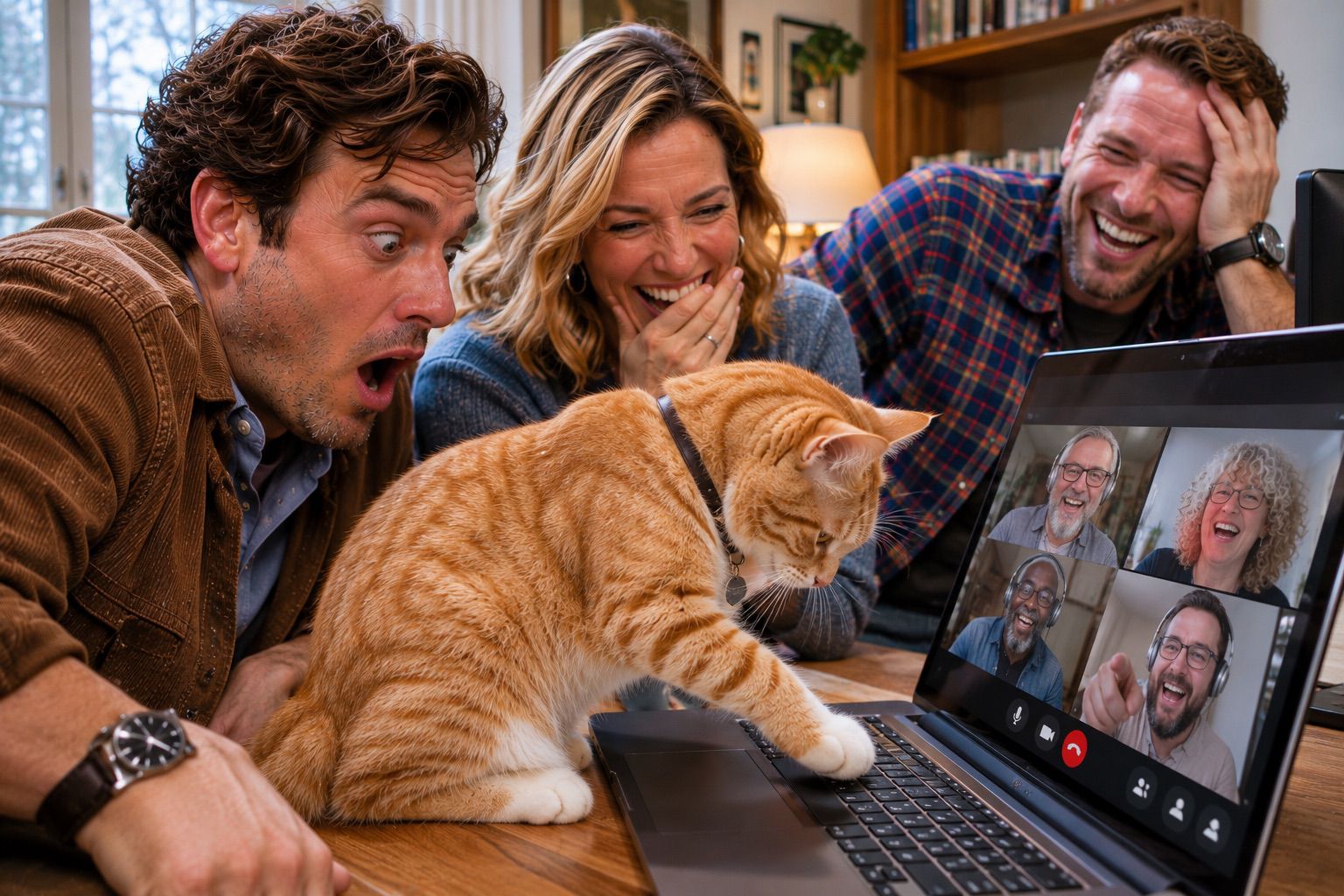
I was about to respond when a familiar voice came from the laptop. John had apparently forgotten to close his trivia group’s video call, and one of his friends was still connected. “Hey, John, is that your cat?” the voice asked. Mr Whiskers stared directly at the screen, raised one paw, and tapped the keyboard. The call disappeared. For a moment, the three of us just stood there. Then Pandora burst out laughing, and John looked genuinely impressed. I leaned down toward Mr Whiskers and told him that was the most productive thing anybody in the house had done all day. He jumped off the chair and headed toward his food bowl, clearly satisfied with his contribution. I watched him go and realized something rather troubling. I’d spent an entire day trying to prove that John’s video calls were a ruse, only to discover that he really was working, his friends knew about my microwave incident, and the cat had figured out how to end a meeting faster than any of us. If Mr Whiskers ever learns to say, “Let’s circle back,” I’m moving out.