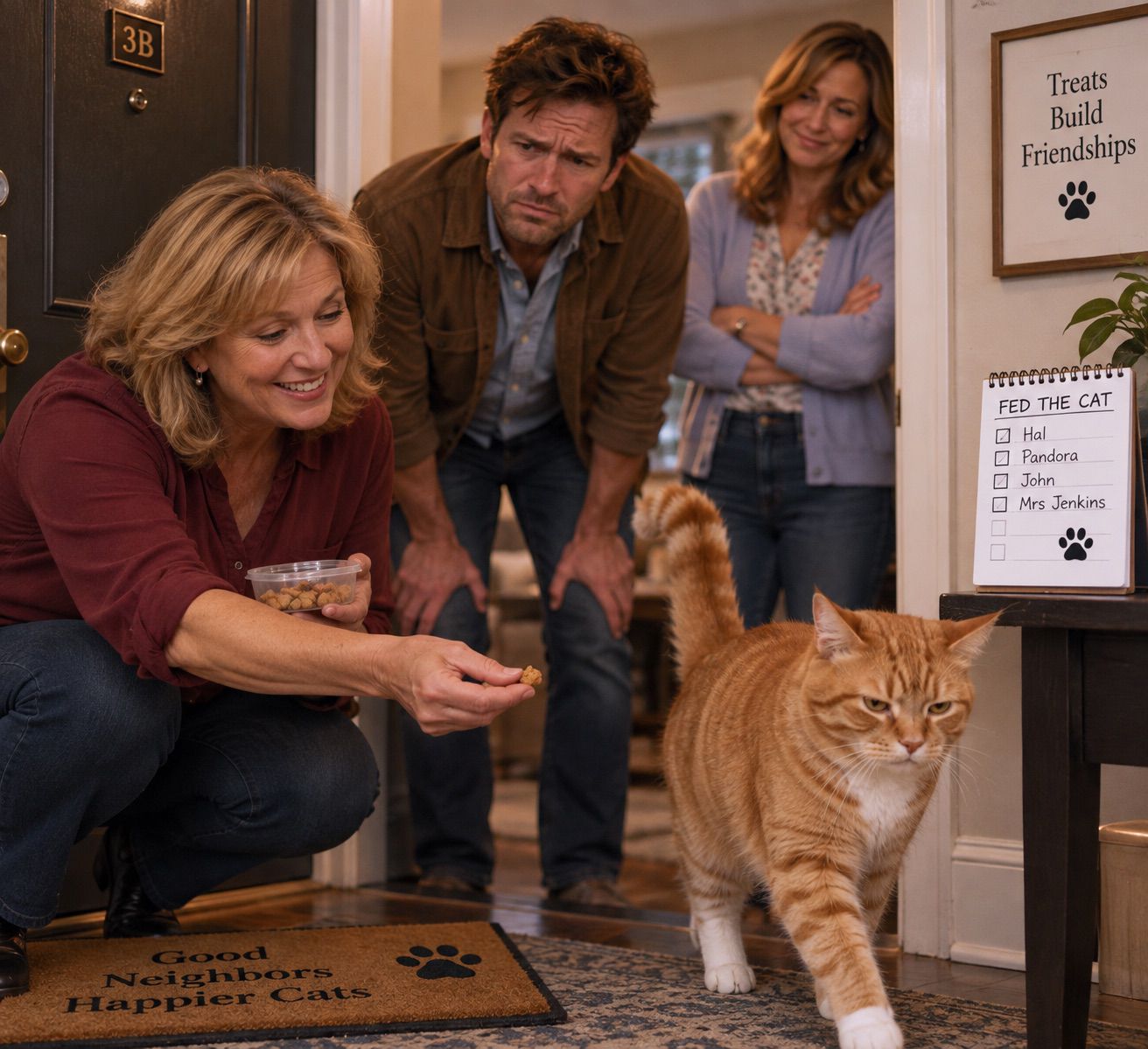
I noticed the problem at breakfast, although at the time I didn’t know it was a problem. Pandora was standing at the kitchen counter drinking coffee from the blue mug that caused yesterday’s completely unnecessary misunderstanding, John was sitting at the table eating toast, and Mr Whiskers was positioned near the hallway with his attention fixed on the front door. This by itself was not unusual. Mr Whiskers has several reasons for monitoring the front door, including deliveries, hallway noises, opportunities for unauthorized exploration, and Mrs Jenkins. The last one has historically been particularly important because Mrs Jenkins has demonstrated what I consider an irresponsible willingness to provide him with treats outside the household feeding system. We have discussed this. We now have a FED THE CAT notepad beside his food container specifically because Mr Whiskers successfully obtained three breakfasts from three different people in one morning, and I have repeatedly pointed out that a system governing internal food distribution is useless if an external actor continues introducing undocumented salmon treats. Pandora says referring to Mrs Jenkins as an external actor makes the situation sound more serious than it is. I disagree. The terminology is accurate.
At approximately eight-fifteen, there is a knock at the door. Mr Whiskers immediately gets up and runs into the hallway, which is normal. I open the door and find Mrs Jenkins standing there holding a small container that belongs to Pandora. She had borrowed it a few days earlier and was returning it. Mr Whiskers sees her, stops, and freezes. Mrs Jenkins smiles down at him and says, “Well, good morning, handsome.” Normally this is the point where he approaches her with the shameless enthusiasm of an animal who has learned that charm produces salmon. Instead, he stares at her for several seconds, turns around, and walks back into the living room. Not casually, either. There is a noticeable amount of tail movement involved. Mrs Jenkins looks at me. I look at Mr Whiskers. “What did I do?” she asks. I tell her I don’t know. Pandora calls from the kitchen, “You didn’t do anything.” This is reassuring to Mrs Jenkins but premature from an evidentiary standpoint.
Mrs Jenkins hands me the container and leaves. I close the door and find Mr Whiskers sitting beside the couch with his back toward the hallway. “That was strange,” I say. Pandora tells me he is a cat. I explain that this does not address the behavioral change. For weeks, Mr Whiskers has treated Mrs Jenkins as though she were a mobile branch office of the food industry. Today he deliberately refused contact. John looks up from his toast and says, “Maybe he wasn’t in the mood.” I remind him that Mr Whiskers once followed Mrs Jenkins halfway down the hallway because he heard something crinkle in her pocket. “Maybe she didn’t have treats,” John says. This is possible, but Mr Whiskers could not have known that before approaching her. Pandora tells me cats have noses. I tell her I am aware of the basic equipment supplied with a cat.
The situation becomes more interesting later that morning when I hear Mrs Jenkins in the hallway talking to another neighbor. Mr Whiskers hears her too. His ears rotate toward the door, and for a moment I expect him to get up. Instead, he remains on the couch. He is awake. He has clearly identified her voice. He simply chooses not to respond. I sit beside him and observe without interfering. “Are you avoiding Mrs Jenkins?” I ask. Mr Whiskers looks at me. Pandora, from across the room, says, “Please don’t interrogate the cat.” I explain that a single question does not constitute an interrogation. “You’re waiting for him to answer.” I tell her I am evaluating his reaction. Mr Whiskers yawns. John walks through carrying a glass of water, sees me studying the cat, and asks what happened. I explain that Mr Whiskers has now ignored Mrs Jenkins twice. John says, “Maybe they had a fight.” I know he is joking, but the possibility of a negative interaction is actually worth considering. Pandora gives John a look. “Don’t encourage him.” I make a mental note that neither of them has provided an alternative explanation supported by evidence.
At work, I mention the behavioral change to Karen. I explain that Mr Whiskers previously displayed a strong positive response to Mrs Jenkins but has now demonstrated repeated avoidance. Karen asks whether Mrs Jenkins recently did anything the cat might dislike. I tell her nothing I know about. Dave asks whether she stepped on his tail. I say no. Karen asks whether she stopped giving him treats. I pause. This possibility has already been raised by John, but hearing it independently increases its credibility. I explain that Mrs Jenkins has historically provided treats without documenting them, which created a weakness in our feeding-control system. Dave asks whether I really have a feeding-control system. I tell him we have a notepad. Karen says, “So you have a feeding-control notepad.” I ignore the terminology and return to the important question: if Mrs Jenkins has stopped giving Mr Whiskers treats, why? Karen looks at me for a moment and says, “Maybe someone asked her to stop.” I tell her nobody discussed that with me. “That doesn’t mean nobody discussed it.” I dislike the direction this is going.
When I get home, Mrs Jenkins is talking to Pandora in the hallway. Mr Whiskers is sitting just inside the open door watching them. Mrs Jenkins bends down and holds out her hand. “Are you still mad at me?” she asks. Mr Whiskers sniffs her fingers, apparently confirms the absence of anything edible, and walks away. I look at Pandora. Pandora looks at me. Mrs Jenkins starts laughing. “He really is mad.” I ask the obvious question: “Why?” Pandora immediately says, “Hal, it’s not a conspiracy.” I remind her that I have not suggested one. Mrs Jenkins then explains that several days ago Pandora told her about the feeding log and asked her to stop giving Mr Whiskers treats every time she saw him because none of us knew how much extra food he was getting. Mrs Jenkins agreed. The next time Mr Whiskers approached her, she petted him but did not produce a treat. Apparently he checked again the following day with the same result. Since then, his enthusiasm for Mrs Jenkins has declined considerably.
I look at Pandora. “You closed the external feeding loophole?” She tells me not to call it that. I point out that this is exactly what happened. The household implemented a documented feeding system, discovered that Mrs Jenkins represented an uncontrolled secondary food source, and corrected the vulnerability. Pandora says, “I asked our neighbor to stop giving the cat so many treats.” I tell her we are describing the same event at different levels of precision. Mrs Jenkins is still laughing. John appears behind me and asks what is going on. When Pandora explains, he looks toward Mr Whiskers, who is now sitting several feet away with his back pointed conspicuously toward Mrs Jenkins. “So he’s holding a grudge?” John asks. Mrs Jenkins says she thinks so. I point out that we cannot establish motive. John says, “You’ve spent all day trying to establish motive.” I tell him I was investigating a behavioral change. Pandora says, “There it is.” I ask what she means. She says nothing.
The explanation is both mundane and remarkably consistent with Mr Whiskers’ previous behavior. He does not hate Mrs Jenkins. If anything, the opposite appears to be true. He developed a relationship with her based partly on an expectation of undocumented food, and when the food component disappeared, he reassessed the value of the relationship. This also explains why he still watches her when she enters the hallway but no longer runs to greet her. He is not frightened. He is not angry about some mysterious incident. He is conducting what appears to be a cost-benefit analysis. I find this somewhat troubling because it means his earlier affection may have been transactional. Pandora reminds me that this is a cat. I remind her that this particular cat successfully obtained three breakfasts by presenting himself to three different household members as though nobody had fed him. We have established capability.
That evening, Mrs Jenkins knocks again. She has brought Pandora a book they had been discussing earlier. Mr Whiskers lifts his head from the couch but does not move. Mrs Jenkins steps inside, hands Pandora the book, and looks toward him. “Still nothing?” she asks. Pandora tells her to give it time. Mrs Jenkins walks over, scratches Mr Whiskers behind the ears, and tells him he is a ridiculous animal. He permits this but offers no visible sign of forgiveness. Then Mrs Jenkins reaches into her pocket. Mr Whiskers is on his feet before her hand comes back out. I immediately stand up. “No.” Mrs Jenkins freezes. Mr Whiskers looks at her hand. I look at her hand. Pandora looks at me. Mrs Jenkins slowly reveals a small salmon treat and says, “Just one?” I point toward the kitchen. “The log is in there.” Pandora starts laughing. John, from the other room, calls, “Write it down.” Mrs Jenkins sighs, walks into the kitchen, and records the treat on the notepad.
Mr Whiskers follows her the entire way.
Thirty seconds later, he is rubbing against her ankles like the previous several days never happened.
I’m not saying Mr Whiskers can be bought.
I’m saying we have now established his price.