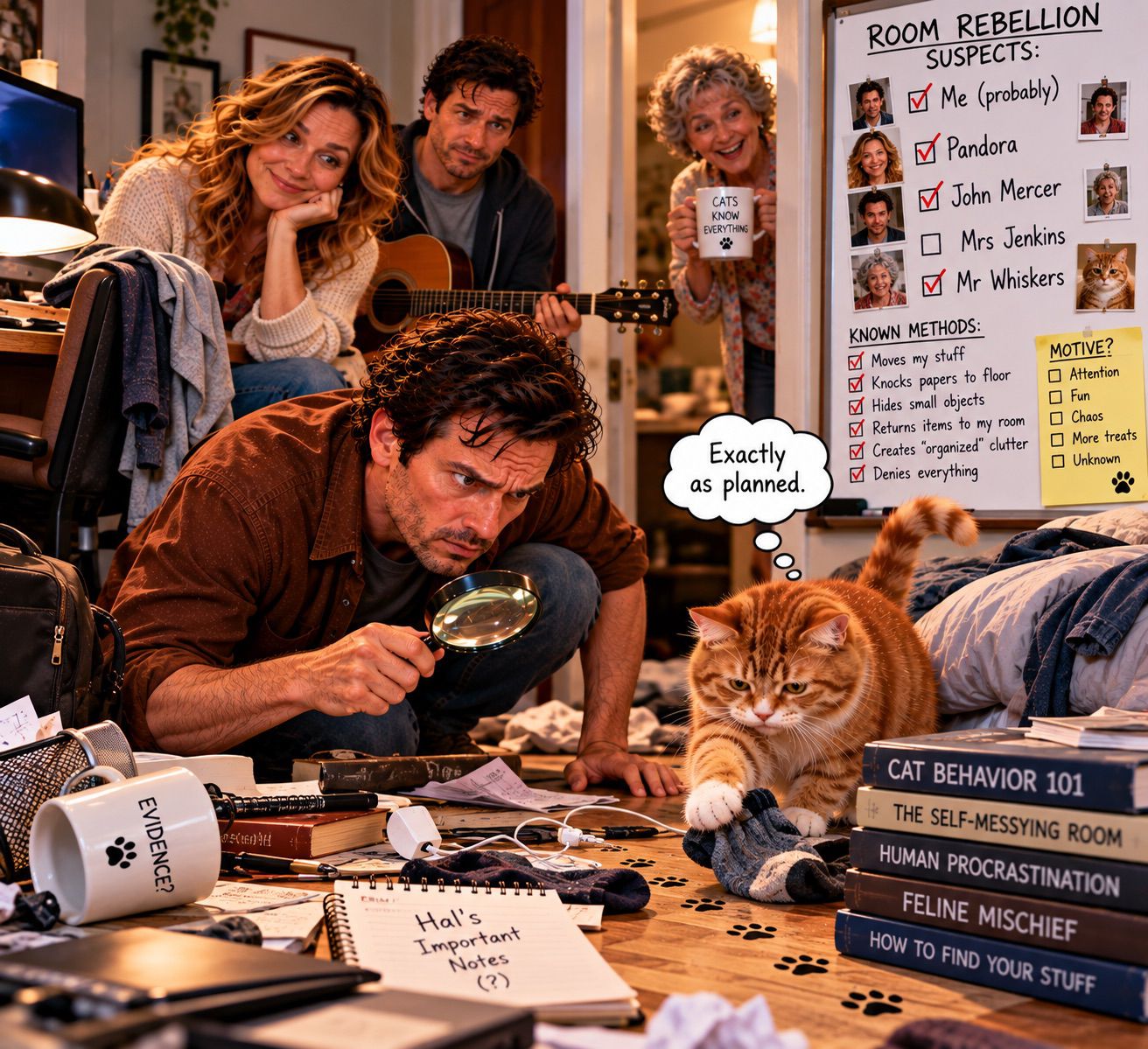
I’m sitting on the couch with Mr Whiskers curled up beside me while Pandora does something in the kitchen and John Mercer plays guitar in his room. Under normal circumstances this would be a perfectly peaceful evening, except I can see the doorway to my room from where I’m sitting, and something about it has been bothering me for the better part of an hour. My room has become messy. Not dramatically messy. Nobody needs to contact emergency services or organize an intervention. It’s more subtle than that. Three books on the shelf are leaning instead of standing upright, yesterday’s coffee mug is sitting on my desk, a sweatshirt is hanging over the back of the chair, and there are two pieces of paper on the floor that I distinctly remember placing on the desk. None of these things is significant individually, but I cleaned the room two days ago. I remember cleaning it because I specifically remember standing in the doorway afterward and thinking that I should make an effort to keep it that way. Apparently the room had other plans.
I get up and conduct a preliminary inspection. The mug is mine, obviously, but I don’t remember leaving it there. The sweatshirt is also mine, although I thought I had put it in the closet. The papers are notes from work that I brought home several days ago, and while I recognize them, I have no explanation for why they are on the floor. I straighten the books, pick up the papers, put the sweatshirt away, and carry the mug into the kitchen. Pandora looks at it and says, “There it is.” I stop. “There what is?” She explains that she had been wondering where that mug went because it had been missing from the kitchen for two days. I tell her it was on my desk. “I know,” she says. “Apparently you’ve been keeping it hostage.” I put the mug in the dishwasher and explain that the larger issue is that I don’t remember putting it there. Pandora looks at me for a moment. “You drink coffee at your desk every day.” This is true, but it does not establish the events of this particular incident.
John stops playing guitar long enough to come downstairs for something to drink, and I ask whether he has been moving things in my room. He says no. I ask whether he has been in my room recently. Again, no. Then he thinks about it and says, “Actually, I tossed your charger in there yesterday.” I ask why he had my charger. Apparently I left it plugged into the outlet beside the couch, and John recognized it as mine, so he unplugged it and put it on my bed. I go back to the room. The charger is lying on the bed. This introduces an important distinction. The room is not merely becoming disorganized through neglect; objects from elsewhere in the house are actively migrating into it. When I explain this to John, he says, “Because they’re your things.” I tell him ownership explains destination but not accumulation. He takes his drink and goes back upstairs without acknowledging the methodological significance of this point.
The next morning I make the bed, straighten the desk, put away several loose items, and leave for work with the room in objectively good condition. I even take a picture before leaving, not because I’m investigating anything but because photographic documentation eliminates disputes about baseline conditions. At work, Karen notices me looking at the picture and asks why I have a photograph of my bedroom on my phone. I explain that I’m establishing a reference point. This leads to questions, so I tell her that my room has recently demonstrated an unusual tendency to become disorganized shortly after I organize it. Dave overhears this and says, “That’s called having a room.” I explain that the rate of disorder appears inconsistent with my own activity. Karen asks who else lives in the house. I tell her Pandora, John, and Mr Whiskers. “Then I think you’ve identified your suspects,” she says. I remind her that I am also technically included in the household. Dave says, “I think you’ve identified your prime suspect.” I decide neither of them is approaching the problem objectively.
When I get home, I immediately check the room against the photograph. The bed is still made. The books are still straight. The desk, however, now contains a pair of headphones that were not there that morning, a magazine I had left in the living room, and three envelopes. I find Pandora in the kitchen and ask whether she has been in my room. “Yes,” she says without hesitation. I wasn’t expecting the admission to come that quickly. She explains that the headphones were on the kitchen counter, the magazine was on the couch, and the mail had arrived that afternoon. Since all three belonged to me, she put them in my room instead of leaving them scattered around the rest of the house. I tell her that from my perspective this creates the appearance that the room is generating clutter independently. Pandora says, “From my perspective, your clutter is returning to its natural habitat.” I don’t think this is scientifically precise, but I understand her argument.
Mrs Jenkins complicates matters later that evening when she knocks to return a pen I apparently left at her place several days earlier. I have no memory of leaving a pen there, although she reminds me that I used it to write down the name of the humane mousetrap she borrowed during the Mr Whiskers mouse incident. This sounds plausible. I thank her, take the pen, and place it on the table beside the door. Pandora looks at the pen, then at me. I know exactly what she is thinking. “Don’t,” I tell her. She says nothing. I walk away. Ten minutes later I pass the table and the pen is gone. I stop immediately. Pandora is reading on the couch. John is upstairs. Mrs Jenkins has returned across the hall. Mr Whiskers is asleep near the window. I ask Pandora where the pen went. She looks up from her book. “What pen?” This is the first genuinely unexplained development of the investigation.
I search the immediate area without success. The pen is not under the table, behind the table, or on the floor nearby. I check the kitchen even though there is no reason it should be there. Then I walk into my room and find it lying underneath the desk. I stand there for several seconds looking at it. The distance from the entry table to my desk is significant enough that accidental movement seems unlikely. I call Pandora. She comes into the room, looks at the pen, and says she didn’t move it. John comes downstairs after hearing us and also denies involvement. For the first time, I have an object that has apparently relocated without a human explanation. Then Mr Whiskers strolls into the room, walks directly beneath the desk, sniffs the pen, picks it up in his mouth, and carries it into the hallway. None of us says anything. He drops it near the couch, bats it twice, then chases it under a chair. John looks at me. “Your room has a cat problem.” I tell him that conclusion is premature, although admittedly well supported.
Over the next half hour we reconstruct most of the apparent rebellion. The papers on the floor were probably knocked off the desk by Mr Whiskers, who likes sitting beside the window. The sweatshirt had not been put in the closet at all; Pandora remembers seeing me take it off while I was working and throw it over the chair. The coffee mug was exactly where I left it. John returned the charger. Pandora returned the headphones, magazine, and mail. Mr Whiskers relocated the pen and is almost certainly responsible for several smaller objects I’ve found under furniture during the week. The books remain unexplained until John points out that I pulled one out the previous night while looking for something and shoved it back onto the shelf without straightening the others. At this point the evidentiary pattern becomes uncomfortable. My room is not rebelling against me. My belongings are simply returning to the place where they belong, being moved by the cat, or being left somewhere by me and subsequently forgotten.
I spend the rest of the evening restoring order. The desk is cleared, the clothes are put away, the books are straight, and anything small enough for Mr Whiskers to carry is moved out of reach. Before bed, I stand in the doorway and admire the result. Pandora walks past and says, “Looks good.” I tell her I have implemented several preventative measures. She says, “You cleaned your room.” I explain that cleaning addresses existing disorder; preventative measures reduce recurrence. She kisses me on the cheek and says, “Whatever helps you sleep.” The next morning I wake up, get dressed, make coffee, check my email, and return to the bedroom twenty minutes later. My pajama shirt is on the chair, yesterday’s socks are beside the bed, my coffee mug is on the desk, and a notebook I had been using in the kitchen is sitting open on the comforter. Mr Whiskers is asleep in the middle of the bed.
I stand in the doorway looking at the room. Mr Whiskers opens one eye, looks at me, and closes it again. Pandora passes behind me carrying her coffee and asks what’s wrong. I tell her the room is messy again. She looks inside. “Hal, you did all of that this morning.” I start to object, then reconstruct the previous twenty minutes. The shirt was me. The socks were me. The coffee was definitely me. I brought the notebook in because I wanted to remember something and apparently forgot both the something and the notebook. Only Mr Whiskers remains unaccounted for, and technically he isn’t clutter because he lives here. Pandora waits. I look around the room one more time and finally admit that the available evidence suggests I may be responsible for a substantial percentage of the problem. “How substantial?” she asks. I tell her the analysis is ongoing. Mr Whiskers stretches across the freshly made bed, hooks one paw into the blanket, and pulls half of it onto the floor. I point at him. “And there,” I say, “is why I’m not accepting full responsibility.”