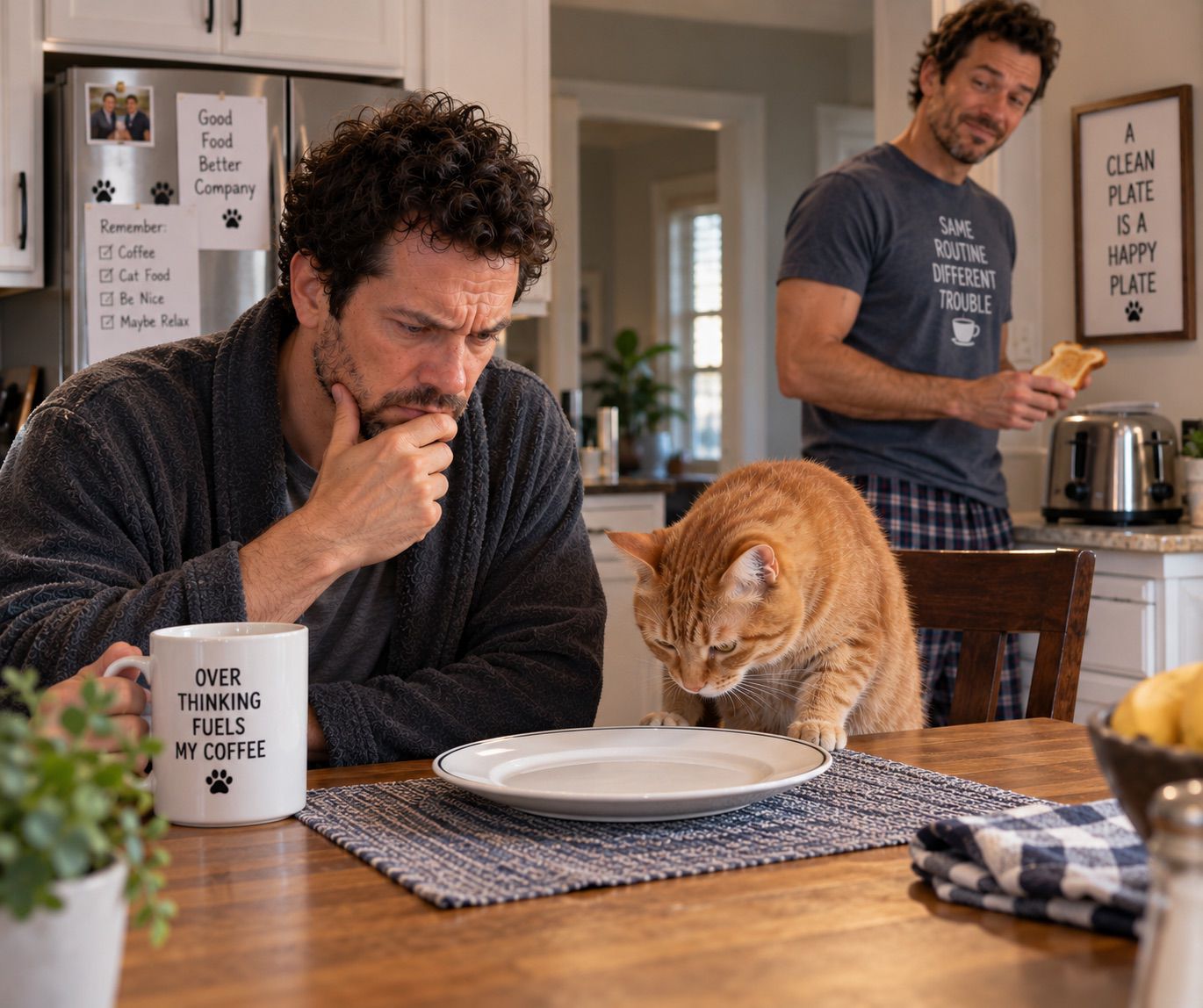
I’m standing in the kitchen with a cup of coffee that stopped being hot sometime during the previous administration when I notice Pandora’s breakfast plate sitting on the table. There is nothing particularly unusual about a plate sitting on a table, and after yesterday’s situation with Karen, I am making a conscious effort not to assign hidden significance to ordinary objects. Karen, as it turned out, had not discovered some sophisticated method of manipulating people. She was simply nice to them before asking for things. Pandora seemed pleased that I had reached this conclusion. John called it “discovering basic human interaction.” I thought that was unnecessarily dismissive of the investigative process that got me there, but the important thing is that I learned something. Sometimes an ordinary thing is just an ordinary thing. Which is why I initially ignore Pandora’s plate.
Then I look at it again. It’s completely clean. Not mostly clean. Not the kind of clean you get after eating toast and leaving behind a few crumbs. I mean clean. It’s sitting exactly where Pandora normally eats breakfast, but there is no evidence that breakfast ever occurred. No crumbs. No smear of butter. No trace of anything. Yesterday there was Texas toast. The day before that there was the whole 6:45 issue. This morning there is an empty plate that looks like it was placed on the table specifically to represent the concept of breakfast without actually participating in it. I take another sip of cold coffee and stare at it. I’m not investigating. I want that established immediately. I’m simply noticing an inconsistency.
John comes into the kitchen while I’m still looking at the plate. Since John actually lives here, his appearance requires no explanation, which is something I’ve recently learned is apparently worth keeping track of. He opens the refrigerator, looks inside for several seconds, and asks if there’s any more of the thick bread. I tell him Pandora finished the Texas toast yesterday. He says, “Good,” with considerably more satisfaction than I think the situation warrants, then notices me staring at the table. “What?” he asks. I point toward Pandora’s plate. John looks at it. Then he looks at me. Then he looks at the plate again, which I appreciate because at least he’s conducting an independent assessment before forming an opinion. “It’s a plate,” he says. I tell him I’m aware of its primary function.
Mr Whiskers walks into the kitchen and sits beside my leg. He looks at me, looks at the plate, and then looks back at me. Under different circumstances I might consider this significant, but yesterday I established that Mr Whiskers is capable of using affection to obtain food, so I’m currently treating all cat behavior as potentially transactional. He jumps onto the empty chair beside Pandora’s place and sniffs the edge of the table. Then he sniffs the plate. This gets my attention. “Interesting,” I say. John closes the refrigerator. “No.” I tell him he doesn’t even know what I was going to say. “You said ‘interesting’ while watching the cat smell a plate.” I admit that’s true, but I also point out that Mr Whiskers has now independently confirmed there is something worth examining. John tells me the cat is checking for food. I tell him that is one interpretation.
The problem is that I distinctly remember Pandora being in the kitchen this morning. I heard the coffee maker at 6:45, which I no longer consider suspicious because we have established that 6:45 is simply the mathematical compromise between 6:30 being too early and 7:00 being too late. I heard cabinet doors. I heard Mr Whiskers complaining about something, although that contributes very little because Mr Whiskers complains whenever reality fails to conform to his immediate preferences. I even remember Pandora telling me she had an early meeting at work. What I don’t remember is hearing her eat anything. This leaves me with three possibilities. She made breakfast and ate it so completely that no physical evidence remains. She intended to eat breakfast but didn’t. Or the plate was never used for breakfast in the first place.
John tells me there is a fourth possibility: Pandora rinsed the plate. I look at him. He shrugs. “People do that, Hal.” I point out that if she rinsed it, she would normally put it in the dishwasher rather than return it to the table. John starts to answer, then stops. I can tell from his expression that he has recognized the same inconsistency. “Don’t,” he says. I ask what he means. “Don’t make that face just because I paused.” I tell him I’m not making a face. “You are. That’s your evidence face.” I didn’t know I had an evidence face, which raises an entirely separate question about how many people are apparently able to predict my behavior based on facial expressions.
I decide the simplest approach is to ask Pandora. This is another methodological improvement I’ve been working on. Instead of developing six theories and testing five of them before speaking to the person directly involved, I can apparently just ask a question at the beginning. I text her: Did you eat breakfast this morning? She responds a few minutes later: Yes. That should settle it. Instead, it creates a new problem, because if Pandora ate breakfast, the clean plate still requires an explanation. I text back: What did you have? There is a longer delay this time. Eventually she replies: Why? I stare at that word. John, who is now making toast with ordinary bread, sees my expression and asks what happened. I tell him Pandora wants to know why I’m asking. “Probably because you’re asking her to account for breakfast while she’s at work,” he says. I tell him I asked a straightforward question. John says, “You’re holding your phone like you’re negotiating a hostage release.”
I decide not to respond immediately. There is no reason to alarm Pandora over something that probably has a perfectly reasonable explanation. Besides, I have additional information available locally. I examine the plate without touching it. Mr Whiskers examines it with considerably less concern for evidentiary integrity and puts one paw on the edge. The plate shifts slightly. I move him away. He returns. I move him again. He looks at me as though I’m interfering with his investigation. Then he jumps down and walks toward the sink. I follow his line of travel and notice a frying pan soaking in the basin. There is a faint trace of egg around the edge. That establishes breakfast. Pandora cooked an egg. I feel an unreasonable amount of satisfaction because I have now confirmed her statement independently, even though there was no reason to doubt it in the first place.
Then I notice something else. There are no utensils on the table.
John has made the mistake of remaining in the kitchen, so I ask him whether he remembers seeing Pandora use a fork this morning. He slowly puts down his toast. “I was asleep.” I ask whether he heard anything. “I was asleep.” I ask when he woke up. “Hal.” I explain that I’m merely establishing a timeline. John says, “Of Pandora eating an egg?” When he puts it that way, it sounds less substantial than it did in my head. I decide to suspend the inquiry until Pandora gets home.
Mrs Jenkins catches me outside that afternoon when I’m bringing in the mail. She asks how Pandora is doing because she saw her leave in a hurry that morning. This is normal neighbor conversation. I know that. I have specifically reminded myself of that before answering. I tell her Pandora had an early meeting. Mrs Jenkins says, “That explains it,” and starts sorting through her own mail. I make it three steps toward the door before turning around. “Explains what?” Mrs Jenkins looks up. “Why she was eating in the car.” I stop. Mrs Jenkins explains that Pandora came outside carrying coffee and what looked like a breakfast sandwich, got into her car, and drove away. There is no mystery. Pandora ate breakfast. She simply ate it on the way to work.
Except now there’s a breakfast sandwich.
When Pandora gets home that evening, I’m waiting in the kitchen. Not waiting waiting. I happen to be in the kitchen when she comes home, although John later claims I had been sitting at the table for twenty minutes, which is technically accurate but unnecessarily contextual. Pandora puts down her bag, looks at me, looks at the plate, and immediately says, “Oh.” That is not the reaction I expected. I ask what “oh” means. She walks over, picks up the plate, and says, “I forgot this.” I tell her I’m aware. She asks whether this is why I texted her about breakfast. I tell her the plate presented an inconsistency. She closes her eyes for a moment.
The explanation takes approximately thirty seconds. Pandora got up at 6:45, fried an egg, toasted some bread, and intended to sit down for breakfast. Then she looked at the time and realized she needed to leave earlier than she thought. She put the egg between the pieces of toast, turning breakfast into a sandwich, rinsed the plate because there was a little egg on it, and set it back on the table while she grabbed her coffee and work bag. Then she forgot about it and left. Mrs Jenkins happened to see her eating the sandwich in the car. The frying pan in the sink was from the egg. The absence of utensils was because Pandora had never sat down to eat. The clean plate was clean because she rinsed it. Every single piece of evidence fits.
I sit there for a moment processing this. Pandora puts the plate in the dishwasher. “Satisfied?” she asks. I tell her I am. Completely. This is exactly the sort of situation I’ve been trying to handle better. I noticed something unusual, considered reasonable possibilities, gathered independent information, and accepted the explanation once the facts aligned. Pandora says, “You interrogated John about whether he heard me use a fork.” I tell her interrogated is a very strong word for what was essentially a brief witness interview. John calls from the living room, “You asked me three questions about breakfast while I was eating breakfast.” I tell him nobody requested commentary from the witness.
Pandora starts laughing and walks into the living room. I stay behind long enough to put my coffee cup in the dishwasher. Mr Whiskers jumps onto the chair beside the table and stares at the spot where Pandora’s plate had been. He sniffs the tabletop once, looks toward the doorway where Pandora disappeared, and then looks directly at me. I tell him the matter has been resolved. He meows. “She made a sandwich,” I explain. He meows again and jumps down, walking toward his food bowl.
I almost follow him.
Then I stop.
Yesterday I learned that Mr Whiskers uses affection to get food. Today I’ve learned he also investigates empty plates.
I’m not saying those things are connected.
I’m just saying the cat has now shown an interest in two separate cases involving breakfast.