I was standing in the kitchen waiting for the coffee maker to finish its morning routine when I noticed something unusual. Pandora’s phone was plugged into the charger beside her wallet, which was sitting exactly where she’d left it the night before. Under ordinary circumstances, I wouldn’t have given either object much thought, but Pandora was usually halfway through her morning by the time I made my first cup of coffee. She had a routine that involved checking her messages, gathering her belongings, and reminding me of at least one thing I’d promised to do but had somehow forgotten. This morning, however, there was no Pandora, no sound of her getting ready, and no indication that she’d even started her day. More surprisingly, John Mercer was still asleep in his bedroom. I glanced at the clock. It was almost nine, and the apartment was so quiet that I could hear Mr Whiskers purring on the windowsill.
Now, John is not what I would describe as an enthusiastic morning person, but he’s generally reliable about getting out of bed. He usually appears in the kitchen around seven, makes coffee, opens the refrigerator, and stands in front of it for several minutes as though the contents might have changed overnight. Sometimes he takes something out. Sometimes he closes the door and walks away without accomplishing anything. I’ve never understood this ritual, but I’ve learned to respect it. Over the past few mornings, though, John had been getting up later and later. On Monday, he’d appeared at eight. Tuesday, it was nearly eight-thirty. Yesterday, I hadn’t seen him until after nine, and he’d looked as though someone had interrupted an important appointment with his pillow. At the time, I’d assumed he was simply tired. Now I was beginning to wonder whether there was a pattern.
I took my coffee into the living room and considered the evidence. John had been unusually quiet in the evenings, disappearing into his bedroom shortly after dinner. His door was often closed, and I’d occasionally heard faint noises coming from inside long after the rest of us had settled down. Once, I thought I’d heard him moving furniture. Another time, there had been a peculiar rattling sound, followed by what might have been a muffled curse. I hadn’t investigated because John was entitled to his privacy, and because the last time I’d asked him about a strange noise in his room, he’d explained that he was assembling a bookshelf. The bookshelf had collapsed two days later, which suggested that perhaps I should have investigated after all. Still, the late nights and increasingly late mornings seemed connected, and I couldn’t help wondering what he was doing in there.
Mr Whiskers interrupted my thoughts by jumping down from the windowsill and walking toward John’s bedroom. He stopped outside the closed door, sat down, and stared at it with remarkable concentration. After a moment, he raised one paw and tapped the wood three times. Nothing happened. He tapped again, this time adding a short, impatient meow. I watched with interest. Mr Whiskers has several methods of communicating with the people in our household, most of which involve making increasingly unreasonable demands until someone gives him what he wants. But this was different. He wasn’t scratching at the door or attempting to force it open. He was simply sitting there, waiting. When no one responded, he turned toward me and gave a look that seemed to suggest I was neglecting an obvious responsibility.
I approached the door and knocked gently. “John? Everything all right in there?” For several seconds, there was silence. Then I heard something fall, followed by a muffled groan. “I’m fine,” John called. His voice sounded thick with sleep. I asked whether he knew what time it was, and he replied that he had a clock and didn’t require a personal announcement service. That was reassuring, at least in the sense that his personality appeared to be intact. I mentioned that he’d been sleeping unusually late, and he told me he’d been having trouble getting a full night’s rest. Before I could ask another question, he added, “And no, Hal, it isn’t anything mysterious.” I found this statement unnecessarily specific. In my experience, people who announce that something isn’t mysterious are often trying to prevent someone from discovering exactly how mysterious it is.
I returned to the kitchen, where Pandora had finally appeared wearing her slippers and carrying a sweater over one arm. She explained that she had taken the morning off after finishing a difficult work deadline the previous evening. Her phone and wallet were still on the counter because she had no immediate plans to leave the apartment. That solved one mystery before I’d even properly begun investigating it, which was disappointing but efficient. I asked whether she’d noticed anything unusual about John’s sleeping habits. She gave me a curious look and said she’d heard him moving around at night, but assumed he was having trouble sleeping. When I explained my theory that he might be working on some kind of secret project, she smiled and asked what sort of project required a man to lose sleep and complain about being tired the following morning. I admitted that I hadn’t reached that part of the theory yet.
Pandora poured herself some coffee and sat at the table while I described the noises I’d heard coming from John’s room. I mentioned the rattling, the movement of furniture, and the increasingly late mornings. She listened patiently, although her expression suggested she was enjoying the investigation more than she wanted to admit. “Maybe you should just ask him,” she suggested. I told her that I had asked him, and that he’d denied anything mysterious was happening. “Then perhaps you should believe him,” she replied. I considered this, but there was something about the situation that continued to bother me. John had always been a fairly straightforward person. If he’d been staying up late watching movies or playing games, he would have said so. Instead, he’d given me a vague explanation about not sleeping well. That wasn’t suspicious in itself, but it certainly left room for further inquiry.
Later that morning, I went outside to take the trash to the bins and encountered Mrs Jenkins watering the plants beside her front steps. She greeted me cheerfully and asked whether everyone was doing well. I mentioned that John had been unusually tired lately, and she immediately looked concerned. I assured her that he wasn’t ill, as far as I knew, but that he’d been having trouble sleeping. Mrs Jenkins nodded sympathetically and said that she sometimes heard odd noises through the open windows late at night. Apparently, there had been a series of soft thumps and scraping sounds coming from our side of the building. She’d assumed someone was rearranging furniture. I thanked her for the information and carried the trash away, trying not to look too pleased. It was one thing for me to notice unusual noises. It was quite another to have independent confirmation from a neighbor.
When I returned, John was finally in the kitchen, looking tired and mildly offended by the existence of daylight. He was pouring cereal into a bowl while Mr Whiskers circled his ankles. I decided to approach the subject delicately. “So,” I said, “have you been moving furniture around in your bedroom?” John stopped pouring cereal and looked at me. “Why?” he asked. I explained that I’d heard noises and that Mrs Jenkins had noticed them too. He sighed, put down the cereal box, and said, “You talked to Mrs Jenkins about my sleeping habits?” I assured him that I hadn’t shared anything personal beyond the fact that he’d been getting up late. He stared at me for a moment, then shook his head. “Hal, sometimes I think you could turn a squeaky floorboard into a neighborhood investigation.” I told him that squeaky floorboards could indicate structural problems, which didn’t seem to improve his mood.
John carried his breakfast to the table and explained that he’d been trying to improve his sleep. A few weeks earlier, he’d read an article suggesting that keeping a consistent bedtime and reducing distractions could help people sleep better. He’d decided to reorganize his bedroom, move his desk away from the window, and make the space more comfortable. Unfortunately, the process had been less straightforward than expected. The desk was heavier than he’d remembered, one of the drawers had jammed, and he’d managed to knock over a stack of books while moving a lamp. The late-night noises, he assured me, had been the result of ordinary furniture rearrangement rather than any secret activity. I nodded thoughtfully. It was a reasonable explanation, although it didn’t account for why he’d continued having trouble sleeping after finishing the rearrangement.
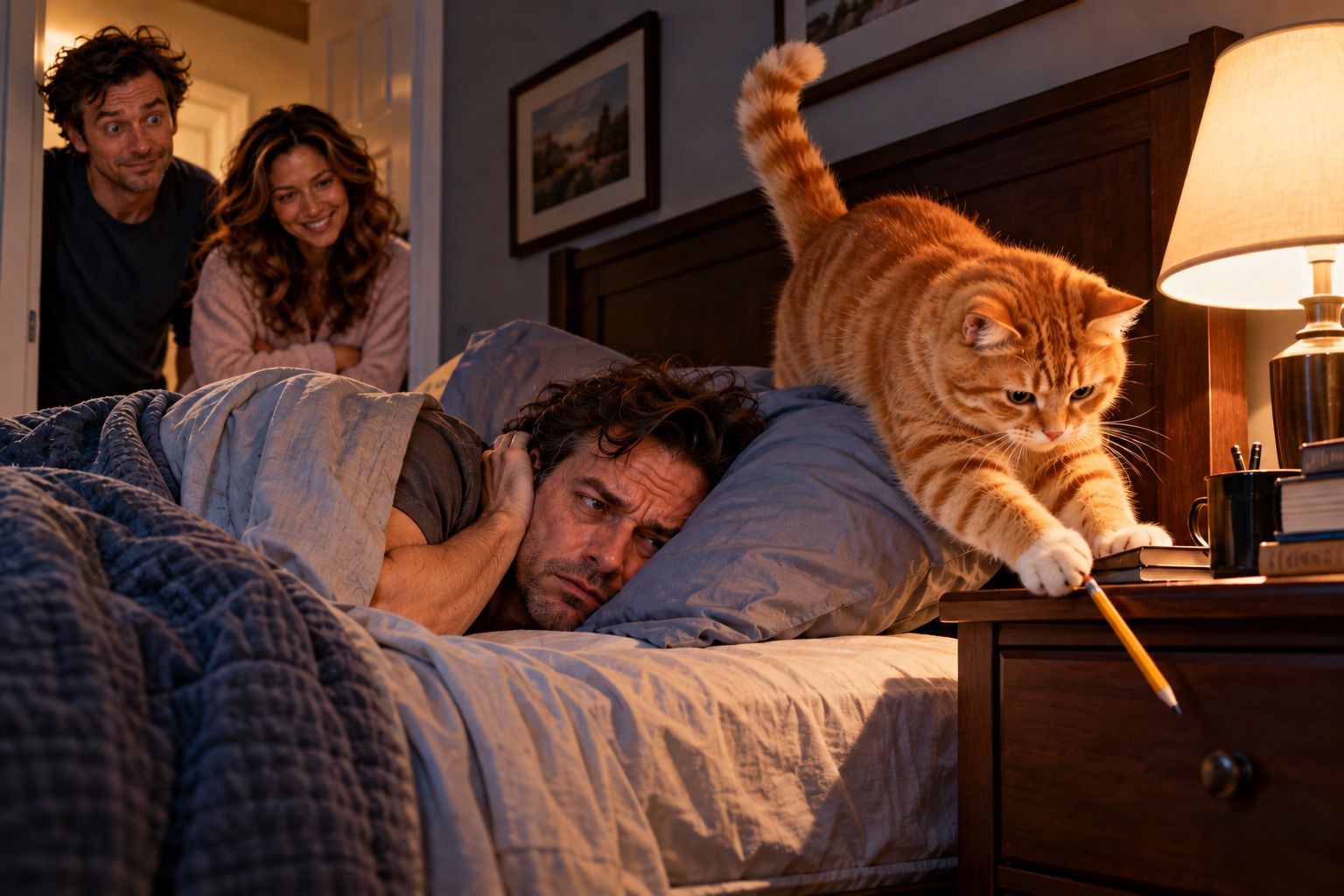
I asked him that exact question, and he looked toward Mr Whiskers. The cat was sitting beside John’s chair, staring up at him with an expression of innocent devotion. “Because of him,” John said. I looked at the cat, then back at John. “Mr Whiskers?” John nodded. Apparently, Mr Whiskers had discovered that John’s newly arranged bedroom provided several excellent opportunities for nighttime entertainment. The desk was now positioned close enough to a shelf that the cat could jump between them. A small rug near the bed made an ideal surface for scratching, and the bedside table had become a convenient launching point for investigating anything John left within reach. Every night, shortly after John turned off the lights, Mr Whiskers began what John described as a private athletic competition involving the furniture, the curtains, and occasionally John’s sleeping body.
I struggled to picture this because Mr Whiskers was currently sitting so quietly that he might have been posing for a portrait. John, however, had photographic evidence. He showed me a picture taken at two in the morning, featuring Mr Whiskers perched on top of the bookshelf with his tail hanging over the edge. Another photograph showed the cat sitting inside an open desk drawer, surrounded by pens and paper clips. A third captured him standing on John’s pillow, staring directly into the camera while John lay beneath the blanket looking thoroughly defeated. I began to laugh. John did not. “Last night,” he said, “he knocked a pencil onto the floor at one-thirty, chased it under the bed, and then spent twenty minutes trying to retrieve it. When I finally got up to help him, he walked away.” I admitted that this sounded exactly like Mr Whiskers.
Pandora joined us at the table, and John continued describing the situation. He’d tried closing his bedroom door, but Mr Whiskers responded by sitting outside and meowing until someone opened it. If John ignored him, the cat began tapping the door with his paw. If that didn’t work, he scratched at the bottom edge just enough to make an irritating noise without causing any real damage. Eventually, John would get up, open the door, and find Mr Whiskers sitting there looking delighted. Sometimes the cat entered the room. Sometimes he walked away. On one particularly frustrating night, he’d demanded entry, jumped onto the bed, settled comfortably beside John’s feet, and immediately fallen asleep. John had spent the next hour lying awake, afraid to move because he didn’t want to disturb the animal responsible for keeping him awake in the first place.
I was beginning to understand the problem. John’s unusual sleep pattern wasn’t the result of a secret project, a complicated personal situation, or anything requiring a neighborhood investigation. He was being kept awake by a cat who had discovered that one of the humans in the apartment was remarkably easy to manipulate. Pandora looked at John sympathetically, then glanced at Mr Whiskers. “Why don’t we keep him in the living room at night?” she suggested. John explained that he’d tried that, but Mr Whiskers had simply transferred his campaign to the hallway outside his door. I suggested putting a few toys in the living room to keep him occupied. John gave me a weary look. “Hal, I’ve bought him three new toys this week. He ignores them and plays with my shoelaces.” Mr Whiskers responded by rolling onto his back and exposing his stomach, which I suspected was an attempt to distract us from the seriousness of the discussion.
That evening, Pandora and I decided to help John establish a more peaceful nighttime routine. We played with Mr Whiskers before bed, gave him his evening meal, and made sure his favorite toys were available in the living room. John closed his bedroom door and announced that he intended to get eight uninterrupted hours of sleep. I wished him luck, although I couldn’t help feeling that he was being overly optimistic. For the first hour, everything went smoothly. Mr Whiskers curled up on the couch, Pandora read a book, and I watched television without hearing a single suspicious noise. At ten-thirty, I went to bed feeling confident that we’d solved the problem. I even considered mentioning our success to Mrs Jenkins the following morning, although Pandora advised me that the neighborhood probably didn’t need a formal report.
At approximately two in the morning, I woke to a soft tapping sound outside our bedroom. At first, I thought it was rain against the window, but then I heard a familiar meow. I opened my eyes and found Mr Whiskers sitting in the hallway, staring through the partially open door. When he saw that I was awake, he stood up and walked toward the kitchen. I waited a moment, hoping he’d lose interest, but the tapping resumed. Eventually, I got out of bed and followed him. He led me directly to the cabinet where we kept his treats, sat down, and looked up at me expectantly. I stared at him in disbelief. He had apparently decided that if John was no longer available to entertain him during the night, I would make an acceptable replacement.
I refused to give him a treat, returned to bed, and closed the door. Five minutes later, the tapping began again. This time it was accompanied by a long, dramatic meow that sounded remarkably like a complaint about poor customer service. Pandora stirred beside me and asked what was happening. I explained that Mr Whiskers was attempting to renegotiate the household’s sleeping arrangements. She listened for a moment, then rolled over and said, “Don’t reward him for it.” I agreed that this was sensible advice. Unfortunately, knowing the correct response and successfully ignoring a determined orange cat at two in the morning are two entirely different things. By three, I had heard tapping, scratching, and a noise that sounded suspiciously like someone dragging a small object across the hallway floor.
When I finally got up the next morning, John was already in the kitchen, looking more rested than he had in days. He greeted me cheerfully and asked how I’d slept. I considered lying, but the dark circles beneath my eyes made that seem pointless. I told him that Mr Whiskers had spent much of the night trying to get into our bedroom. John smiled with the unmistakable satisfaction of a man who had just been released from an unpleasant obligation. “Really?” he asked. “That’s strange. I slept great.” Pandora walked in a moment later, took one look at me, and started laughing. Mr Whiskers followed her, looking completely refreshed despite having spent several hours attempting to wear down my resistance. He jumped onto a chair, stretched, and settled in for what appeared to be a well-deserved morning nap.
That’s when I realized what had happened. John hadn’t developed an unusual sleep pattern because something mysterious was going on in his life. He’d simply been the designated nighttime entertainment for a cat who had learned how to keep a human awake. By helping John establish a new routine, I’d unintentionally volunteered to take his place. Mr Whiskers had accepted the arrangement without hesitation, and John was now enjoying the best sleep he’d had in weeks. I looked at the cat, who was already snoring softly, and wondered how an animal that slept most of the day could be so determined to prevent everyone else from doing the same. John poured himself another cup of coffee and asked whether I wanted some. I told him I wanted an entire pot.
I suppose the lesson here is that unusual sleep patterns don’t always indicate a complicated mystery. Sometimes they simply mean that someone in the household has four paws, unlimited free time, and absolutely no respect for bedtime. John is back to waking up early, Pandora is delighted that the apartment has returned to something resembling a normal routine, and Mr Whiskers has discovered that I am apparently easier to wake than anyone else. As for me, I’ve started keeping my bedroom door firmly closed and ignoring the tapping whenever possible. Unfortunately, last night I heard a new sound coming from the hallway, followed by the unmistakable scrape of something being pushed across the floor. This morning, I discovered one of Mr Whiskers’ toy mice positioned neatly outside my door. I don’t know whether it was a peace offering, a bribe, or a warning, but given his recent history of negotiations, I’m inclined to believe he’s preparing another proposal.