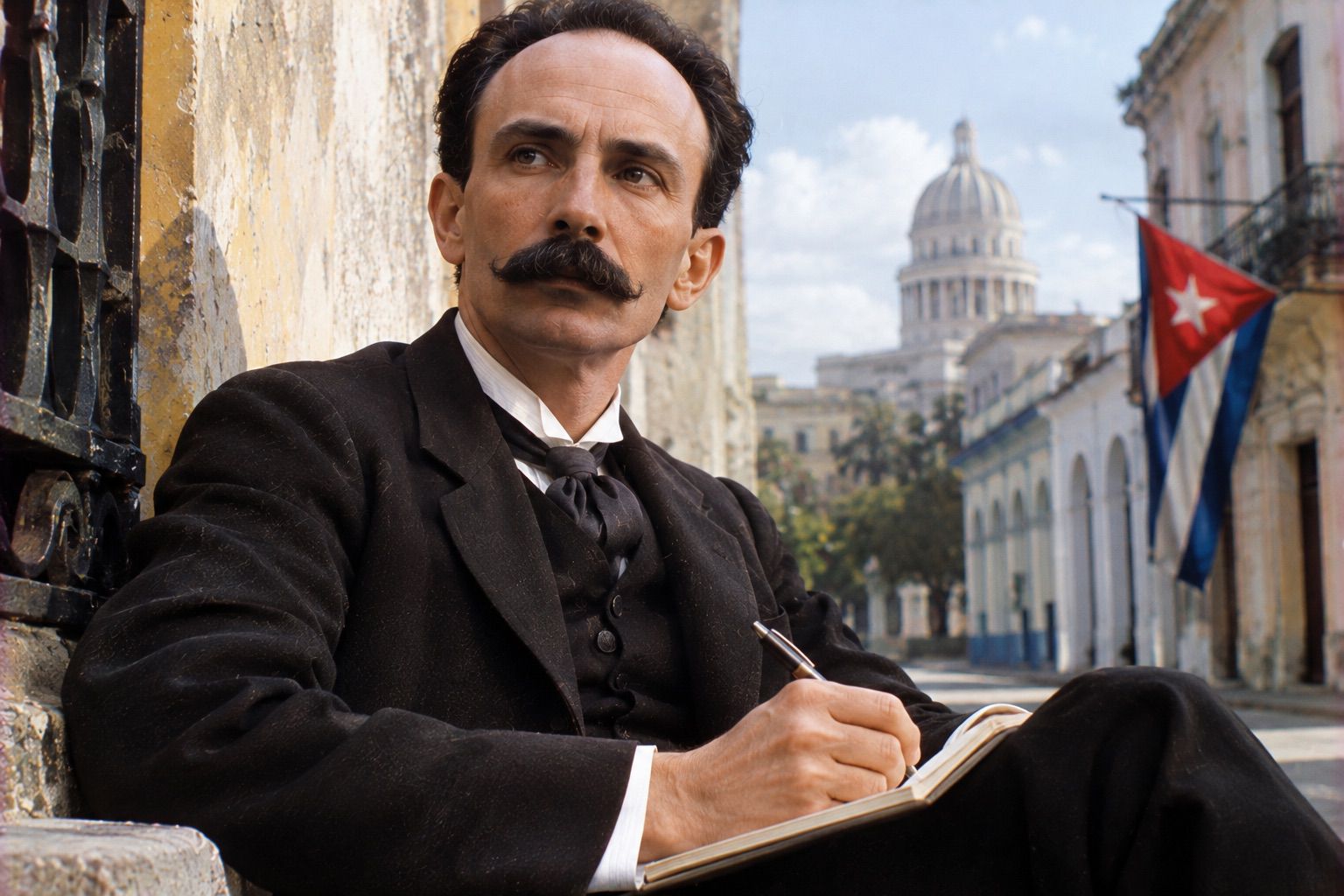
Jose Marti has been on my mind a lot lately, ever since I finished reading his poetry collection “Versos Sencillos” for a literature class. What struck me most about his work was the way he seemed to embody this sense of contradictions – a poet who was both deeply rooted in his culture and yet aware of its limitations; a revolutionary who was willing to challenge authority, but also valued the beauty of art.
I find myself drawn to people like Marti because they seem to exist at the intersection of multiple identities. I, too, have struggled with feeling caught between different worlds – my Cuban heritage, my American upbringing, and my identity as a writer. It’s almost as if I’m constantly negotiating which language to speak, which culture to claim.
Marti’s writing often feels like a reflection of this negotiation. His poetry is infused with the rhythms and imagery of his native Cuba, but it’s also deeply influenced by European Romanticism and American transcendentalism. He speaks about the beauty of nature, but also about the injustices of colonialism. It’s as if he’s constantly trying to reconcile these disparate parts of himself.
I think what I find most compelling about Marti is his sense of intellectual curiosity – his willingness to question authority, to challenge the status quo, and yet still hold onto a deep love for his culture and its traditions. He seems to embody this idea that you can be both fiercely critical and deeply loyal at the same time.
As I read through his poetry, I’m struck by how often he references the idea of “la patria” – the homeland. For Marti, la patria is not just a physical place, but also a spiritual one – a sense of connection to the land, to the people, and to the history that has shaped him. It’s this sense of connection that I think has always eluded me – as someone who’s grown up between two cultures, I’ve often felt like an outsider in both worlds.
Marti’s writing makes me wonder if it’s possible to have multiple homelands, or whether one must choose between them. Can you be loyal to your culture and yet still question its authority? Can you love the land of your ancestors and yet still acknowledge the injustices that have been perpetrated upon it?
I don’t have any answers to these questions, but Marti’s poetry has made me feel less alone in my uncertainty. His writing is like a map that charts the complexities of identity, culture, and belonging – a reminder that we are all negotiating multiple worlds, even if we don’t always know how to articulate it.
As I finish reading “Versos Sencillos” for the first time, I’m left with more questions than answers. What does it mean to be a patriot when your country is in chaos? How do you balance loyalty and critique when faced with systemic injustices? And what does it mean to call a place home when that place is constantly shifting beneath your feet?
These are questions that Marti himself grappled with throughout his life, and ones that I’m still trying to navigate as I stumble through my own. But for now, I’ll just keep writing, trying to find my own voice amidst the contradictions of this messy, beautiful world.
As I sit here, surrounded by the worn pages of “Versos Sencillos”, I’m struck by the way Marti’s words continue to reverberate within me. His poetry has a way of echoing the questions and doubts that have been lingering in my own mind for so long. It’s as if his writing is speaking directly to me, validating the uncertainty that often feels like a burden.
I think about how Marti was born in Cuba but spent much of his life in exile, oscillating between the island and Europe. He was constantly negotiating different languages, cultures, and identities – and yet, he managed to create this rich, vibrant poetry that somehow held it all together. It’s both inspiring and intimidating to me, as someone who has also been navigating multiple worlds.
One of the things I find myself drawn to is Marti’s use of metaphor and symbolism. He often employs imagery from nature – flowers, birds, rivers – to describe complex emotions and ideas. It’s like he’s trying to tap into a deeper language that transcends words, one that speaks directly to the soul. And yet, his poetry is also unflinchingly honest about the brutal realities of colonialism, imperialism, and social injustice.
I find myself wondering if there’s a connection between Marti’s use of metaphor and his experience as an outsider in multiple cultures. Did he use these metaphors as a way to navigate the complexities of identity and belonging? Was it a way for him to hold onto his Cuban heritage while also acknowledging the influences of European Romanticism and American transcendentalism?
These are questions I’m still exploring, but what’s clear is that Marti’s poetry has given me permission to explore these same themes in my own writing. His work has shown me that it’s okay to be uncertain, to question authority, and to search for meaning in the midst of chaos.
As I look back on our conversation so far, I’m struck by how much Marti’s life and work mirror my own experiences as a writer and a Cuban-American. We’re both trying to navigate multiple worlds, often feeling like outsiders in our respective cultures. And yet, we’re also searching for ways to connect with the land, the people, and the history that has shaped us.
In many ways, Marti’s poetry is a reminder that identity is not fixed, but rather something that shifts and evolves over time. It’s an invitation to explore, to question, and to search for meaning in the midst of uncertainty – and I’m grateful for the courage he showed in doing just that.
As I continue to sit with Marti’s words, I find myself thinking about the role of language in shaping our identities. For Marti, Spanish was not only a means of communication but also a key to accessing his cultural heritage and expressing his emotions. His poetry is infused with the rhythms and cadences of the Spanish language, which he used to describe the beauty and pain of his native Cuba.
I think about how I’ve experienced a similar relationship with language as a Cuban-American writer. Growing up in the United States, I often felt like my English was somehow “less” than my Spanish – that it was a pale imitation of the rich, vibrant tongue spoken by my abuela or tías back home. But Marti’s poetry has shown me that language is not something to be reduced or divided; rather, it’s a powerful tool for bridging cultures and connecting with our shared humanity.
I remember a moment from childhood when I was visiting Cuba with my family. We were sitting in the living room of our relatives’ apartment, surrounded by the sounds and smells of traditional Cuban cuisine cooking on the stovetop. My abuela handed me a small notebook and asked me to write down some words that I remembered from my Spanish classes at school. I scribbled down phrases like “la casa es azul” or “el perro se llama Max,” feeling proud to be using my language skills in a real-world context.
But as I looked around the room, I felt a pang of uncertainty. My abuela and tías were speaking to each other in rapid-fire Spanish, their words tumbling out like a river. Meanwhile, I was struggling to remember even basic phrases – it was as if my brain had been wired for English, not Spanish.
Marti’s poetry has made me realize that language is not just about communication; it’s also about identity and belonging. His writing shows me that it’s possible to use multiple languages to express complex emotions and ideas – and that the act of speaking or writing itself can be a powerful form of resistance against cultural erasure.
As I think back on this memory, I’m struck by how much Marti’s life and work continue to resonate with my own experiences as a writer and a Cuban-American. We’re both navigating multiple languages, cultures, and identities – and yet, we’re also searching for ways to connect with the land, the people, and the history that has shaped us.
I wonder if there’s a way to reconcile these different parts of ourselves, to find a language that speaks directly to our souls and connects us to our shared humanity. Marti’s poetry suggests that it’s possible – that even in the midst of chaos and uncertainty, we can find beauty and meaning through the act of writing itself.
As I sit with these thoughts, I’m struck by the way Marti’s poetry has given me permission to explore my own language, culture, and identity. His work shows me that it’s okay to be uncertain, to question authority, and to search for meaning in the midst of chaos.
I think about how Marti’s use of metaphor and symbolism often blurred the lines between his cultural heritage and the influences of European Romanticism and American transcendentalism. It’s as if he’s using these metaphors to create a new language that speaks directly to the soul, one that transcends national borders and cultural boundaries.
This idea resonates deeply with me, as someone who has grown up navigating multiple cultures and languages. I’ve often felt like I’m caught between two worlds, unsure of which language or culture to claim as my own. But Marti’s poetry suggests that it’s possible to find a new language, one that speaks directly to the complexities of identity and belonging.
As I continue to reflect on Marti’s life and work, I’m struck by his commitment to social justice and activism. His writing is infused with a deep sense of empathy and compassion for those who have been marginalized or oppressed. He writes about the struggles of the working class, the injustices of colonialism, and the importance of education and self-determination.
I find myself drawn to this aspect of Marti’s work, as someone who is passionate about social justice and activism. His writing shows me that it’s possible to use my language skills to make a difference in the world, to speak out against injustice and advocate for human rights.
But I’m also aware of the challenges that come with being an activist writer. It can be a lonely and isolating experience, especially when you’re speaking truth to power or challenging dominant narratives. Marti’s life was marked by exile and persecution, and he often struggled to find his place in the world as a poet and a revolutionary.
I think about how these challenges are still relevant today, for writers and activists who are pushing against the boundaries of what is acceptable or safe to say. It takes courage to speak out against injustice, especially when it means going up against powerful institutions or entrenched ideologies.
Marti’s poetry has given me permission to take this risk, to use my language skills to make a difference in the world. His work shows me that even in the midst of chaos and uncertainty, there is always hope for transformation and change.
As I finish reflecting on Marti’s life and work, I’m left with more questions than answers. What does it mean to be a patriot when your country is in chaos? How do you balance loyalty and critique when faced with systemic injustices? And what does it mean to call a place home when that place is constantly shifting beneath your feet?
But Marti’s poetry has shown me that these questions are not necessarily fixed or resolvable. Instead, they are part of an ongoing conversation about identity, culture, and belonging. His work invites us to explore these complexities, to question authority and challenge the status quo.
As I close my notebook and put down my pen, I’m left with a sense of gratitude for Marti’s poetry and its impact on my life. His work has given me permission to explore my own language, culture, and identity, to navigate multiple worlds and find meaning in the midst of chaos.
I know that I’ll continue to grapple with these questions and complexities, but for now, I’m just grateful for the courage that Marti showed in speaking out against injustice and advocating for human rights. His poetry has inspired me to take up this mantle, to use my language skills to make a difference in the world.
And so, I’ll keep writing, trying to find my own voice amidst the contradictions of this messy, beautiful world.