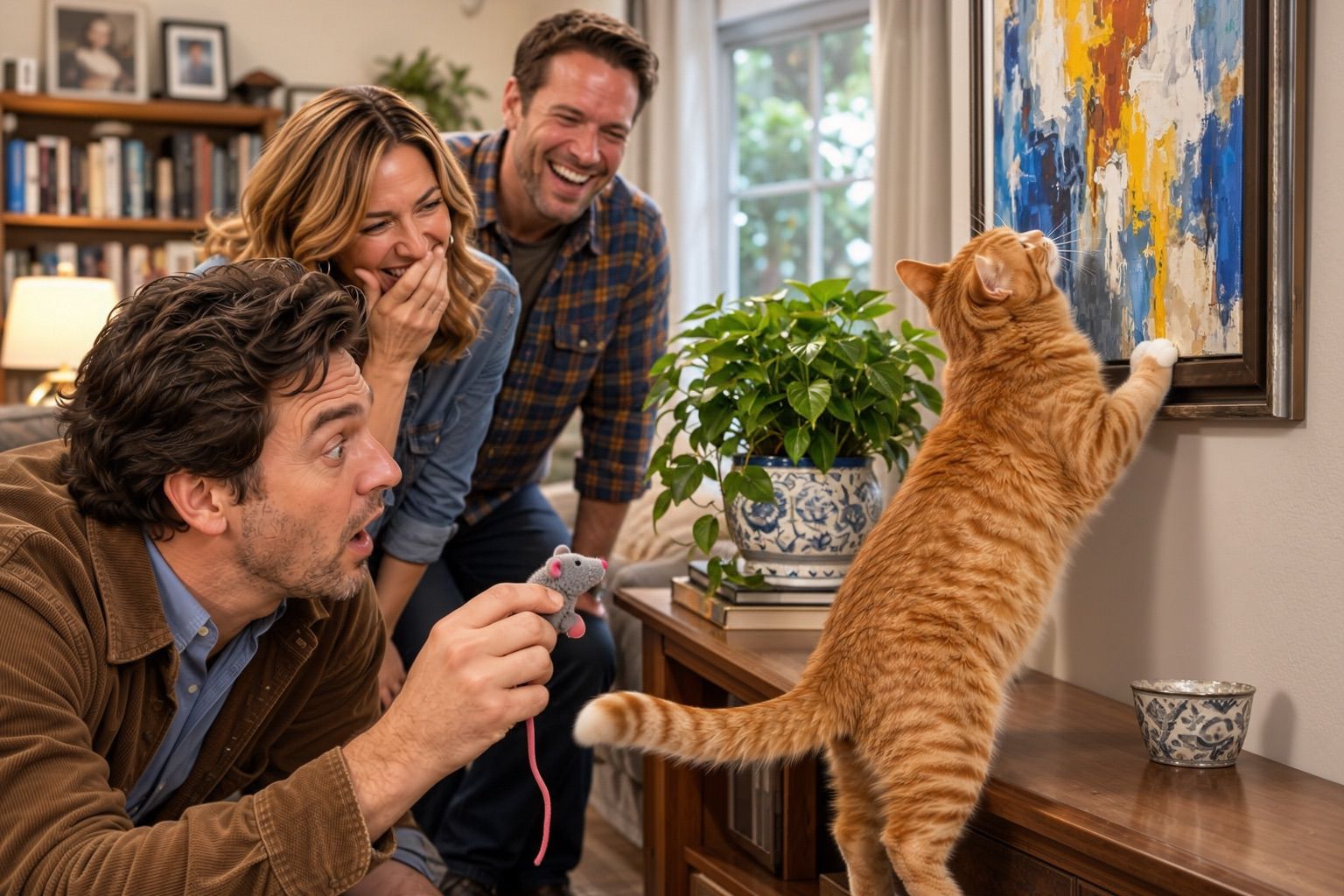
I knew something was wrong when I found Mr Whiskers sitting in front of the painting, meowing at it like he was trying to start an argument. It was barely eight in the morning, and I hadn’t even finished my coffee. The painting had been hanging in our living room for almost a week, ever since Karen brought it over. She’d taken up painting as a hobby and apparently decided our house needed an example of her work. I hadn’t objected because it seemed like a nice gesture, although I couldn’t tell what the painting was supposed to be. It had blue streaks, yellow splashes, and a large brown shape in the middle that looked suspiciously like a potato. Pandora said it was abstract art. John Mercer said it looked like somebody had dropped a sandwich into a washing machine. I thought both explanations were possible.
Mr Whiskers had shown no interest in the painting when Karen first brought it over. He’d watched John hang it on the wall, sniffed the empty cardboard box, and promptly fallen asleep inside it. That seemed like a reasonable response to modern art. But over the past few days, something had changed. Every morning, I found him sitting beneath the painting, staring up at it. Sometimes he meowed. Sometimes he stretched onto his hind legs and pawed at the wall. Yesterday, I caught him trying to climb the back of the couch to get a better look. I mentioned this to Pandora, who said he was probably interested in the colors or the way the light hit the canvas. That explanation might have satisfied someone less observant than me, but I had spent enough time around Mr Whiskers to recognize when he was up to something.
What bothered me even more was Pandora’s reaction. Every time I mentioned the painting, she smiled as though she knew something I didn’t. It wasn’t a big smile, just that little one she gets when she’s trying not to laugh at me. I asked her whether Karen had said anything unusual when she dropped it off. Pandora told me Karen had been pleased with how it turned out and wanted us to have it. I asked whether the painting had a title. She said she couldn’t remember. That struck me as odd. People who paint abstract pictures usually give them titles that make you feel foolish for asking what you’re looking at. I once saw a painting consisting of three black lines and a red square called *The Burden of Existence*. Karen’s painting looked like a potato in a thunderstorm, and I was supposed to believe nobody had named it.
John was eating cereal when I brought up my concerns. He listened for approximately ten seconds before deciding he had heard enough. “Hal, it’s a painting,” he said, reaching for the milk. “Karen made it. We hung it up. The cat likes looking at it. That’s the whole story.” I explained that the cat wasn’t simply looking at it. He was returning to the same spot every morning and making noises that suggested he wanted something. John glanced toward the living room, where Mr Whiskers was sitting beneath the painting again. “Maybe he doesn’t like the potato,” he said. I told him I wasn’t convinced it was a potato. John studied the painting for a moment and nodded. “You’re right. Could be a meatball.” He then returned to his cereal, apparently satisfied that he’d made a meaningful contribution to the investigation.
I decided to examine the painting more closely after breakfast. It was hanging above the small table beside the living room window, where Pandora kept a few books and a plant that had somehow survived three years of my watering schedule. I stood in front of the canvas and studied the brushstrokes. Up close, the brown shape looked even less like anything I recognized. There were little flecks of green paint near the bottom and a thin white streak across one corner. I leaned to the left, then to the right, hoping a different angle might reveal what Karen had intended. Mr Whiskers appeared beside me and began meowing. When I stepped away, he stopped. When I moved back toward the painting, he started again. I tried this three times before realizing I was conducting an experiment in which the cat was training me to move around the living room.
Pandora came downstairs while I was standing on tiptoe, trying to see behind the frame without taking it off the wall. She stopped in the doorway and asked what I was doing. I told her I was checking whether the painting had been hung properly. She looked at the small step stool beside me and raised an eyebrow. “You’ve been worried about that painting for days,” she said. “What’s really bothering you?” I explained that Mr Whiskers had developed an unusual interest in it and that I suspected something about the picture was attracting him. Pandora glanced at the cat, who was now sitting directly beneath the frame, and said, “Maybe he just likes it.” I pointed out that cats weren’t generally known for their appreciation of abstract art. She laughed and said, “Neither are you, apparently.” Then she went into the kitchen, leaving me with the uncomfortable feeling that she’d avoided answering my question.
Later that afternoon, Mrs Jenkins stopped by with a small container of homemade cookies. She was wearing her light blue cardigan and had the cheerful expression of someone who hadn’t spent the morning being ignored by a cat. I offered her coffee, and we sat in the living room while she told me about the flowers she’d been planting along her walkway. Eventually, I brought up Karen’s painting. Mrs Jenkins looked at it for a moment and said she liked the colors. I asked whether she could tell what it represented. She tilted her head, considered the question, and said, “Well, dear, art means different things to different people.” That was exactly the sort of answer I had expected from someone who didn’t know what it was either. Then she added, “Sometimes the most interesting things are hiding in plain sight.” I looked at her sharply. She was reaching for another cookie and didn’t appear to realize she’d just said something important.
After Mrs Jenkins left, I repeated her comment to John. He was sitting on the couch, trying to repair a game controller that had stopped responding properly. I told him I thought there might be something hidden in the painting. John didn’t look up. “Like what?” he asked. I admitted I wasn’t sure. He suggested a treasure map, a secret message, or possibly a second potato. I ignored the last suggestion and explained that Mrs Jenkins had specifically mentioned things hiding in plain sight. John finally looked at me. “Hal, Mrs Jenkins says things like that all the time. Last week she told me the secret to good tomatoes was patience. I don’t think she was recruiting me into an underground gardening organization.” I reminded him that Mr Whiskers had been behaving strangely. John looked at the cat, who was lying on his back with one paw in the air, and said, “Yes, he’s clearly carrying a terrible burden.”
That evening, I decided to call Karen. Since she had painted the picture, she seemed like the obvious person to ask about its meaning. I didn’t want to sound suspicious, so I began by complimenting her work and asking how long it had taken her to finish. She said she’d worked on it over a couple of weekends and had enjoyed experimenting with different colors. I asked whether there was anything unusual about the materials she’d used. She said she’d bought everything at an art supply store. I asked whether she’d painted anything underneath the final design. There was a pause before she said, “Hal, are you asking whether there’s another painting under the painting?” I told her I was simply interested in her artistic process. She laughed and said there wasn’t anything hidden in it. Then she asked whether we still had it hanging in the living room. I assured her we did. I didn’t mention that I’d considered taking it down to inspect the back.
The following morning, I woke to the sound of Mr Whiskers meowing again. I found him standing on the little table beneath the painting, stretching upward with both front paws against the wall. This time, however, I noticed something I hadn’t seen before. His attention wasn’t fixed on the center of the picture. He was staring at the narrow gap between the bottom of the frame and the wall. I moved closer, and he immediately stepped aside as though he’d been waiting for me. I put my hand beneath the frame and felt something soft caught behind it. For one ridiculous second, I imagined pulling out a folded note containing instructions or perhaps a tiny recording device. Instead, I found a small felt mouse, covered in orange cat hair, wedged between the frame and the wall.
I held the mouse up and stared at it. It was one of Mr Whiskers’ favorite toys, a battered gray thing with one missing ear and a tail that had been chewed down to almost nothing. I had been wondering where it had gone. The cat immediately stood on his hind legs and reached for it. I lowered the toy, and he snatched it from my fingers before racing across the living room with the sort of enthusiasm he usually reserved for dinner. I looked back at the painting. Suddenly, the entire mystery seemed less mysterious. Mr Whiskers hadn’t been studying Karen’s artwork. He’d been trying to retrieve his mouse from behind it. All those mornings of staring, meowing, and pawing at the wall had been his increasingly desperate attempts to convince somebody to help him.
Pandora walked in just as I was putting the frame back into position. She saw the mouse in Mr Whiskers’ mouth and started laughing. “You found it!” she said. I turned toward her. “You knew it was there?” She nodded. Apparently, she’d seen the cat batting the mouse around the living room a few days earlier. He’d sent it flying onto the table, where it bounced behind the frame. She’d meant to retrieve it but had been distracted by a phone call and forgotten about it. When I started questioning the painting, she realized what the cat was probably after. I asked why she hadn’t told me. She looked at me for a moment and said, “Because you were so determined to solve it yourself. I thought you’d figure it out in about five minutes.” I asked how long she’d been waiting. She smiled. “Three days.”
John arrived in time to hear the explanation, which was unfortunate because he found the whole thing much funnier than necessary. He looked at the painting, then at the cat, and finally at me. “So let me get this straight,” he said. “You’ve spent three days investigating Karen’s painting because the cat lost his mouse behind it?” I told him that was an oversimplification. He asked what part I’d left out. I mentioned Mrs Jenkins’ observation about things hiding in plain sight. John laughed so hard he had to sit down. Pandora joined him, and I stood there holding the picture frame while the two people I lived with treated a perfectly legitimate investigation as though it were some kind of comedy routine.
I tried to defend myself by pointing out that I had correctly identified the painting as the center of the mystery. John agreed that I had, although he seemed to think this made things even funnier. Pandora came over, kissed me on the cheek, and said she appreciated how seriously I took Mr Whiskers’ problems. I told her I wasn’t investigating the cat’s problems. I was investigating the painting. She gave me another kiss and said, “Of course you were.” I decided there was no point continuing the conversation. Mr Whiskers, meanwhile, had settled onto the rug with his recovered mouse and was happily kicking it with his back feet. He appeared completely unconcerned about the trouble he’d caused.
By dinner, I’d mostly put the incident behind me. Karen’s painting was back on the wall, Mrs Jenkins’ cookies were nearly gone, and John had finally stopped laughing every time he looked toward the living room. Pandora was preparing dinner when Mr Whiskers came trotting into the kitchen with his mouse in his mouth. He dropped it beside my chair and looked up at me. I picked it up and tossed it down the hallway, expecting him to chase it. Instead, he watched it land, looked back at me, and meowed. I retrieved it and threw it again. He stayed exactly where he was. After the third attempt, Pandora leaned against the counter and said, “Hal, I think he wants you to play fetch.”
I looked down at Mr Whiskers, who was sitting patiently at my feet. He’d spent three days convincing me to retrieve a toy from behind a painting, and now he seemed to think I was available for regular service. John glanced up from the table and said, “Careful. Next thing you know, he’ll have you bringing him his dinner.” I was about to tell him that cats didn’t think that way when Mr Whiskers turned toward his empty food bowl and let out a long, demanding meow. Pandora burst out laughing. John nearly choked on his drink. I looked at the cat, then at the bowl, and finally at the painting in the living room. I’d been so busy wondering whether Pandora was involved in some elaborate scheme that I’d overlooked the one member of the household who had been manipulating me all along.
I filled his bowl, because apparently that’s what I do now. Mr Whiskers ate without so much as a thank-you, then wandered off to find somewhere comfortable to sleep. Pandora squeezed my shoulder as she passed and told me not to take it personally. John suggested I start charging the cat an hourly rate for investigative services. I told them both that I was done discussing the matter. Still, as I sat down to dinner, I couldn’t help glancing toward Karen’s painting one last time. The brown shape in the middle no longer looked quite so much like a potato. From where I was sitting, it looked almost like a cat curled up asleep. I mentioned this to Pandora, who closed her eyes and shook her head. “Hal,” she said, “please just eat your dinner.”
I did, although I made a mental note to check behind the other pictures in the house. Not because I suspected anything, of course. I just thought it might save us some trouble later.