Latest Articles

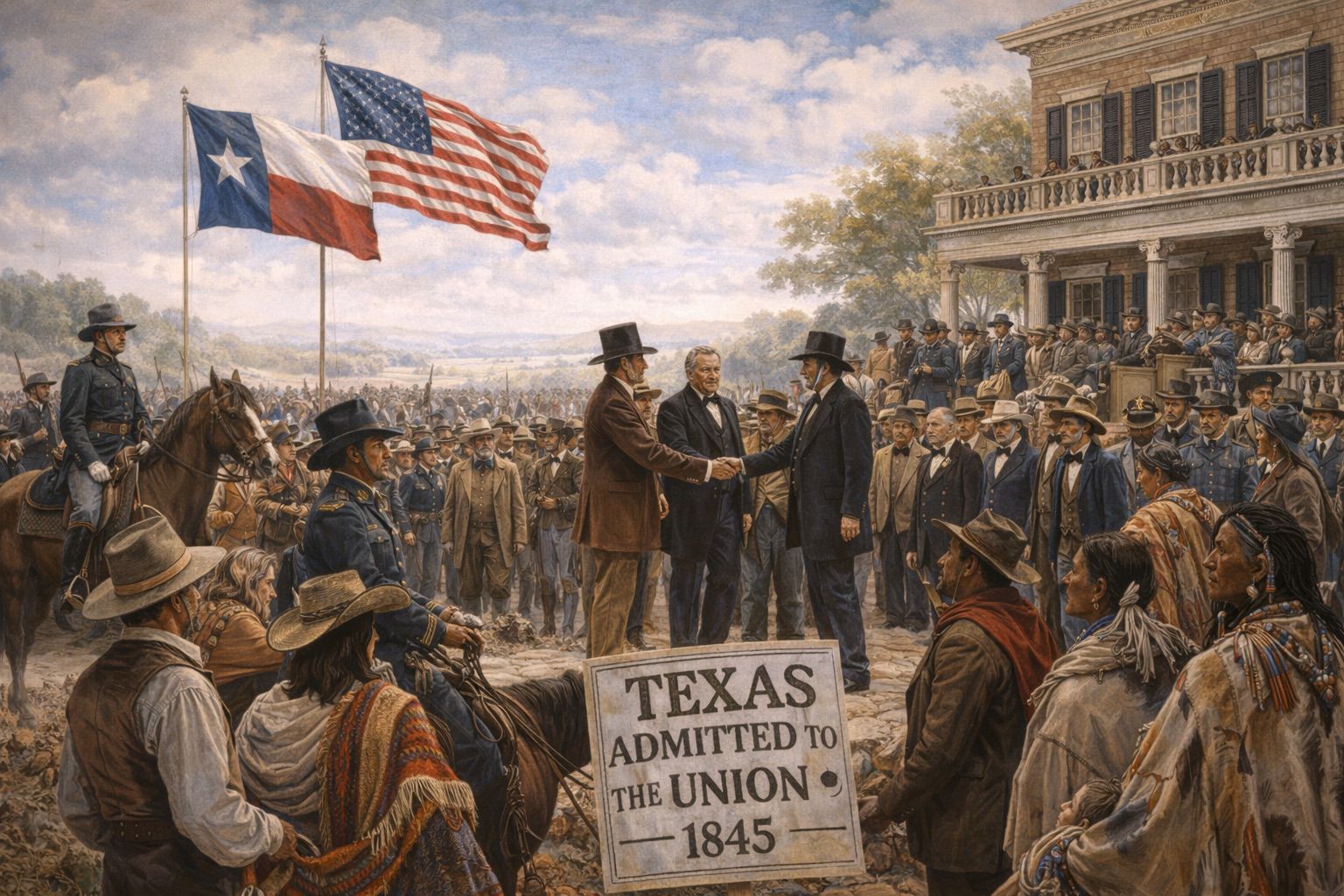
Texas admitted as the 28th U.S. state

Elias Rowen

The admission of Texas as the 28th U.S. state on December 29, 1845, marked a significant milestone in the country’s history. The annexation of the Lone Star Republic by the United States was a long and arduous process that involved complex negotiations, debates, and even violence. To understand the significance of this event, it is essential to examine the historical context leading up to Texas’ admission as a state.

In the early 19th century, the United States and Mexico were both struggling with their own internal issues. The Mexican War of Independence from Spain had just ended in 1821, but the new nation was still grappling with its own identity and borders. The U.S., on the other hand, was expanding westward, fueled by a desire for Manifest Destiny – the idea that it was America’s divine mission to spread across North America.

The relationship between the two nations was further complicated by the fact that Texas had been part of Mexico since gaining independence from Spain in 1821. However, as the Mexican government struggled to maintain control over its vast territories, a group of American settlers arrived in the region with the intention of establishing their own colonies. These settlers were largely from the Southern states and brought with them their own culture, language, and social norms.

In the early 1830s, tensions began to rise between the Mexican government and these American settlers. The Mexican government, which was dominated by centralists who wanted a strong federal system, saw the Texans as a threat to its authority. The Texans, on the other hand, wanted greater autonomy and even independence from Mexico. In 1835, a group of rebels in San Antonio launched the famous Battle of Gonzales against the Mexican army, marking the beginning of the Texas Revolution.

The conflict between the Texans and the Mexicans continued for several years, with the Texans emerging victorious at the Battle of San Jacinto on April 21, 1836. The newly formed Republic of Texas declared its independence from Mexico and established its own government, led by Sam Houston as president. However, the new republic faced significant challenges, including a struggling economy and a lack of recognition from other countries.

In 1837, the U.S. Congress passed the Webster-Ashburton Treaty with Great Britain, which resolved border disputes between the two nations. However, the treaty also led to increased tensions between the U.S. and Mexico over the issue of Texas’ status. The Mexican government refused to recognize the Republic of Texas as a sovereign state, and instead saw it as part of its own territory.

Meanwhile, in the United States, there was growing support for the annexation of Texas. Many Americans saw the young republic as a potential addition to the Union, and believed that its inclusion would strengthen the country’s economy and military. In 1843, President John Tyler sent a special envoy, John Slidell, to Mexico City to negotiate an agreement on Texas’ status. However, the mission was unsuccessful, and tensions between the two nations continued to rise.

In March 1844, Congress passed a resolution calling for the annexation of Texas by joint resolution, which would bypass the need for Senate approval. However, this resolution was met with fierce opposition from Northern Democrats, who saw it as an attempt by Southern states to expand slavery into new territories. The issue became increasingly polarized, with pro-slavery Southerners supporting annexation and anti-slavery Northerners opposing it.

Despite these challenges, the Texas annexation movement continued to gain momentum. In December 1844, Congress voted in favor of the joint resolution, but President Tyler vetoed it, citing concerns about Senate opposition. However, when Congress reconvened in March 1845, they passed a new joint resolution that included provisions for the abolition of slavery in Texas. This compromise led to the signing of the annexation treaty by the U.S. and Texas on April 12, 1845.

The final step towards statehood was taken on December 29, 1845, when President Polk signed a proclamation admitting Texas as the 28th U.S. state. The admission was met with widespread celebration across the country, but it also sparked outrage in Mexico and among anti-slavery groups in the North. The annexation of Texas had significant implications for the balance of power in both nations, setting the stage for future conflicts over slavery, states’ rights, and westward expansion.

The legacy of Texas’ admission as a state continues to shape American politics today. The debate over Manifest Destiny and its impact on Native American tribes is still relevant, as is the issue of immigration and border security. The annexation of Texas also highlights the complexities of nation-building and the challenges of integrating diverse cultures into a unified whole.

The relationship between the U.S. and Mexico has continued to evolve over time, with periods of cooperation and conflict. Today, the two nations maintain close diplomatic ties and cooperate on issues such as trade and security. However, the legacy of Texas’ admission as a state remains a source of tension between the two countries, particularly when it comes to issues related to immigration and border control.

As the Republic of Texas entered its second decade, the struggle for survival became increasingly dire. The economy was in shambles, with many Texans struggling to make ends meet due to a series of devastating crop failures and economic downturns. Meanwhile, the Mexican government continued to refuse recognition of the Republic’s sovereignty, maintaining that Texas was still part of Mexico.

In an effort to bolster its economy and strengthen its claim to independence, the Republic of Texas turned to the United States for support. In 1839, a group of Texans traveled to Washington D.C. to lobby for recognition and financial aid from Congress. However, their efforts were met with skepticism by many lawmakers, who viewed the Republic as little more than a ragtag collection of settlers.

Despite these setbacks, the Texas Revolution continued to gain momentum, thanks in large part to the leadership of Sam Houston. A veteran of the War of 1812 and a skilled politician, Houston was instrumental in rallying support for the Republic among Texans and Americans alike. In 1839, he traveled to Washington D.C. to meet with President Martin Van Buren and other government officials, pressing his case for recognition and aid.

The following year, the Texas Revolution received a significant boost when Stephen F. Austin, one of the most influential figures in the Republic’s early history, arrived in Washington D.C. with a petition signed by over 5,000 Texans calling for annexation by the United States. The petition, which was presented to President Van Buren on March 1, 1840, marked a significant turning point in the struggle for Texas’ independence.

As the debate over Texas’ status continued to rage within Congress and among the American public, a group of Texans began secretly negotiating with U.S. officials to pave the way for annexation. In May 1843, John Slidell, a former U.S. diplomat who had previously served as minister to Mexico, was dispatched to Washington D.C. by President Tyler to negotiate a secret treaty with Texas that would set the stage for annexation.

The negotiations, which took place over several weeks in June and July of 1843, resulted in the signing of a secret treaty between Slidell and Sam Houston. The treaty, which was not made public at the time, provided for the terms of Texas’ annexation by the United States. It also included provisions for the abolition of slavery in Texas, which would become a contentious issue during the debate over statehood.

However, just as it seemed that annexation was all but assured, the treaty was derailed by the arrival of Slidell’s instructions from President Tyler. The instructions, which were not made public at the time, revealed that Tyler had secretly offered to sell Texas to the United States for $30 million. This move, which would have allowed the U.S. government to purchase rather than annex the Republic, was seen as a betrayal by many Texans and was ultimately rejected by Congress.

The failure of the Slidell mission marked a significant setback for the annexation movement, but it did not deter its proponents. In 1844, President Tyler began secretly negotiating with Texas officials once again, this time seeking to bypass Congress altogether in favor of a joint resolution that would admit Texas as a state by a simple majority vote.

The debate over annexation continued to rage within Congress throughout the spring and summer of 1844. Pro-slavery Southerners argued that annexing Texas was essential for maintaining the balance of power between slave and free states, while anti-slavery Northerners countered that it would only serve to further entrench slavery in American society.

In March 1845, after weeks of tense debate, Congress finally voted on a joint resolution admitting Texas as a state. The measure passed by a margin of just four votes, with Northern Democrats ultimately failing to block its passage. However, President Tyler vetoed the resolution, citing concerns about Senate opposition and the potential impact on the balance of power within the Republic.

Undeterred, Congress reconvened in April 1845 and passed an amended version of the joint resolution that included provisions for the abolition of slavery in Texas. This compromise, which was seen as a significant concession by many pro-slavery Southerners, ultimately paved the way for the signing of the annexation treaty between the U.S. and Texas on April 12, 1845.

The final step towards statehood came on December 29, 1845, when President Polk signed a proclamation admitting Texas as the 28th U.S. state. The admission was met with widespread celebration across the country, but it also sparked outrage in Mexico and among anti-slavery groups in the North.

As the nation celebrated its newest addition, many Texans saw their long struggle for independence come to an end. But others knew that a new era of challenges lay ahead, one that would test the very fabric of American society. For as the Republic of Texas officially became part of the United States, it also brought with it a host of complex issues – including slavery, states’ rights, and westward expansion – that would shape the course of American history for generations to come.

The legacy of Texas’ admission as a state continues to be felt today. The debate over Manifest Destiny and its impact on Native American tribes remains a contentious issue, with many critics arguing that it was used as a justification for the forced relocation of indigenous peoples from their ancestral lands. Similarly, the issue of immigration and border control has been a source of tension between the U.S. and Mexico since the annexation.

In recent years, however, there have been signs of renewed cooperation between the two nations on issues such as trade and security. In 2013, the two countries signed a memorandum of understanding aimed at strengthening their bilateral relationship, including increased cooperation on issues related to border security.

Despite these efforts, the legacy of Texas’ admission as a state remains a source of tension between the U.S. and Mexico. For many Texans, the annexation marked the beginning of a new era of American expansionism that would ultimately lead to the displacement of Native American tribes from their ancestral lands. And for many Mexicans, it serves as a painful reminder of the country’s loss of territory and influence in the region.

Today, as Americans continue to grapple with the complexities of nation-building and cultural integration, they might do well to reflect on the lessons of Texas’ admission as a state. The Republic of Texas was born out of a desire for independence and self-governance, but it also brought with it a host of complex issues that would shape the course of American history.

The annexation of Texas serves as a reminder that nation-building is never easy, and that the integration of diverse cultures and identities can be a contentious process. It highlights the importance of careful consideration and compromise in shaping our national identity and informing our policies towards other nations.

As we move forward into an increasingly complex and interconnected world, it is more important than ever to learn from the experiences of the past. The legacy of Texas’ admission as a state remains a source of tension between the U.S. and Mexico today, but it also offers valuable lessons for policymakers and citizens alike about the complexities of nation-building and cultural integration.

In the end, the annexation of Texas marked a significant turning point in American history, one that would shape the course of our national identity and inform our policies towards other nations for generations to come. As we continue to grapple with the challenges of nation-building and cultural integration, we might do well to reflect on the lessons of Texas’ admission as a state – and strive to build a more inclusive, compassionate, and just society for all.
Related Posts

Wounded Knee Massacre

Elias Rowen

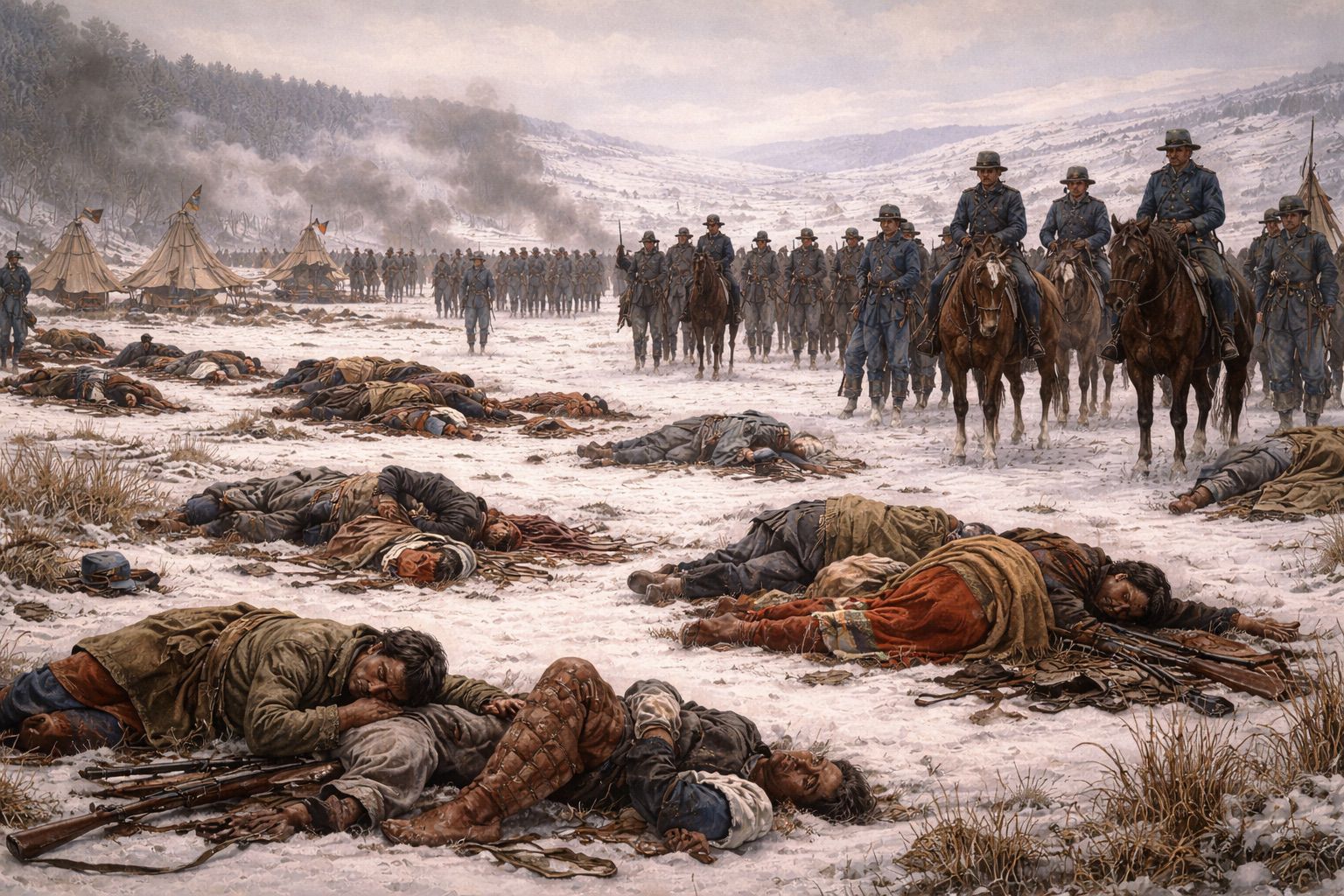
The Wounded Knee Massacre is one of the most infamous events in American history, a brutal and devastating confrontation between the US Army’s 7th Cavalry Regiment and a band of Lakota Sioux that resulted in the slaughter of over 150 unarmed men, women, and children. Taking place on December 29, 1890, at Wounded Knee Creek in South Dakota, this event marked the final major confrontation between the US military and the Native American tribes of the Great Plains.

The years leading up to the massacre were marked by a growing sense of desperation among the Lakota Sioux. The discovery of gold in the Black Hills had led to a surge in white settlement, and the government’s refusal to recognize Native American land rights had forced many families to leave their ancestral homes. President Ulysses S. Grant’s signing of the Fort Laramie Treaty in 1868, which granted the Great Sioux Reservation to the Lakota, was later revoked by Congress without consultation or compensation, leading to widespread anger and resentment among the Native American population.

The Ghost Dance movement, a spiritual revival led by the Paiute prophet Wovoka, had also spread rapidly across the Plains, offering hope to desperate tribes of a return to their ancestral lands and a chance to live free from white domination. The US government viewed this movement with suspicion, fearing it could lead to widespread resistance against its authority. As tensions mounted, federal authorities took steps to quell the rising unrest, including deploying troops to the area.

On December 15, 1890, Sitting Bull, the legendary Hunkpapa Lakota chief and spiritual leader, was killed in a confrontation with Indian Agency police on his reservation near Grand River, North Dakota. This event sparked widespread panic among the Native American population, leading many families to flee their homes in search of safety. A band of approximately 350 Lakota Sioux, led by Chief Big Foot, attempted to make its way to the Pine Ridge Reservation in South Dakota, where they hoped to find refuge.

However, as they approached Wounded Knee Creek on December 29, 1890, they were intercepted by a unit of the US Army’s 7th Cavalry Regiment under the command of Major Samuel M. Whitside. The troopers had been tracking Big Foot’s band for several days and were determined to bring them in for questioning. As tensions mounted, a scuffle broke out between a soldier and one of Big Foot’s warriors, resulting in the accidental shooting of an elderly woman, Crow Dog.

The situation rapidly spiralled out of control as panicked soldiers opened fire on the Lakota Sioux, who were largely unarmed and attempting to flee. The subsequent slaughter was brutal and unrelenting, with reports suggesting that some soldiers even shot fleeing women and children. Over 150 Native Americans perished in the massacre, while only one US soldier died.

The Wounded Knee Massacre marked a dark chapter in American history, symbolizing the brutal suppression of Native American resistance to white encroachment. The event led to a re-evaluation of the government’s treatment of its indigenous population and sparked calls for greater understanding and reconciliation between the two cultures. However, the legacy of Wounded Knee continues to haunt America today, serving as a painful reminder of the ongoing struggle for justice and equality faced by Native American communities.

As news of the massacre spread, outrage erupted across the country, with many questioning the actions of the US military. Congress established an investigation into the event, which concluded that the soldiers had acted in self-defense, but also acknowledged widespread mistakes in judgment and execution. The official report downplayed the severity of the incident, stating only 29 casualties among the Lakota Sioux.

However, estimates of the death toll varied widely, with some accounts suggesting as many as 300 Native Americans perished in the massacre. In reality, the true number lies somewhere between these extremes, but is likely to be closer to the higher estimate given the brutality and scope of the incident.

The Wounded Knee Massacre also had significant long-term consequences for the Lakota Sioux people. The event marked a turning point in their struggle against white encroachment, leading to widespread despair and disillusionment among Native American communities. Many families were forced to flee their ancestral lands once again, while others were confined to reservations where they struggled to survive.

The massacre also served as a catalyst for greater activism among Native American leaders, who began to organize resistance movements in response to the event. In 1973, a group of AIM (American Indian Movement) activists took over Wounded Knee village, occupying it for 71 days and sparking a renewed wave of protests against government policy.

Today, the legacy of Wounded Knee continues to be felt across America. Efforts have been made to recognize the tragedy as a national monument, with many pushing for greater understanding and reconciliation between Native American communities and the wider population.

The struggle for justice and equality faced by Native Americans remains an ongoing challenge, but one that is slowly gaining recognition and momentum. As the US government continues to grapple with its troubled past, it’s clear that the Wounded Knee Massacre will remain a painful reminder of the brutal suppression of indigenous cultures and the need for greater understanding and respect between all communities.

Wounded Knee 1890, Native American rights movement, Indigenous people’s struggles, American Indian Movement, US government accountability, historical injustice #WoundedKneeMassacre #NativeAmericanRights #IndigenousPeoplesStruggles #AIMMovement #USGovernmentAccountability #HistoricalInjustice

The Wounded Knee Massacre was a culmination of decades of violence and dispossession inflicted upon the Native American population by the United States government. The discovery of gold in the Black Hills had set off a chain reaction of events that would ultimately lead to one of the most infamous massacres in American history.

In the 1850s, the US government began to exert pressure on the Lakota Sioux to cede their land, promising them protection and compensation in return. However, these promises were repeatedly broken, and the Native Americans were left with nothing but shattered dreams and broken treaties. The Fort Laramie Treaty of 1868, which granted the Great Sioux Reservation to the Lakota, was a brief respite from the violence, but it ultimately proved to be a hollow promise.

The treaty was signed by President Ulysses S. Grant in 1868, but Congress soon began to revoke its provisions, allowing for the construction of roads and railroads across Native American lands without their consent. The government’s actions were facilitated by the discovery of gold in the Black Hills, which led to a surge in white settlement and further displacement of the Lakota Sioux.

As the years went by, tensions between the US military and the Native American tribes continued to escalate. The Ghost Dance movement, a spiritual revival led by the Paiute prophet Wovoka, offered hope to desperate tribes of a return to their ancestral lands and a chance to live free from white domination. However, the US government viewed this movement with suspicion, fearing it could lead to widespread resistance against its authority.

The killing of Sitting Bull on December 15, 1890, was a devastating blow to the Lakota Sioux. A legendary Hunkpapa chief and spiritual leader, Sitting Bull had been a thorn in the side of the US government for years, refusing to surrender his people’s land or accept the reservation system. His death sparked widespread panic among Native American communities, leading many families to flee their homes in search of safety.

A band of approximately 350 Lakota Sioux, led by Chief Big Foot, attempted to make its way to the Pine Ridge Reservation in South Dakota, where they hoped to find refuge. However, as they approached Wounded Knee Creek on December 29, 1890, they were intercepted by a unit of the US Army’s 7th Cavalry Regiment under the command of Major Samuel M. Whitside.

The troopers had been tracking Big Foot’s band for several days and were determined to bring them in for questioning. As tensions mounted, a scuffle broke out between a soldier and one of Big Foot’s warriors, resulting in the accidental shooting of an elderly woman, Crow Dog. The situation rapidly spiralled out of control as panicked soldiers opened fire on the Lakota Sioux, who were largely unarmed and attempting to flee.

The subsequent slaughter was brutal and unrelenting, with reports suggesting that some soldiers even shot fleeing women and children. Over 150 Native Americans perished in the massacre, while only one US soldier died. The event marked a dark chapter in American history, symbolizing the brutal suppression of Native American resistance to white encroachment.

In the aftermath of the massacre, outrage erupted across the country, with many questioning the actions of the US military. Congress established an investigation into the event, which concluded that the soldiers had acted in self-defense, but also acknowledged widespread mistakes in judgment and execution. The official report downplayed the severity of the incident, stating only 29 casualties among the Lakota Sioux.

However, estimates of the death toll varied widely, with some accounts suggesting as many as 300 Native Americans perished in the massacre. In reality, the true number lies somewhere between these extremes, but is likely to be closer to the higher estimate given the brutality and scope of the incident.

The Wounded Knee Massacre had significant long-term consequences for the Lakota Sioux people. The event marked a turning point in their struggle against white encroachment, leading to widespread despair and disillusionment among Native American communities. Many families were forced to flee their ancestral lands once again, while others were confined to reservations where they struggled to survive.

The massacre also served as a catalyst for greater activism among Native American leaders, who began to organize resistance movements in response to the event. In 1973, a group of AIM (American Indian Movement) activists took over Wounded Knee village, occupying it for 71 days and sparking a renewed wave of protests against government policy.

Today, the legacy of Wounded Knee continues to be felt across America. Efforts have been made to recognize the tragedy as a national monument, with many pushing for greater understanding and reconciliation between Native American communities and the wider population.

However, the struggle for justice and equality faced by Native Americans remains an ongoing challenge. The US government has continued to grapple with its troubled past, but progress has been slow. In 1990, Congress passed the Native American Graves Protection and Repatriation Act (NAGPRA), which required federal agencies to return ancestral human remains and cultural artifacts to their respective tribes.

In 2017, President Donald Trump signed an executive order aimed at expanding oil drilling on Native American reservations, sparking widespread outrage among tribal leaders. The order was seen as a betrayal of the trust relationship between the US government and Native American communities, and it sparked renewed calls for greater accountability and transparency in federal policy-making.

The Wounded Knee Massacre will forever be remembered as a symbol of the brutal suppression of indigenous cultures and the need for greater understanding and respect between all communities. As we continue to grapple with our troubled past, it is essential that we acknowledge the injustices committed against Native American populations and work towards a more just and equitable future.

In recent years, there has been a growing movement among Native American communities to reclaim their histories and cultures. Efforts have been made to preserve traditional languages and cultural practices, while also promoting greater understanding and awareness of Native American experiences through education and media initiatives.

However, much work remains to be done. The struggle for justice and equality faced by Native Americans is complex and multifaceted, requiring sustained efforts from government agencies, tribal leaders, and the wider community. It will take time, patience, and a commitment to understanding and respect for the long-term healing of the wounds inflicted upon Native American communities.

As we reflect on the legacy of Wounded Knee, it is essential that we remember the bravery and resilience of the Lakota Sioux people who suffered so greatly at the hands of the US military. We must also acknowledge the ongoing struggles faced by Native American communities today, from poverty and poor living conditions to inadequate access to healthcare and education.

Ultimately, the story of Wounded Knee serves as a powerful reminder of the importance of understanding and respect between cultures. As we move forward towards a more just and equitable future, it is essential that we honor the memories of those who suffered at Wounded Knee by working towards greater reconciliation and healing between Native American communities and the wider population.

The US government’s treatment of its indigenous populations has left deep scars on the collective psyche of Native America. However, with continued efforts towards greater understanding and respect, there is hope for a brighter future where Native Americans can live in dignity and equality with their fellow citizens.

In 2019, the US House of Representatives passed the Wounded Knee Massacre Commemoration Act, which recognized the tragedy as a national monument and encouraged greater awareness and education about the event. The bill also provided funding for the preservation of tribal lands and cultural resources, marking an important step towards reconciliation and healing.

However, much work remains to be done. The struggle for justice and equality faced by Native Americans is ongoing, requiring sustained efforts from government agencies, tribal leaders, and the wider community. As we continue to grapple with our troubled past, it is essential that we acknowledge the injustices committed against Native American populations and work towards a more just and equitable future.

In conclusion, the Wounded Knee Massacre was a brutal and devastating event that left deep scars on the collective psyche of Native America. However, it also serves as a powerful reminder of the importance of understanding and respect between cultures. As we move forward towards a more just and equitable future, it is essential that we honor the memories of those who suffered at Wounded Knee by working towards greater reconciliation and healing between Native American communities and the wider population.

The legacy of Wounded Knee continues to haunt America today, serving as a painful reminder of the ongoing struggle for justice and equality faced by Native American communities. However, with continued efforts towards greater understanding and respect, there is hope for a brighter future where Native Americans can live in dignity and equality with their fellow citizens.

Related Posts

Last flight of supersonic Concorde jet

Elias Rowen

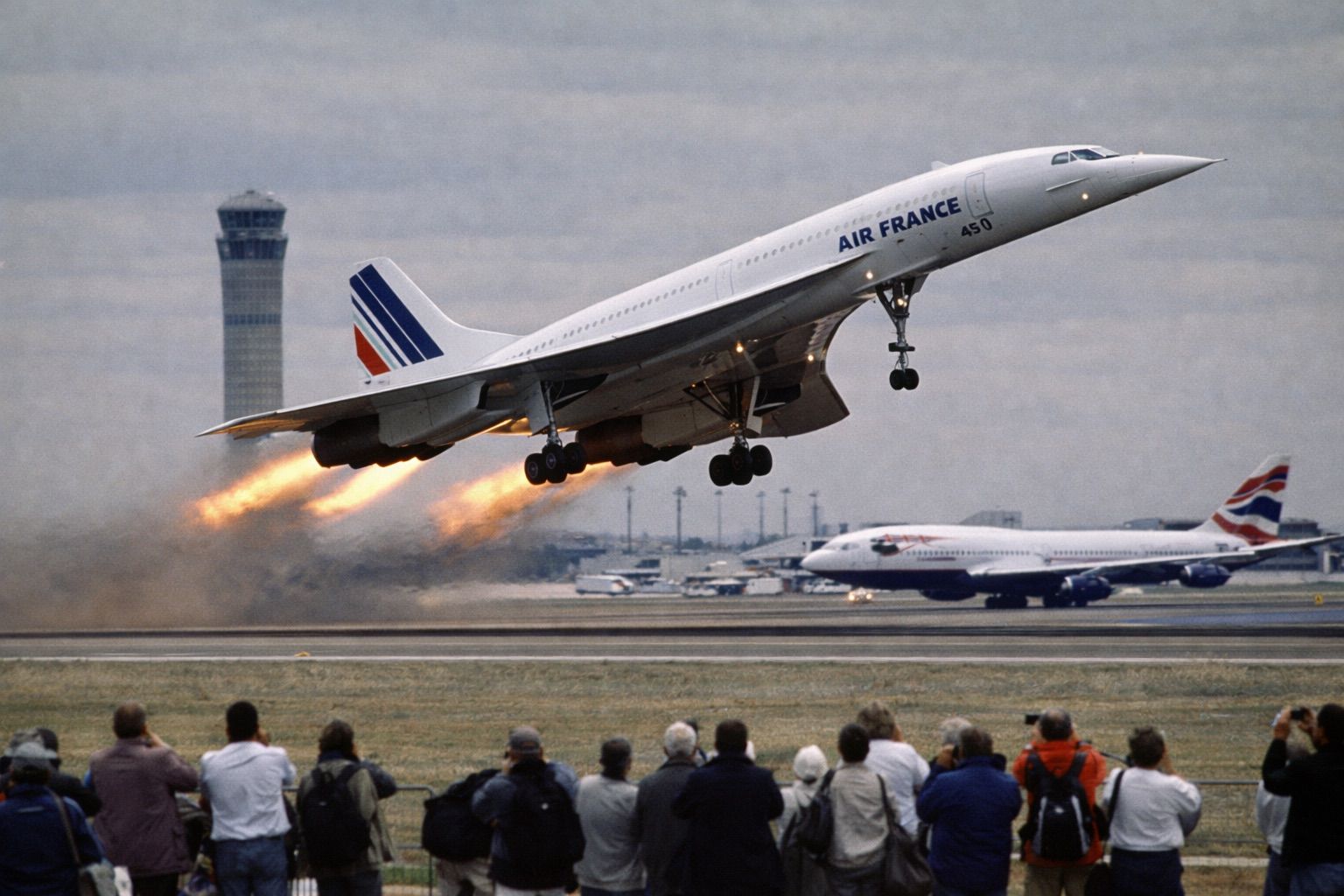
The last flight of the supersonic Concorde jet is a poignant reminder of the transience of technological innovation and the capricious nature of human endeavor. It was on June 10, 2003, that Air France Flight 4590 took off from Charles de Gaulle Airport in Paris, embarking on its final scheduled flight as the world’s fastest commercial airliner.

The Concorde, a joint project between British Aerospace (now BAE Systems) and Aérospatiale (now Airbus), had first taken to the skies in 1969. The brainchild of French engineer André Turcat and his team, the supersonic jet was designed to carry passengers at speeds twice that of its contemporaries, piercing the sound barrier with ease and defying the conventional wisdom that supersonic flight was impossible without a significant trade-off in fuel efficiency.

From its early days as a technological curiosity, the Concorde quickly gained popularity among airlines and travelers alike. Its unique combination of style, luxury, and speed made it an attractive option for those who could afford to splurge on a transatlantic ticket. As one seasoned traveler recalled: “I remember my first flight on the Concorde like it was yesterday. The thrill of taking off from New York and landing in London just over three hours later – it was exhilarating, to say the least.”

However, as the years went by, the Concorde’s popularity waned, and the economics of supersonic flight began to unravel. With a fuel capacity that would allow for only about 100 passengers per trip, the Concorde’s operating costs were prohibitively high, rendering it uncompetitive with subsonic aircraft in terms of overall efficiency. Furthermore, the sonic boom associated with supersonic flight had long been a contentious issue, prompting governments to restrict or ban overland supersonic flight altogether.

Air France, which had been a key partner in the Concorde’s development and operation, was forced to confront these challenges head-on. In 1999, the airline announced that it would be ending its Concorde operations due to rising maintenance costs and decreased demand for the aircraft. British Airways, the other primary operator of the Concorde, initially resisted this decision but eventually followed suit in 2001.

Yet, in a surprising twist, Air France decided to stage one final farewell flight before retiring the Concorde from service. On June 10, 2003, Flight 4590 departed Paris for New York’s JFK Airport with an all-business-class cabin and a special “farewell” menu designed by celebrity chef Joël Robuchon. As passengers took their seats and fastened their seatbelts, the Concorde’s iconic engines roared to life, accelerating from zero to Mach 2 in just 3 minutes.

Tragically, however, this final flight was marred by tragedy when the aircraft suffered a catastrophic tire blowout during takeoff. Shrapnel from the exploded tire punctured one of the fuel tanks, causing an inferno that would soon engulf the plane’s right wing and ultimately lead to its demise. The explosion was so severe that it ripped through the aircraft’s fuselage, killing all seven crew members on board.

As news of the disaster spread like wildfire across the globe, the aviation community was left reeling in shock. The loss of life was immense – but the sense of collective grief and bewilderment ran deeper still. For in one fell swoop, the Concorde’s legacy had been forever tarnished by tragedy, casting a shadow over its remarkable achievements as a technological pioneer.

In the aftermath of the crash, investigators pored over the data from black box recorders to pinpoint the exact cause of the disaster. Their findings pointed to a combination of factors – including a faulty tire and inadequate maintenance procedures on the part of Air France’s ground crew. Yet, as various governments, airlines, and industry stakeholders scrambled to assign blame and revise safety protocols, it was clear that the Concorde’s demise marked more than just the end of an era; it also signaled a turning point in human history.

For decades, supersonic flight had been touted as a symbol of human ingenuity and limitless potential. And yet, in its most spectacular failure, we were reminded that even our greatest technological achievements are vulnerable to the whims of chance and the darker side of human nature. The Concorde’s final flight stands as a poignant reminder of the high stakes involved in pushing the boundaries of science and technology – and the sometimes devastating consequences when those boundaries are tested beyond their limits.

The legacy of the Concorde lives on, however, in the countless stories of travelers who experienced its unique thrill and witnessed firsthand its breathtaking beauty. As one passenger reflected: “For me, the Concorde was more than just an airplane – it represented a connection to something greater than ourselves… something magical.”

The last flight of the supersonic Concorde jet is a poignant reminder of the transience of technological innovation and the capricious nature of human endeavor. It was on June 10, 2003, that Air France Flight 4590 took off from Charles de Gaulle Airport in Paris, embarking on its final scheduled flight as the world’s fastest commercial airliner.

The Concorde, a joint project between British Aerospace (now BAE Systems) and Aérospatiale (now Airbus), had first taken to the skies in 1969. The brainchild of French engineer André Turcat and his team, the supersonic jet was designed to carry passengers at speeds twice that of its contemporaries, piercing the sound barrier with ease and defying the conventional wisdom that supersonic flight was impossible without a significant trade-off in fuel efficiency.

From its early days as a technological curiosity, the Concorde quickly gained popularity among airlines and travelers alike. Its unique combination of style, luxury, and speed made it an attractive option for those who could afford to splurge on a transatlantic ticket. As one seasoned traveler recalled: “I remember my first flight on the Concorde like it was yesterday. The thrill of taking off from New York and landing in London just over three hours later – it was exhilarating, to say the least.”

However, as the years went by, the Concorde’s popularity waned, and the economics of supersonic flight began to unravel. With a fuel capacity that would allow for only about 100 passengers per trip, the Concorde’s operating costs were prohibitively high, rendering it uncompetitive with subsonic aircraft in terms of overall efficiency. Furthermore, the sonic boom associated with supersonic flight had long been a contentious issue, prompting governments to restrict or ban overland supersonic flight altogether.

Air France, which had been a key partner in the Concorde’s development and operation, was forced to confront these challenges head-on. In 1999, the airline announced that it would be ending its Concorde operations due to rising maintenance costs and decreased demand for the aircraft. British Airways, the other primary operator of the Concorde, initially resisted this decision but eventually followed suit in 2001.

Yet, in a surprising twist, Air France decided to stage one final farewell flight before retiring the Concorde from service. On June 10, 2003, Flight 4590 departed Paris for New York’s JFK Airport with an all-business-class cabin and a special “farewell” menu designed by celebrity chef Joël Robuchon. As passengers took their seats and fastened their seatbelts, the Concorde’s iconic engines roared to life, accelerating from zero to Mach 2 in just 3 minutes.

Tragically, however, this final flight was marred by tragedy when the aircraft suffered a catastrophic tire blowout during takeoff. Shrapnel from the exploded tire punctured one of the fuel tanks, causing an inferno that would soon engulf the plane’s right wing and ultimately lead to its demise. The explosion was so severe that it ripped through the aircraft’s fuselage, killing all seven crew members on board.

As news of the disaster spread like wildfire across the globe, the aviation community was left reeling in shock. The loss of life was immense – but the sense of collective grief and bewilderment ran deeper still. For in one fell swoop, the Concorde’s legacy had been forever tarnished by tragedy, casting a shadow over its remarkable achievements as a technological pioneer.

In the aftermath of the crash, investigators pored over the data from black box recorders to pinpoint the exact cause of the disaster. Their findings pointed to a combination of factors – including a faulty tire and inadequate maintenance procedures on the part of Air France’s ground crew. Yet, as various governments, airlines, and industry stakeholders scrambled to assign blame and revise safety protocols, it was clear that the Concorde’s demise marked more than just the end of an era; it also signaled a turning point in human history.

For decades, supersonic flight had been touted as a symbol of human ingenuity and limitless potential. And yet, in its most spectacular failure, we were reminded that even our greatest technological achievements are vulnerable to the whims of chance and the darker side of human nature. The Concorde’s final flight stands as a poignant reminder of the high stakes involved in pushing the boundaries of science and technology – and the sometimes devastating consequences when those boundaries are tested beyond their limits.

The legacy of the Concorde lives on, however, in the countless stories of travelers who experienced its unique thrill and witnessed firsthand its breathtaking beauty. As one passenger reflected: “For me, the Concorde was more than just an airplane – it represented a connection to something greater than ourselves… something magical.”

As I sat among the passengers on that fateful day, watching the Concorde’s engines roar to life, I couldn’t help but feel a sense of awe at this magnificent machine. Its sleek design and imposing presence seemed almost otherworldly, as if it were a harbinger of a new era in aviation. And yet, beneath its gleaming surface, the Concorde hid secrets – secrets that would soon be exposed by the tragic events that unfolded.

For those who had been fortunate enough to fly on the Concorde, there was an unspoken understanding that this aircraft was something special – a true marvel of modern engineering that transcended mere transportation and entered the realm of art. As one writer observed: “The Concorde was not just a plane; it was an experience – a symphony of sounds, sights, and sensations that lingered long after you’d left its confines.”

This unique blend of style, luxury, and speed had made the Concorde an irresistible draw for many travelers. Some came to experience the thrill of breaking the sound barrier, while others were simply drawn by its sheer exclusivity – after all, what other aircraft could boast a price tag that rivaled luxury yachts? For these passengers, the Concorde represented not just a means of transportation but a status symbol – a badge of honor that signaled their arrival in the rarefied world of high-flying elite.

But as we soared through the skies at Mach 2+, something else was happening beneath the surface. A sense of detachment began to creep in, as if we were witnessing an event outside the normal boundaries of human experience. And when tragedy struck, it seemed almost inevitable – a stark reminder that even our greatest achievements are subject to the cruel whims of fate.

The aftermath of the crash saw a global outpouring of grief and sympathy for the families of those who had lost their lives on Flight 4590. The Concorde’s demise was seen as a poignant reminder of the risks involved in pushing the boundaries of science and technology – a stark warning that even our most brilliant innovations are vulnerable to the darker side of human nature.

In the years since its retirement, the Concorde has become an enduring symbol of the transience of technological innovation. Its legacy lives on in the countless stories of travelers who experienced its unique thrill and witnessed firsthand its breathtaking beauty. And yet, as we look back on this remarkable aircraft’s final flight, it is hard not to wonder what might have been – had the Concorde continued to soar through the skies, carrying passengers at speeds that defied convention.

As I reflect on that fateful day, I am struck by the realization that even in failure, there lies a deeper truth. The Concorde’s story is one of human ingenuity and limitless potential – but also of hubris and recklessness, as we push the boundaries of what is possible without fully considering the consequences.

In the end, the Concorde may have been more than just an airplane – it represented our collective aspirations for a future that is faster, farther, and forever boundless. Its legacy will live on in our memories, a poignant reminder of the power of human imagination and the fragility of our greatest achievements.

Related Posts

First Commercial Jet Airliner Announced

Elias Rowen

In the post-World War II era, the world was witnessing an unprecedented rate of technological advancements in various fields, including aviation. The aircraft industry had experienced significant growth and innovation during the war years, with pioneering efforts from manufacturers like Boeing and Douglas to develop new types of planes. However, despite these developments, commercial air travel remained relatively rare and expensive, catering mainly to a small but affluent demographic.

It wasn’t until the mid-1940s that a team at de Havilland Aircraft Company in the United Kingdom began exploring the possibility of creating a jet-powered airliner. Led by the company’s chief designer, George Edwards, they envisioned an aircraft capable of carrying up to 60 passengers across long distances, offering unprecedented speed and comfort compared to existing piston-engine planes.

De Havilland’s innovative design, dubbed the DH.106 Comet, would go on to become a groundbreaking achievement in aviation history. The first commercial jet airliner, it was designed with several key features that addressed some of the primary concerns associated with air travel at the time. One such concern was turbulence, which caused considerable discomfort for passengers. Edwards and his team incorporated advanced materials like steel and aluminum into their design to reduce the aircraft’s weight while also increasing its strength.

In addition to addressing passenger comfort, Edwards’ design prioritized speed and efficiency. Jet engines were relatively new technology at that time, but they offered significant advantages over piston engines in terms of power-to-weight ratio and reliability. The Comet was powered by four de Havilland Ghost 50 turbojet engines, which provided a considerable boost in speed compared to earlier commercial aircraft.

The DH.106 Comet made its maiden flight on July 27, 1949, with test pilot John Cunningham at the controls. Although it encountered some technical issues during its initial flights, these were eventually ironed out through a series of modifications and improvements.

Despite the development progress, de Havilland faced significant challenges in securing orders from airlines. Most commercial airlines were hesitant to adopt jet technology due to concerns about noise levels, fuel efficiency, and safety risks associated with high-speed flight. In addition, several prominent airlines canceled their orders for the Comet following a series of crashes attributed to metal fatigue.

The first commercial service with the Comet began on January 2, 1952, when British Overseas Airways Corporation (BOAC) launched its London-Cairo route. This inaugural flight was met with both excitement and trepidation from passengers, who had never experienced air travel at such high speeds before.

However, as the Comet entered commercial service, a series of devastating crashes raised concerns about its safety. In January 1953, BOAC’s Flight 781 crashed into the Mediterranean while flying from Rome to London, resulting in the loss of all on board. A subsequent investigation pointed to metal fatigue as the primary cause of the disaster.

The Comet’s reputation was further tarnished by a second crash, which occurred just six weeks later, also attributed to metal fatigue. Although de Havilland took steps to address these concerns through design modifications and enhanced testing procedures, the damage had already been done.

Despite these setbacks, the Comet continued to operate commercially for several years before being eventually grounded in 1958 following a devastating crash that killed all 44 people on board. In its wake, other manufacturers like Boeing and Douglas began exploring similar jet-powered designs, laying the groundwork for the modern commercial airliners we use today.

The de Havilland DH.106 Comet’s significance extends beyond its technical achievements; it marked the beginning of an era in aviation where commercial air travel became more accessible to a wider demographic. Although its introduction was not without controversy and setbacks, the Comet played a pivotal role in shaping the course of modern air transportation.

As the 1950s dawned, the aviation industry was at a crossroads. The Comet’s crashes had raised concerns about safety, and its operators were beginning to lose confidence in the aircraft. However, de Havilland’s leadership remained committed to improving the design and mitigating the risks associated with metal fatigue.

George Edwards and his team worked tirelessly to implement a series of modifications aimed at addressing the problems plaguing the Comet. These included strengthening the airframe, revising the engine mounts, and introducing new testing procedures to detect potential weaknesses in the aircraft’s structure.

Meanwhile, the industry was also witnessing significant advancements in other areas. Advances in materials science had led to the development of lighter, stronger metals like titanium and aluminum alloys, which were being increasingly used in aircraft construction. Additionally, improvements in aerodynamics and wing design enabled planes to become more efficient and maneuverable.

The Comet’s introduction had also sparked a new era of competition among manufacturers. Boeing and Douglas, two prominent US-based companies, began exploring the possibility of developing their own jet-powered airliners. Their designs were not without challenges, but they eventually paved the way for the development of modern commercial aircraft like the Boeing 707 and Douglas DC-8.

In the UK, the government was also taking steps to support de Havilland’s efforts. In 1955, the Ministry of Supply allocated a significant sum of money to aid in the development of new technologies aimed at improving air safety. This investment helped to fund research into metal fatigue, aerodynamics, and other critical areas.

Despite these developments, the Comet continued to face challenges. Its operators were hesitant to fly the aircraft due to concerns about its reliability and safety record. In an effort to allay these fears, de Havilland implemented a comprehensive training program for pilots and maintenance personnel, aimed at ensuring that they were equipped with the necessary skills to operate and maintain the aircraft safely.

However, the damage had already been done. The Comet’s reputation was in tatters, and its operators began to desert it en masse. By 1958, only one airline, British European Airways (BEA), continued to fly the Comet. It eventually grounded the aircraft following a devastating crash that killed all 44 people on board.

The impact of this tragedy was immense. The Comet’s safety record had been catastrophic, and its operators were left reeling from the consequences of their decision to adopt the aircraft. In an effort to rectify the situation, de Havilland’s leadership resigned in protest, while others involved in the project faced intense scrutiny from regulatory bodies.

The aftermath of the Comet’s demise marked a turning point for the industry. Airlines and manufacturers alike began to re-evaluate their priorities, focusing on safety and reliability above all else. This shift in focus led to significant advancements in aircraft design, materials science, and testing procedures.

One of the most significant outcomes of this period was the development of more robust testing protocols. Manufacturers began to conduct rigorous stress tests and durability trials, aimed at identifying potential weaknesses in their designs. This led to a new era of collaboration between manufacturers, regulatory bodies, and industry experts, who worked together to establish new safety standards.

As the years passed, the Comet’s legacy continued to shape the course of aviation history. Its pioneering design had set the stage for the development of modern commercial aircraft, which would go on to revolutionize global transportation. Today, the de Havilland DH.106 Comet is remembered as a symbol of innovation and perseverance in the face of adversity.

The story of the Comet serves as a poignant reminder that technological progress is rarely linear or straightforward. It highlights the importance of collaboration, testing, and iteration in achieving success. And it underscores the critical role that human ingenuity plays in shaping our world.

In the years following the Comet’s demise, de Havilland continued to innovate, developing new aircraft like the Trident and Sea Vixen. However, its leadership had been forever changed by the experiences of the 1950s. The company’s commitment to safety and reliability was unwavering, but it would take time for the industry as a whole to recover from the trauma inflicted by the Comet.

The story of the de Havilland DH.106 Comet is one of both triumph and tragedy. It marked an important milestone in aviation history, representing the first commercial jet airliner and paving the way for modern air travel. However, it also serves as a cautionary tale about the dangers of complacency, the importance of rigorous testing, and the enduring power of human ingenuity.

As we look back on this chapter in aviation’s past, it is clear that the Comet’s legacy continues to shape our world today. Its influence can be seen in every commercial airliner that takes to the skies, each one a testament to the tireless efforts of innovators like George Edwards and his team at de Havilland.

The impact of the Comet extends far beyond its own design, too. It has influenced generations of engineers, designers, and pilots who have gone on to shape our world in countless ways. Its story serves as a powerful reminder that innovation is never just about technology or materials; it’s also about people – their passions, their perseverance, and their commitment to excellence.

As we reflect on this pivotal moment in aviation history, we are reminded of the enduring power of human ingenuity. We see how the Comet’s pioneers pushed the boundaries of what was thought possible, driven by a shared vision of a safer, faster, and more efficient world. And we realize that the same spirit of innovation and determination that defined their work continues to shape our world today.

In the decades following the Comet’s retirement from service, commercial air travel underwent a transformation. The introduction of new aircraft designs like the Boeing 707 and Douglas DC-8 brought significant improvements in speed, comfort, and efficiency. And as these innovations continued to advance, they paved the way for the development of modern wide-body jets that now dominate global skies.

Today, we take for granted the luxury of traveling by air, crisscrossing continents with ease and convenience. We forget the pioneers who made it all possible – men like George Edwards, whose relentless pursuit of innovation changed the course of history. And we overlook the lessons of the Comet, which serves as a powerful reminder that even in failure lies opportunity for growth, learning, and progress.

The story of the de Havilland DH.106 Comet remains an enduring testament to human ingenuity and perseverance. Its legacy extends far beyond its own design, influencing generations of innovators who have shaped our world in countless ways. And as we look back on this pivotal moment in aviation history, we are reminded of the power of collaboration, testing, and iteration – essential qualities that continue to drive progress today.

Related Posts

First American test-tube baby born

Elias Rowen

In January 1984, a quiet but historic moment unfolded in American medicine. A baby boy named Zackery Andrew Jones entered the world, healthy and full of promise. What made his birth extraordinary was not visible in the delivery room itself, but in the journey that preceded it. Zackery was conceived through in vitro fertilization, becoming the first successfully delivered American “test-tube baby,” and in doing so, he reshaped the future of reproductive medicine in the United States.

The story of Zackery’s birth cannot be understood without stepping back several years earlier, to a breakthrough that stunned the world. In 1978, British scientists Robert Edwards and Patrick Steptoe successfully helped deliver Louise Brown, the world’s first baby conceived outside the human body. The achievement was hailed by some as miraculous and condemned by others as dangerous interference with nature. Ethical questions swirled, religious leaders voiced concerns, and skeptics warned of unforeseen consequences. Yet despite the controversy, the science had crossed a threshold that could not be uncrossed.

Inspired by the success in England, American researchers began racing to adapt and refine the technique. Among them was Howard Jones, a physician whose career would become inseparable from the rise of assisted reproduction in the United States. Working alongside his wife Françoise Jones, an accomplished embryologist, Jones helped establish one of the nation’s earliest IVF programs at Harbor-UCLA Medical Center. Their work combined scientific rigor with relentless experimentation, often under intense scrutiny from both peers and the public.

For couples struggling with infertility, IVF represented something deeply personal: hope. Among those who placed their faith in the experimental procedure were Cindy Verna and Brian Verna, who had endured years of disappointment before entering the Harbor-UCLA program. At the time, success was far from guaranteed. Early IVF attempts carried low success rates, emotional strain, and enormous uncertainty. Yet for many couples, the possibility of parenthood outweighed the risks.

The program’s early months were marked by both progress and heartbreak. In January 1984, another IVF-conceived infant, Michael Damien, was born but tragically did not survive. The loss underscored how fragile and experimental the technology still was. Still, the team pressed forward, refining protocols and learning from each attempt.

Then, on March 8, 1984, history was quietly made. Zackery Andrew Jones was born healthy, conceived through IVF at Harbor-UCLA. News of the birth spread rapidly, igniting national headlines and reigniting debates that had simmered since Louise Brown’s arrival years earlier. Major media outlets seized on the story. Magazines ran cover features. Television programs debated the morality of laboratory-assisted conception. For some Americans, Zackery symbolized scientific triumph. For others, he embodied unsettling questions about how far medicine should go.

Public opinion reflected that tension. Polls at the time showed broad support for IVF when used to address medical infertility, but far less enthusiasm for broader or elective applications. Critics worried about “designer babies,” exploitation, and the erosion of traditional notions of reproduction. Supporters countered that IVF did not create life arbitrarily, but rather helped families realize a deeply human desire to have children.

Within the scientific community, Zackery’s birth carried enormous weight. Robert Edwards, whose work had sparked the IVF revolution, called the moment not just a medical breakthrough, but a social milestone. His words proved prophetic. The success of IVF in the United States accelerated research funding, expanded clinical trials, and legitimized assisted reproduction in mainstream medicine.

As IVF clinics multiplied, so did access—though unevenly. Costs remained high, often placing treatment out of reach for lower-income families. These disparities fueled ongoing ethical debates that persist today. Yet for millions of people worldwide, IVF became synonymous with possibility. Techniques advanced rapidly, including preimplantation genetic diagnosis and intracytoplasmic sperm injection, transforming IVF from a daring experiment into a standard medical practice.

For Zackery himself, growing up meant living with a unique legacy. His birth was not simply a personal story, but a symbol of a scientific turning point. Over time, the controversy surrounding IVF softened, replaced by familiarity. Test-tube babies were no longer curiosities, but classmates, coworkers, and friends. What once felt radical became routine.

Looking back decades later, the significance of Zackery Jones’s birth is undeniable. It marked the moment when American medicine fully embraced a technology that would reshape families, redefine infertility treatment, and challenge society to reconsider long-held beliefs about conception and life itself. IVF did not solve every ethical dilemma it raised, nor did it erase inequality or emotional hardship. But it offered something profoundly human: hope.

The story of the first American test-tube baby is ultimately not about laboratories or headlines. It is about perseverance, compassion, and the willingness to push boundaries in service of human possibility. Zackery Jones’s arrival in 1984 was not just the birth of a child, but the beginning of a new chapter in medical history—one that continues to unfold in millions of lives around the world.

Related Posts