Latest Articles

Lockerbie bombing destroys Pan Am Flight 103

Elias Rowen

It was December 21, 1988, and the world was still reeling from the devastating news of a series of bombings that had rocked the international community in recent months. From the streets of Beirut to the cities of Europe, terrorism had become a household word, with its agents and masters striking fear into the hearts of governments and civilians alike.

But on this particular evening, as Pan American Flight 103 took off from London’s Heathrow Airport bound for New York’s John F. Kennedy International Airport, few could have anticipated the horrors that would soon unfold. The flight was a routine one, carrying 259 passengers and crew members across the Atlantic Ocean in preparation for a holiday season filled with family gatherings and festive celebrations.

However, unbeknownst to those on board, a small group of operatives had been planning this very flight for months, their intent not to merely crash it, but to blow it out of the sky. These men were part of Libyan intelligence, acting under the orders of none other than Muammar Gaddafi himself, the erratic and enigmatic leader of Libya who had made a career out of defying Western powers.

The operatives in question were Abdelbaset al-Megrahi and Lamin Khalifah Fhimah, two men with ties to Libyan intelligence who would soon find themselves at the center of one of the most infamous terrorist attacks in history. Their mission was simple yet devastating: to plant a bomb on Flight 103 that would ensure its destruction over the skies of Scotland.

The device they chose to use was a cleverly designed package of Semtex explosive, wrapped around a timer and concealed within a Toshiba radio cassette player. It was a design eerily reminiscent of previous terrorist attacks in Europe, which had left behind similar calling cards. And it was this very similarity that would ultimately prove to be the undoing of al-Megrahi and Fhimah’s plans.

As Flight 103 soared through the skies above Lockerbie, Scotland, its passengers unaware of the deadly cargo hidden among them, the crew members began to sense something was amiss. The plane was experiencing strange malfunctions, and several alarms were sounded in the cockpit as the pilots struggled to make sense of what was happening.

At 7:03 PM GMT, disaster struck. A massive explosion ripped through the plane’s fuselage, sending debris hurtling towards the ground below. The screams of passengers filled the air as the aircraft broke apart, its wings and engines separating from the main body before crashing to earth in a fiery blaze.

The impact was felt for miles around, with reports flooding in of a massive explosion rocking the small Scottish town of Lockerbie. Emergency services were quickly scrambled to the scene, where they found a devastating picture of destruction: 270 people lay dead or dying on the streets below, their bodies mangled beyond recognition by the force of the blast.

The investigation that followed was one of the most complex and far-reaching in modern history, involving intelligence agencies from around the world and a team of forensic experts tasked with unraveling the tangled threads of terrorism. As it turned out, the evidence pointing to al-Megrahi and Fhimah’s involvement was extensive, including eyewitness testimony, flight manifest records, and crucial physical evidence collected from the crash site.

In 1991, the two Libyan agents were indicted by a Scottish court for their role in the bombing. Their trial would become one of the most infamous in history, with prosecutors building a case that relied heavily on circumstantial evidence. In the end, al-Megrahi was found guilty and sentenced to life imprisonment, while Fhimah was acquitted due to lack of evidence.

The Lockerbie bombing marked a turning point in the global struggle against terrorism, as governments and intelligence agencies began to realize that the threats they faced were not limited to traditional state actors, but also included rogue states and non-state actors willing to use violence on an unprecedented scale. It also highlighted the importance of international cooperation in tackling this problem, as nations struggled to share information and coordinate their efforts against a common enemy.

In the aftermath of the disaster, the people of Lockerbie came together to support each other, establishing a memorial garden in honor of those who had lost their lives. As the years passed, however, the town also became synonymous with tragedy and loss, its name becoming a byword for the devastating power of terrorism.

For many, the memory of Pan Am Flight 103 remains etched in their minds like a scar, a reminder of the senseless brutality that can be unleashed upon innocent lives. The bombing also serves as a poignant reminder of the importance of vigilance and cooperation in the face of terror, as nations continue to grapple with the complex web of threats that surround us.

Megrahi’s release from prison on compassionate grounds in 2009 marked a bitter end to a chapter in Scottish justice, but his death in 2012 brought some closure to the families of those affected. Yet, even now, questions remain about the full extent of Libyan involvement and whether other players were involved in the bombing.

The aftermath of Lockerbie also serves as a reminder that terrorism is not limited by geography or politics, nor is it driven solely by ideology or extremism. Rather, it is often the product of complex webs of motivation and circumstance, which can be exploited by individuals and groups willing to do harm.

As we continue to navigate this treacherous landscape, the lessons of Lockerbie remain as relevant today as they were in 1988. They remind us that terrorism will not be vanquished easily or quickly, but rather it demands sustained effort and commitment from governments, intelligence agencies, and ordinary people alike.

The investigation into the Lockerbie bombing was one of the most complex and far-reaching in modern history. It involved intelligence agencies from around the world, including the FBI, MI5, and Scotland Yard, as well as forensic experts who combed through the crash site for clues. The team was led by Lord Justice Comyn, a Scottish judge who would later become a key figure in the trial of al-Megrahi.

As investigators poured over the evidence, they began to piece together a timeline of events leading up to the bombing. They discovered that al-Megrahi and Fhimah had traveled to Malta on November 21, 1988, where they met with Libyan intelligence officials who handed them a bag containing the explosive device. The two men then flew to Frankfurt, Germany, where they boarded Pan Am Flight 103.

The investigation also revealed that al-Megrahi had purchased a ticket for Fhimah under a false name, and that both men had been in contact with Libyan intelligence agents throughout their travels. Forensic experts found fragments of the Toshiba radio cassette player at the crash site, which matched the design of the device used in previous terrorist attacks.

As the investigation continued, investigators began to interview witnesses who had seen al-Megrahi and Fhimah on board Flight 103. One passenger, Paul Holmes, reported seeing a man matching al-Megrahi’s description arguing with a flight attendant just before takeoff. Another witness, Tim Shea, described seeing two men acting suspiciously in the terminal at Heathrow.

The combination of eyewitness testimony, physical evidence, and circumstantial evidence eventually led investigators to conclude that al-Megrahi and Fhimah were responsible for planting the bomb on Flight 103. The Lockerbie bombing was a deliberate act of terrorism, designed to kill as many people as possible and inflict maximum damage on Western targets.

In 1991, the two Libyan agents were indicted by a Scottish court for their role in the bombing. Their trial would become one of the most infamous in history, with prosecutors building a case that relied heavily on circumstantial evidence. Al-Megrahi was found guilty and sentenced to life imprisonment, while Fhimah was acquitted due to lack of evidence.

The Lockerbie bombing marked a turning point in the global struggle against terrorism, as governments and intelligence agencies began to realize that the threats they faced were not limited to traditional state actors, but also included rogue states and non-state actors willing to use violence on an unprecedented scale. It highlighted the importance of international cooperation in tackling this problem, as nations struggled to share information and coordinate their efforts against a common enemy.

In the aftermath of the disaster, the people of Lockerbie came together to support each other, establishing a memorial garden in honor of those who had lost their lives. As the years passed, however, the town also became synonymous with tragedy and loss, its name becoming a byword for the devastating power of terrorism.

For many, the memory of Pan Am Flight 103 remains etched in their minds like a scar, a reminder of the senseless brutality that can be unleashed upon innocent lives. The bombing also serves as a poignant reminder of the importance of vigilance and cooperation in the face of terror, as nations continue to grapple with the complex web of threats that surround us.

In the years following the trial, there were numerous claims of Libyan government involvement in the Lockerbie bombing. Some alleged that Gaddafi himself had ordered the attack, while others claimed that he had given his agents carte blanche to carry out such operations. However, none of these allegations could be proven, and al-Megrahi’s conviction stood as the only tangible result of the investigation.

The aftermath of Lockerbie also serves as a reminder that terrorism is not limited by geography or politics, nor is it driven solely by ideology or extremism. Rather, it is often the product of complex webs of motivation and circumstance, which can be exploited by individuals and groups willing to do harm.

As we continue to navigate this treacherous landscape, the lessons of Lockerbie remain as relevant today as they were in 1988. They remind us that terrorism will not be vanquished easily or quickly, but rather it demands sustained effort and commitment from governments, intelligence agencies, and ordinary people alike.

The legacy of Lockerbie continues to resonate around the world. In 2011, the Scottish government agreed to release al-Megrahi on compassionate grounds due to his terminal illness with prostate cancer. His release was met with widespread criticism, as many felt that he had been given a “get out of jail free” card.

Al-Megrahi’s death in 2012 brought some closure to the families of those affected, but also raised questions about the fairness of his conviction. In the years since, numerous appeals have been lodged on behalf of al-Megrahi and Fhimah, but none have been successful.

In recent years, there has been a growing trend towards re-examining the evidence in the Lockerbie case. Some have argued that new information has come to light, which suggests that the bombing may not have been carried out by Libyan agents after all. However, these claims remain unproven and are widely disputed.

As we look back on the events of December 21, 1988, it is clear that the Lockerbie bombing was a pivotal moment in modern history. It marked a turning point in the global struggle against terrorism, and highlighted the importance of international cooperation in tackling this problem.

The aftermath of Lockerbie also serves as a reminder of the devastating impact of terrorism on innocent lives. The bombing claimed 270 victims, including 189 Americans, and left hundreds more injured or traumatized. It is a stark reminder of the senseless brutality that can be unleashed upon our communities, and the importance of taking action to prevent such tragedies from occurring in the future.

In conclusion, the Lockerbie bombing was a devastating act of terrorism that continues to resonate around the world today. The legacy of this tragedy serves as a poignant reminder of the importance of vigilance and cooperation in the face of terror, and highlights the need for sustained effort and commitment from governments, intelligence agencies, and ordinary people alike.

As we continue to navigate the complex web of threats that surround us, the lessons of Lockerbie remain as relevant today as they were in 1988. They remind us that terrorism is a global problem that demands a collective response, and that it can only be defeated through sustained effort and commitment from all corners of society.

Related Posts

From the Mayflower to a New World: How the Pilgrims Built America’s First Experiment in Self-Rule

Elias Rowen

The year was 1620 and the English Separatists, also known as the Pilgrims, had been planning their journey to the New World for years. They were a group of devout Christians who felt that the Church of England had strayed from its original principles and sought to establish a new colony where they could worship freely without interference from the state or the established church.

The Pilgrims, led by William Bradford and William Brewster, set sail on the Mayflower from Plymouth, England on September 6th. They were bound for the Hudson River area in present-day New York, but due to a combination of navigational errors and the reluctance of their investors, they eventually anchored off Cape Cod in November.

After exploring the region, the Pilgrims decided that the rocky coast of Massachusetts would be an unsuitable location for their settlement. They were drawn to the more fertile land on the opposite side of Cape Cod Bay, which is now known as Plymouth Harbor. On December 25th, they established a temporary settlement near what is now Provincetown and began to explore the surrounding area.

However, it soon became apparent that the location was not ideal for their needs. The soil was poor, there were no natural sources of fresh water nearby, and the region was prone to disease. Despite these challenges, the Pilgrims decided to press on with establishing a permanent settlement at Plymouth.

The Mayflower Compact, signed by 41 of the Pilgrims in November 1620, established a framework for governing their new colony. This document outlined the principles of self-government and the importance of mutual cooperation among the settlers. It also acknowledged their allegiance to King James I of England, while also asserting their independence from the crown.

The winter of 1620-21 was harsh for the Pilgrims, with many suffering from disease and malnutrition. In February 1621, they sent a group to trade with the local Wampanoag tribe, led by Chief Massasoit. The two groups formed an alliance that would last for generations, with the Wampanoag providing crucial aid to the Pilgrims in their early years.

In the spring of 1621, the Pilgrims began to clear land and plant crops. They were aided in this effort by the Wampanoag, who taught them how to farm using traditional techniques. The first harvest was a successful one, and the Pilgrims celebrated with a feast, now known as the First Thanksgiving.

The Plymouth Colony prospered in its early years, thanks in large part to the guidance of William Bradford. He served as governor from 1621 until his death in 1657 and played a key role in establishing trade relationships with other colonies and European powers. The colony also attracted new settlers, including many who were not members of the original group.

One of the most significant events in the early history of Plymouth Colony was the arrival of Governor John Carver in 1621. He had been appointed by the Virginia Company to oversee the new settlement and brought with him a group of investors and administrators. However, his tenure as governor was short-lived, and he died in May 1621.

In 1623, the Massachusetts Bay Colony, which would eventually become one of the largest and most influential colonies in New England, was established by a group of English Separatists who had left Plymouth to establish their own settlement. The two colonies maintained a complex relationship over the years, with Plymouth Colony serving as an important hub for trade and commerce.

The Pilgrims played a significant role in shaping American history, not only through their contributions to the establishment of colonial governance but also through their interactions with Native American tribes. Their experiences had a lasting impact on the development of American culture, politics, and society.

Plymouth Colony continued to thrive throughout the 17th century, despite facing numerous challenges, including conflicts with other European powers and rival colonies. It remained an important center for trade and commerce in New England until its dissolution in 1691.

The year was 1620 and the English Separatists, also known as the Pilgrims, had been planning their journey to the New World for years. They were a group of devout Christians who felt that the Church of England had strayed from its original principles and sought to establish a new colony where they could worship freely without interference from the state or the established church.

The Pilgrims, led by William Bradford and William Brewster, set sail on the Mayflower from Plymouth, England on September 6th. They were bound for the Hudson River area in present-day New York, but due to a combination of navigational errors and the reluctance of their investors, they eventually anchored off Cape Cod in November.

After exploring the region, the Pilgrims decided that the rocky coast of Massachusetts would be an unsuitable location for their settlement. They were drawn to the more fertile land on the opposite side of Cape Cod Bay, which is now known as Plymouth Harbor. On December 25th, they established a temporary settlement near what is now Provincetown and began to explore the surrounding area.

However, it soon became apparent that the location was not ideal for their needs. The soil was poor, there were no natural sources of fresh water nearby, and the region was prone to disease. Despite these challenges, the Pilgrims decided to press on with establishing a permanent settlement at Plymouth.

The Mayflower Compact, signed by 41 of the Pilgrims in November 1620, established a framework for governing their new colony. This document outlined the principles of self-government and the importance of mutual cooperation among the settlers. It also acknowledged their allegiance to King James I of England, while also asserting their independence from the crown.

The winter of 1620-21 was harsh for the Pilgrims, with many suffering from disease and malnutrition. In February 1621, they sent a group to trade with the local Wampanoag tribe, led by Chief Massasoit. The two groups formed an alliance that would last for generations, with the Wampanoag providing crucial aid to the Pilgrims in their early years.

In the spring of 1621, the Pilgrims began to clear land and plant crops. They were aided in this effort by the Wampanoag, who taught them how to farm using traditional techniques. The first harvest was a successful one, and the Pilgrims celebrated with a feast, now known as the First Thanksgiving.

The Plymouth Colony prospered in its early years, thanks in large part to the guidance of William Bradford. He served as governor from 1621 until his death in 1657 and played a key role in establishing trade relationships with other colonies and European powers. The colony also attracted new settlers, including many who were not members of the original group.

One of the most significant events in the early history of Plymouth Colony was the arrival of Governor John Carver in 1621. He had been appointed by the Virginia Company to oversee the new settlement and brought with him a group of investors and administrators. However, his tenure as governor was short-lived, and he died in May 1621.

In 1623, the Massachusetts Bay Colony, which would eventually become one of the largest and most influential colonies in New England, was established by a group of English Separatists who had left Plymouth to establish their own settlement. The two colonies maintained a complex relationship over the years, with Plymouth Colony serving as an important hub for trade and commerce.

The Pilgrims played a significant role in shaping American history, not only through their contributions to the establishment of colonial governance but also through their interactions with Native American tribes. Their experiences had a lasting impact on the development of American culture, politics, and society.

Plymouth Colony continued to thrive throughout the 17th century, despite facing numerous challenges, including conflicts with other European powers and rival colonies. It remained an important center for trade and commerce in New England until its dissolution in 1691.

As the years passed, Plymouth Colony began to take on a more formal structure. In 1626, the colony was formally incorporated, and William Bradford was appointed as its governor. The colony also began to establish a system of laws, which were based on the Mayflower Compact but also took into account the unique needs and circumstances of the colony.

The relationship between the Pilgrims and the Wampanoag continued to be crucial to the success of Plymouth Colony. In 1627, Chief Massasoit and Governor Bradford signed a treaty that solidified their alliance and established clear boundaries for trade and settlement. This treaty marked an important milestone in the history of American-Indian relations and had far-reaching implications for the development of colonial governance.

The Pilgrims also made significant contributions to the development of American culture and society. They brought with them new technologies, such as the printing press, which helped to spread knowledge and literacy throughout the colony. They also established a system of education, which included both formal schools and apprenticeships.

In 1635, a group of settlers from Plymouth Colony left for Massachusetts Bay Colony, where they would eventually become part of a thriving community of English Separatists. This marked an important turning point in the history of American colonialism, as it set the stage for the growth and development of other colonies throughout New England.

Plymouth Colony continued to grow and prosper throughout the 17th century, despite facing numerous challenges and setbacks. In 1677, a group of settlers from Plymouth Colony left to establish the city of Salem in Massachusetts Bay Colony. This marked an important milestone in the history of American colonialism, as it demonstrated the willingness of English Separatists to venture out into new territory and establish new communities.

The Pilgrims also made significant contributions to the development of American politics and governance. They established a system of self-government, which was based on the principles outlined in the Mayflower Compact. This system included both local and regional councils, as well as a governor who served as the head of state.

In 1687, King James II issued the “Royal Charter,” which formally granted Plymouth Colony a charter to govern itself. This marked an important milestone in the history of American colonialism, as it recognized the autonomy of Plymouth Colony and its right to self-governance.

The relationship between the Pilgrims and the Wampanoag continued to be crucial to the success of Plymouth Colony. In 1690, a group of settlers from Plymouth Colony left for the Connecticut River Valley, where they would eventually become part of a thriving community of English colonists. This marked an important turning point in the history of American colonialism, as it set the stage for the growth and development of other colonies throughout New England.

The Pilgrims played a significant role in shaping American history, not only through their contributions to the establishment of colonial governance but also through their interactions with Native American tribes. Their experiences had a lasting impact on the development of American culture, politics, and society.

Plymouth Colony continued to thrive until its dissolution in 1691, when it was merged with Massachusetts Bay Colony to form a single colony known as Massachusetts. The legacy of the Pilgrims lives on today, not only through their contributions to American history but also through their impact on contemporary culture and society.

The story of the Pilgrims is one of courage, perseverance, and determination in the face of overwhelming odds. Their journey to the New World was marked by hardship, struggle, and sacrifice, but it ultimately resulted in the establishment of a thriving community that would go on to shape American history.

Their legacy can be seen in the values they established as a community: hard work, self-reliance, and mutual support. These values continue to guide Americans today, and they serve as a reminder of the importance of perseverance and determination in the face of adversity.

The story of the Pilgrims also serves as a powerful reminder of the complex relationships between different cultures and communities. Their experiences with the Wampanoag tribe demonstrate the importance of mutual respect, understanding, and cooperation in building strong relationships between different groups.

As we look back on the history of Plymouth Colony, it is clear that the Pilgrims played a significant role in shaping American history. They established a thriving community that would go on to shape colonial governance, politics, and culture. Their experiences continue to inspire Americans today, serving as a reminder of the importance of perseverance, determination, and mutual respect.

The legacy of the Pilgrims lives on in the city of Plymouth, Massachusetts, where their story is commemorated through numerous museums, monuments, and historical sites. Visitors from around the world come to pay tribute to the brave men and women who established this thriving community, and to learn more about the complex history that shaped America.

As we continue to grapple with the complexities of American history, it is essential that we remember the story of the Pilgrims. Their experiences serve as a powerful reminder of the importance of perseverance, determination, and mutual respect in building strong communities and shaping our shared future.

Related Posts

Apollo 8: The Daring Mission That Took Humanity to the Moon Before It Ever Landed

Elias Rowen

December 21st, 1968 was a pivotal moment in the history of space exploration as the Apollo 8 mission successfully launched from Kennedy Space Center’s Launch Complex 39A, marking the first time humans would venture into lunar orbit. The mission, crewed by astronauts Frank Borman, Jim Lovell, and Bill Anders, was a testament to the dedication and perseverance of the thousands of individuals who had worked tirelessly over the past five years to make this feat possible.

The Apollo program had its roots in the late 1950s, when President Dwight Eisenhower tasked NASA with developing a plan for landing humans on the Moon by the end of the decade. However, it wasn’t until John F. Kennedy’s presidency that the program gained momentum, and he famously declared in 1961 that the United States would put a man on the Moon before the end of the decade. This challenge was accepted by NASA Administrator T. Keith Glennan and his team, who began working on developing the Saturn V rocket and the Command Service Module (CSM).

The CSM, also known as Apollo 8, would be the first spacecraft to carry humans beyond low-Earth orbit. It consisted of two main components: the Command Module, which housed the astronauts and provided life support systems, navigation, and communication equipment, and the Service Module, which contained the propulsion system, power generation, and other essential systems. The CSM was designed to be a highly versatile spacecraft capable of accommodating various mission profiles.

Meanwhile, at Kennedy Space Center’s Launch Complex 39A, preparations were underway for the Apollo 8 launch. The Saturn V rocket, standing over 363 feet tall and weighing approximately 6.5 million pounds, was undergoing its final checks before liftoff. A series of complex systems tests had been conducted in the days leading up to the launch, ensuring that all components were functioning as expected.

At 7:51 AM EST on December 21st, the Apollo 8 spacecraft lifted off from Launch Complex 39A with a roar that shook the surrounding area. The Saturn V’s five F-1 engines produced over 1.5 million pounds of thrust, propelling the rocket into the sky at an incredible rate. As it rose above the launch pad, the Saturn V’s six main engines cut off, followed by the vernier thrusters a few seconds later.

The rocket continued to ascend through the Earth’s atmosphere, passing through areas known as Max Q and Staging, where the intense heat generated from atmospheric friction threatened to destabilize the vehicle. However, the robust design of the Saturn V proved up to the task, and it emerged from these critical phases with its mission intact.

As Apollo 8 entered the vast expanse of space, the crew began their orbital checkouts, conducting systems tests on the Command Module’s propulsion system, life support equipment, and communication gear. The spacecraft was also subjected to a series of precision maneuvers designed to test the accuracy of its navigation system.

On December 24th, exactly three days after launch, the Apollo 8 spacecraft reached lunar orbit. This milestone marked the first time humans had entered into an orbit around another celestial body. As the CSM approached the Moon’s gravitational field, it underwent a complex series of maneuvers designed to place it in a precise elliptical orbit.

The crew spent several hours observing the Moon from close proximity, gathering valuable data on its geology and composition. The images taken during this period provided scientists with unprecedented insights into the lunar surface, including its rugged terrain, craters, and vast expanses of dark plains.

As the Apollo 8 mission drew to a close, the crew began preparations for re-entry into Earth’s atmosphere. On December 27th, the spacecraft successfully left lunar orbit and initiated its descent back towards home. The return journey was marked by a series of critical events, including the firing of the Service Module’s engines to adjust the spacecraft’s trajectory.

Finally, on December 27th at 17:49 EST, Apollo 8 splashed down safely in the Pacific Ocean, approximately 1,000 miles southwest of Hawaii. The crew had completed their historic mission with precision and skill, demonstrating that humans could venture into space and return home safely.

Their achievement marked a significant milestone in the history of space exploration, paving the way for future manned missions to the Moon. The Apollo 8 astronauts returned to Earth as heroes, hailed by the public and celebrated in scientific circles for their bravery and ingenuity.

Apollo 8’s success was more than just a triumph of human endeavor; it represented a testament to the power of international cooperation, American ingenuity, and the unwavering commitment of thousands of individuals who worked tirelessly behind the scenes to make this achievement possible. As we continue to push the boundaries of space exploration, the legacy of Apollo 8 serves as a powerful reminder of what can be accomplished when nations come together in pursuit of a common goal.

As the Apollo 8 spacecraft splashed down into the Pacific Ocean on December 27th, the world was abuzz with excitement and awe. The mission had been a resounding success, marking a historic milestone in space exploration. But behind the scenes, the journey to this moment had been years in the making.

The seeds of the Apollo program were sown in the late 1950s, when President Dwight Eisenhower tasked NASA with developing a plan for landing humans on the Moon by the end of the decade. The challenge was daunting, but it sparked a sense of purpose and determination within the agency’s leadership.

John F. Kennedy’s presidency brought new momentum to the program. In his famous speech at Rice University in 1962, he declared that the United States would put a man on the Moon before the end of the decade. The message was clear: America was ready to take on the challenge and push the boundaries of space exploration.

T. Keith Glennan, NASA’s Administrator at the time, played a crucial role in shaping the agency’s approach to the Apollo program. He brought together a team of engineers, scientists, and technicians who shared his vision for putting humans on the Moon. Together, they worked tirelessly to develop the Saturn V rocket and the Command Service Module (CSM).

The CSM was the heart of the Apollo spacecraft, providing life support systems, navigation, and communication equipment for the astronauts. It consisted of two main components: the Command Module, which housed the astronauts, and the Service Module, which contained the propulsion system, power generation, and other essential systems.

As the mission drew near, the crew began their intense training regimen. Frank Borman, Jim Lovell, and Bill Anders were seasoned astronauts who had already flown on several missions. But Apollo 8 was different – it was a lunar orbital mission that would take them farther than ever before.

The Saturn V rocket, which stood over 363 feet tall and weighed approximately 6.5 million pounds, was undergoing its final checks at Kennedy Space Center’s Launch Complex 39A. The five F-1 engines produced an incredible 1.5 million pounds of thrust, propelling the rocket into the sky with a roar that shook the surrounding area.

As Apollo 8 lifted off on December 21st, the world watched in anticipation. The mission was not without its risks – the Saturn V’s complex systems and the harsh conditions of space presented many challenges. But the crew was confident, knowing they had undergone extensive training to prepare for every eventuality.

The rocket pierced the sky, passing through areas known as Max Q and Staging, where the intense heat generated from atmospheric friction threatened to destabilize the vehicle. But the robust design of the Saturn V proved up to the task, emerging from these critical phases with its mission intact.

As Apollo 8 entered space, the crew began their orbital checkouts, conducting systems tests on the Command Module’s propulsion system, life support equipment, and communication gear. The spacecraft was also subjected to a series of precision maneuvers designed to test the accuracy of its navigation system.

The days passed quickly as the crew settled into their routine. They slept in shifts, alternating between rest periods and working hours. The isolation of space was palpable, but they remained focused on their mission.

On December 24th, exactly three days after launch, Apollo 8 reached lunar orbit. This milestone marked the first time humans had entered into an orbit around another celestial body. As the CSM approached the Moon’s gravitational field, it underwent a complex series of maneuvers designed to place it in a precise elliptical orbit.

The crew spent several hours observing the Moon from close proximity, gathering valuable data on its geology and composition. The images taken during this period provided scientists with unprecedented insights into the lunar surface, including its rugged terrain, craters, and vast expanses of dark plains.

One of the most memorable moments of the mission came when Bill Anders took a photograph of the Earth from the Moon’s surface. Known as “Earthrise,” the image would become an iconic symbol of human spaceflight and a testament to the power of exploration.

As Apollo 8 drew to a close, the crew began preparations for re-entry into Earth’s atmosphere. On December 27th, the spacecraft successfully left lunar orbit and initiated its descent back towards home. The return journey was marked by a series of critical events, including the firing of the Service Module’s engines to adjust the spacecraft’s trajectory.

The world held its breath as Apollo 8 approached the Pacific Ocean, ready to splash down safely in the early evening hours on December 27th. The crew had completed their historic mission with precision and skill, demonstrating that humans could venture into space and return home safely.

Their achievement marked a significant milestone in the history of space exploration, paving the way for future manned missions to the Moon. The Apollo 8 astronauts returned to Earth as heroes, hailed by the public and celebrated in scientific circles for their bravery and ingenuity.

The legacy of Apollo 8 extends far beyond its technical achievements. It represented a testament to the power of international cooperation, American ingenuity, and the unwavering commitment of thousands of individuals who worked tirelessly behind the scenes to make this achievement possible.

In the years that followed, NASA continued to push the boundaries of space exploration. The next major milestone came with Apollo 11, which successfully landed astronauts Neil Armstrong and Buzz Aldrin on the Moon’s surface in July 1969. But the success of Apollo 8 laid the foundation for these achievements, demonstrating that humans could venture into space and return home safely.

As we continue to explore the vast expanse of space, the legacy of Apollo 8 serves as a powerful reminder of what can be accomplished when nations come together in pursuit of a common goal. The mission’s impact extends far beyond its technical achievements – it represents a testament to human ingenuity, determination, and the boundless potential that exists within us all.

In the years since Apollo 8, we have made significant strides in space exploration. We have sent robots to Mars, established permanent presence on the International Space Station, and developed cutting-edge technologies for deep space missions. But as we push forward into the unknown, we must never forget the pioneering spirit of those who came before us.

The story of Apollo 8 is a testament to the power of human endeavor – it shows that even in the face of seemingly insurmountable challenges, we can achieve greatness when we work together towards a common goal. As we continue to push the boundaries of space exploration, let us draw inspiration from the courage and ingenuity of Frank Borman, Jim Lovell, and Bill Anders, who dared to dream big and paved the way for future generations.

The Apollo 8 mission marked the beginning of a new era in space exploration – an era that would take humans to the Moon and beyond. As we look back on this historic achievement, let us remember the pioneers who came before us and honor their legacy by continuing to push the boundaries of what is possible.

Related Posts

Macau returned to China: The Night a 500-Year Colonial Era Came to an End

Elias Rowen

In the early morning hours of December 20, 1999, Macau’s streets were abuzz with activity as the eyes of the world turned towards this tiny Portuguese enclave on the southern coast of China. For nearly five centuries, Macau had been a colonial outpost of Portugal, a place where East met West and where the rhythms of the Orient merged with those of the Mediterranean. But now, after more than 400 years of Portuguese rule, Macau was set to return to its rightful owners: the People’s Republic of China.

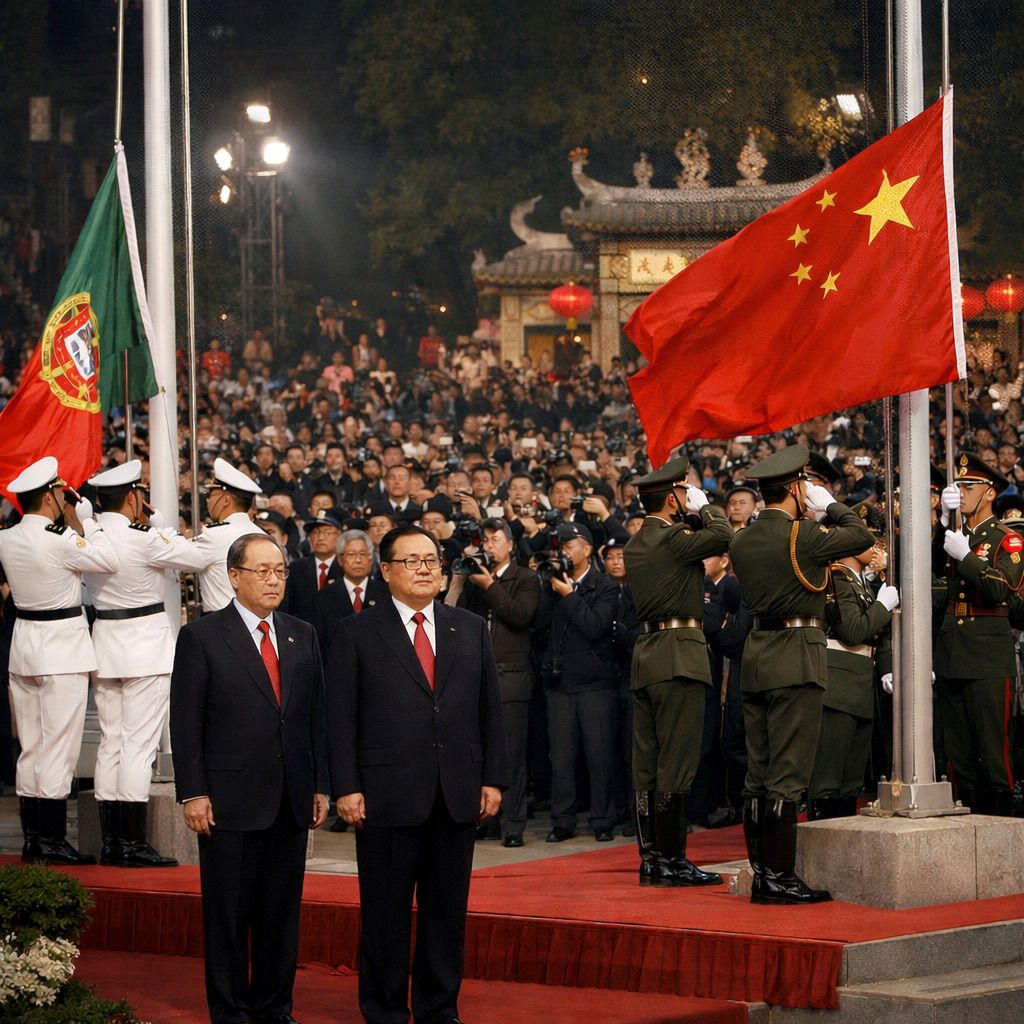
The handover ceremony, which took place in the forecourt of the Kun Iam Temple, marked a significant moment in modern history, one that would have far-reaching implications for the people of Macau, for Portugal, and for China itself. The crowd was immense, comprising local residents, journalists from around the world, and high-ranking officials from Beijing and Lisbon.

As the clock struck 00:02 on December 20, the Portuguese flag was lowered, and the Chinese national anthem was played. This marked the official transfer of sovereignty over Macau to China, a process that had been months in the making. The scene was one of great pomp and ceremony, with Chinese President Jiang Zemin and his Portuguese counterpart, Jorge Sampaio, flanked by senior officials from both governments.

But behind the pageantry and spectacle lay a complex web of politics, economics, and diplomacy. For centuries, Macau had been a strategic outpost for Portugal in Asia, providing access to China’s vast markets and resources. As colonial powers vied for control in the region, Macau became an important hub for trade and commerce. In the late 19th century, Portugal signed a series of treaties with China, which effectively placed Macau under Portuguese jurisdiction.

However, as decolonization swept across Africa and Asia in the mid-20th century, Portugal found itself increasingly isolated in its colonies. The Carnation Revolution of 1974 brought an end to the dictatorship that had ruled Portugal for nearly five decades, but it also led to a re-evaluation of the country’s colonial policies. In Macau, this meant the beginning of a transition period towards eventual handover to China.

The Sino-Portuguese Joint Declaration, signed in 1987, marked a significant milestone in this process. This agreement outlined the terms under which Portugal would transfer sovereignty over Macau to China on December 20, 1999. The document included provisions for the protection of individual rights and freedoms, as well as measures aimed at preserving Macau’s unique cultural identity.

As the handover date approached, tensions rose in Macau between those who welcomed the return to Chinese rule and others who feared a loss of autonomy and freedom. For many residents, particularly those of Portuguese ancestry, there was a deep-seated attachment to the colonial legacy that had shaped their lives for generations. Some worried about the impact on Macau’s economy, which relied heavily on gaming and tourism.

Others, however, saw the handover as an opportunity for growth and development. China’s economic rise in the 1980s and 1990s had created a massive market for Macau’s products, from textiles to electronics. The city’s casino industry, which was dominated by Portuguese firms such as Sociedade de Jogos de Macau (SJM), stood to benefit greatly from increased access to mainland Chinese visitors.

The handover ceremony itself was a masterclass in diplomatic protocol and symbolic gesture-making. Jiang Zemin, flanked by his Portuguese counterpart, Sampaio, delivered a speech that emphasized the importance of maintaining close ties between China and Portugal. He also praised Macau’s unique cultural heritage and its strategic position as a bridge between East and West.

For the people of Macau, the return to Chinese rule marked the beginning of a new era. The first years following the handover were marked by significant economic growth, driven in part by increased investment from China. Macau’s casino industry boomed, with SJM’s Stanley Ho becoming one of the city’s richest men.

However, beneath the surface of this rapid development lay deeper issues. As China asserted its control over Macau, concerns grew about the erosion of individual freedoms and human rights. The city’s democratic institutions were largely dismantled in favor of a more authoritarian system, with Beijing exerting significant influence over local politics.

In the years since 1999, Macau has continued to evolve as a unique blend of East and West. Today, it is one of Asia’s premier gaming destinations, attracting visitors from across the globe. But beneath its glitzy façade lies a complex web of history, culture, and politics that continues to shape the lives of its residents.

As the handover ceremony came to a close, Macau’s residents were left to ponder their future under Chinese rule. For many, there was a sense of nostalgia for the Portuguese colonial era, which had brought a unique blend of Western culture and Asian traditions to the city. The sound of fado music still lingered in the air, while the scent of saltwater taffy and traditional Portuguese pastries wafted from street vendors.

But amidst this nostalgic atmosphere, there was also a sense of uncertainty about what lay ahead. Would Macau continue to thrive as a major gaming hub? Or would its economy suffer under China’s more restrictive policies? The answers to these questions were far from clear, but one thing was certain: the handover marked a significant turning point in the city’s history.

In the months and years that followed, Macau underwent a remarkable transformation. The city’s infrastructure was upgraded, with new roads, bridges, and public buildings springing up across its landscape. Chinese investment poured into the city, driving economic growth and creating thousands of new jobs. Macau’s casino industry boomed, with SJM’s Stanley Ho becoming one of the city’s richest men.

However, beneath this façade of prosperity lay deeper issues. As China asserted its control over Macau, concerns grew about the erosion of individual freedoms and human rights. The city’s democratic institutions were largely dismantled in favor of a more authoritarian system, with Beijing exerting significant influence over local politics. This was a far cry from the days when Macau had been a semi-autonomous territory, governed by its own laws and regulations.

One of the most contentious issues was the role of the Portuguese language and culture in Macau’s daily life. For generations, Portuguese had been an official language alongside Chinese, with many residents speaking it as their first language. But under Chinese rule, there were concerns that this cultural heritage would be eroded, replaced by Mandarin Chinese as the dominant language.

In 2001, the Macau government introduced a new law that made Mandarin Chinese the primary language for all official business and education. This sparked widespread protests among residents who had grown up speaking Portuguese, with many arguing that their cultural identity was being threatened. The issue became a major point of contention between Beijing and Lisbon, with China insisting on the importance of promoting Mandarin Chinese as a unifying force.

Meanwhile, Macau’s economy continued to boom, driven by its thriving casino industry and increasing tourism numbers. The city’s skyline began to change dramatically, with towering skyscrapers and grand hotels springing up across its landscape. But amidst this rapid development, there were growing concerns about the impact on the environment and public health.

Macau’s waterways became increasingly polluted, with trash and waste from casinos and restaurants spilling into the sea. Air pollution worsened, with the city’s infamous smog becoming a major concern for residents and visitors alike. The once-pristine beaches of Macau began to suffer, with tourists complaining about the unsightly mess.

As these issues came to light, there were growing calls for greater transparency and accountability from the government. But in practice, this proved difficult, given Beijing’s tight control over local politics. In 2012, a high-profile corruption scandal involving several top officials sparked widespread outrage among residents, with many calling for greater accountability and reform.

In the years that followed, Macau’s government implemented various measures to address these concerns, including increased investment in environmental protection and public health initiatives. But underlying issues persisted, reflecting deeper structural problems within the city’s governance system.

One of the most significant challenges facing Macau was its growing reliance on gaming revenue, which accounted for over 80% of the city’s GDP. This created a precarious economic situation, with the city vulnerable to fluctuations in the global economy and changing attitudes towards gaming. Moreover, this focus on gaming obscured deeper issues, such as poverty and inequality, which remained significant concerns.

Today, Macau stands at a crossroads, its future shaped by both local and international forces. As China continues to assert its control over the city, there are growing concerns about the erosion of individual freedoms and human rights. The role of the Portuguese language and culture remains a contentious issue, with many residents still advocating for greater recognition.

Meanwhile, Macau’s economy continues to boom, driven by its thriving casino industry and increasing tourism numbers. But amidst this prosperity lies a complex web of challenges, including environmental degradation, public health concerns, and economic vulnerability. As the city looks towards the future, it is clear that there are no easy answers – only a deep-seated recognition of the need for change.

In recent years, Macau has been at the forefront of China’s efforts to promote its “One Belt, One Road” initiative, a vast infrastructure project aimed at connecting Asia with Europe. The city has become a key hub for international trade and investment, attracting major players from around the world. But as it continues on this path, there are growing concerns about the impact on Macau’s unique cultural identity.

As the years pass, the handover ceremony of 1999 becomes increasingly distant, a relic of a bygone era. But its legacy lives on in the hearts and minds of Macau’s residents, who continue to grapple with the complexities of their city’s past, present, and future.

Related Posts

Operation Just Cause: The Invasion That Redefined U.S. Power in Latin America

Elias Rowen

In December 1989, the United States launched Operation Just Cause, a military invasion of Panama that aimed to overthrow dictator Manuel Noriega’s regime and restore democracy to the Central American nation. The intervention marked one of the most significant military actions undertaken by the US in Latin America since the Bay of Pigs debacle in Cuba three decades earlier.

The roots of the crisis lay in Noriega’s increasingly authoritarian rule, which had been tolerated if not encouraged by successive US administrations. Noriega, a former Panamanian general and close ally of Washington during the Cold War, had risen to power in 1983 after ousting President Ricardo de la Espriella through a bloodless coup. However, his presidency was marked by widespread corruption, repression, and human rights abuses. The regime’s security forces killed or disappeared hundreds of opponents, including students, journalists, and ordinary citizens who dared to challenge Noriega’s rule.

The US government initially ignored these abuses, continuing to provide military aid and economic assistance to Panama in the name of counterinsurgency against leftist movements in Central America. However, as Noriega’s regime became increasingly repressive and isolated, Washington began to reassess its policy. In 1988, Congress passed a law prohibiting US military aid to Panama due to human rights concerns, which effectively terminated the funding that had sustained Noriega’s regime for so long.

The turning point came in 1989 when Panamanian opposition leader Guillermo Endara won the presidential election, but Noriega refused to accept the results. The regime responded with violence, burning buildings and attacking civilians who dared to protest. On December 16, 1989, US President George H.W. Bush authorized Operation Just Cause, a comprehensive military plan that aimed to neutralize Noriega’s forces and secure Endara’s inauguration.

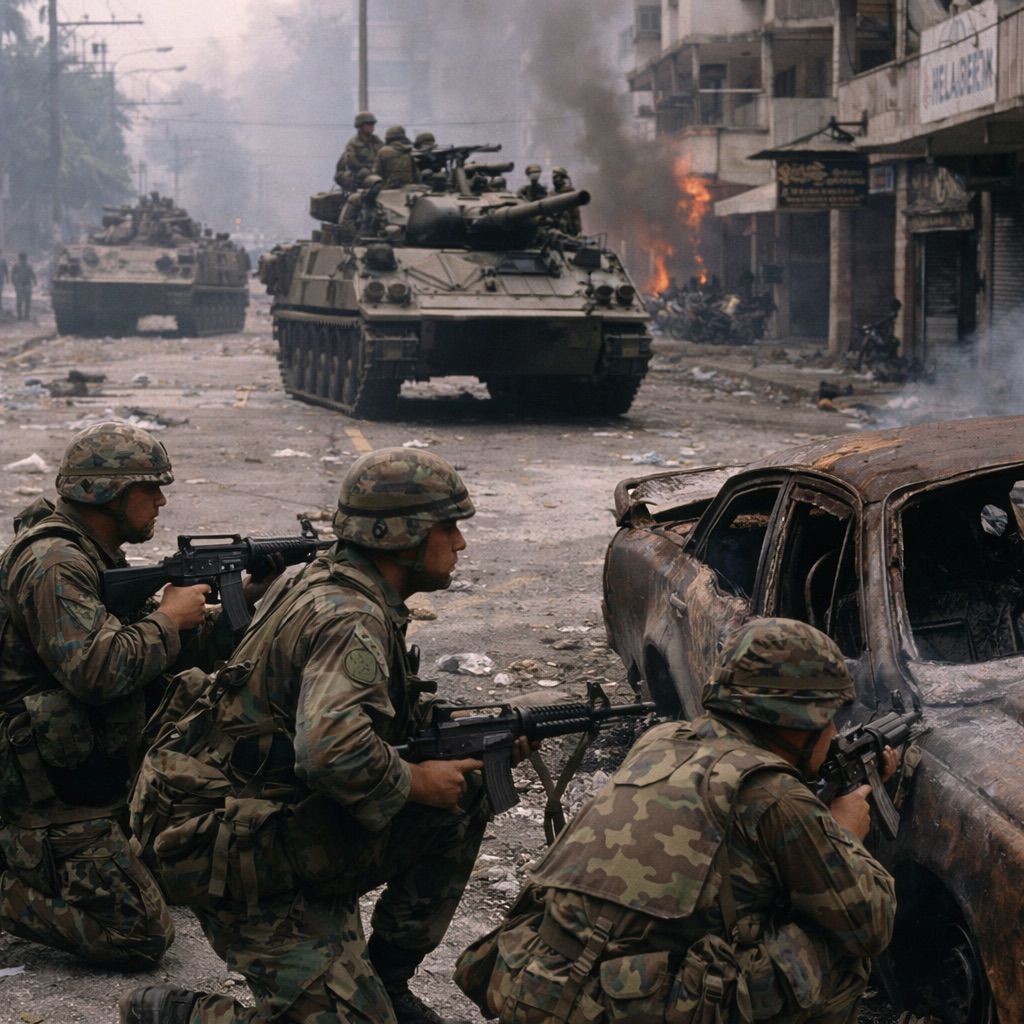
The invasion began at midnight on December 20, when US troops from the Southern Command in Panama City launched a surprise attack on key targets, including the presidential palace, the military headquarters, and major military installations. The initial assault was swift and devastating, with US Marines quickly overrunning Noriega’s forces and securing key infrastructure.

However, the operation soon turned into a complex battle as Panamanian resistance fighters, known as Dignity Battalions, began to engage American troops in urban warfare. US forces faced fierce resistance from Dignity Battalions, who had prepared for an invasion by digging trenches, laying mines, and conducting ambushes against the invaders.

Over the next few days, US military units engaged in house-to-house searches and raids to root out Noriega’s loyalists. Despite initial successes, American forces soon found themselves bogged down in a long and bloody fight for control of Panama City. The urban warfare tactics employed by Dignity Battalions made it difficult for the US military to dislodge them from their entrenched positions.

Meanwhile, Noriega himself remained at large, refusing to surrender even as his regime collapsed around him. On December 25, he was spotted in a hotel room in Panama City, where he was reportedly using a satellite phone to coordinate resistance efforts with Cuban officials.

As the battle raged on, Washington faced intense international criticism for its actions. Leaders from Mexico to Argentina condemned the invasion as a flagrant disregard for sovereignty and self-determination. In response, US officials argued that Operation Just Cause was justified by Noriega’s brutal repression of opposition and his alleged ties to drug cartels.

Despite these claims, evidence suggests that Washington’s primary motivation for invading Panama lay in its desire to secure strategic military bases and protect American business interests in the region. The US had long been interested in expanding its presence in Panama, which provided a crucial location for deploying troops and equipment in Latin America.

As Operation Just Cause finally drew to a close on January 3, 1990, Noriega was forced to flee to the Vatican Embassy, where he took refuge along with his closest advisors. After a two-week siege by US forces, Noriega surrendered on January 31, marking the end of a brutal regime that had terrorized Panama for over a decade.

The aftermath of the invasion saw Endara inaugurated as president, backed by a caretaker government established by the US military. However, many Panamanians questioned the legitimacy of this new government and resented Washington’s perceived attempts to impose its will on their nation. The experience left deep scars in Panama, where anti-American sentiment remains strong to this day.

The invasion also sparked controversy within the United States, with some lawmakers questioning the constitutionality of Bush’s actions. Critics argued that Operation Just Cause was an impeachable offense for violating Congressional authority over foreign policy and disregarding international law. Others praised the operation as a necessary intervention in support of democracy and human rights.

In the end, the legacy of Operation Just Cause remains complex and contested. While it marked a significant departure from Washington’s earlier tolerance of authoritarian rule in Panama, it also demonstrated the willingness of US leaders to disregard sovereignty and due process when deemed necessary. As the world continues to grapple with questions of interventionism and human rights, the US invasion of Panama serves as a cautionary tale about the dangers of unchecked executive power and the importance of respecting national sovereignty.

Operation Just Cause also marked a turning point in US-Latin American relations, highlighting the deepening rift between Washington’s commitment to democracy and its pursuit of strategic interests. As the 1990s unfolded, US policymakers increasingly turned their attention to the complexities of globalization and multilateralism, recognizing that military intervention alone could no longer guarantee stability or security in a rapidly changing world.

As the dust settled on Panama City, the full extent of Operation Just Cause’s destruction became clear. Entire neighborhoods lay in ruins, with buildings reduced to rubble and streets littered with debris. The once-thriving metropolis was now a war zone, its people traumatized by the violence they had endured.

The US military’s actions sparked widespread outrage across Latin America, where leaders from Mexico to Argentina condemned the invasion as an affront to regional sovereignty. In Panama itself, anti-American sentiment surged, with many citizens viewing the US intervention as a betrayal of their nation’s independence.

As Washington grappled with international criticism, internal debates raged within the United States about the constitutionality and legitimacy of Operation Just Cause. Some lawmakers argued that Bush had overstepped his authority by launching a military invasion without Congressional approval, while others defended the operation as a necessary measure to protect American interests and restore democracy in Panama.

The controversy surrounding Operation Just Cause was not limited to the halls of Congress or the corridors of international diplomacy. Within Panama itself, tensions ran high between supporters and opponents of the US intervention. Many Panamanians saw the invasion as an opportunity for their country to break free from Noriega’s authoritarian rule and embark on a new era of democratic governance.

Others, however, viewed the US presence with suspicion and resentment. They remembered the long history of American interference in Panama, dating back to the construction of the canal at the turn of the 20th century. Many saw Operation Just Cause as just another example of US imperialism, where Washington imposed its will on a sovereign nation for the benefit of its own interests.

As the months passed following Noriega’s ouster, Panamanian society struggled to come to terms with the trauma inflicted by the invasion. The aftermath of Operation Just Cause left deep scars that would take years to heal. Many civilians continued to live in makeshift refugee camps, while others returned to their homes only to find them damaged or destroyed.

In the midst of this chaos, US policymakers began to reassess the long-term implications of Operation Just Cause. They recognized that the invasion had marked a significant shift in Washington’s approach to Latin America, one that prioritized strategic interests over traditional notions of sovereignty and non-interference.

This new paradigm was driven by a growing recognition within the US government that globalization and multilateralism were transforming the regional security landscape. As trade agreements and international institutions gained prominence, policymakers began to view military intervention as an increasingly inadequate tool for maintaining stability in Latin America.

Instead, Washington turned its attention to more nuanced forms of engagement, including diplomatic efforts to promote democratic governance and economic development. This shift was exemplified by the Clinton administration’s push for the Free Trade Agreement of the Americas (FTAA), a comprehensive trade pact aimed at integrating Western Hemisphere economies under a single framework.

The aftermath of Operation Just Cause also saw a growing recognition within the US government that human rights abuses were not confined to Panama, but rather were endemic in many Latin American nations. This realization led to increased emphasis on supporting civil society and promoting democratic institutions throughout the region.

In Panama itself, this newfound focus on human rights helped facilitate a national dialogue about the country’s dark past. In 1992, President Endara established an independent commission to investigate Noriega-era atrocities and provide reparations to victims’ families. The commission’s report, released in 1994, exposed widespread human rights abuses committed by Noriega’s regime, including forced disappearances, torture, and summary executions.

The report’s findings sparked widespread outrage within Panama, with many citizens demanding justice for the regime’s victims. In response, the Panamanian government implemented a series of reforms aimed at strengthening accountability and promoting human rights protections.

However, this newfound commitment to accountability was not without its challenges. Many Panamanians continued to question the legitimacy of their country’s new democratic institutions, which had been imposed by Washington through Operation Just Cause. This skepticism was fueled by ongoing US military presence in Panama, including a significant American base at Howard Air Force Base.

As the years passed following Operation Just Cause, Panamanian society grappled with the complexities of rebuilding and reconciliation. The experience left deep scars that would take decades to heal, but also created an opportunity for Panama to forge its own path towards democratic governance and human rights.

The legacy of Operation Just Cause serves as a cautionary tale about the dangers of unchecked executive power and the importance of respecting national sovereignty. As policymakers continue to navigate the complex landscape of international relations, they would do well to remember the lessons of this forgotten war: that military intervention can have far-reaching consequences, and that the most effective forms of engagement often lie in promoting democratic governance and human rights through diplomacy rather than force.

Today, as the United States grapples with its own identity crisis in Latin America, Operation Just Cause stands as a reminder of the complex and contested history between these two hemispheres. As we move forward into an uncertain future, it is essential to acknowledge the legacy of this forgotten war and the profound impact it has had on our understanding of international relations, human rights, and democracy itself.

Related Posts