Latest Articles

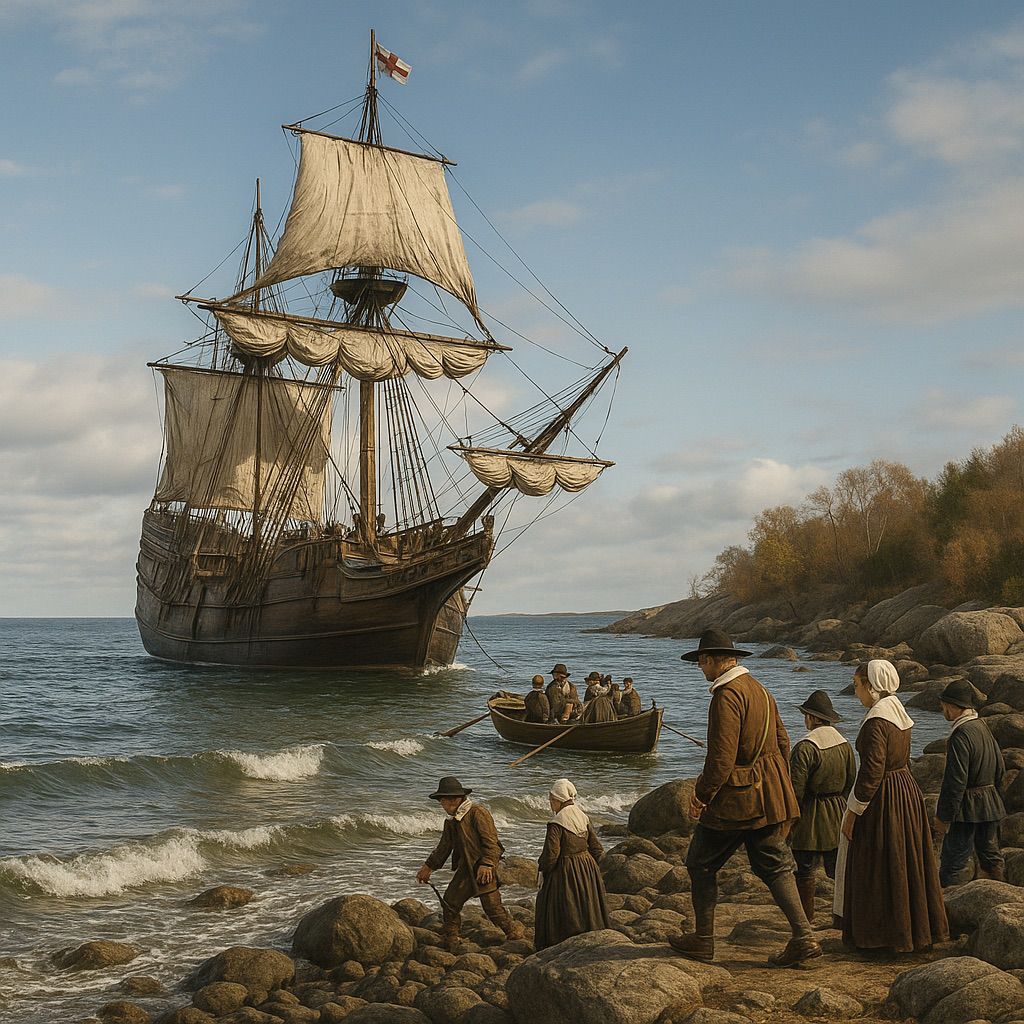
The Mayflower Landing: Faith, Survival, and the Birth of Plymouth Colony

Elias Rowen

In the early seventeenth century, a single wooden ship crossing the Atlantic carried far more than passengers and cargo. The Mayflower carried fear, hope, desperation, faith, and ambition—elements that would collide on the shores of North America and help shape the future of an entire continent. When the ship finally dropped anchor off the coast of Cape Cod in November 1620, the people aboard were exhausted, uncertain, and unprepared for what lay ahead. Yet they were united by a shared belief that their survival depended on building something new in a land they barely understood.

The passengers of the Mayflower were not explorers in the traditional sense. They were families, craftsmen, laborers, and religious dissenters fleeing a world that no longer offered them security or freedom. Among them were the Separatists—later known as the Pilgrims—who had broken away from the Church of England in search of a simpler, more democratic form of worship. Their refusal to conform made them targets of persecution, forcing them first into exile and eventually toward the unknown.

Years before the voyage, these Separatists had settled in Leiden, Holland, where they enjoyed religious tolerance but struggled economically and culturally. While they were free to worship as they chose, their children began to lose English identity, and work was scarce. At the same time, political changes in England threatened to close even that fragile refuge. Faced with an uncertain future, the community made a decision that would alter history: they would leave Europe entirely.

The opportunity came through negotiations with English investors and the Virginia Company, which hoped to profit from new colonies in North America. The Pilgrims secured permission to settle in the New World, though their destination was meant to be farther south. On September 6, 1620, the Mayflower departed Plymouth Harbour carrying 102 passengers and a crew accustomed to the dangers of the sea.

The voyage was brutal. Storms battered the ship, forcing passengers below deck for weeks at a time. Food spoiled, illness spread, and morale wavered. Yet the travelers endured, bound together by necessity and belief. When land was finally sighted after more than two months at sea, relief quickly gave way to uncertainty. They had arrived far north of their intended destination, beyond the reach of their charter.

Before anyone set foot on land, the settlers faced a critical problem: authority. Without a valid charter, no one technically held legal power. In response, the adult men aboard drafted and signed the Mayflower Compact, an agreement that bound them to govern themselves through collective decision-making. This simple document became one of the earliest expressions of self-governance in American history.

On December 11, 1620, the settlers landed at what would become Plymouth. The land was cold, forested, and unforgiving. There were no towns, no fields, no supplies waiting. Winter came quickly, bringing hunger, disease, and death. Nearly half of the settlers would not survive their first year.

It was during this desperate period that the story of Plymouth Colony became inseparable from the story of the Wampanoag people. Long before the English arrived, Native communities had lived on this land, adapting to its rhythms and dangers. Among them was Tisquantum—known as Squanto—a man whose life had already been shaped by European intrusion. Kidnapped years earlier and taken to England, Squanto returned to find his village destroyed by disease.

Squanto’s knowledge of English and his understanding of both cultures placed him in a unique position. Despite personal loss and mistrust on all sides, he chose to help the settlers. He taught them how to plant corn using fish as fertilizer, how to hunt and fish, and how to survive the harsh New England environment. Without his guidance, the colony likely would have failed.

Relations between the Pilgrims and the Wampanoag were complex and fragile. An alliance formed with the Wampanoag leader Massasoit, driven as much by mutual survival as goodwill. For the English, Native knowledge meant survival. For the Wampanoag, an alliance offered protection against rival tribes and a chance to manage European expansion—though few could foresee the consequences that would follow.

As the seasons passed, Plymouth Colony slowly stabilized. Crops grew, shelters improved, and trade networks formed. Governance evolved as well, reflecting the Pilgrims’ belief in collective responsibility. Yet beneath these successes lay constant tension—between settlers and Native peoples, between faith and survival, and between ideals and reality.

Disease continued to haunt both communities. European illnesses devastated Native populations, while settlers faced recurring outbreaks that threatened to erase their fragile foothold. Each winter brought new uncertainty, reinforcing the understanding that survival depended on cooperation, adaptability, and resilience.

Over time, the colony expanded, drawing new settlers and reshaping the landscape. What began as a refuge gradually became a foothold for broader colonization. Agreements made in desperation became contested as power shifted, and alliances strained under pressure. The story of Plymouth Colony is therefore not one of simple triumph, but of layered complexity—hope entangled with loss, faith intertwined with conflict.

Squanto’s legacy, often reduced to a footnote, remains central to this story. He was neither villain nor savior, but a human being navigating an impossible position between worlds. His role reminds us that the survival of Plymouth Colony was not solely the result of European determination, but of Native knowledge, sacrifice, and compromise.

The arrival of the Mayflower marked a beginning, not a conclusion. It set into motion forces that would shape American identity for centuries, raising enduring questions about governance, faith, coexistence, and consequence. The Pilgrims sought freedom, but their story is inseparable from the land and people they encountered—a truth that complicates the legacy they left behind.

Plymouth Colony stands as both symbol and warning. It represents resilience in the face of adversity, but also the costs of expansion and misunderstanding. To remember it honestly is to acknowledge both the courage of those who crossed the ocean and the lives forever altered by their arrival.

Related Posts

Echo 1A and the Birth of Global Communication: When the World First Spoke Through Space

Elias Rowen

The moment humanity first learned how to speak to itself through space did not arrive with fanfare or celebration, but with quiet precision, careful planning, and a shimmering sphere drifting silently above Earth. When Echo 1A successfully launched on April 1, 1960, it marked the beginning of a revolution that would permanently reshape how people communicated, cooperated, and understood the world. Though often overshadowed by the drama of manned spaceflight and the Cold War rivalry between superpowers, Echo 1A quietly changed everything.

The roots of satellite communication stretch back decades before the first rocket ever left Earth. Visionaries like Konstantin Tsiolkovsky imagined artificial satellites long before technology could support the idea. Later, Arthur C. Clarke expanded that vision, proposing in 1945 that satellites placed in orbit could act as communication relays, bouncing signals across the globe. At the time, his ideas seemed like science fiction. Within fifteen years, they became reality.

The late 1950s were defined by urgency. The Soviet Union’s launch of Sputnik 1 in October 1957 stunned the world, proving that space was no longer theoretical. When Sputnik 2 followed with Laika aboard, the geopolitical implications became impossible to ignore. Space was now a strategic frontier, and communication within it was just as important as exploration itself. The United States responded not only with rockets, but with ideas focused on peaceful, practical applications of space technology.

Echo 1A emerged from this environment of innovation and competition. Developed through collaboration between NASA, the U.S. Army’s Ballistic Missile Agency, and RCA, Echo 1A was unlike any satellite before it. It had no transmitters, no onboard electronics for communication, and no propulsion system. Instead, it was essentially a giant reflective balloon—an enormous Mylar sphere designed to bounce radio signals back to Earth.

At nearly 100 feet in diameter, Echo 1A was astonishing to see. When sunlight struck its surface, it became one of the brightest objects in the night sky, visible to the naked eye. For many people around the world, seeing Echo glide overhead was a profound experience. It was a visible reminder that humanity had extended its reach beyond the atmosphere and into the vastness above.

The satellite’s simplicity was its brilliance. Engineers wanted to test whether radio signals could be reliably reflected off an orbiting object. If successful, this would prove that satellites could serve as global communication platforms. Echo 1A’s passive design eliminated many technical risks while allowing scientists to gather invaluable data about signal behavior, orbital mechanics, and atmospheric interference.

The launch itself was the culmination of years of trial and error. Previous attempts with Echo 1 had failed when the satellite did not properly deploy. Engineers refined the design, improved materials, and adjusted deployment mechanisms until Echo 1A was ready. When the Thor-Able rocket lifted off from Cape Canaveral on April 1, 1960, it carried more than hardware—it carried the future of communication.

Once in orbit, Echo 1A exceeded expectations. Radio transmissions sent from California were reflected back to receivers thousands of miles away. For the first time, voices and signals traveled around the curvature of Earth by touching space itself. The implications were staggering. Distance, once a fundamental limitation, had been fundamentally altered.

Beyond communication, Echo 1A contributed to scientific understanding. Researchers used the satellite to study atmospheric density, orbital decay, and solar radiation pressure. These experiments provided insights that would later support weather satellites, navigation systems, and deep-space missions. Echo was not just a tool—it was a classroom in orbit.

The geopolitical impact of Echo 1A was subtle but powerful. Unlike weapons-focused projects, Echo symbolized peaceful innovation. It demonstrated that space could connect rather than threaten. In an era defined by suspicion and rivalry, Echo offered a glimpse of cooperation and shared progress, even as Cold War tensions remained high.

Echo 1A also laid the groundwork for active communication satellites. While passive reflection had limitations, it proved the concept beyond doubt. Engineers quickly moved toward satellites capable of amplifying and retransmitting signals. This evolution led directly to Telstar, Syncom, and eventually the vast satellite networks that define modern telecommunications.

Within a decade, satellite communication enabled live transatlantic television broadcasts, global telephone networks, and real-time international news. What once took days or weeks now took seconds. Economies expanded, diplomacy evolved, and cultures connected in ways previously unimaginable.

The legacy of Echo 1A lives quietly beneath modern convenience. GPS navigation, satellite internet, disaster response coordination, and global broadcasting all trace their origins back to that reflective balloon drifting above Earth. It did not carry humans, but it carried humanity’s voice.

Echo 1A remained in orbit for several years, slowly descending as atmospheric drag pulled it closer to Earth. When it finally burned up in the atmosphere in 1968, its mission was already complete. The world it helped create no longer needed passive reflection—it had learned how to speak through the stars.

Today, thousands of satellites orbit Earth, forming an invisible web of communication that supports daily life. From video calls to emergency alerts, satellite communication has become so integrated that its absence is difficult to imagine. That seamless connectivity began not with complexity, but with simplicity.

Echo 1A reminds us that innovation does not always roar. Sometimes it whispers, reflects, and quietly changes everything. It stands as one of the most important yet understated milestones in human technological history—a moment when Earth first learned to listen to itself from space.

Related Posts

Verdun: The 303-Day Slaughter That Redefined the Horror of Modern Warfare

Elias Rowen

The Battle of Verdun did not begin with a dramatic breakthrough or a swift advance. Instead, it unfolded slowly, deliberately, and mercilessly, grinding human lives into the soil of northeastern France over the course of 303 days. When it finally ended on December 18, 1916, Verdun had become more than a battlefield. It was a symbol of industrialized death, of endurance pushed beyond reason, and of a war that seemed determined to consume an entire generation.

Verdun was never intended to be just another offensive. For the German high command, it was meant to be something far more calculated and devastating. General Erich von Falkenhayn believed that France could be bled white by attacking a position the French could never afford to abandon. Verdun, with its historic fortresses and strategic importance, was the perfect target. Falkenhayn did not necessarily seek to capture the city outright. His aim was attrition—forcing France to pour men into the fight until its army collapsed under the weight of its own losses.

On February 21, 1916, the German assault began with one of the most intense artillery barrages the world had ever seen. Shells rained down relentlessly, tearing apart trenches, forests, and bodies alike. The earth itself seemed to scream under the violence. French soldiers, many of them stunned and buried alive, struggled to regroup as German infantry advanced through a shattered landscape.

Verdun’s defenses were formidable but incomplete. Years of complacency had left some forts under-garrisoned and inadequately supplied. Yet what the French lacked in preparation, they made up for in resolve. Reinforcements were rushed to the front along the “Sacred Way,” a single supply road kept open day and night under constant shellfire. Trucks moved in endless columns, carrying men toward the front and wounded away from it, creating a grim rhythm that would continue for months.

General Philippe Pétain emerged as the battle’s defining figure on the French side. Calm, methodical, and deeply aware of his soldiers’ limits, he reorganized defenses and emphasized artillery coordination. His famous declaration, “They shall not pass,” became both a rallying cry and a grim vow. Verdun would be held, no matter the cost.

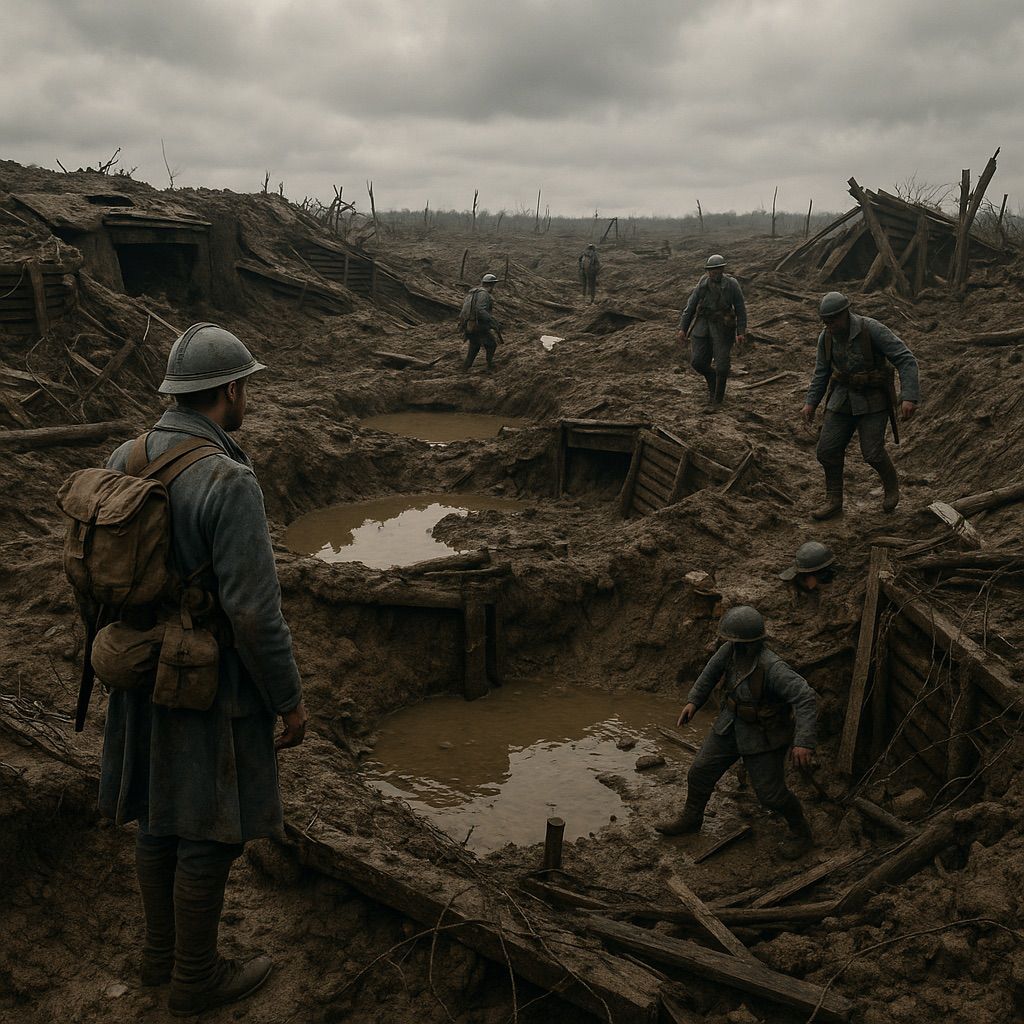
The cost was staggering. Attacks and counterattacks turned hills, forts, and villages into names etched in blood—Douaumont, Vaux, Fleury. Ground was gained and lost repeatedly, sometimes measured in meters at the price of thousands of lives. Trenches collapsed under shellfire, forcing soldiers to fight in open craters filled with mud, water, and decomposing bodies. The landscape became unrecognizable, transformed into a lunar wasteland scarred by millions of shell holes.

As spring turned into summer, Verdun became a war within the war. Both sides fed divisions into the furnace, rotating units to prevent complete collapse. Even so, psychological trauma spread rapidly. Soldiers spoke of “shell shock,” of men reduced to silence or hysteria by constant bombardment. Sleep became impossible. Survival felt arbitrary, dependent on chance rather than skill or bravery.

German frustration mounted as the battle dragged on without decisive results. Falkenhayn’s strategy succeeded only in destroying his own army alongside the French. By mid-1916, German resources were strained, and public confidence wavered. Falkenhayn was eventually replaced, but the damage had been done. Verdun had become a trap for both sides.

In the autumn, the French regained momentum. Improved artillery tactics and renewed offensives slowly pushed German forces back from key positions. Fort Douaumont, once a symbol of German success, was retaken. Fort Vaux, defended with almost mythic desperation earlier in the year, stood as a monument to endurance and suffering.

By December, exhaustion defined both armies. When fighting finally ceased on December 18, 1916, neither side could claim real victory. Verdun remained in French hands, but at an almost incomprehensible cost. Roughly 700,000 men had been killed, wounded, or gone missing. Entire regiments ceased to exist. Families across Europe would never recover from the loss.

The physical devastation was matched by moral shock. Verdun exposed the true nature of modern warfare—mechanized, impersonal, and ruthlessly efficient at killing. It shattered illusions of glory and honor, replacing them with images of mud, blood, and endless artillery fire. For France, Verdun became sacred ground, a symbol of national endurance. For Germany, it became a cautionary tale of strategic hubris.

The battle reshaped military thinking. It accelerated the search for alternatives to trench warfare, contributing to the development of tanks, improved artillery coordination, and new infantry tactics. Yet no innovation could erase Verdun’s legacy. It remained a warning etched into history, a reminder of what happens when strategy ignores humanity.

In the years that followed, Verdun became a place of remembrance. Memorials rose where soldiers once fell. Forests regrew over shattered ground, but beneath the soil lay unexploded shells and unmarked graves. Even today, the land bears scars that refuse to disappear.

Verdun endures not because it was decisive, but because it was relentless. It showed how modern war could devour nations without resolution, how victory itself could feel indistinguishable from defeat. It stands as one of the clearest lessons of World War I: that courage alone cannot redeem a war built on attrition and mass sacrifice.

The Battle of Verdun ended in December 1916, but its echoes continue to shape how we understand war, memory, and loss. It remains one of history’s most haunting reminders that survival, not triumph, is sometimes the only possible outcome.

Related Posts

The Simpsons Redefined Television and American Culture Forever

Elias Rowen

On the evening of December 17, 1989, millions of Americans settled into their living rooms expecting nothing more than another quiet Sunday night of television. Families flipped through channels, children sprawled across carpets, and parents half-watched the screen while thinking about the workweek ahead. Few could have imagined that what aired that night would not only change television forever, but become one of the most influential cultural creations of the modern era. When The Simpsons premiered on Fox, it did not arrive with thunder or spectacle. It arrived quietly, wrapped in yellow skin, crude animation, and a humor that felt oddly familiar and dangerously honest.

At its core, The Simpsons was never about outrageous jokes or shocking satire alone. It was about family, frustration, and the contradictions of modern life. Creator Matt Groening drew deeply from his own upbringing in Portland, Oregon, using personal experience as the emotional blueprint for Springfield’s most famous household. Homer, Marge, Bart, Lisa, and Maggie were exaggerated reflections of people Groening had known all his life, flawed but recognizable, absurd yet grounded in reality.

Groening had little interest in creating traditional cartoon heroes. Instead, he envisioned characters who failed often, contradicted themselves, and stumbled through life with imperfect intentions. Homer Simpson, lazy and impulsive yet strangely endearing, embodied the anxieties of the working-class American father. Marge represented emotional resilience and quiet strength. Bart was rebellion incarnate, Lisa the moral compass, and Maggie the silent witness to it all. Together, they mirrored the American family more truthfully than many live-action sitcoms ever dared.

The road to The Simpsons began humbly with animated shorts on The Tracey Ullman Show. These crude sketches introduced audiences to the Simpson family in brief segments, rough in design but sharp in tone. Viewers responded immediately. There was something refreshing about the show’s irreverence, its willingness to mock authority, consumerism, and even itself. Recognizing its potential, producers James L. Brooks and Sam Simon encouraged Groening to expand the idea into a full half-hour series.

The transition was not easy. Animation schedules were brutal, budgets tight, and early episodes plagued by production challenges. Yet these struggles shaped the show’s identity. The animation style, initially criticized as crude, became iconic. Its imperfections gave the show character, allowing the writing and performances to shine. The voice cast, including Dan Castellaneta, Julie Kavner, Nancy Cartwright, Yeardley Smith, and Hank Azaria, transformed flat drawings into living, breathing personalities.

When the first full episode, Simpsons Roasting on an Open Fire, aired, it set the emotional tone for the series. Rather than opening with cynicism, the episode focused on failure, empathy, and compassion. Homer’s attempt to provide a Christmas gift ends in disappointment, only to transform into something meaningful when Santa’s Little Helper joins the family. It was funny, yes, but also sincere. Viewers saw themselves in that struggle, and the connection was immediate.

Critics took notice. While some were initially skeptical of animated programming in prime time, many praised the show’s intelligence and heart. The Simpsons wasn’t just parodying America—it was holding up a mirror. It tackled issues like class inequality, corporate greed, environmental neglect, and political hypocrisy long before such themes became mainstream in entertainment. It trusted its audience to laugh and think at the same time.

As the first season unfolded, the show’s confidence grew. Storylines expanded beyond slapstick, allowing characters to evolve emotionally. Homer’s stupidity became a lens for exploring insecurity and longing. Lisa’s intelligence highlighted alienation and moral struggle. Springfield itself became a character, populated by exaggerated archetypes that reflected real societal roles: corrupt politicians, incompetent police, predatory businessmen, and apathetic media figures.

By the early 1990s, The Simpsons had become a phenomenon. Bart Simpson emerged as a cultural icon, plastered across lunchboxes, T-shirts, and billboards. Parents worried about his rebellious influence while children embraced his irreverence. The show found itself at the center of national debates about morality, parenting, and popular culture—ironically proving its relevance in the process.

Yet the show’s greatest strength lay in its writing. Episodes like Marge vs. the Monorail showcased how satire could be layered with music, character, and absurdity without losing coherence. The annual Treehouse of Horror episodes pushed creative boundaries, allowing writers to experiment with science fiction, horror, and parody in ways no other series attempted. These episodes demonstrated the show’s willingness to take risks and trust its audience.

Throughout the 1990s, The Simpsons consistently reinvented itself. It tackled racism, gender roles, labor exploitation, and environmentalism with humor sharp enough to cut but never alienate. Episodes like Stark Raving Dad and Lisa the Vegetarian showed the series’ ability to balance comedy with genuine emotional resonance. These were stories that stayed with viewers long after the jokes faded.

Behind the scenes, the writers’ room became legendary. Many writers would go on to shape American comedy for decades, bringing The Simpsons’ DNA into late-night television, film, and stand-up. The show’s influence spread quietly but profoundly, shaping the rhythm, tone, and expectations of modern comedy.

As the years passed, The Simpsons faced the inevitable challenge of longevity. Maintaining relevance across generations is no small task, yet the show adapted. It addressed the rise of the internet, celebrity culture, social media, climate change, and political polarization. Some episodes landed better than others, but the willingness to engage with the present remained constant.

Matt Groening’s influence expanded beyond Springfield. Futurama and Disenchantment carried his signature blend of absurdity and emotional intelligence into new worlds. Still, The Simpsons remained his defining achievement, not because of its length, but because of its cultural reach.

Today, The Simpsons stands as the longest-running primetime scripted series in television history. It has won dozens of awards, inspired countless creators, and permanently altered what animation can achieve. More importantly, it continues to reflect society back at itself—flaws, contradictions, and all.

What began as a simple cartoon has become a living chronicle of modern life. The Simpsons did not just entertain; it taught audiences that humor could be smart, that cartoons could matter, and that satire could be compassionate. Its legacy is not measured in episodes, but in influence.

More than three decades later, the Simpson family still sits on that couch, frozen in time yet forever relevant. And in that simple image lies the show’s greatest achievement: the ability to remain familiar while continually evolving, reminding us that laughter, when wielded honestly, can be one of the most powerful tools of storytelling ever created.

Related Posts

The Spark That Shook the Arab World: How Tunisia Ignited the Arab Spring

Elias Rowen

The year 2010 quietly closed one chapter of Middle Eastern history and violently opened another. What began as scattered frustrations over unemployment, corruption, and rising prices soon erupted into one of the most consequential political movements of the twenty-first century. The Arab Spring did not start in a palace or a parliament, nor was it engineered by foreign powers or elite political groups. It began with ordinary people who had reached a breaking point, and nowhere was that clearer than in Tunisia, where the first sparks of revolt ignited an uprising that would reshape an entire region.

For decades, Tunisia had been held up as a model of stability in North Africa. Tourists flocked to its beaches, foreign investors praised its predictability, and Western governments pointed to it as an example of controlled modernization. Beneath the surface, however, resentment simmered. Economic growth existed on paper, but for millions of Tunisians, daily life told a very different story. Jobs were scarce, wages stagnated, and opportunities were distributed not by merit but by proximity to power.

At the center of this imbalance stood President Zine El Abidine Ben Ali and his inner circle. Having seized power in a bloodless coup in 1987, Ben Ali promised reform, progress, and prosperity. In reality, his rule became increasingly authoritarian. Political opposition was crushed, journalists were silenced, and surveillance became a routine part of daily life. Fear replaced hope, and silence became a survival strategy.

Corruption was not a side effect of Ben Ali’s rule; it was its foundation. The president’s wife, Leila Trabelsi, and her extended family were notorious for their grip on Tunisia’s economy. Entire industries fell under their control, from banking and telecommunications to real estate and mining. State contracts flowed to favored insiders, while ordinary citizens watched opportunity slip further out of reach.

As the global financial crisis hit in 2008, Tunisia’s fragile social contract collapsed. Unemployment soared, particularly among young people who had done everything society asked of them. University degrees no longer guaranteed work. Graduates returned home to live with their parents, trapped between ambition and reality. Frustration turned into humiliation, and humiliation hardened into anger.

Rural Tunisia suffered just as deeply. Farmers faced falling prices for their crops while costs for fuel and supplies rose. Many were forced to sell their land or migrate in search of work. Entire communities felt abandoned, invisible to a government more concerned with protecting elite wealth than addressing public need.

The phosphate mining industry became a symbol of everything that was broken. Despite being one of Tunisia’s most valuable resources, profits rarely reached workers or local communities. Instead, wealth flowed upward, reinforcing the perception that the state existed to serve a narrow elite rather than the nation as a whole. Protests over jobs and wages in mining towns were frequent, but they were usually crushed quickly and quietly.

What made 2010 different was not the presence of discontent, but the sudden collapse of fear. On December 17, in the small town of Sidi Bouzid, a young street vendor named Mohamed Bouazizi was humiliated for the last time. Harassed by local officials and stripped of his livelihood, Bouazizi did something unthinkable. He set himself on fire in front of the governor’s office, a desperate act that transformed private suffering into public outrage.

Bouazizi’s self-immolation struck a nerve that years of repression had failed to sever. Images and stories spread rapidly through social media, satellite television, and word of mouth. Protests erupted almost immediately, first in Sidi Bouzid, then in neighboring towns, and soon across the entire country. What began as demands for jobs and dignity quickly evolved into calls for the end of Ben Ali’s rule.

The government responded with force. Police fired tear gas and live ammunition. Protesters were arrested, beaten, and in some cases killed. But repression no longer worked. Each act of violence fueled more anger, drawing larger crowds into the streets. Workers, students, lawyers, farmers, and civil servants stood shoulder to shoulder, united by a shared sense that the system had failed them.

Tunisia witnessed scenes that would have been unthinkable just weeks earlier. Mass demonstrations filled city centers. Chants of “Ben Ali must go” echoed through neighborhoods once silenced by fear. Flags waved not for a political party, but for dignity and accountability. The regime attempted concessions, promising reforms and blaming corruption on lower officials, but the public no longer believed words without action.

By January 2011, the situation had reached a tipping point. The army, sensing the inevitability of change, refused to fire on protesters. International allies began distancing themselves from Ben Ali. On January 14, after twenty-three years in power, the president fled Tunisia under cover of darkness, leaving behind a stunned nation and a political vacuum filled with uncertainty and hope.

Tunisia’s revolution sent shockwaves far beyond its borders. Across the Arab world, people saw what had seemed impossible: a dictator removed by mass popular protest. Demonstrations soon erupted in Egypt, Libya, Yemen, Bahrain, and Syria. The Arab Spring had begun, and Tunisia stood at its origin.

The aftermath of revolution was anything but simple. Tunisia faced economic instability, political fragmentation, and security threats. Extremist groups sought to exploit uncertainty, and old networks of power resisted reform. Yet unlike many of its neighbors, Tunisia managed to navigate its transition without descending into civil war.

A new constitution, adopted in 2013, enshrined democratic principles, human rights, and gender equality. Elections followed, producing coalition governments that reflected compromise rather than domination. Progress was uneven and often frustratingly slow, but it existed.

Tunisia’s experience revealed both the promise and the limits of popular uprisings. While dictatorship could be overthrown, building democracy required patience, institutions, and sustained civic engagement. Economic challenges persisted, and corruption did not vanish overnight. Still, Tunisia proved that change was possible without total collapse.

More than a decade later, the legacy of Tunisia’s revolution remains contested, debated, and unfinished. Yet its significance cannot be denied. It demonstrated the power of ordinary people to challenge entrenched authority and forced the world to reckon with voices long ignored.

The Arab Spring began not with ideology or violence, but with dignity. It began with a single act of protest that exposed the fragility of authoritarian rule. Tunisia’s story stands as both a warning and an inspiration—a reminder that stability without justice is temporary, and that when people lose fear, even the strongest regimes can fall.

Related Posts