Latest Articles

The Wright Brothers Invented Powered Flight and Changed the World Forever

Elias Rowen

For thousands of years, humans looked to the sky with a mixture of wonder and envy. Birds soared effortlessly overhead while people remained bound to the ground, dreaming of flight but unable to escape gravity’s grip. Myths told stories of wings made from wax and feathers, of gods and heroes who could defy nature, yet reality always pulled dreamers back to earth. That reality finally changed in the early years of the twentieth century, not through magic or myth, but through patience, experimentation, and relentless determination. The dawn of powered flight arrived quietly on a cold December morning in 1903, carried aloft by two brothers from Dayton, Ohio, who refused to accept that human flight was impossible.

Orville and Wilbur Wright were not famous scientists, wealthy industrialists, or government-backed engineers. They were bicycle mechanics, self-taught thinkers who believed that careful observation and methodical testing could solve even the most complex problems. What set them apart from other would-be aviators was not raw genius alone, but their willingness to question assumptions, collect their own data, and learn from every failure. Their story is not one of sudden inspiration, but of years spent chasing answers through trial, error, and persistence.

By the late nineteenth century, the idea of human flight had shifted from fantasy into serious scientific inquiry. Engineers and inventors across Europe and America were experimenting with gliders, kites, and powered contraptions, all attempting to unlock the secrets of lift and control. One of the most influential figures of the era was Octave Chanute, whose book Progress in Flying Machines compiled decades of aeronautical experiments into a single volume. For the Wright brothers, this book was a revelation. It showed them that flight was not a foolish dream, but a technical challenge waiting to be solved.

Another key influence was Otto Lilienthal, a German engineer whose glider flights demonstrated that controlled, heavier-than-air flight was possible. Lilienthal’s work fascinated the Wright brothers, but his death in a gliding accident also served as a sobering reminder of how dangerous aviation could be. Rather than discouraging them, his death convinced Orville and Wilbur that careful control, not just lift, was the missing piece of the puzzle. They believed that mastering control would be the key to safe and sustained flight.

Their early experiments began modestly. In 1899, the brothers built small kite-like machines to test wing warping, a method of controlling an aircraft by twisting the wings. These tests revealed something revolutionary: control could be achieved not by brute force, but by subtle adjustments that worked with the air rather than against it. Encouraged by these results, they turned their attention to gliders capable of carrying a human pilot.

Finding the right testing ground was crucial. After extensive research, the Wright brothers chose Kitty Hawk, North Carolina, a remote coastal area known for steady winds, soft sand, and isolation from prying eyes. There, far from crowds and critics, they could test freely and fail safely. Beginning in 1900 and continuing through 1902, they made repeated trips to Kitty Hawk, hauling gliders, tools, and notebooks across rough terrain in pursuit of progress.

Those early glider experiments were anything but smooth. The brothers quickly realized that existing aerodynamic data was flawed. Lift calculations from respected scientists did not match real-world results. Instead of abandoning their efforts, Orville and Wilbur did something radical: they built their own wind tunnel back in Dayton. Using carefully crafted models, they gathered more accurate data than anyone before them. This quiet innovation laid the foundation for modern aerodynamics and gave the Wright brothers an enormous advantage over their competitors.

By 1902, their improved glider represented a major breakthrough. It incorporated effective wing warping and a movable rear rudder, allowing pilots to maintain balance and direction. For the first time, sustained controlled gliding was possible. The brothers knew they were close. All that remained was the most difficult challenge of all: powering the aircraft without making it too heavy to fly.

No existing engine met their needs, so they built one themselves. Working with their mechanic, Charlie Taylor, they designed a lightweight gasoline engine capable of delivering enough power without weighing the aircraft down. It wasn’t elegant, and it wasn’t particularly powerful by modern standards, but it was sufficient. Paired with custom-designed propellers—another area where the brothers’ calculations surpassed conventional wisdom—the engine transformed their glider into a true airplane.

By December 1903, everything was ready. The Wright Flyer, constructed from spruce wood and fabric, was assembled at Kill Devil Hills near Kitty Hawk. It was fragile, awkward, and unremarkable in appearance, yet it represented years of accumulated knowledge and perseverance. On December 14, Wilbur attempted the first powered flight, but the aircraft stalled and crashed shortly after takeoff. The damage was repaired, and the brothers prepared for one final attempt.

On the morning of December 17, 1903, the wind was strong but manageable. Orville took his place in the Flyer while Wilbur steadied the wing. At 10:35 a.m., the engine roared to life, and the aircraft began moving along its wooden rail. Then, almost imperceptibly, it lifted off the ground. For twelve seconds, Orville Wright flew. The aircraft covered 120 feet before settling back onto the sand, but history had been made.

Three more flights followed that day, each longer than the last. The final flight, piloted by Wilbur, lasted nearly a minute and traveled over 800 feet. It ended abruptly when a gust of wind overturned the aircraft, damaging it beyond immediate repair. Yet the damage didn’t matter. The goal had been achieved. Human beings had flown under their own power, with control, and returned safely to the ground.

At the time, few people noticed. The event was witnessed by only a handful of locals, and early newspaper reports were skeptical or dismissive. The Wright brothers themselves returned quietly to Dayton, focused not on fame, but on improvement. They understood that their invention was only the beginning. True success would require reliability, endurance, and practical applications.

Over the next several years, Orville and Wilbur refined their designs, developing aircraft that could fly longer distances, turn smoothly, and remain stable in changing conditions. One of their most important contributions was the three-axis control system, which allowed pilots to manage roll, pitch, and yaw independently. This innovation remains fundamental to aircraft design today.

As evidence of their success accumulated, skepticism faded. Public demonstrations in the United States and Europe silenced critics and established the Wright brothers as legitimate pioneers. Governments and militaries took notice. In 1908, the U.S. Army Signal Corps purchased a Wright aircraft, marking the birth of military aviation. Soon after, flying schools, air shows, and experimental aircraft began appearing around the world.

The brothers’ impact extended far beyond aviation. Their methods—testing assumptions, collecting data, and learning from failure—became models for modern engineering and scientific research. Their work accelerated advancements in transportation, communication, and global connectivity. Within a few decades, airplanes shrank the world, making international travel and commerce routine rather than extraordinary.

Tragically, Wilbur Wright died of typhoid fever in 1912 at the age of forty-five, before he could witness the full scope of their achievement. Orville lived on, watching aviation evolve from fragile biplanes to powerful aircraft capable of crossing oceans and continents. He remained humble, often emphasizing that flight was not the result of a single moment, but of years of careful effort.

Today, the Wright brothers are remembered not just as inventors, but as symbols of human potential. Their story reminds us that progress rarely comes from sudden brilliance alone. It comes from persistence, curiosity, and the courage to fail repeatedly in pursuit of something greater. The first powered flight was short and unremarkable by modern standards, yet it changed everything.

Every airplane that lifts off today carries a piece of that December morning at Kitty Hawk. Every jet crossing the sky traces its lineage back to two brothers who believed that controlled flight was possible and refused to give up until they proved it. Their legacy is written not only in history books, but across the skies themselves, wherever human beings continue to rise above the earth and push the boundaries of what is possible.
Related Posts

The Night Tea Sparked a Revolution: How the Boston Tea Party Changed America Forever

Elias Rowen

The Boston Tea Party stands as one of those rare moments in history when a single night of action rippled outward to change the fate of an entire nation. It wasn’t a battle, it wasn’t a declaration, and no blood was shed, yet its impact echoed louder than cannon fire. On a cold December night in 1773, ordinary colonists made an extraordinary decision: they would no longer quietly accept being ruled, taxed, and ignored by a distant government that saw them as little more than a source of revenue. What followed was not random vandalism or mob violence, but a carefully planned act of political defiance that would become a cornerstone of American identity.

To understand why the Boston Tea Party happened, it’s important to step back into the world of the American colonies in the mid-18th century. The colonists were, in many ways, loyal British subjects. They shared language, customs, legal traditions, and a sense of pride in being part of the British Empire. But loyalty had its limits, especially when decisions made thousands of miles away in London began to directly affect daily life in the colonies without any meaningful colonial input. That tension simmered for years before finally boiling over.

The first sparks appeared after Britain emerged victorious from the French and Indian War in 1763. The war had been costly, and Parliament faced staggering debts. British leaders reasoned that the colonies, which had benefited from British military protection, should help shoulder the financial burden. From the perspective of Parliament, this seemed logical. From the perspective of the colonists, it felt deeply unfair. They had no representatives in Parliament, yet they were being asked to pay taxes decided entirely without their consent.

The Sugar Act of 1764 marked one of the earliest signs of trouble. By taxing imported sugar, molasses, and other goods, the British government struck at the economic lifeblood of colonial trade. Merchants, sailors, and artisans felt the effects almost immediately. What angered colonists just as much as the tax itself was the aggressive enforcement that accompanied it. British customs officials were given expanded powers, and smugglers faced harsh penalties. The message was clear: London was tightening its grip.

Then came the Stamp Act of 1765, and with it, a wave of outrage that swept through the colonies. For the first time, a direct tax was imposed on everyday items like newspapers, legal documents, licenses, and even playing cards. This wasn’t a distant tax hidden in shipping fees or trade regulations; it was impossible to ignore. Colonists from all walks of life suddenly felt the weight of British authority pressing down on them.

Protests erupted almost immediately. Crowds gathered in the streets, effigies of British officials were burned, and tax collectors were harassed, threatened, and sometimes forced to resign. In Boston, resistance coalesced into a more organized form with the rise of the Sons of Liberty. This loosely connected group of merchants, craftsmen, and political agitators became the beating heart of colonial resistance. Figures like Samuel Adams emerged as powerful voices, arguing that liberty itself was at stake.

Although Parliament repealed the Stamp Act in 1766, it did so with a warning. The Declaratory Act asserted that Britain retained full authority over the colonies “in all cases whatsoever.” This wasn’t reconciliation; it was a reminder of who held the power. The tension never truly faded, and before long, new taxes arrived in the form of the Townshend Acts. Duties on imported goods such as glass, paint, paper, and tea reignited colonial anger. Boycotts followed, and once again, resistance spread.

Boston became the epicenter of unrest. British soldiers were stationed in the city to maintain order, but their presence only made things worse. The streets felt occupied, tempers ran high, and mistrust grew on both sides. This volatile atmosphere eventually led to the Boston Massacre in 1770, where British soldiers fired into a crowd, killing five colonists. Though the Townshend duties were largely repealed afterward, the tax on tea remained, serving as a symbol of Parliament’s authority and the unresolved conflict between ruler and ruled.

Tea might seem like a small thing, but in colonial America, it was anything but. Tea was a daily ritual, a symbol of refinement, and a staple in households across social classes. By keeping the tea tax in place, Parliament was sending a message: it still had the right to tax the colonies. Many colonists understood this clearly. Accepting taxed tea meant accepting Parliament’s authority, and that was something growing numbers of Americans were unwilling to do.

The situation escalated dramatically in 1773 with the Tea Act. Designed to rescue the struggling British East India Company, the act allowed the company to sell tea directly to the colonies at a lower price, undercutting colonial merchants and smugglers. On paper, it made tea cheaper. In reality, it was a political trap. The tax remained, and the monopoly threatened local businesses. Colonists saw it as a calculated attempt to force them into submission.

When ships carrying East India Company tea arrived in colonial ports, resistance flared. In New York and Philadelphia, ships were turned away. In Charleston, the tea was seized and stored. But in Boston, Governor Thomas Hutchinson refused to budge. He insisted the tea be unloaded and the tax paid. With the ships sitting in the harbor and tensions rising, Boston stood at a crossroads.

On the night of December 16, 1773, the decision was made. Thousands gathered at the Old South Meeting House, where heated debates filled the air. When it became clear that the governor would not compromise, a signal was given. As darkness fell, a group of men, many disguised as Mohawk Indians, moved quietly toward Griffin’s Wharf.

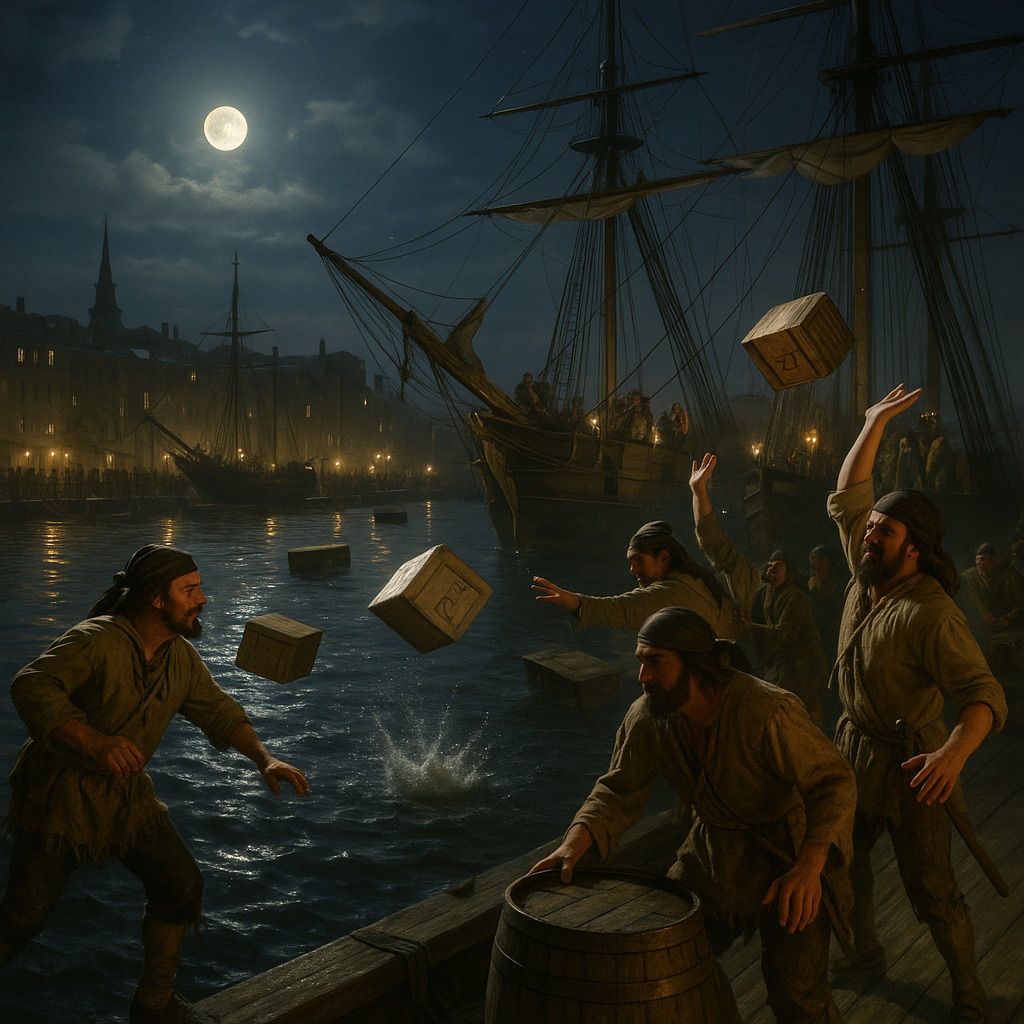
They boarded three ships—the Dartmouth, the Eleanor, and the Beaver—with remarkable discipline. This was not a drunken riot or chaotic outburst. The men worked methodically, breaking open 342 chests of tea and dumping them into Boston Harbor. They took care not to damage other cargo, and even replaced a broken padlock. By the end of the night, the harbor was thick with tea leaves, and a powerful statement had been made.

News of the Boston Tea Party spread quickly throughout the colonies and across the Atlantic. To many colonists, it was an act of courage and principle. To British officials, it was a shocking display of lawlessness and defiance. Parliament responded with fury, determined to make an example of Massachusetts. The result was the Coercive Acts, known to colonists as the Intolerable Acts.

Boston Harbor was closed until the tea was paid for. Massachusetts’ self-government was severely restricted. British officials accused of crimes were given protection from colonial courts. Soldiers were quartered in private homes. These measures were meant to isolate Boston and crush resistance, but they had the opposite effect. Instead of dividing the colonies, they united them.

Sympathy poured in from other colonies. Supplies were sent to Boston. Committees of correspondence strengthened communication and coordination. In 1774, colonial leaders gathered for the First Continental Congress, marking a new level of unity and resolve. The Boston Tea Party had transformed resistance into something far more powerful: a shared American cause.

Within two years, shots would be fired at Lexington and Concord. Within three, independence would be declared. The Boston Tea Party didn’t cause the American Revolution on its own, but it made compromise nearly impossible. It forced both sides to confront the reality that the relationship between Britain and the colonies was fundamentally broken.

Today, the Boston Tea Party is remembered not just as an act of protest, but as a defining moment in the story of democracy. It showed that ordinary people, when pushed too far, could organize, resist, and reshape their destiny. It wasn’t about tea. It was about dignity, representation, and the belief that government derives its power from the consent of the governed.

That belief continues to resonate centuries later. The image of chests splashing into dark harbor waters remains a symbol of resistance to unjust authority. It reminds us that history is often changed not by kings or parliaments, but by people who decide they have had enough and are willing to act.

Related Posts

Operation Desert Fox: The Four-Day Air War That Set the Stage for Iraq’s Future

Elias Rowen

In December 1998, as the world approached the end of the twentieth century, a brief but consequential military campaign unfolded over Iraq that would quietly shape the trajectory of Middle Eastern geopolitics for years to come. Operation Desert Fox, launched by the United States and the United Kingdom, was a four-day bombing campaign aimed at degrading Iraq’s military infrastructure and compelling Saddam Hussein’s regime to comply with United Nations weapons inspections. Though short in duration, the operation carried profound political, strategic, and humanitarian implications that continue to be debated decades later.

The roots of Operation Desert Fox lay in the unresolved tensions following the 1991 Gulf War. Iraq’s defeat had forced Saddam Hussein to accept strict ceasefire conditions, including the dismantling of nuclear, chemical, and biological weapons programs. United Nations inspectors were tasked with verifying compliance, while economic sanctions placed enormous pressure on Iraq’s economy and civilian population. For much of the 1990s, this uneasy standoff defined relations between Iraq and the international community.

From the outset, Saddam Hussein viewed the inspections as an affront to Iraqi sovereignty. While inspectors uncovered and destroyed large quantities of prohibited weapons and materials, cooperation was inconsistent. Iraqi authorities frequently restricted access to sites, delayed inspections, or accused inspectors of espionage. Each confrontation heightened tensions, reinforcing mistrust on both sides.

By 1998, the situation had deteriorated significantly. Iraq suspended cooperation with UN inspectors altogether, effectively daring the international community to respond. For U.S. policymakers, this defiance was unacceptable. President Bill Clinton’s administration argued that allowing Iraq to obstruct inspections undermined global nonproliferation efforts and threatened regional stability.

Operation Desert Fox was conceived as a punitive and preventative measure rather than a full-scale war. Its objectives were narrowly defined: degrade Iraq’s ability to produce and deliver weapons of mass destruction, weaken its air defense systems, and signal that continued defiance would carry consequences. Unlike the Gulf War, there would be no ground invasion. Air power would carry the mission alone.

The operation began on December 16, 1998. Cruise missiles and aircraft struck Iraqi air defense installations, command-and-control facilities, missile production sites, and suspected chemical and biological weapons infrastructure. Over four days, coalition forces conducted hundreds of sorties, employing precision-guided munitions designed to minimize collateral damage while maximizing military impact.

From a tactical standpoint, the strikes demonstrated the growing sophistication of Western air power. Advances in targeting technology allowed aircraft to hit hardened and deeply buried facilities with unprecedented accuracy. U.S. and British officials claimed that the campaign significantly degraded Iraq’s military capabilities, setting back weapons programs and limiting its ability to threaten neighbors.

Yet the political context surrounding the operation complicated its reception. The timing of Desert Fox coincided with domestic political turmoil in the United States, including impeachment proceedings against President Clinton. Critics questioned whether the operation was influenced by internal political considerations, casting doubt on its legitimacy and intent.

International reactions were mixed. Britain strongly supported the strikes, framing them as a necessary response to Iraqi noncompliance. Other allies were less enthusiastic. France, Russia, and China expressed concern over the use of force without explicit new authorization from the UN Security Council, arguing that diplomacy had not been exhausted.

Within Iraq, the impact was immediate and visible. Bombing damaged military installations but also affected infrastructure already weakened by years of sanctions. Iraqi officials accused the coalition of targeting civilian areas, a claim echoed by humanitarian organizations monitoring conditions on the ground. While coalition leaders insisted that strikes were carefully planned to avoid civilian harm, independent assessments raised questions about unintended consequences.

Operation Desert Fox underscored the limitations of air power as a tool for coercion. While the campaign inflicted damage, it did not compel Saddam Hussein to resume cooperation with inspectors. In fact, Iraq expelled UN inspection teams entirely in the aftermath, leaving the international community without direct oversight of its weapons programs.

The operation also deepened the humanitarian crisis inside Iraq. Sanctions had already strained healthcare, food supply, and infrastructure. Additional damage from airstrikes exacerbated suffering among civilians, fueling criticism that military pressure was being borne disproportionately by the Iraqi population rather than the regime itself.

Strategically, Desert Fox marked a shift in U.S. policy toward containment through periodic force. Rather than pursuing regime change outright, Washington sought to manage the Iraqi threat through sanctions, no-fly zones, and occasional military action. This approach reflected both caution and constraint, shaped by lessons from earlier conflicts and uncertainty about long-term outcomes.

Despite its limited scope, Operation Desert Fox foreshadowed developments that would culminate in the 2003 invasion of Iraq. The absence of inspectors, combined with continued intelligence assessments suggesting potential weapons programs, created a climate of suspicion that proved difficult to dispel. The operation did not resolve the Iraq problem; it prolonged it.

In retrospect, Desert Fox revealed the complexities of enforcing international norms through military means. It highlighted the difficulty of achieving compliance without sustained diplomatic engagement or credible enforcement mechanisms. It also exposed the moral tension inherent in strategies that seek to pressure regimes while minimizing harm to civilians—a balance that is rarely achieved in practice.

For military planners, the operation offered lessons in joint operations, precision strike capabilities, and rapid deployment. For policymakers, it raised enduring questions about proportionality, legitimacy, and effectiveness. For Iraq, it was another chapter in a decade defined by isolation, hardship, and confrontation.

Operation Desert Fox did not change Saddam Hussein’s behavior in any fundamental way, but it altered perceptions. It reinforced the view within Washington that limited force alone could not resolve the Iraqi issue. It also reinforced Saddam’s belief that survival depended on defiance, not accommodation.

Today, Desert Fox is often overshadowed by the events that followed in the next decade. Yet its significance lies precisely in its position between wars—a moment when the international community grappled with how to respond to defiance without escalation, and ultimately failed to find a durable solution.

The four-day campaign serves as a case study in the limits of military power when political objectives are ambiguous and humanitarian consequences unavoidable. It reminds us that short wars can have long shadows, shaping decisions and perceptions long after the last missile is launched.

Related Posts

The Battle of the Bulge and Hitler’s Last Gamble

Elias Rowen

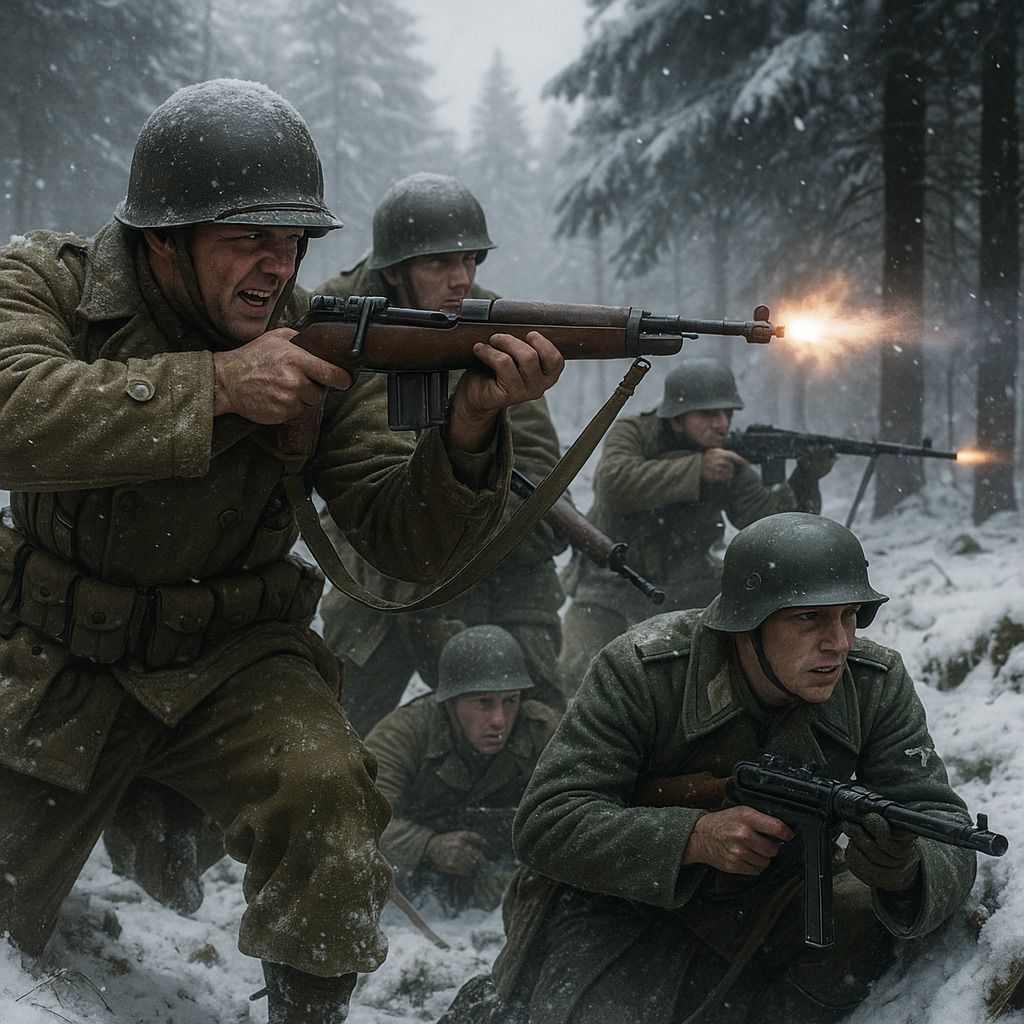
December 16, 1944, dawned cold, quiet, and deceptively calm across the Ardennes Forest. Snow blanketed the rolling hills of Belgium and Luxembourg, muffling sound and limiting visibility. For many Allied soldiers stationed in the region, the area was considered a rest sector, a place to recover from months of brutal fighting across France. Few suspected that this frozen landscape was about to become the stage for the largest and bloodiest battle ever fought by the United States Army.

The Battle of the Bulge was born out of desperation. By late 1944, Nazi Germany was losing on every front. The Allied invasion of Normandy had succeeded beyond expectations, Paris had been liberated, and Allied armies were pushing steadily toward Germany’s western borders. In the east, Soviet forces were closing in relentlessly. Adolf Hitler, increasingly isolated and dismissive of his generals, believed only a bold, decisive strike could reverse Germany’s fortunes.

Hitler’s plan was audacious to the point of recklessness. He ordered a massive surprise offensive through the Ardennes, the same forested region used successfully during Germany’s 1940 invasion of France. The goal was to split Allied forces, capture the vital port of Antwerp, and force the Western Allies into a negotiated peace. It was a gamble based on speed, surprise, and the hope that Allied morale would collapse under pressure.

To carry out the plan, Germany assembled over 200,000 troops, along with tanks, artillery, and limited air support. Many units were composed of inexperienced soldiers, older reservists, and teenage conscripts. Fuel shortages plagued the operation from the start, and German commanders quietly doubted its chances. Still, orders were orders, and preparations moved forward in secrecy.

At 5:30 a.m. on December 16, German artillery shattered the silence. Shells rained down on American positions, followed by waves of infantry and armored units pushing through fog and snow. The surprise was nearly complete. Many American units were understrength and scattered, caught off guard by the scale of the assault. Roads quickly clogged with retreating troops, refugees, and burning vehicles.

The German advance created a massive bulge in the Allied lines, giving the battle its enduring name. In the opening days, German forces achieved alarming gains, overrunning towns and capturing thousands of American soldiers. Panic spread in some sectors, but collapse never came. Small units fought stubbornly, delaying German progress and buying precious time.

Weather played a decisive role in the battle’s early phase. Thick clouds grounded Allied aircraft, preventing air support and reconnaissance. German forces advanced under cover of fog, while American troops struggled to resupply and reposition. The cold was relentless. Temperatures plunged below zero, and frostbite became as deadly as enemy fire.

One of the most critical points of the battle centered on the Belgian town of Bastogne. Its road network made it strategically vital, and German commanders were determined to seize it. The U.S. 101st Airborne Division, rushed to the area in trucks, was ordered to hold the town at all costs. They arrived poorly equipped for winter warfare and quickly found themselves surrounded.

Encircled, low on ammunition, and battered by constant attacks, the defenders of Bastogne became symbols of defiance. When a German envoy demanded surrender on December 22, General Anthony McAuliffe famously replied with a single word: “NUTS.” The message encapsulated the unbreakable resolve of Allied forces and soon spread throughout the ranks as a rallying cry.

As the siege continued, American artillery units fired relentlessly, often at close range. Medics worked without rest, treating wounded soldiers in freezing conditions. Civilians huddled in cellars, caught between advancing armies. Bastogne held, denying German forces a crucial objective and slowing their entire offensive.

Meanwhile, Allied command reacted swiftly. General Dwight D. Eisenhower recognized the threat and ordered reserves into action. The most dramatic response came from General George S. Patton, whose Third Army executed a rapid and daring pivot northward. In a matter of days, Patton’s forces marched through brutal winter conditions to relieve Bastogne.

On December 23, the weather finally broke. Clear skies returned, and Allied air power roared back into action. Fighter-bombers struck German supply lines, tanks, and troop concentrations with devastating effect. Without adequate fuel or air cover, German momentum stalled.

The battle turned decisively in favor of the Allies. American, British, and Canadian forces launched coordinated counterattacks, squeezing the bulge from both sides. German units, exhausted and undersupplied, began to retreat. What had been intended as a bold offensive became a costly withdrawal.

By January 25, 1945, the Battle of the Bulge was effectively over. The front lines returned nearly to their original positions, but the cost had been enormous. Approximately 19,000 Americans were killed, with tens of thousands wounded or captured. German losses were even greater, including irreplaceable tanks, aircraft, and experienced troops.

The battle marked Germany’s last major offensive in the West. After the Ardennes, the Wehrmacht would never regain the initiative. Allied forces surged forward into Germany, crossing the Rhine and accelerating the collapse of the Third Reich. Victory in Europe was now inevitable.

Beyond its strategic significance, the Battle of the Bulge became a defining test of endurance, leadership, and unity. Soldiers fought not only the enemy but starvation, exhaustion, and freezing cold. Acts of heroism occurred daily, often unnoticed, as small units held ground against overwhelming odds.

The battle also revealed the adaptability of Allied command. Initial surprise gave way to rapid coordination, flexible planning, and decisive action. Lessons learned in the Ardennes would influence modern military doctrine for decades to come.

For Adolf Hitler, the failure of the offensive was catastrophic. It shattered any remaining confidence among his generals and drained Germany’s final reserves. The illusion of a negotiated peace evaporated, replaced by the grim reality of total defeat.

Today, the forests and towns of the Ardennes stand quiet once more. Memorials and cemeteries mark where thousands fought and fell. Veterans’ stories, preserved through memory and history, continue to remind the world of the cost of freedom.

The Battle of the Bulge endures as a testament to the resilience of the human spirit. It was a battle defined not by flawless planning, but by perseverance under the harshest conditions imaginable. Against surprise, cold, and overwhelming pressure, Allied forces stood firm—and in doing so, helped bring an end to the most devastating war in human history.

Related Posts

Gone With the Wind Premieres: The Night Hollywood Changed Forever

Elias Rowen

On the evening of December 15, 1939, Atlanta, Georgia became the epicenter of the cinematic world. Searchlights cut through the Southern night sky, streets overflowed with spectators, and anticipation hung thick in the air as one of the most ambitious films ever produced prepared to make its debut. Gone with the Wind was more than a movie premiere—it was a cultural event, a statement of Hollywood’s power, and the unveiling of a story that would shape American cinema for generations.

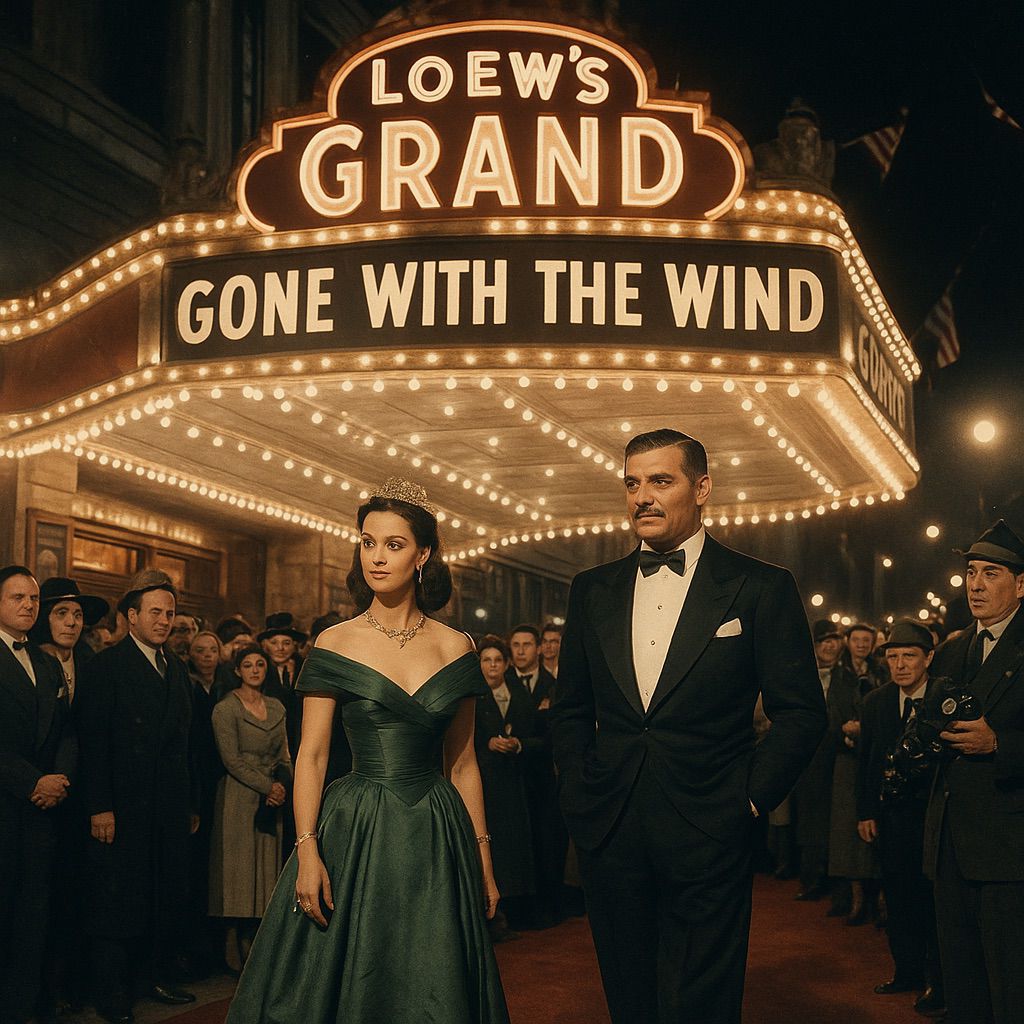
The Loew’s Grand Theatre stood at the heart of the celebration, transformed into a shrine of glamour and spectacle. Thousands gathered outside, hoping to catch a glimpse of stars arriving in elegant gowns and tailored tuxedos. The premiere was treated with the grandeur of a royal coronation, complete with parades, fireworks, and national attention. In an era still recovering from the Great Depression, the night offered an intoxicating sense of escapism and wonder.

Gone with the Wind had already achieved legendary status before a single frame reached the screen. Margaret Mitchell’s novel, published in 1936, became an instant phenomenon, selling millions of copies and embedding itself deeply into American culture. Readers were captivated by the story of Scarlett O’Hara, a fiercely determined Southern woman whose life is upended by the Civil War and its aftermath. The book’s success made a film adaptation inevitable, but also immensely risky.

From the outset, adapting the novel proved to be a monumental challenge. The story spanned decades, featured dozens of characters, and grappled with themes of love, survival, loss, and societal collapse. Producer David O. Selznick committed himself to honoring the scope of Mitchell’s work, even as Hollywood insiders doubted that such a sprawling narrative could be translated to film. The result was a production plagued by rewrites, director changes, and mounting pressure.

Casting Scarlett O’Hara became one of the most publicized searches in Hollywood history. Hundreds of actresses were considered, auditions scrutinized, and opinions fiercely debated. When Vivien Leigh, a relatively unknown British actress, was finally cast, the decision was met with both excitement and skepticism. Yet from her first appearance on screen, it became clear that Leigh embodied Scarlett’s fire, vulnerability, and resilience in a way few others could have achieved.

Clark Gable, already one of Hollywood’s biggest stars, was cast as Rhett Butler, the charismatic rogue whose wit and emotional detachment mask deep complexity. Gable’s presence brought gravitas and star power, but his participation was not without personal strain. Behind the scenes, he was grieving the recent death of his wife and struggling with health issues, adding emotional weight to his performance.

The production itself was an endurance test. Filming stretched over two years, with multiple directors rotating through the project before Victor Fleming ultimately guided it to completion. Sets were constructed on a massive scale, costumes meticulously crafted, and battle scenes staged with unprecedented ambition. Over a thousand costumes were designed, many of them worn by Scarlett alone, visually charting her transformation from sheltered plantation daughter to hardened survivor.

Music played a crucial role in shaping the film’s emotional power. Max Steiner’s sweeping score underscored moments of romance, despair, and defiance, weaving itself into the identity of the film. The music elevated scenes into operatic grandeur, reinforcing Gone with the Wind’s epic tone and emotional resonance.

As the premiere approached, anticipation reached a fever pitch. Atlanta embraced the film as its own, seeing it as both a tribute to Southern history and a major cultural milestone. Streets were decorated, Confederate imagery prominently displayed, and the city transformed into a living backdrop for the film’s themes. While this celebration reflected the sentiments of the time, it also foreshadowed the complex and controversial legacy the film would carry.

When the lights dimmed inside the Loew’s Grand Theatre, the audience was transported to Tara, Scarlett’s beloved plantation. From the opening moments, the scale of the film was unmistakable. Sweeping landscapes, vivid Technicolor, and emotionally charged performances drew viewers into a world both romanticized and ravaged by war.

Audiences were mesmerized. Gasps echoed during battle scenes, tears flowed during moments of loss, and applause erupted at iconic lines that would later become legendary. By the time Rhett Butler delivered his now-famous farewell, the film had secured its place in cinematic history.

Critical reception was overwhelmingly positive. Reviewers praised the film’s ambition, performances, and visual splendor. Vivien Leigh was hailed as a revelation, while Clark Gable’s portrayal of Rhett Butler was celebrated as one of his defining roles. The film would go on to win eight Academy Awards, including Best Picture and Best Actress, further cementing its status.

Financially, Gone with the Wind became an unprecedented success. Adjusted for inflation, it remains one of the highest-grossing films of all time. Its popularity endured through multiple re-releases, drawing new audiences with each generation and reinforcing its place in the American canon.

Yet even at the height of its acclaim, the film was not without controversy. Its portrayal of slavery and the Old South drew criticism for romanticizing a brutal and oppressive system. Characters were depicted through lenses that reflected the prejudices of the era, sparking debates that continue to this day. Over time, Gone with the Wind became a focal point for discussions about historical memory, representation, and the responsibility of art.

Despite these debates, the film’s influence on cinema is undeniable. It set new standards for epic storytelling, production design, and emotional scope. Countless filmmakers drew inspiration from its scale and ambition, while its characters and dialogue became embedded in popular culture.

Gone with the Wind also demonstrated the power of film as a shared national experience. At a time when the world stood on the brink of global conflict, the movie offered both escape and reflection, reminding audiences of resilience in the face of upheaval.

As decades passed, interpretations of the film evolved. What was once seen primarily as a romantic epic came to be examined through more critical lenses. Scholars, historians, and audiences reassessed its themes, acknowledging both its artistic achievements and its problematic elements. This ongoing dialogue has ensured that the film remains relevant, not frozen in time but continually reexamined.

More than eighty years after its premiere, Gone with the Wind continues to provoke conversation, admiration, and debate. Its legacy is complex, layered with both brilliance and contradiction. Yet its impact is unquestionable. Few films have shaped the language of cinema so profoundly or left such a lasting imprint on cultural consciousness.

The night of December 15, 1939 marked more than a premiere—it marked a turning point. Hollywood demonstrated its capacity for grand storytelling, emotional depth, and cultural influence. Gone with the Wind became not just a film, but a mirror reflecting both the dreams and the flaws of the society that created it.

In the end, Gone with the Wind endures because it tells a story about survival—about people clinging to identity, love, and purpose as their world collapses around them. That theme, more than any spectacle or controversy, is what continues to resonate across generations.

Related Posts