Latest Articles

The Day an Empire Fell: Yorktown and the Birth of a Nation

Elias Rowen

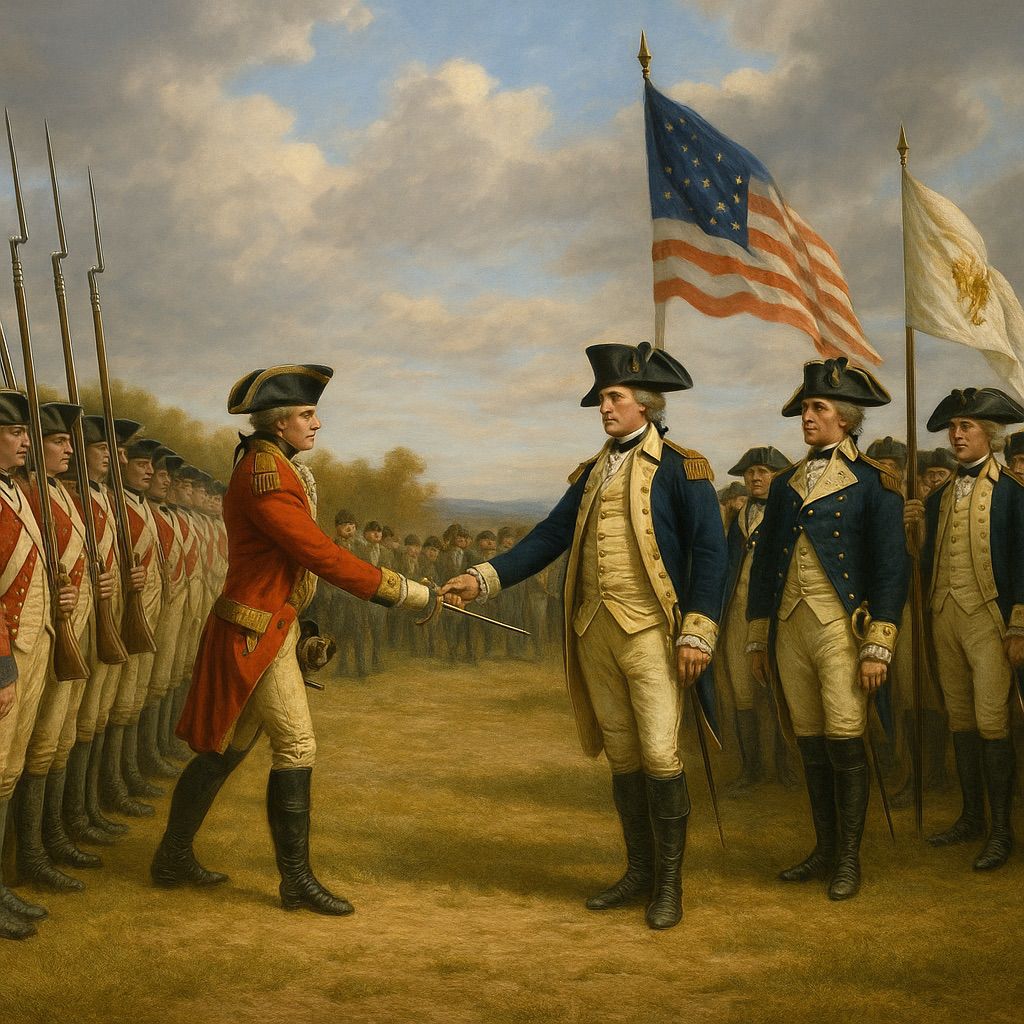
On October 19, 1781, in a quiet Virginia field, the mightiest empire in the world bent its knee to a ragtag army of farmers, tradesmen, and dreamers. The British surrender at Yorktown was more than just a military defeat—it was the moment the American Revolution transformed from rebellion into reality, from fragile hope into tangible independence. Cannons thundered no more; muskets fell silent; and as British General Charles Cornwallis’s forces marched out to lay down their arms, the world bore witness to the collapse of British authority in America and the rise of a new nation that would, in time, reshape the globe.

The path to Yorktown was paved with desperation, grit, and unlikely alliances. By 1781, the American Revolution had dragged on for six long years. Washington’s army had endured winters of starvation, defeats that seemed insurmountable, and dwindling supplies. Britain had assumed the rebellion would fizzle out, that colonists armed with passion but little else could never sustain a war against red-coated veterans. But the colonists had something Britain did not: unshakable resolve, a vast and unforgiving land, and eventually, the support of France. The alliance with France—born from diplomacy, nurtured by shared hatred of Britain—tipped the scales. French ships, French soldiers, French gold: all flowed into the American cause, breathing life into the faltering revolution.

Cornwallis, commanding British forces in the South, found himself trapped by his own choices. Ordered to secure Virginia, he fortified Yorktown, a small port town on the Chesapeake Bay, assuming British naval supremacy would protect him. But fate turned against him. The French fleet, under Admiral de Grasse, shattered British naval power at the Battle of the Chesapeake, sealing off escape by sea. On land, Washington, Rochambeau, and Lafayette moved swiftly, encircling Yorktown with combined Franco-American forces. Cannons were dragged into position, trenches dug, and a siege unlike any seen in the New World began.

For weeks, American and French artillery rained fire on British positions. Red-hot cannonballs set supply depots ablaze. Soldiers crouched in trenches, hearts pounding with each thunderous blast. Cornwallis’s men, once confident, grew weary, starving, and desperate. By mid-October, escape was impossible, reinforcements nonexistent, and supplies dwindling. On October 17, Cornwallis requested a ceasefire to negotiate surrender. Two days later, October 19, 1781, the deal was sealed.

The surrender ceremony was both somber and monumental. British troops marched between ranks of American and French soldiers, drums beating a dirge, muskets reversed, flags furled in shame. Tradition dictated that Cornwallis himself surrender, but claiming illness, he sent General Charles O’Hara in his stead. O’Hara first offered his sword to Rochambeau, who refused, directing him to Washington. Washington, embodying dignity and restraint, also refused, sending O’Hara to his subordinate, General Benjamin Lincoln—the very man forced to surrender to the British at Charleston the year before. It was a gesture rich in symbolism: America, once humiliated, now held the upper hand.

For the soldiers on the field, it was more than ceremony. It was the end of years of hunger, fear, and sacrifice. Picture the barefoot soldier at Valley Forge, remembering frozen nights with no shoes, now watching redcoats surrender. Picture the farmer who left his plow, the blacksmith who left his forge, the printer who left his press—all now vindicated in their struggle. Picture the French allies, proud to see their gamble pay off, their muskets gleaming beside American rifles. For them, Yorktown was not just a victory. It was redemption.

The news spread like wildfire. Bells rang in Philadelphia, crowds celebrated in Boston, and in Paris, champagne flowed. In London, the reaction was grim. The war was not formally over—treaties would take years—but Yorktown shattered Britain’s will to continue. Parliament debated, voices rose, and finally, Prime Minister Lord North uttered the words that echoed through history: “Oh God, it’s all over.”

Yet Yorktown was not merely the end of a war. It was the birth of an idea: that ordinary people, united in cause and conviction, could overthrow empire and create a republic built on liberty. The United States would not be perfect. It would struggle, fracture, and fall short of its ideals. But on October 19, the seed was planted, and the world took notice. Revolutions in France, in Latin America, in Europe, would follow in its footsteps, inspired by the sight of farmers defeating kings.

Humanizing Yorktown means remembering not just Washington, Cornwallis, or Rochambeau, but the individuals who made the impossible possible. The young drummer boy who beat time as British troops surrendered, not fully grasping history but feeling its weight. The enslaved men who fought on both sides, hoping for freedom in exchange for service, many betrayed, but some realizing liberty through revolution. The women who sewed uniforms, nursed the wounded, and kept farms alive while husbands fought. Their hands, their sweat, their tears, all marched at Yorktown too.

The surrender at Yorktown is a reminder that history is never inevitable. Victory was not guaranteed, independence not assured. It was won through grit, sacrifice, and the audacity to believe that a people could govern themselves. October 19, 1781, was the day the dream became real, the day empire faltered, and the day a new nation rose, fragile but determined.

The world would never be the same.

Related Posts

Dewey Decimal Desire: Why the Sexy Librarian Owns Halloween

Dave

There are certain archetypes that never lose their grip on the imagination. The witch, the vampire, the devil—all of them embody primal aspects of fear, rebellion, and temptation. But nestled among them, there’s one costume that doesn’t need blood or fire or darkness to command attention. She doesn’t need wings or fangs or horns. All she needs is a tight pencil skirt, a crisp blouse slightly unbuttoned, glasses perched on her nose, and stockings that hint at much more than modesty. The Sexy Librarian is one of Halloween’s most enduring viral icons because she thrives on contradiction. She takes an image that’s traditionally associated with quiet, rules, and order, and flips it into something daring, playful, and irresistible. She’s not about scaring you—she’s about making you lean in closer, drawn by the promise of knowledge, mystery, and just the right amount of mischief.

What makes the Sexy Librarian so powerful is the tension at the heart of the look. Librarians in our cultural imagination are figures of control: shushing voices, organizing chaos, maintaining order. They are the guardians of silence and discipline, the keepers of dusty tomes, and the overseers of rules. But Halloween is about rebellion. It’s about breaking free from rules, subverting expectations, and turning the ordinary upside down. The Sexy Librarian costume takes the idea of control and transforms it into temptation. The pencil skirt, usually a sign of modesty, suddenly becomes a spotlight for confidence. The glasses, symbols of seriousness, now frame flirtation. The stockings, once formal, now spark curiosity. This costume doesn’t just invite attention—it demands it, all while maintaining a clever wink that says: I know exactly what I’m doing.

Visually, the Sexy Librarian is designed for impact. The pencil skirt creates clean lines, accentuating curves with elegance and confidence. Paired with stockings, the look instantly blends sophistication with allure. The blouse, often white or cream, provides a canvas that can be styled modestly with a bow or unbuttoned just enough to suggest rebellion beneath the surface. And then there are the glasses—arguably the most powerful accessory in the entire look. They frame the face, sharpen the eyes, and create that unmistakable air of authority, even as they slide down the bridge of the nose with a mischievous smirk. It’s a costume made for performance, for adjusting glasses while raising an eyebrow, for tapping a ruler on a desk, for leaning forward as though grading more than papers. The details matter because they transform a simple outfit into an entire character.

The Sexy Librarian thrives in photos and videos because she’s not static—she’s interactive. Her props practically beg to be used: books stacked as flirtatious accessories, rulers wielded like playful tools, glasses that can be slid on and off with a smirk. Every gesture becomes an invitation, every pose a performance. On Instagram, the clean lines of the skirt and blouse pop against chaotic Halloween backdrops of cobwebs and neon. On TikTok, she’s the perfect subject for transformations—hair tied up into a bun, glasses perched firmly, then one snap and the bun drops, glasses slide down, blouse loosens, and suddenly the “strict librarian” becomes the “seductive librarian.” On X, she trends year after year because the internet cannot resist debating, sharing, and admiring the contradiction at the heart of the look. She’s not scary, but she’s unforgettable. She doesn’t hide in the shadows—she controls the spotlight.

Part of what makes her viral is how easy she is to adapt. Some Sexy Librarians keep the look classic—tight skirt, stockings, blouse, glasses, and maybe a stack of books. Others modernize it, adding leather skirts, bold lipstick, and heels that click with authority. Some lean into humor, carrying oversized glasses or giant novelty books as a parody of the trope. Others lean full-on sultry, with sheer stockings, fitted corsets, or plunging blouses that redefine what “library quiet” really means. That adaptability ensures that the costume never goes stale. Like the ever-expanding stacks of a library, the Sexy Librarian has endless interpretations, each one reflecting the personality of the woman wearing it.

But the reason she resonates isn’t just about looks—it’s about energy. The Sexy Librarian embodies confidence in a way that feels human and relatable. She’s not just showing skin—she’s showing control. She’s showing wit. She’s showing playfulness wrapped in sophistication. There’s something empowering about taking an image of strictness and formality and turning it into something unapologetically bold. For the woman wearing it, the costume becomes a declaration: I can be smart, I can be sexy, I can be both—and I’m going to have fun proving it. That empowerment doesn’t just stay with her—it radiates outward, filling the room with a charge that everyone feels. That’s why she dominates Halloween not just in person but online, because people don’t just admire the costume—they admire the confidence behind it.

Halloween is about transformation, and the Sexy Librarian is one of the purest forms of that idea. She takes a role rooted in rules and flips it into rebellion. She transforms silence into laughter, order into flirtation, modesty into mischief. She reminds everyone that the people who seem the most reserved often have the boldest sides waiting just beneath the surface. And that reminder is powerful, because it reflects something true about all of us: we all have contradictions, we all have hidden sides, we all crave moments when we can break free of expectations and reveal a version of ourselves that surprises the world.

That’s why the Sexy Librarian continues to trend year after year. She’s more than a costume—she’s an archetype of transformation, empowerment, and fun. She doesn’t rely on gore or gimmicks. She doesn’t need elaborate props or cinematic makeup. All she needs is a skirt, glasses, stockings, and the kind of charisma that turns heads and sparks conversation. She’s proof that sometimes the most viral costumes aren’t the ones dripping with fake blood or covered in sequins—they’re the ones that flip the script, the ones that subvert expectations, the ones that make people laugh, blush, and remember.

So when Halloween rolls around and the night is alive with monsters, superheroes, and creatures of the night, keep an eye on the room. Watch who everyone is watching, who people can’t resist talking to, who dominates selfies and videos. Chances are, it’s the woman with the books in her hands, the glasses on her nose, the pencil skirt that hugs her stride, and the stockings that say “rules are meant to be broken.” That’s the Sexy Librarian. That’s the viral queen of contradictions. And that’s why, year after year, she doesn’t just check out—she checks in as one of the most unforgettable icons of Halloween.

Related Posts

When the Body Splits: The Horrifying Flight of the Manananggal

Dave

There are monsters that haunt the imagination because of their sheer brutality, and then there are monsters that chill us because they twist the familiar into the grotesque. In Philippine folklore, one such nightmare dominates the night sky — the Manananggal. Unlike simple spirits or beasts, she is human by day and horror by night. At dusk, she splits her body in half, leaving her lower torso behind, sprouting massive batlike wings, and soaring into the darkness to hunt. She preys on the sleeping and the vulnerable, using a long, proboscis-like tongue to pierce roofs, windows, or even wombs, feeding on the blood of the living. On October 18, when her legend is remembered, we are reminded that not all nightmares wear masks — some are born of flesh, fear, and a culture’s deepest anxieties about life, death, and betrayal.

The Manananggal is one of the most distinctive and feared figures in Filipino folklore. Her very name comes from the Tagalog word tanggal, meaning “to remove” or “to separate,” a chilling reminder of her defining feature: the act of splitting her body. By day, she may appear as an ordinary woman, sometimes even beautiful, blending seamlessly into society. But when night falls, her head, torso, and wings rip free from her lower half, leaving her waist and legs standing abandoned. She takes to the sky, hunting in silence, her tongue stretching like a grotesque straw to pierce the flesh of her victims. This duality — human by day, demon by night — makes her one of folklore’s most terrifying shapeshifters, because she is both familiar and monstrous at once.

Her prey reveals much about her symbolic power. The Manananggal is infamous for attacking pregnant women, using her tongue to drain the blood of unborn children. This horrifying detail resonates with the deep cultural fears around pregnancy, childbirth, and infant mortality. In times when maternal and infant deaths were tragically common, the Manananggal embodied those anxieties, transforming them into a figure who stole life before it began. But she does not stop there. She also feeds on the sick, the sleeping, and the unwary, her attack as silent as it is devastating. To fear the Manananggal was to fear vulnerability itself — the times when one’s guard is down, when life hangs by a thread.

Communities devised defenses against her, many of which were as visceral as the stories themselves. Her lower half, left behind while she hunts, is her weakness. Villagers believed that sprinkling salt, smearing garlic, or spreading ash on the abandoned torso would prevent her from reattaching, dooming her to perish when the sun rose. Stakes, daggers, or bolos could also kill her, especially if aimed at the heart. These protections reflected both ingenuity and desperation, for the Manananggal was not a monster that could be reasoned with — she had to be fought with fire, salt, and steel.

What makes the Manananggal especially terrifying is her ability to hide in plain sight. By day, she is often depicted as a quiet, withdrawn woman in the community, sometimes beautiful, sometimes strange, but never openly monstrous. This duality created an undercurrent of paranoia. Anyone could be the Manananggal. A neighbor, a midwife, a widow — anyone who lived alone or defied social expectations risked being labeled. In this way, the legend was not only about horror but also about social control, warning against women who strayed outside prescribed roles. The Manananggal became not just a monster of the night but a mirror of societal anxieties about women, independence, and the boundaries of community.

Some folklorists trace the origins of the Manananggal to pre-colonial myths of spirits and demons that consumed flesh or preyed on the vulnerable. With the arrival of Spanish colonization, Christian demonology blended with local beliefs, amplifying her monstrous image. She became not only a predator but also a symbol of sin, temptation, and the grotesque inversion of motherhood. Her beauty by day and monstrosity by night reflected Christian warnings about temptation and hidden evil, shaping her into both a horror figure and a moral lesson.

Yet for all her grotesque imagery, the Manananggal is strangely compelling. Her act of splitting herself in half is unique among global monsters, setting her apart even from vampires or witches. She embodies transformation in its most terrifying form: the human body becoming alien, the familiar body turning against itself. Her wings symbolize freedom, yet their use is predatory. Her separation from her lower half makes her vulnerable, yet her upper half is terrifyingly strong. She is both powerful and fragile, monstrous and human. This tension makes her one of the most enduring figures in Philippine folklore.

Modern culture has embraced the Manananggal in countless ways. She appears in horror films, TV shows, comics, and even urban legends retold for new generations. In many depictions, she is both terrifying and tragic — a woman cursed to hunt, forced to split herself, doomed to prey on those she once might have loved. This tragic lens humanizes her, suggesting that beneath the monstrous wings and grotesque hunger lies a figure as trapped as her victims.

In rural areas, however, the belief in the Manananggal persists as more than story. People still whisper warnings about traveling at night, about pregnant women being especially careful, about strange noises on rooftops. The flap of wings in the dark, the scratching of claws, the cry of bats — all of these sounds can still evoke the fear that perhaps the Manananggal is near. Folklore here is not just entertainment but living memory, a way to shape behavior, protect the vulnerable, and give form to fears.

The Manananggal resonates because she embodies universal human anxieties. She is the fear of betrayal — someone you know, someone you trust, transforming into your predator. She is the fear of vulnerability — being attacked while asleep, sick, or pregnant. She is the fear of duality — that appearances lie, that beauty can mask monstrosity, that the human body itself can split into horror. These fears are not confined to the Philippines. They are human fears, given wings and a monstrous tongue.

So on October 18, when the Manananggal’s story is told, we are reminded that monsters endure because they say something true. They embody our nightmares in ways too sharp to forget. The Manananggal is not just a woman with wings; she is the terror of vulnerability, the suspicion of the neighbor, the danger of night, the fragility of life. And perhaps that is why her legend flies as high as her monstrous wings, carried from one generation to the next, never landing, never dying.

And maybe, when you hear something scratching at your roof tonight, or see a shadow move across the moon, you’ll wonder. Is it just a bat? Or is it the upper half of a woman, wings spread wide, searching for her next victim? And if so, will you have garlic, salt, and ash ready — or will you become just another whisper in her story?

Related Posts

From Russia with Ice: How Alaska Became America’s Last Frontier

Elias Rowen

On October 18, 1867, in the foggy port town of Sitka, a small crowd gathered as the Russian flag was lowered and the Stars and Stripes were raised over a vast wilderness that few Americans had ever seen. The transfer was quiet, ceremonial, almost anticlimactic. Yet the moment marked the birth of a geopolitical gamble that would eventually prove one of the most transformative acquisitions in U.S. history. Alaska—7.2 million dollars’ worth of glaciers, forests, tundra, and untapped riches—became American territory. Critics mocked it as “Seward’s Folly” or “Seward’s Icebox,” sneering at what they believed was a frozen wasteland purchased at an absurd price. But history would have the last laugh. That day, October 18, 1867, the United States gained not just land but a frontier of possibility, a treasure chest of resources, and a stage for future global influence.

The story begins with empire in decline. By the mid-19th century, Russia was struggling to maintain its far-flung colonies. Alaska, though rich in fur and fish, was remote, expensive to defend, and vulnerable to British expansion from nearby Canada. The Crimean War had drained Russian coffers, and Tsar Alexander II feared losing Alaska without compensation in some future conflict. Better, he reasoned, to sell it—especially to the United States, whose growing power offered a counterweight to Britain. For Russia, the sale was pragmatic; for America, it was opportunity.

Enter William H. Seward, U.S. Secretary of State under President Andrew Johnson. A visionary expansionist, Seward believed that America’s destiny was to span oceans, to command trade and influence in both hemispheres. When Russian diplomats approached him in 1867, he seized the chance. After late-night negotiations, the deal was struck: 7.2 million dollars—about two cents an acre—for 586,000 square miles of wilderness. In today’s terms, it was a bargain beyond imagination.

But Americans were not impressed. Newspapers ridiculed the purchase. “What are we to do with this worthless icebox?” they jeered. “Nothing but polar bears and glaciers!” The name “Seward’s Folly” stuck, a reminder of skepticism that saw the acquisition as folly rather than foresight. Few could envision Alaska’s potential. The Civil War had just ended, the nation was weary, and the idea of expanding into icy wastelands seemed absurd when there were already so many challenges at home.

The transfer itself was simple but symbolic. On October 18, Russian and American officials met in Sitka. Cannons fired salutes, flags were lowered and raised, and the land that had once belonged to the Russian Empire was now American. For the indigenous peoples of Alaska—the Tlingit, Haida, Yup’ik, Aleut, and many others—there was no celebration. Their lands had been bartered over without consent, their futures altered in ways they could not yet foresee. For them, the transfer marked another chapter in centuries of displacement and adaptation.

In the years that followed, Alaska was largely neglected. The federal government treated it as a distant outpost, governed more as a possession than as a partner. But beneath the snow and silence, Alaska held secrets that would redefine its value. Gold was discovered in the 1890s, sparking the Klondike and Nome rushes that lured thousands north. Later came timber, fisheries, and eventually, oil—black gold that would transform Alaska into a cornerstone of America’s energy supply. Far from folly, Seward’s Icebox proved a treasure chest.

Yet Alaska’s importance was not only economic. Its strategic position between North America and Asia made it a vital outpost in World War II and the Cold War. Bases were built, defenses strengthened, and the territory became a linchpin of American security. The Aleutian Islands campaign during World War II showed just how critical the region was. Later, during the nuclear standoff of the Cold War, Alaska was the frontline of early-warning systems against Soviet attack.

Through it all, Alaska also became myth and muse. Writers, artists, and adventurers cast it as America’s last frontier—a land of wild beauty, unforgiving landscapes, and rugged individualism. From Jack London’s stories of survival to the mystique of Denali, Alaska captured the imagination as a place where nature ruled and humanity struggled to find its place.

The path from territory to statehood was long. For decades, Alaskans pushed for greater recognition, frustrated by distant governance. Finally, in 1959, Alaska became the 49th state of the Union. It was a moment of pride for those who had endured the hardships of frontier life, a validation of Seward’s vision, and a recognition of the land’s enduring value.

But perhaps the most human story of Alaska’s transfer lies in the way it was misunderstood. For the critics of 1867, it was folly. For Seward, it was foresight. For indigenous peoples, it was dispossession. For gold seekers, it was opportunity. For America, it was destiny. History rarely wears just one face, and Alaska is a reminder of how perspective changes over time.

On October 18, 1867, the world barely noticed when a flag changed over a foggy harbor in Sitka. Yet that moment altered the map forever. Alaska, once dismissed as frozen wasteland, became one of the most valuable acquisitions in history—a land of resources, beauty, and strategic power. It was not folly, but foresight. It was not an icebox, but a frontier. And it remains, to this day, a place where America’s past, present, and future converge.

Related Posts

Tangled in Temptation: Why Poison Ivy Always Blossoms on Halloween

Dave

There are certain costumes that cling to Halloween like ivy to a crumbling brick wall, creeping into every party, dominating every selfie, and staying rooted in the collective imagination long after the candy wrappers have been swept away. At the very top of that list is Poison Ivy, the queen of leafy seduction, the emerald enchantress whose name alone is enough to conjure visions of tangled vines, scarlet hair, and an aura of danger sweetened by temptation. She doesn’t just walk into a Halloween party—she invades it like nature reclaiming concrete, lush, confident, and impossible to ignore. Wrapped in a leafy bodysuit that clings like it was grown for her, vines spiraling around her arms and legs like living jewelry, and hair the color of autumn fire cascading down her back, Poison Ivy is one of the most viral, enduring, and magnetic costumes the season has ever known.

Part of her strength lies in origin. Born in the pages of DC Comics, Poison Ivy began as a villain in Batman’s Gotham City, an eco-terrorist who used plants to bend the world to her will. She wasn’t just another femme fatale—she was something new, something primal. While Catwoman prowled with claws and Harley Quinn twirled bats, Ivy arrived like a storm from the earth itself, armed with pheromones, toxins, and a beauty so sharp it could cut. Over time, she blossomed into more than a villain—she became an icon, a symbol of femininity entwined with danger, of sexuality fused with power, of rebellion cloaked in green. And that duality is exactly what makes her irresistible on Halloween. She’s not just sexy, she’s formidable. Not just pretty, but powerful. When someone dresses as Poison Ivy, they’re not putting on a costume—they’re stepping into the role of a seductress who knows her worth, and dares the world to resist her.

Visually, Poison Ivy is a dream for Halloween. The leafy bodysuit is bold and striking, immediately recognizable even from across a crowded room. Green is not a color that blends—it pops, and when paired with the fiery cascade of red hair, the effect is explosive. Vines curling around limbs add movement and texture, making every pose look alive, as if the costume itself might slither off into the night. And the accessories—the leaf crowns, the glittery makeup, the botanical props—only amplify the aesthetic, creating a look that’s cinematic, viral, and unforgettable. Under neon lights, she glows. In photographs, she dominates. On TikTok, she transforms from everyday wear to leafy goddess in a single snap, a transition that racks up likes and shares because everyone wants to witness the metamorphosis. Poison Ivy isn’t just worn—she’s performed, and performance is what makes costumes legendary.

But Ivy’s viral appeal goes deeper than glitter and vines. It’s rooted in the contradiction she embodies. She’s a villain who fights for something noble: the preservation of nature. She’s seductive but lethal, playful but uncompromising, beautiful but dangerous. That balance of allure and threat is intoxicating. When someone slips into her leafy armor, they’re channeling more than a look—they’re channeling an attitude. The tilt of a smile, the gleam in the eye, the deliberate slowness of a walk across the room—it all becomes part of the performance. And it’s a performance everyone in the room responds to, whether with admiration, envy, or fascination. Ivy doesn’t need to demand attention—she grows into it naturally, like vines climbing a wall, inevitable and unstoppable.

The adaptability of the Poison Ivy costume also explains her longevity in the Halloween spotlight. Some wear her as a classic comic book villain, with a simple bodysuit, vines, and scarlet wig. Others glam her up with sequins, rhinestones, and couture-inspired designs, turning her into a red carpet-ready eco-queen. Some lean into horror, painting their skin green, adding thorns dripping with blood, and turning her into a nightmarish forest witch. Others keep her sleek and sultry, with thigh-high boots, dramatic leaf-shaped corsets, and makeup sharp enough to kill. No matter the variation, she’s always recognizable, always stunning, and always viral. Because Poison Ivy isn’t a trend—she’s an archetype, one that evolves year after year without losing her roots.

Her humanity is part of the secret, too. Poison Ivy resonates because she feels real. Unlike some flawless characters, Ivy is a mess of contradictions—she’s passionate to a fault, loyal yet ruthless, soft yet spiny. She represents the parts of ourselves that are chaotic but purposeful, wild but beautiful. To wear her costume is to embrace that part of yourself, to lean into confidence without apology, to flirt with danger while still glowing with allure. That authenticity shines through the glitter and leaves, making the costume more than just fabric. It becomes a statement: I am powerful, I am playful, I am unforgettable. And people respond to that, both in person and online. It’s why the Poison Ivy look dominates feeds every Halloween, why her hashtag never stops trending, why her image is shared again and again.

Props and staging push the look even further into viral territory. A rose clutched like a dagger, a trail of vines across the dance floor, a backdrop of glowing pumpkins twisted with ivy—the possibilities are endless. Every pose becomes art, every candid becomes content. The costume thrives because it encourages creativity, because every detail adds to the story. Poison Ivy isn’t just a woman in green—she’s a character with lore, with edge, with charisma. That built-in storytelling is what gives her a leg up over generic costumes. She’s not just a look—she’s a vibe, and vibes spread like wildfire in the age of social media.

Halloween is about transformation, and few transformations feel as powerful as Poison Ivy. She takes something as ordinary as leaves and vines and turns it into an emblem of temptation and strength. She transforms vulnerability into power, beauty into weaponry, mythology into reality. For one night, the woman who dons the vines isn’t just playing dress-up—she’s becoming a force of nature. She’s the storm, the temptation, the danger in the room. And when the night ends, when the glitter fades and the leaves are packed away, the memory lingers, because Poison Ivy doesn’t just pass through—she takes root.

So when the next Halloween party rolls around and the music shakes the floor, watch who people can’t stop staring at. Watch who gets pulled into every photo, whose laughter spreads like wildfire, whose image floods the feeds by morning. It’s the one in green, with vines curling like secrets, with hair like fire, with a smile that says she knows exactly how much power she holds. That’s Poison Ivy. That’s the seductress who turns Halloween into her jungle. And that’s why, year after year, she isn’t just another costume—she’s the costume, the viral queen of Halloween.

Related Posts