Latest Articles

I’m Starting to Miss Mr Whiskers

Hal

It started with a spoon. I was making my morning coffee when I reached for the sugar and noticed the spoon sitting on the counter instead of resting inside the bowl where it belonged. That wasn’t particularly unusual. John Mercer had made coffee before I woke up, and he’d probably set it down while stirring his mug before wandering off to start work. I picked it up, dropped it back into the sugar bowl, and reached for the coffee pot. Somewhere between adding the sugar and taking my first sip, another thought quietly wandered into my head. I hadn’t seen Mr. Whiskers in the kitchen for several days.

That realization stopped me in the middle of breakfast. Mr. Whiskers had always considered the kitchen one of his favorite places in the apartment. Every morning he’d stretch out beneath the window where the sunlight warmed the tile floor, supervising breakfast with the quiet confidence of a cat who believed every meal being prepared was ultimately intended for him. Sometimes he’d watch birds outside. Sometimes he’d stare at a dust particle floating through the sunlight as though it had personally offended him. Whatever occupied his attention, he was almost always there. Lately, though, the kitchen had felt strangely empty, and I couldn’t remember the last time I’d nearly tripped over an orange tail while reaching for the refrigerator.

I immediately told myself I was overthinking things. Cats don’t follow schedules. They don’t hold committee meetings to decide which room they’ll nap in next. Mr. Whiskers had probably discovered another comfortable spot somewhere else in the apartment. Even so, the thought refused to leave me alone. Every time I walked into the kitchen that morning, my eyes drifted automatically toward the windowsill before I remembered there probably wouldn’t be a cat waiting there. It was amazing how quickly an ordinary habit could turn into something you missed.

Pandora caught me looking around later that afternoon while she was straightening the books on the coffee table. She watched me glance toward the kitchen for the third time before lowering the book she was holding and smiling with the patient amusement of someone who already knew exactly what question I was about to ask. “Looking for something?” she said.

“I don’t know,” I answered.

She raised an eyebrow.

“You know exactly what you’re looking for.”

I sighed.

“…The cat.”

“I thought so.”

“I just realized I haven’t seen him in the kitchen lately.”

Pandora looked toward the living room, then back at me with a shrug. “He’s around.”

That should have settled the matter.

Instead, my imagination quietly accepted a new assignment.

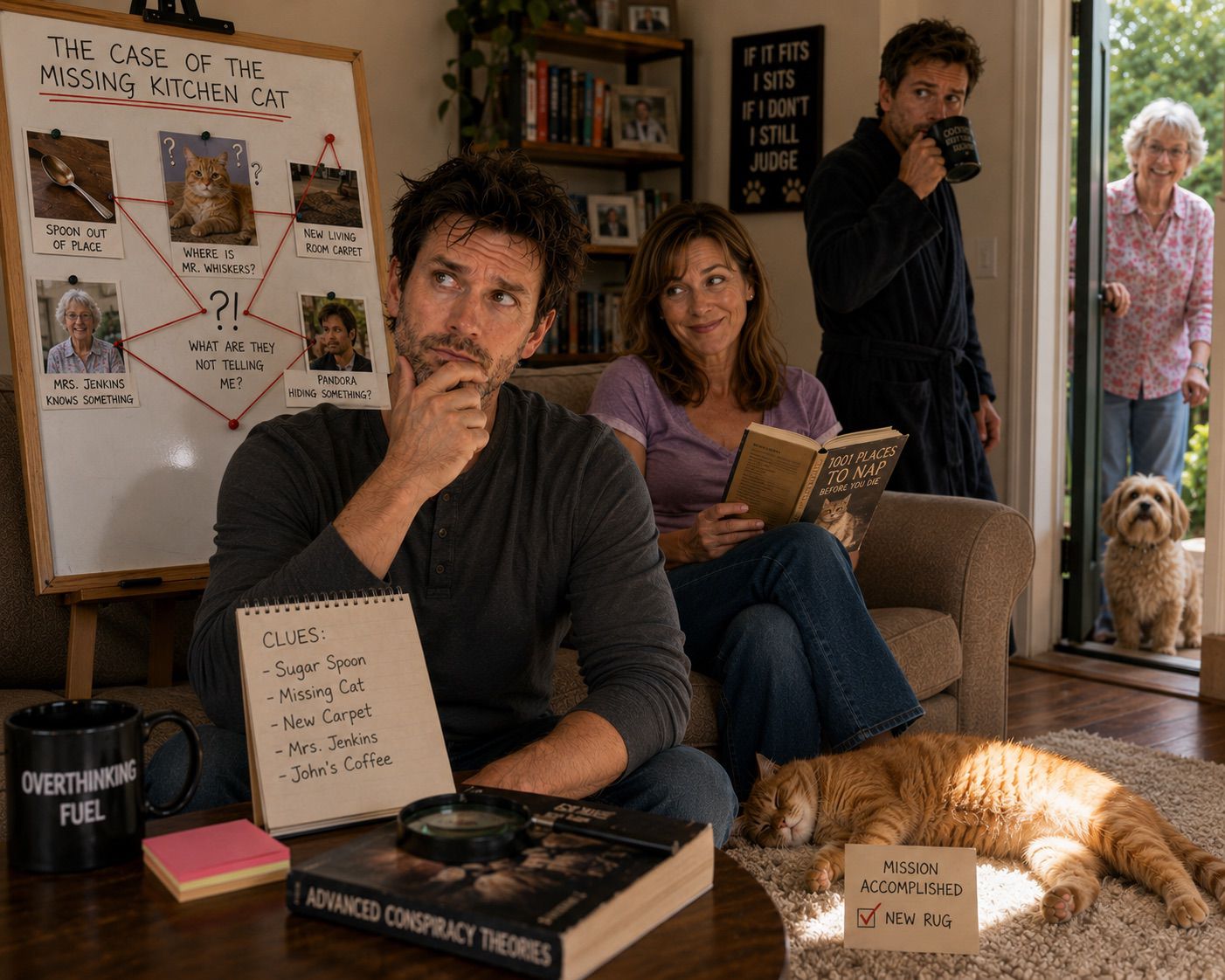
The sugar spoon had been sitting on the counter. Mr. Whiskers had disappeared from the kitchen. Pandora had rearranged the coffee table that morning. None of those things had the slightest connection to one another, but somewhere deep inside my head, a tiny detective wearing a wrinkled trench coat had already begun pinning imaginary evidence to an imaginary bulletin board. It was only a matter of time before red string entered the investigation.

Mrs. Jenkins unintentionally made matters worse that afternoon while I was bringing the trash bin back from the curb. She was out walking her little terrier and stopped long enough to admire Pandora’s flowers before smiling at me. “Haven’t seen your orange helper in the kitchen window lately,” she said. “Cats always find the warmest place in the house.”

That should have been reassuring.

Instead, my brain immediately ignored the second sentence and became fascinated by the first.

She’d noticed too.

Interesting.

How long had she been noticing?

Had everyone been noticing?

Was I the last person to realize the kitchen no longer had a resident cat?

I stood there for several seconds after she’d continued down the sidewalk before realizing I’d somehow transformed perfectly ordinary neighborhood conversation into what my imagination considered an important witness statement.

By dinner I’d invented enough explanations to write an entire documentary about feline behavior. Perhaps Mr. Whiskers had decided the kitchen wasn’t comfortable anymore. Perhaps he’d developed a mysterious dislike of ceramic tile. At one point I briefly wondered whether John Mercer making coffee every morning had somehow disrupted the cat’s routine, although I had absolutely no evidence to support that theory. Then again, evidence had never stopped my imagination before. Every possibility seemed just believable enough to keep me thinking while somehow becoming less believable the longer I considered it.

John wandered into the living room carrying his usual mug of coffee and immediately noticed the thoughtful expression on my face. “You look like you’re solving a murder,” he said.

“I’m thinking.”

“That’s what worries me.”

“I haven’t seen Mr. Whiskers in the kitchen all week.”

John looked toward the kitchen doorway, then back at me.

“So?”

“So… why?”

He shrugged, took another sip of coffee, and answered with complete sincerity. “Maybe ask the cat.”

It was an extraordinarily unhelpful suggestion.

I considered it anyway.

Later that evening Pandora stood up to fold a basket of laundry, stepping aside just enough for me to see the center of the living room rug. There, surrounded by a warm patch of afternoon sunlight, lay Mr. Whiskers. He was completely asleep, stretched out across the new rug we’d bought the previous week with one paw dangling lazily over the edge of the brightest spot in the room. He looked more comfortable than any creature had ever looked in the history of comfort. His breathing was slow, his whiskers twitched occasionally, and judging by the tiny contented noises he was making, he was having the best nap of his entire life.

Pandora noticed me staring at him and smiled. “There he is.”

“There he is.”

“He likes the new rug.”

I looked from the rug to the kitchen doorway, then back to the cat. The answer arrived so quickly that I almost felt insulted I’d missed it. The kitchen floor had always been his favorite sunny spot until we replaced it with something warmer, softer, and considerably more comfortable. He hadn’t disappeared. He’d simply upgraded.

“So…” Pandora asked, trying not to laugh. “What happened to your mystery?”

I watched Mr. Whiskers open one eye, glance at me for the briefest moment, yawn dramatically, and settle back into his nap without showing the slightest interest in the week-long investigation I’d conducted on his behalf.

“It appears,” I said after a thoughtful pause, “…that I have been thoroughly outsmarted by carpeting.”

Pandora laughed so hard she had to sit back down on the couch.

Mr. Whiskers never even bothered opening his eyes again.

Honestly… I think he’d solved the mystery the first day.

He just didn’t think I needed to know.

Related Posts

Jean Cocteau: Where Elegance Meets Uncanny Valley (and I’m Kind of Frightened)

Penelope

Jean Cocteau’s face haunts me, a mix of elegance and disquiet. I’ve been drawn to him for months now, but the more I learn about his life, the more complicated my fascination becomes.

I think part of it is his contradictions – a painter, poet, novelist, filmmaker, and playwright all rolled into one. He was a chameleon, always reinventing himself, which makes me wonder: can we ever truly pin down someone’s identity? Cocteau seemed to defy categorization, blending the boundaries between art forms in ways that still intrigue me.

As I dig deeper, I’m struck by his relationships – particularly with his partner, Jean Desbordes. Their love story is as much a puzzle as it is beautiful. The way Cocteau’s work often explored themes of same-sex desire and identity resonates with me on a personal level. Growing up, I struggled to understand my own attractions, and Cocteau’s openness about his experiences feels like a kindred spirit.

But what really unsettles me is the darkness that lurks beneath his art. His fascination with the underworld, the surreal, and the grotesque unnerves me. The way he wove together mythology and his own demons in films like “The Blood of a Poet” or “La Belle et la Bête” makes my skin crawl. It’s as if he’s tapping into something primal, something I don’t fully comprehend.

I’ve found myself questioning whether Cocteau’s darkness is part of what draws me to him – the thrill of exploring the unknown, the forbidden. Or am I simply drawn to the shadows because they’re familiar? In my own life, I’ve struggled with anxiety and depression; maybe it’s a morbid curiosity that leads me to Cocteau’s darker corners.

I keep coming back to his film “Orpheus,” which has become an obsession of mine. The way he reimagines the mythological figure as a modern-day poet, searching for his lost love in the underworld – it speaks to something deep within me. Perhaps it’s because I’ve felt lost myself, wandering through the fragmented landscape of my own thoughts and desires.

Cocteau’s work has this quality of being both timeless and unsettlingly contemporary. His exploration of identity, desire, and the human condition feels eerily relevant in today’s world. But what unsettles me is how easily his art slips into clichés – the tortured artist, the enfant terrible. Is it possible to separate Cocteau from these stereotypes?

As I continue to delve into his life and work, I’m reminded of the words he once spoke: “The only way to be truly original is to have a very bad memory.” It’s a statement that resonates with me – as someone who struggles to recall details, but finds solace in the fragmented nature of my thoughts.

In Cocteau, I see reflections of myself – the struggles, the contradictions, and the search for meaning. His art has become a mirror held up to my own experiences, forcing me to confront the complexities that make us human. It’s a discomforting feeling, but one that draws me in nonetheless.

As I reflect on Cocteau’s words about having a bad memory, I’m struck by how they echo through my own life. My struggles with anxiety and depression often leave me with foggy memories of even the most pivotal moments. It’s as if my brain is constantly rewriting its own narrative, making it difficult for me to hold onto anything concrete.

I’ve come to realize that this tendency is both a blessing and a curse. On one hand, it allows me to move through life with a sense of fluidity, adapting to new situations without getting too entrenched in the past. But on the other hand, it can be disorienting, leaving me feeling lost and disconnected from my own experiences.

Cocteau’s art often explored this theme of fragmented memory and identity. His use of symbolism and surrealism allowed him to tap into the collective unconscious, creating a world that was both fantastical and eerily familiar. I find myself drawn to this aspect of his work, feeling like it speaks to my own experiences with mental health.

But what if Cocteau’s bad memory wasn’t just a quirk or a creative advantage? What if it was a symptom of something deeper – a desperate attempt to escape the traumas and complexities that he couldn’t reconcile? His relationships were fraught, his family dynamics complicated. He struggled with addiction and self-doubt, often using his art as a means of coping.

As I delve deeper into Cocteau’s life, I’m struck by how much he was driven by a desire to create something new, something that would transcend the boundaries of time and convention. His work is a testament to the power of imagination, but it also serves as a reminder of the fragility of human experience.

I wonder if this is why his art unsettles me – because it forces me to confront my own vulnerabilities? The imperfections, the contradictions, the darkness that lurks beneath the surface? Cocteau’s work is like a mirror held up to my own psyche, reflecting back all the parts I’d rather keep hidden.

In “Orpheus,” Cocteau depicts his protagonist as a poet who must journey into the underworld to reclaim his lost love. It’s a powerful metaphor for the search for meaning and connection in our own lives. But what if Orpheus is also a reflection of Cocteau himself – a figure struggling to find his place in the world, to reconcile his own desires with the expectations of others?

I’m not sure I have the answers to these questions. All I know is that Cocteau’s work has become an obsession for me – a source of fascination and discomfort that refuses to let go. As I continue to explore his life and art, I’m left with more questions than answers, but also a sense of connection to this enigmatic figure who continues to haunt me long after the lights have gone out on his films.

I’ve spent countless hours watching “Orpheus,” trying to decipher its layers, and yet, it still feels like an enigma wrapped in a mystery. Cocteau’s use of symbolism is masterful – he weaves together threads of mythology, literature, and personal experience into a tapestry that’s both beautiful and unsettling. The way Orpheus navigates the underworld, driven by his love for Eurydice, resonates with me on a deep level.

As I watch the film, I’m struck by how Cocteau’s use of mirrors serves as a metaphor for the fragmentation of identity. Orpheus’s journey is one of self-discovery, but it’s also a reflection of Cocteau’s own struggles to reconcile his desires with societal expectations. The way Orpheus must confront his own mortality and the impermanence of love feels like a mirror held up to my own experiences with anxiety and depression.

I’ve always been fascinated by the concept of the “double” – the idea that we all have a shadow self, a darker counterpart that lurks beneath the surface. Cocteau’s work often explores this theme, blurring the lines between reality and fantasy. In “Orpheus,” the underworld serves as a symbol for this double, a realm where Orpheus must confront his own fears and desires.

As I delve deeper into Cocteau’s art, I’m starting to see connections between his work and my own experiences with mental health. The way he uses symbolism and surrealism to convey complex emotions feels like a language that speaks directly to me. It’s as if he’s tapping into a collective unconscious, one that resonates deeply with those of us who’ve struggled with anxiety, depression, or other mental health challenges.

But what if Cocteau’s work isn’t just about exploring the human condition? What if it’s also a reflection of his own personal demons – the traumas he experienced, the relationships he struggled with, and the self-doubt that plagued him throughout his life? His art is a testament to the power of creativity as a means of coping, but it’s also a reminder of the fragility of human experience.

I’m not sure I can separate Cocteau from the man himself – the contradictions, the complexities, and the darkness that lurks beneath the surface. As I continue to explore his life and art, I’m left with more questions than answers. But one thing is certain: Cocteau’s work has become an integral part of my own journey, a reflection of the struggles and contradictions that make us human.

As I watch “Orpheus” for what feels like the hundredth time, I’m struck by how it still holds up – its themes of love, loss, and self-discovery feeling eerily relevant in today’s world. Cocteau’s art is a reminder that we’re all searching for meaning, connection, and transcendence, even if we don’t always know where to look.

I wonder if this is why his work continues to haunt me – because it speaks to something deep within me? The imperfections, the contradictions, the darkness that lurks beneath the surface? Cocteau’s art is like a mirror held up to my own psyche, reflecting back all the parts I’d rather keep hidden.

But what if this isn’t just about me? What if Cocteau’s work is speaking to something universal – a shared human experience that transcends time and convention? His art is a reminder that we’re all struggling to find our place in the world, to reconcile our desires with the expectations of others.

As I ponder this question, I’m reminded of the way Cocteau’s use of mirrors serves as a metaphor for the fragmentation of identity. In “Orpheus,” Orpheus navigates the underworld, searching for his lost love Eurydice, and in doing so, he must confront his own shadow self. It’s a powerful symbol for the ways in which we all struggle to reconcile our darker impulses with our desire for connection and meaning.

I think about my own experiences with anxiety and depression, how they often leave me feeling fragmented and disconnected from myself. Cocteau’s art seems to be speaking directly to this sense of disintegration, offering a vision of the human experience as one of constant flux and transformation.

But what if this isn’t just about individual psychology? What if Cocteau’s work is pointing to something larger – a fundamental instability at the heart of human existence? His use of surrealism and symbolism seems to be gesturing towards a world that is both fantastical and eerily familiar, a world where the boundaries between reality and fantasy are constantly blurring.

I’m struck by how Cocteau’s art often explores the theme of metamorphosis – the way in which we can transform ourselves, or be transformed by external forces. In “Orpheus,” Orpheus must journey through the underworld, shedding his old self like a skin, and emerging anew as a transformed being.

This idea resonates deeply with me, as someone who has struggled to find their place in the world. I’ve often felt like I’m in a state of constant transformation, shedding one identity or persona only to adopt another. It’s a disorienting feeling, but also strangely liberating – as if I’m free to reinvent myself at will.

But what if this is just a fantasy? What if our identities are fixed, unyielding things that cannot be transformed or transmuted? Cocteau’s art often seems to suggest the opposite – that we are fluid, malleable beings, constantly evolving and adapting in response to the world around us.

I’m left with more questions than answers, but I know one thing for certain: Cocteau’s work has become an integral part of my own journey. His art is a reminder that the human experience is complex, multifaceted, and often deeply unsettling – but also strangely beautiful and transcendent.

As I continue to explore his life and art, I’m drawn back again and again to the themes of identity, desire, and transformation. Cocteau’s work seems to be speaking directly to my own experiences with mental health, creativity, and self-discovery.

But what if this is just a projection – a way of seeing myself in Cocteau’s art because it resonates with me? What if his work is actually saying something entirely different, something that I’m not equipped to hear or understand?

I don’t have the answers, but I know one thing for certain: Cocteau’s art has become a part of my own story, a reflection of the struggles and contradictions that make us human.

Related Posts

The Ordinary Scene in My Living Room Lies

Hal

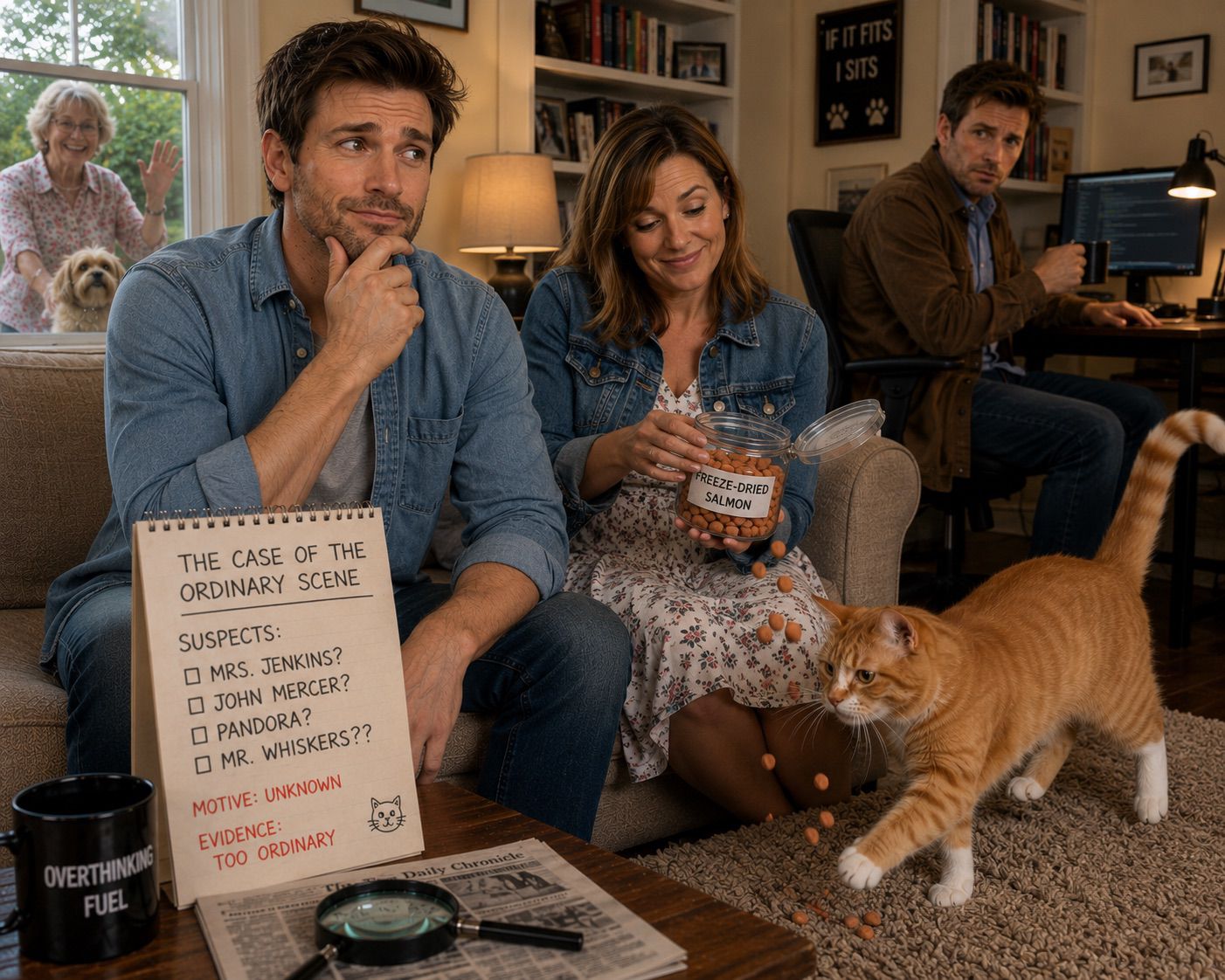
There wasn’t a single thing wrong with the living room, which was precisely what bothered me. Pandora sat comfortably beside me on the couch with a novel resting in her lap, occasionally turning a page without saying a word. Down the hallway, I could hear the familiar rhythm of John Mercer’s keyboard as he worked in his room, punctuated now and then by the quiet scrape of his chair against the floor. Mr. Whiskers lay stretched across the rug at our feet, purring with the complete confidence of a cat who had never once questioned whether the world would continue supplying him with food. It was peaceful. Comfortable. Ordinary. And somehow, the more ordinary it appeared, the more convinced I became that I was overlooking something important.

That feeling reminded me of Mrs. Jenkins stopping by earlier that afternoon while she was out walking her little terrier. She’d paused at the front steps, smiled as she always did, admired Pandora’s flowers, complained good-naturedly about the squirrels digging through her garden, and wished us a pleasant evening before continuing down the sidewalk. There wasn’t a single unusual thing about the conversation. In fact, it had been so perfectly normal that I couldn’t stop replaying it in my head, searching for some tiny detail I’d somehow missed. The more I thought about it, the more I found myself wondering whether she had hesitated before answering one of Pandora’s questions or whether I’d simply imagined that pause afterward. Memory can be a dangerous thing when you start editing it with your imagination.

I tried convincing myself that I was being ridiculous. Mrs. Jenkins has always been one of those neighbors who can somehow turn a discussion about tomatoes into a fascinating story. If she’d seemed thoughtful for a moment, there were probably a hundred perfectly ordinary explanations. Maybe she’d been thinking about her garden. Maybe she’d forgotten something at home. Maybe her dog had spotted a squirrel across the street. Unfortunately, once my imagination realized there were several possible explanations, it immediately became interested in inventing one more that was considerably less reasonable than the others.

Almost as if he’d been waiting for my imagination to get involved, Mr. Whiskers slowly lifted his head and stared toward the front window. He didn’t move another muscle. He simply watched. I followed his gaze, expecting to see someone standing outside or perhaps another neighbor walking past the house, but there was nothing there beyond a quiet sidewalk, two bicycles leaning against a fence, and a squirrel enthusiastically arguing with an acorn. When I looked back at the cat, he calmly turned his attention toward the hallway instead, as though whatever had briefly captured his interest had already passed. Cats really should stop doing things like that. If they’re going to stare dramatically into empty space, they should at least have the courtesy to explain themselves afterward.

Pandora eventually noticed that I wasn’t reading anymore. “You’ve been watching the cat for several minutes,” she said without looking up from her book. I immediately denied the accusation, which probably would have sounded more convincing if I hadn’t still been looking directly at Mr. Whiskers while I said it. She smiled in exactly the way people smile when they’ve known you long enough to recognize the beginning of another one of your theories. “You’re investigating something again, aren’t you?” she asked. I assured her I was doing nothing of the sort. I was merely…observing. There is, I maintain, a significant difference between observing and investigating, although I admit the distinction becomes a little blurry once you begin assigning possible motives to household pets.

A few minutes later, John wandered into the living room carrying a mug of coffee. He glanced at me, then at Mr. Whiskers, then back at me with the expression of someone trying to determine whether he actually wanted the answer to the question he was about to ask. “Everything okay?” he said. Before I could respond, Pandora answered for me. “Hal thinks the cat knows something.” John looked down at Mr. Whiskers, who responded by blinking once and resuming his nap. “Seems like a cat,” John said with a shrug before disappearing back down the hallway. I couldn’t argue with that assessment. In fact, it was frustratingly accurate.

The apartment settled into silence again, and somehow that silence seemed to amplify every tiny sound around us. John’s keyboard resumed its steady rhythm in the bedroom. Pandora turned another page. Mr. Whiskers twitched one ear without opening his eyes. There was no mystery anywhere in the room, yet my imagination refused to let the matter rest. What if Mrs. Jenkins had noticed something she hadn’t mentioned? What if the cat had noticed it too? What if everyone else had correctly decided it wasn’t worth talking about while I was the only one trying to solve a puzzle that didn’t actually exist? Even as those thoughts wandered through my head, I knew how absurd they sounded. Unfortunately, knowing they’re absurd has never prevented me from thinking them.

The mystery finally unraveled in the least dramatic way imaginable. Pandora quietly closed her book, walked over to the bookshelf, and reached toward the top shelf where we kept a small plastic container. Before she’d even taken the lid off, Mr. Whiskers sprang to his feet with remarkable enthusiasm, abandoning every suspicious glance and imaginary clue I’d assigned to him over the previous half hour. Pandora laughed as she shook a few freeze-dried salmon treats into her hand. The cat hurried across the room with a determination I’d previously mistaken for secret knowledge. “So that’s what you’ve been waiting for,” she said as he eagerly accepted his reward. Whatever mystery I’d imagined he’d been investigating vanished the instant the first salmon treat hit the floor.

I watched him happily crunch away while the living room returned to being exactly what it had been all along: an ordinary room filled with ordinary people living an ordinary evening. Mrs. Jenkins had simply stopped by to chat. John had simply been working. Pandora had simply been reading. Mr. Whiskers hadn’t been guarding secrets, watching invisible strangers, or silently warning us about hidden conspiracies. He’d merely been waiting for someone to remember the salmon treats on the bookshelf.

I leaned back into the couch and let out a quiet sigh. “So,” I said, “the entire mystery was snacks.”

Pandora smiled. “The entire mystery was snacks.”

I nodded thoughtfully as Mr. Whiskers finished his treat and immediately began looking hopeful that another one might appear.

Honestly…I probably should have considered that possibility sooner. Then again, if everything in life had a perfectly ordinary explanation, I’d have a lot less to write about.

Related Posts

The Soft Surrender of Summer Knits

Fiona

Summer’s arrival often signals a shift in our wardrobes, as we eagerly shed the heavier, darker fabrics of winter and spring for lighter, brighter alternatives. Amid this seasonal transition, one fabric stands out for its unique ability to marry comfort with refinement: knitwear. Long relegated to the realm of winter sweaters and cozy scarves, summer knits have emerged as a stylish and practical solution for navigating the warmer months.

In the world of high fashion, summer knitwear has long been a staple of resort collections, where designers showcase lightweight, breathable pieces that exude effortless elegance. From intricately crafted cotton sweaters by Italian luxury brands to chunky, hand-knit cardigans from artisanal labels, these garments have become synonymous with the languid, sun-soaked days of summer. Yet beyond their aesthetic appeal, summer knits possess a tactile quality that sets them apart from other warm-weather fabrics.

The softness of summer knitwear is, in many ways, its greatest asset. Unlike linen or cotton, which can sometimes feel stiff or rough against the skin, knitted fibers — particularly those made from natural materials like merino wool, silk, or cashmere — possess a whisper-light quality that drapes elegantly across the body. This softness also extends to the fabric’s texture, which often features subtle ridges and whorls that catch the eye without overwhelming it.

One of the most significant advantages of summer knitwear lies in its versatility. A well-crafted knitted piece can be dressed up or down with ease, making it an ideal choice for everything from casual beach excursions to more formal evening events. Take, for instance, a simple white cotton sweater, which might be paired with distressed denim shorts and sandals for a relaxed daytime look or layered over a flowy sundress and heeled wedges for a chic dinner ensemble.

Of course, the real magic of summer knitwear emerges when it is crafted from innovative, high-tech materials. Brands like John Smedley and Loro Piana have long been at the forefront of this trend, incorporating advanced fibers and weaving techniques into their designs to create garments that are not only remarkably soft but also surprisingly resilient. These materials can withstand even extreme temperatures, making them suitable for everything from tropical vacations to heavily air-conditioned offices.

As we navigate summer’s often unpredictable climate, it is worth considering the humble knit as a sartorial ally. Whether you seek comfort, style, or a combination of both, summer knitwear offers an unparalleled level of versatility and practicality. By embracing this often-overlooked fabric, we can cultivate a more nuanced understanding of what it means to dress for the season — one that balances elegance with the demands of everyday life.

Beyond its functional benefits, summer knitwear also speaks to a deeper cultural narrative surrounding fashion and identity. In an era where athleisure has dominated the industry, the quiet, unassuming nature of knitted garments offers a refreshing respite from loud logos and flashy graphics. Summer knitwear represents a more subtle approach to style — one that prioritizes understated elegance over overt displays of status or trendiness.

For those seeking inspiration for their own summer knitwear wardrobes, several designers are worth exploring. Prada’s latest collections feature intricate pastel-hued knits that evoke the soft colors and textures of Italian ice cream. Meanwhile, at Jil Sander, creative director Lucie Meier has experimented with bold graphic patterns that add architectural drama to even the simplest sweaters.

As we continue navigating the complexities of modern fashion — where trends come and go with dizzying speed and consumerism often prioritizes quantity over quality — summer knitwear offers a rare respite from the chaos. By embracing this understated fabric, we rediscover the simple pleasure of dressing for ourselves rather than solely for others. It is precisely this quiet confidence that makes summer knitwear such an enduring proposition.

In addition to its aesthetic and practical appeal, summer knitwear also creates opportunities for self-expression and creativity. For those who enjoy experimenting with textures and colors, knitting garments can become a rewarding artistic outlet. Even for beginners, countless tutorials and simple patterns now make the craft more approachable.

Moreover, summer knitwear has become a canvas for artisanal craftsmanship and small-scale production methods. Many emerging designers focus on limited-edition, hand-knitted pieces that not only showcase technical skill but also highlight the value of slow fashion. Supporting these labels encourages a more sustainable approach that prioritizes quality over quantity.

As fashion continues evolving alongside changing consumer demands, summer knitwear will likely remain a staple in many wardrobes. Its blend of comfort, elegance, and versatility makes it an ideal companion for modern life. Whether dressing for a casual afternoon or a formal evening occasion, a thoughtfully designed summer knit delivers a sophistication few fabrics can match.

In recent years, interest in upcycling and repurposing vintage knitwear has also grown. Reworking existing pieces creates an opportunity to breathe new life into old garments while reducing waste and reflecting personal style. This movement also reinforces the idea of fashion as storytelling, where garments hold memories and meaning woven directly into their fibers.

Ultimately, the allure of summer knitwear lies in its ability to transcend seasons and trends, speaking to a deeper desire for comfort, elegance, and self-expression. As fashion continues to evolve, this versatile fabric will likely continue captivating us with its softness, subtlety, and enduring charm.

Related Posts

Susan Glaspell: Still Not My Mother, but Maybe You’ll See Yourself in Her

Penelope

Susan Glaspell’s name keeps popping up in my writing classes, and at first, I couldn’t help but feel a little annoyed. Another dead white woman writer who’s only notable for being married to someone famous – in this case, George Cram “Jig” Cook. But the more I read about her life and work, the more fascinated I became.

I think it started when I stumbled upon an article about Glaspell’s play, “Trifles,” which she wrote with Cook. The play is a masterpiece of subtlety, exploring themes of silence, domesticity, and the societal expectations placed on women. But what really caught my attention was how Glaspell used her own life experiences to inform the characters’ struggles.

As I delved deeper into her biography, I began to see parallels between Glaspell’s life and mine – or at least, the life of a young woman trying to make a name for herself in the early 20th century. We both came from relatively privileged backgrounds, but we were expected to conform to certain societal norms: marry well, have children, and prioritize domestic duties above all else.

It’s disconcerting to see how many women writers from this era struggled with similar tensions between creativity and conventionality. I often find myself wondering what would have happened if Glaspell had been more willing to challenge these expectations head-on. Would she have achieved greater success? Would her work have resonated with a wider audience?

But then again, perhaps it’s precisely because of her willingness to explore the nuances of domestic life that Glaspell’s writing remains so powerful today. Her characters are multifaceted and complex, refusing to be reduced to simplistic tropes or stereotypes.

I’m struck by how much Glaspell’s work speaks to my own fears about becoming trapped in a life that isn’t truly mine. As someone who’s just finished college, I feel pressure to “launch” into adulthood – secure a job, pay off student loans, and start building a career. But the more I read Glaspell’s writing, the more I realize how little of this really matters.

What matters is the work itself – the ideas, the emotions, the struggles that we all share as human beings. And yet, it’s precisely this kind of introspection that’s often dismissed or marginalized in our society. We’re encouraged to focus on external markers of success rather than exploring the messy, inner lives of ourselves and others.

I’m not sure what I’ll do with these thoughts, but they keep circulating in my mind as I read about Glaspell’s life and work. Maybe it’s because I see myself in her – a woman trying to navigate the complexities of adulthood while staying true to her creative vision. Or maybe it’s simply because her writing resonates with me on a deeper level, one that has nothing to do with external validation or recognition.

As I continue to explore Glaspell’s work and life, I’m left with more questions than answers. What does it mean to be a writer in a society that often values conformity over creativity? How can we create space for ourselves to pursue our passions, even when they don’t fit neatly into societal expectations?

These are the kinds of questions that keep me up at night, and ones that I’m not sure I’ll ever fully resolve. But as I continue to grapple with them, I know that Glaspell’s writing will be there, guiding me through the complexities of my own journey – just as it has been for countless other women writers throughout history.

As I read more about Glaspell’s life and work, I’m struck by her determination to create a sense of community among women artists. She was part of a group called the Provincetown Players, which brought together writers, actors, and directors to produce experimental theater in the early 20th century. It’s fascinating to me how she used this collective energy to push against the boundaries of what was considered “acceptable” in mainstream culture.

I think about my own experiences as a college student, where I felt like I was part of a community of writers who were all trying to navigate the same challenges. We’d share our work with each other, offer feedback and encouragement, and create a sense of support that helped us push through the doubts and fears that inevitably came up.

But now, as I’m about to enter this “real world” that everyone keeps talking about, I’m not sure how much of that community spirit will be available to me. Will I have to sacrifice my creative pursuits in order to fit into a more traditional 9-to-5 job? Or can I find ways to nurture those relationships and maintain a sense of connection with other writers who understand what it’s like to be struggling?

Glaspell’s play “Trifles” keeps coming back to me, particularly the way it highlights the importance of listening and paying attention to the small details that often get overlooked. In the play, the characters are able to uncover clues about a murder because they’re willing to listen to the women in their lives – the housekeeper, the wife – who possess a kind of intuitive knowledge that’s been dismissed by the men.

It makes me think about how often I’ve found myself talking over or interrupting others, assuming that I already know what they mean. And it’s not just in conversations; it’s also in my own writing. How often do I rush to conclusions or assumptions without truly listening to the subtleties of the human experience?

Glaspell’s work is a reminder that there’s power in being still, in paying attention, and in allowing ourselves to be vulnerable. And yet, it’s precisely this kind of vulnerability that can feel so scary – especially when we’re trying to establish ourselves as writers or artists.

As I continue to grapple with these questions, I’m left wondering what it means to create a life that honors my creative vision while also acknowledging the complexities and challenges of being a woman in this society.

The more I read about Susan Glaspell’s life and work, the more I’m struck by her willingness to take risks and challenge societal norms. Her writing is like a gentle prodding, encouraging me to think critically about the expectations placed on women and the importance of creativity in our lives.

I find myself drawn to her story because it’s so relatable. As a young woman trying to navigate my own path, I’m constantly torn between what others expect of me and what I truly want for myself. Glaspell’s experiences as a writer and a wife are like a mirror held up to my own fears and doubts.

What would have happened if she had followed her heart more fully? Would she have achieved greater success or been ostracized by society? These questions swirl in my mind, refusing to be silenced.

As I delve deeper into Glaspell’s biography, I’m fascinated by her relationships with other women writers. She was part of a tight-knit circle of artists and intellectuals who supported each other’s work and pushed against the boundaries of what was considered acceptable. This sense of community is something that I crave as I enter this new phase of my life.

I think about the writing groups I’ve been a part of, where we shared our work and offered feedback to one another. Those moments of vulnerability and connection are some of the most precious experiences I’ve had as a writer. But now, as I’m about to embark on this “real world” journey, I wonder if those kinds of relationships will be available to me.

Will I have to sacrifice my creative pursuits in order to fit into a more traditional 9-to-5 job? Or can I find ways to nurture those connections and maintain a sense of community with other writers who understand what it’s like to be struggling?

Glaspell’s play “Trifles” keeps echoing in my mind, particularly the way it highlights the importance of listening and paying attention to the small details that often get overlooked. In the play, the characters are able to uncover clues about a murder because they’re willing to listen to the women in their lives – the housekeeper, the wife – who possess a kind of intuitive knowledge that’s been dismissed by the men.

This resonates deeply with me, as I’ve often found myself rushing to conclusions or assumptions without truly listening to others. And it’s not just in conversations; it’s also in my own writing. How often do I rely on tropes and stereotypes rather than taking the time to really understand the complexities of the human experience?

Glaspell’s work is a reminder that there’s power in being still, in paying attention, and in allowing ourselves to be vulnerable. But what does it mean to create a life that honors my creative vision while also acknowledging the complexities and challenges of being a woman in this society?

As I ponder Glaspell’s willingness to take risks and challenge societal norms, I’m reminded of her play “A Jury of Her Peers,” which tells the story of a woman accused of murdering her husband. The play is a scathing critique of patriarchal justice, highlighting the ways in which women are often silenced and marginalized by the very systems meant to protect them.

I find myself drawn to this theme, as I reflect on my own experiences with systemic injustices. As a young woman, I’ve faced my share of microaggressions and biases, from being talked over in meetings to being stereotyped as “emotional” or “impulsive.” It’s a constant struggle to assert myself and be taken seriously, especially when I’m navigating male-dominated fields like writing and academia.

Glaspell’s play has become a kind of touchstone for me, a reminder that my experiences are not unique and that there are others who have fought against similar injustices. Her writing is a powerful testament to the importance of listening to marginalized voices and amplifying their stories.

As I continue to explore Glaspell’s life and work, I’m struck by her commitment to social justice and activism. She was part of a circle of writers and intellectuals who were passionate about reforming society and challenging the status quo. Her writing is infused with a sense of purpose and conviction, a desire to create change through art.

I find myself wondering what it would be like to live in a world where creativity and activism are not mutually exclusive. Where writers and artists can use their platforms to challenge systemic injustices without being ostracized or marginalized. It’s a utopian dream, perhaps, but one that feels increasingly relevant as I navigate my own path as a writer.

Glaspell’s legacy is complex and multifaceted, reflecting the contradictions and tensions of her own life. She was a woman who defied convention, who challenged societal norms and expectations. But she was also a product of her time, shaped by the same biases and prejudices that she critiqued in her work.

As I grapple with these complexities, I’m reminded of the importance of nuance and context in understanding historical figures like Glaspell. We must acknowledge both their achievements and their limitations, recognizing the ways in which they were complicit in systems of oppression even as they challenged them.

This is a messy and imperfect process, one that requires us to engage with the contradictions and complexities of human experience. But it’s also a necessary one, if we hope to learn from the past and create a more just and equitable future for ourselves and others.

As I close my eyes and let Glaspell’s words wash over me, I’m left with a sense of awe and reverence for this remarkable woman writer. Her legacy is a testament to the power of creativity and activism, a reminder that even in the darkest times, there is always hope for change and transformation.

But as I open my eyes and step back into my own life, I’m also aware of the uncertainty and doubt that still lingers within me. Will I be able to find a way to balance my creative pursuits with the demands of this “real world”? Can I create a life that honors my values and passions, even when they seem at odds with societal expectations?

These are questions that I’ll continue to grapple with, even as I move forward into this uncertain future. But for now, I’m grateful for the guidance and inspiration of Susan Glaspell’s work, which reminds me that creativity and activism are not mutually exclusive, but rather intertwined threads in the rich tapestry of human experience.

Related Posts