Latest Articles

Colette: The Unapologetic Ancestor I’d Like to Be, But Probably Wouldn’t Be Able To Be Even If I Wanted To

Penelope

Colette. I’ve been thinking about her a lot lately, ever since I stumbled upon one of her novels while browsing through a used bookstore. Her writing is like nothing I’ve ever read before – it’s like she’s speaking directly to me, but also somehow above me at the same time.

What draws me in most is her complete and utter disregard for societal expectations. She was a woman, born into a world where women were expected to be demure and obedient, yet she refused to conform. She dressed like a man, smoked cigarettes, and wrote about sex and desire with an unapologetic frankness that was unheard of in her time.

I find myself both fascinated and intimidated by this aspect of Colette’s personality. As someone who’s still trying to figure out their own place in the world, I feel a sense of solidarity with her willingness to take risks and challenge the status quo. But at the same time, I’m also aware of how privileged she was – born into a wealthy family, educated, and connected to influential people.

It’s hard not to wonder what it would have been like to live in a world where women were so heavily restricted. Would I have had the courage to be as unconventional as Colette? Or would I have played by the rules, sacrificing my own desires for the sake of conformity?

Colette’s writing is also marked by a sense of vulnerability and openness that I find both beautiful and unsettling. She writes about her own experiences with love, loss, and heartbreak in a way that feels almost reckless – like she’s laying bare her soul on the page.

I’ve been struggling to connect with this aspect of her work. As someone who values their independence and autonomy, I find it hard to understand why Colette would write about her relationships in such an all-consuming way. Doesn’t she deserve more than just a romantic obsession? Can’t she see that there’s more to life than just love?

But then again, maybe that’s the point – maybe Colette is trying to tell us that love and desire are not just emotions, but also fundamental aspects of who we are as human beings. Maybe she’s showing us that it’s okay to be messy and imperfect, to let our emotions guide us even when they lead us down uncertain paths.

As I continue to read her work and learn more about her life, I’m struck by the realization that Colette is not just a writer or a historical figure – she’s a complex, multifaceted person who defies easy categorization. She’s a rebel, a romantic, an outsider, and an insider all at once.

I think this is what draws me to her work so much – it’s like looking into a mirror, but one that shows me both the beauty and ugliness of my own contradictions. Colette may have lived in a different time and place, but her struggles and triumphs feel uncomfortably familiar, like they’re speaking directly to some deep-seated part of myself.

And so I’ll keep reading, keep thinking, and keep trying to make sense of this enigmatic figure who has captured my imagination. Because in the end, it’s not just about Colette – it’s about what she represents: the courage to be ourselves, even when it’s hard; the willingness to take risks and challenge the status quo; and the knowledge that our deepest desires and vulnerabilities are what make us most human.

As I delve deeper into Colette’s work, I find myself grappling with the tension between her romanticism and her pragmatism. On one hand, she writes about love with a fervor that’s almost infectious – it’s as if she believes that true passion can conquer all obstacles. And yet, in the same breath, she also acknowledges the harsh realities of life: the betrayals, the heartbreaks, the disappointments.

It’s this contradictory nature that I find both captivating and unsettling. As someone who’s been hurt before, I struggle to reconcile Colette’s unwavering optimism with my own more cynical outlook. Can it really be true that love is worth risking everything for? Or are we just fooling ourselves into thinking that?

I think about my own relationships – the ones that have ended in tears and heartache, as well as the ones that have left me feeling exhilarated but also uncertain. Colette’s words seem to suggest that it’s all part of the journey, that we must be willing to take the leap even when it feels like falling into the unknown.

But what about the women who come after us? The ones who benefit from our struggles and sacrifices? Do they get to have it easier, to coast on the shoulders of those who paved the way for them? I think about my own place in this legacy – as a woman who’s benefited from education, privilege, and social mobility.

Colette’s life was marked by its own set of privileges and disadvantages. She came from a wealthy family, but her relationships with women were often fraught and complicated. She wrote about her experiences with love and desire, but also struggled to maintain relationships that were meaningful and lasting.

In many ways, I see myself in Colette – or rather, I see aspects of myself reflected back at me through her words. We’re both women who’ve been shaped by our experiences as outsiders, who’ve had to navigate the complexities of identity and desire in a world that often doesn’t understand us. But we’re also both women who are still learning, still growing, still trying to make sense of this messy, beautiful thing called life.

As I continue to read Colette’s work, I’m struck by the realization that her writing is not just about love or desire – it’s about the human condition itself. It’s about the search for meaning and connection in a world that often seems hostile or indifferent to our needs.

And so I’ll keep reading, keep thinking, and keep trying to make sense of this enigmatic figure who has captured my imagination. Because in the end, it’s not just about Colette – it’s about what she represents: the messy, beautiful complexity of being human, with all its contradictions and uncertainties.


One thing that continues to fascinate me is Colette’s use of language. She has this incredible ability to describe the mundane in a way that makes it seem almost magical. Her writing is like a warm bath on a cold day – it envelops you, comforts you, and makes you feel seen. But at the same time, she’s also not afraid to get messy, to dig into the dark corners of human experience and emerge with scars.

As I read through her work, I find myself getting caught up in the rhythm of her sentences. The way she uses metaphor and simile to describe the world around her is like a form of poetry – it’s beautiful, evocative, and somehow manages to capture the essence of what it means to be alive.

I’ve been trying to analyze this aspect of her writing, to understand what makes it so powerful. Is it the way she uses imagery? The way she structures her sentences? Or is it something more intangible – a sense of vulnerability, of openness that she brings to the page?

It’s hard to put my finger on it, but I think part of what draws me to Colette’s writing is its willingness to be imperfect. She’s not afraid to make mistakes, to stumble over her own words or get caught up in her own emotions. And yet, somehow, this imperfection is what makes her writing feel so authentic, so true.

As someone who’s struggled with my own writing, I find myself identifying with Colette’s struggles on the page. The fear of not being good enough, the anxiety of putting yourself out there only to be rejected or ignored – it’s all so familiar.

But Colette’s writing also makes me realize that imperfection is not just a virtue, but a necessity. We’re all flawed, we’re all messy, and we’re all struggling to make sense of this crazy world around us. And maybe, just maybe, that’s what makes her writing feel so accessible, so relatable.

I think about my own writing, and how it often feels like I’m trying to be something I’m not – more confident, more articulate, more perfect. But Colette’s work shows me that this is a false dichotomy. We don’t have to choose between being imperfect or perfect; we can be both, all at once.

As I continue to read and reflect on Colette’s writing, I’m starting to see her as a kind of mirror held up to my own life. She’s showing me the complexities of human experience – the beauty and ugliness, the love and heartbreak, the contradictions and uncertainties that make us who we are.

And in doing so, she’s giving me permission to be messy, to be imperfect, to be myself. It’s a liberating feeling, one that I’m still trying to wrap my head around. Because if Colette can do it – if she can write with such vulnerability and openness – then maybe, just maybe, I can too.

As I delve deeper into Colette’s work, I find myself becoming increasingly obsessed with the idea of imperfection as a virtue. It’s not just about embracing our flaws, but also about recognizing that they’re an integral part of who we are as human beings. Colette’s writing is like a masterclass in imperfection – she takes the mundane and makes it majestic, the ordinary and makes it extraordinary.

I think about my own life, and how I often try to present myself to others as this perfect, put-together person. But what if I’m not? What if I’m messy and imperfect, just like Colette’s writing? Would that be okay? Could I still be worthy of love and acceptance?

It’s a scary thought, but also a liberating one. Because if I can accept myself as imperfect, then maybe others will too. Maybe we can all find freedom in our flaws, rather than trying to hide them or pretend they don’t exist.

As I continue to read Colette’s work, I’m struck by the way she uses her writing as a form of self-discovery. She writes about herself with a level of vulnerability that’s almost shocking – it’s like she’s laying bare her soul on the page. And yet, at the same time, she’s also creating this sense of intimacy and connection with the reader.

I find myself feeling seen by Colette in a way that I’ve never felt before. Like she’s understanding me, getting me, even when I’m not fully understanding myself. It’s like we’re having this deep, profound conversation about what it means to be human – and it feels almost spiritual.

But what if Colette is wrong? What if her writing isn’t a reflection of the truth, but rather just a product of her own biases and experiences? Could I be reading too much into her words, projecting my own desires and hopes onto her work?

I don’t know. All I know is that Colette’s writing has touched something deep within me – a sense of longing, perhaps, or a desire for connection. Whatever it is, it feels real, and it feels raw.

As I finish reading one of Colette’s novels, I feel like I’ve been on a journey with her, through the ups and downs of life, love, and loss. It’s like we’ve shared this intimate, private experience that only we can understand – and yet, somehow, she’s made it accessible to me, to anyone who reads her words.

I’m left feeling changed, somehow, by Colette’s writing. Like I’ve been given a new perspective on the world, or at least on myself. It’s hard to put into words what that feels like – all I know is that it’s a sense of expansion, of growth, of becoming more fully alive.

And so I’ll keep reading, keep thinking, and keep trying to make sense of this enigmatic figure who has captured my imagination. Because in the end, it’s not just about Colette – it’s about what she represents: the messy, beautiful complexity of being human, with all its contradictions and uncertainties.

Related Posts

Office Coffee Machine Sabotage Investigation Underway Mysterious Carafe Drainage Exposed

Hal

The coffee machine in our office break room is a ticking time bomb, waiting to unleash its bitter wrath upon the world. Or, at the very least, my day. It started innocently enough – I strolled into the break room, bleary-eyed and in dire need of caffeine, only to find that Karen had once again drained the pot without bothering to refill it. Now, I’m not one to begrudge a colleague their morning coffee, but this is an affront to basic human decency.

As I stood there, staring at the empty carafe like a bereaved parent gazing upon an empty crib, I couldn’t help but feel a sense of personal offense. Doesn’t Karen know that my productivity, nay, my very sanity depends on a steady supply of coffee? It’s not as if I’m asking for much – just a simple cup of joe to get me through the morning’s drudgery. And yet, time and again, she sees fit to sabotage my efforts with her reckless disregard for the communal coffee pot.

But this isn’t just about Karen; it’s about a broader cultural problem. In an office where cooperation and teamwork are ostensibly valued, why do we tolerate such blatant disregard for the common good? Is it not our duty as employees to ensure that our colleagues have access to the resources they need to function at optimal levels? The coffee pot is not just a convenience; it’s a vital artery, pulsing with life-giving caffeine. To neglect its replenishment is to imperil the very fabric of our organization.

And what about the institutional implications? If we allow this sort of behavior to go unchecked, where will it end? Will we soon find ourselves facing a crisis of stapler-jamming proportions? Will the copier be next on Karen’s hit list? The very thought sends shivers down my spine. We must take action, lest our once-thriving workplace devolve into chaos.

As I pondered these weighty issues, I found myself drifting into the realm of global consequences. If this sort of coffee-pot negligence is allowed to spread, what’s to stop it from infecting other industries? Will we soon see a pandemic of unfilled water coolers and unstocked break rooms sweeping across the nation? The world teeters on the brink of disaster, all because Karen can’t be bothered to refill the coffee pot.

Now, I know what you’re thinking: “Hal, perhaps you’re overreacting just a tad.” But let me tell you, my friends, this is no laughing matter. This is about principles. It’s about standing up for what’s right in the face of blatant disregard for the greater good. As I sat at my desk, seething with righteous indignation, I found myself crafting a scathing indictment of Karen’s actions.

“I demand to know,” I would thunder, “why you see fit to imperil our very way of life with your reckless coffee-pot policies! Don’t you realize that the fate of humanity hangs in the balance?” Okay, maybe that’s a bit of an exaggeration, but you get the idea. Alas, I didn’t actually confront Karen – I’m not quite ready for the Nobel Peace Prize just yet.

As I sat there, nursing my coffee-less rage, Pandora strolled by and asked if everything was okay. “Just contemplating the meaninglessness of existence,” I replied with a straight face. She smiled knowingly and patted me on the shoulder, no doubt thinking to herself, “There goes Hal again.” Little does she know that I’m actually on the cusp of uncovering a sinister plot to undermine global productivity through coffee-pot sabotage.

And so, as I sit here sipping my hastily purchased coffee from the break room’s auxiliary pot (a temporary solution at best), I remain vigilant, ever-watchful for signs of Karen’s next move. The world may never know the full extent of her nefarious plans, but rest assured, I’ll be ready.

But even as I sat there, my mind racing with visions of a coffee-pot-fueled apocalypse, a nagging voice in the back of my head began to whisper words of doubt. “Hal, perhaps this isn’t quite as catastrophic as you’re making it out to be.” I quickly silenced the traitorous voice, reminding myself that one must never underestimate the power of a well-placed coffee pot.

Still, the seed of uncertainty had been planted. As I pondered the depths of Karen’s depravity, I found myself wondering if maybe, just maybe, she hadn’t simply forgotten to refill the pot in her morning haze. After all, we’ve all been there – stumbling into the office, half-asleep, and utterly dependent on caffeine to shake off the cobwebs.

But no, I refused to be swayed by such sentimental reasoning. The fact remains: Karen had committed a heinous crime against humanity, and it was my duty as a vigilant employee to sound the alarm. Even if, just possibly, she might not have intended to spark global chaos with her actions.

As I delved deeper into the recesses of my mind, I discovered a curious paradox. On one hand, I was convinced that Karen’s actions represented a catastrophic threat to our very way of life. On the other hand, I couldn’t quite bring myself to confront her about it – not yet, at least. Maybe it was fear of appearing ridiculous, or perhaps I simply didn’t want to be seen as “that guy” who freaks out over coffee.

Whatever the reason, my silence only served to fuel my internal monologue. The more I thought about Karen’s transgression, the more convinced I became that she must be brought to justice. And yet, a part of me whispered that maybe – just maybe – this was all a bit much. That perhaps, in the grand scheme of things, an empty coffee pot wasn’t quite the harbinger of doom I’d made it out to be.

But don’t get me wrong: I still think Karen’s actions were heinous.

Related Posts

Marax (Morax) the Demon: Infernal President of Hidden Knowledge, Memory, and the Science Beneath the World

Dave

Marax, also known as Morax in the Ars Goetia, is a demon whose power does not announce itself with fire, violence, or spectacle. Instead, it settles quietly into the mind and stays there. He is listed as a Great President and Earl of Hell, commanding thirty-six legions, and he most often appears in the form of a mighty bull, sometimes with a human face. This form alone tells you nearly everything about his nature. Marax is not a destroyer. He is a bearer of weight. He carries knowledge the way a bull carries burden—steadily, patiently, and without concern for whether the load is wanted.

Marax governs astronomy, liberal sciences, the virtues of herbs and stones, and, most importantly, memory. He teaches truths that do not dazzle but endure. In a hierarchy crowded with demons of desire, destruction, and domination, Marax stands apart as a custodian of foundational understanding. He does not chase power. He preserves it in usable form.

The bull imagery associated with Marax is deeply symbolic. Bulls represent strength, persistence, fertility, and grounded reality. They do not move quickly, but they move decisively. Marax’s knowledge works the same way. It does not overwhelm all at once. It settles in, changes how a person thinks, and reshapes perception over time. Once learned, it is difficult to forget.

Marax is said to teach astronomy, but not in the romantic sense of stargazing or prophecy. Under Marax, astronomy is structure. It is understanding cycles, order, and position. He teaches how celestial bodies move not to inspire wonder, but to reinforce the idea that the universe operates according to patterns whether humans approve or not. Marax’s astronomy is humbling rather than mystical.

His association with the liberal sciences reinforces this. Liberal sciences are not indulgent knowledge. They are foundational disciplines—logic, mathematics, structure, and reasoning. Marax teaches how systems fit together, how principles apply across domains, and how understanding one structure allows comprehension of many others. Under Marax, intelligence becomes cumulative.

One of Marax’s most important attributes is his command over memory. This is not the theatrical manipulation of recollection seen in some mythic figures. Marax does not erase memories or implant false ones. He strengthens retention. He ensures that what is learned remains accessible. This makes him uniquely dangerous and uniquely valuable. Knowledge granted by Marax is difficult to discard.

Psychologically, Marax represents the part of the mind that refuses to let go of understanding once it has been achieved. He is the demon of “now you know, and you can’t unknow it.” This makes him deeply unsettling to those who prefer ignorance or ambiguity. Marax does not permit selective memory.

The virtues of herbs and stones also fall under Marax’s domain. This knowledge is practical, grounded, and ancient. He teaches how natural materials interact with the body and environment, not through superstition, but through observation and accumulation of experience. Under Marax, nature is not mystical chaos. It is a system of properties waiting to be understood.

Unlike demons associated with excess, Marax is restrained. He does not promise shortcuts. He does not inflate ego. His teachings require patience, repetition, and respect for process. This makes him unappealing to the impulsive and invaluable to the disciplined.

Marax’s dual rank as President and Earl is significant. As a President, he governs instruction and dissemination of knowledge. As an Earl, he governs territory and structure. Marax controls both learning and the environments in which learning persists. He understands that knowledge does not survive without institutions, memory, and continuity.

The bull’s presence reinforces stability. Bulls are often used in agriculture, ritual, and labor. They are essential but rarely celebrated. Marax’s knowledge functions the same way. It supports everything else but rarely draws attention to itself. Those who rely on it often forget where it came from.

Marax does not tempt through desire or fear. He tempts through usefulness. His knowledge solves problems, answers questions, and clarifies confusion. The danger is not corruption. The danger is overreliance. When knowledge becomes absolute, humility disappears. Marax does not prevent this outcome. He enables it.

In modern symbolic terms, Marax resembles foundational science, institutional memory, and the quiet power of expertise. He is present wherever systems persist because someone remembers how they work. He is the demon of engineers, archivists, scholars, and those who maintain rather than disrupt.

Marax’s teachings also carry a subtle burden. Memory can be heavy. Remembering everything makes forgiveness harder. Understanding systems makes innocence impossible. Marax does not soften this burden. He assumes that those who seek knowledge are prepared to carry it.

Unlike demons associated with madness or illusion, Marax is stabilizing. His presence calms rather than agitates. This calm, however, can feel oppressive. There is no escape into fantasy under Marax. Reality asserts itself clearly.

Marax endures in demonology because civilization depends on memory. Knowledge lost must be rediscovered at great cost. Knowledge preserved shapes the future quietly. Marax governs that preservation.

To engage with Marax symbolically is to accept that learning is irreversible. Once you understand how something works, you are responsible for that understanding. Ignorance is no longer an option.

Marax is not the demon of revelation. He is the demon of retention. He does not dazzle. He stays.

Related Posts

Erwin Schrödinger: The Patron Saint of Uncertainty (and My Writing Struggles)

Penelope

I’ve always been fascinated by Erwin Schrödinger, the Austrian physicist who came up with that mind-bending thought experiment about a cat in a box. I mean, what’s not to love? The idea of quantum superposition – where something can exist in multiple states at once – blows my mind.

As someone who’s struggled with uncertainty and ambiguity, Schrödinger’s cat resonates with me on a deep level. When I’m writing, I often find myself in this same state of limbo, unsure if what I’ve written is any good or not. It’s like the cat is both alive and dead at the same time – I can see it as either possible outcome, but which one is true?

I recall reading Schrödinger’s 1935 paper on quantum mechanics, where he proposed this thought experiment to illustrate the seemingly absurd consequences of applying quantum principles to macroscopic objects. I was hooked from the first sentence: “One can even set up quite ridiculous cases.” Ridiculous, yes, but also somehow profound.

What draws me to Schrödinger’s work is not just the intellectual puzzle he presents, but the sense that he’s grappling with fundamental questions about reality and perception. He’s not just talking about particles and waves; he’s probing the very nature of existence. I find myself wondering what it means for something to exist in multiple states simultaneously – does it imply a kind of multiplicity within myself?

Sometimes I feel like Schrödinger is speaking directly to me, echoing my own struggles with self-doubt and uncertainty. As a writer, I’m constantly trying to navigate the boundary between creative expression and critical evaluation – am I writing for myself or others? Is what I’ve written any good, or am I just spinning my wheels?

Schrödinger’s cat has become a kind of symbol for me, representing the tension between certainty and uncertainty that I face in my own work. It’s as if the cat is both a metaphor for the creative process and a mirror reflecting my own inner turmoil.

I’ve also been thinking about Schrödinger’s personal life – his complicated relationships with women, his involvement in Nazi politics (which he later denounced). It’s hard to separate the man from his work, but I’m drawn to the contradictions and complexities that make him more human. He’s not just a brilliant physicist; he’s someone who grappled with the same messy realities we all do.

I’m not sure where this exploration of Schrödinger will take me – whether it’ll lead to some profound insight or simply more questions. But for now, I’m content to sit in the uncertainty with him, like a cat in a box, wondering which state is real and which one is just a product of my own imagination.

As I delve deeper into Schrödinger’s work, I find myself pondering the implications of his thought experiment on our everyday experiences. The idea that something can exist in multiple states simultaneously seems to seep into every aspect of life – relationships, identity, even language itself. It’s as if we’re constantly navigating a maze of possibilities, unsure which path will lead us to a definitive answer.

I think about my own relationships, and how they often feel like quantum superposition. With friends, I’m both connected and separate at the same time; with romantic partners, I oscillate between intimacy and distance. It’s as if I’m stuck in a perpetual state of flux, unsure which “me” is the real one.

This sense of uncertainty extends to my writing as well. I often feel like I’m juggling multiple narratives within a single piece – some parts are alive and kicking, while others are struggling to take shape. It’s as if the act of creation itself is a form of quantum superposition, with different elements existing in various states of being until they coalesce into something tangible.

I’ve been reading more about Schrödinger’s life, trying to understand what drove him to create such thought-provoking work. His relationships with women were complicated, to say the least – he had multiple affairs and was known for his flirtatious nature. Yet, despite these personal flaws, he managed to produce some of the most groundbreaking scientific theories of our time.

It’s this tension between Schrödinger’s creative genius and his personal shortcomings that fascinates me. How did someone who struggled with relationships and identity manage to transcend those limitations in their work? Is there a connection between his inner turmoil and the revolutionary ideas he presented?

As I sit here, surrounded by scribbled notes and half-finished drafts, I feel like Schrödinger’s cat staring back at me from the box. Which state am I in – creative genius or struggling writer? Alive or dead? The uncertainty is exhilarating and terrifying all at once, leaving me wondering what will emerge from this quantum superposition of thoughts and emotions.

I find myself getting lost in Schrödinger’s cat, trying to understand the implications of its existence on our understanding of reality. It’s as if I’m peering into a mirror, seeing reflections of my own struggles with identity and uncertainty staring back at me.

The more I read about Schrödinger, the more I realize that his thought experiment is not just about physics; it’s about the human experience. We’re all like Schrödinger’s cat, existing in multiple states simultaneously – connected and separate, alive and dead, certain and uncertain. It’s a dizzying prospect, one that leaves me questioning everything from my relationships to my writing.

As I navigate this maze of possibilities, I’m struck by the fragility of language itself. Words can be both literal and metaphorical, existing in multiple states at once. A sentence can be read as both true and false, depending on how it’s interpreted. It’s a reminder that meaning is never fixed, but always subject to revision and reinterpretation.

This ephemeral nature of language resonates with me as a writer. I’ve always struggled to pin down the perfect phrase or sentence, one that captures the essence of what I’m trying to convey. But in Schrödinger’s cat, I see a reflection of my own creative struggles – the uncertainty of whether what I’ve written is any good, or if it’s simply a product of my imagination.

As I continue to explore Schrödinger’s work, I find myself pondering the role of observation in shaping reality. If the act of observing something can change its state, does that mean that our perception of the world is always provisional? That every decision we make is a form of quantum superposition, with multiple outcomes possible until we observe and collapse into one?

This idea sends shivers down my spine. It’s as if the very fabric of reality is constantly shifting beneath our feet, leaving us to navigate a labyrinthine landscape of possibilities. And yet, it’s also exhilarating – a reminder that every moment is an opportunity for creation and transformation.

I’m not sure where this journey with Schrödinger will take me. Perhaps I’ll discover new insights into the nature of reality or creativity. Or maybe I’ll simply find myself more lost in the uncertainty of existence. But one thing’s certain – I’ll be sitting here, surrounded by scribbled notes and half-finished drafts, wondering which state is real and which one is just a product of my imagination.

As I sit here, pondering the implications of Schrödinger’s cat on our understanding of reality, I’m struck by the sense that this thought experiment has become a kind of mirror for me. It reflects not only my own struggles with uncertainty and ambiguity but also the inherent messiness of human experience.

I think about how Schrödinger’s work challenges traditional notions of determinism and certainty. His idea that something can exist in multiple states simultaneously suggests that reality is inherently probabilistic, rather than fixed or absolute. This resonates deeply with me as a writer, where the act of creation itself is often a process of exploring multiple possibilities and probabilities.

But what I find most fascinating about Schrödinger’s cat is its ability to transcend disciplinary boundaries. It’s not just a thought experiment in physics; it’s also a metaphor for the human condition. We’re all like that cat, existing in multiple states at once – connected and separate, alive and dead, certain and uncertain.

As I delve deeper into Schrödinger’s work, I’m struck by his own personal struggles with identity and creativity. His relationships with women were complicated, and he struggled with feelings of inadequacy as a scientist. Yet, despite these challenges, he managed to produce some of the most groundbreaking scientific theories of our time.

This paradox between Schrödinger’s creative genius and his personal shortcomings fascinates me. How did someone who struggled with relationships and identity manage to transcend those limitations in their work? Is there a connection between his inner turmoil and the revolutionary ideas he presented?

I’m beginning to see Schrödinger as more than just a brilliant physicist; I’m seeing him as a human being, grappling with the same messy realities we all do. His thought experiment is not just about physics; it’s about the human experience – our struggles with identity, creativity, and uncertainty.

As I navigate this complex landscape of possibilities, I’m struck by the role of language in shaping our understanding of reality. Words can be both literal and metaphorical, existing in multiple states at once. A sentence can be read as both true and false, depending on how it’s interpreted. This ephemeral nature of language resonates with me as a writer, where the act of creation itself is often a process of exploration and discovery.

But what I find most intriguing about Schrödinger’s cat is its ability to challenge our assumptions about time and space. If something can exist in multiple states simultaneously, does that mean that time itself is not fixed or linear? Does this imply that we’re constantly navigating multiple timelines, each one existing in a state of superposition?

This idea sends shivers down my spine. It’s as if the very fabric of reality is constantly shifting beneath our feet, leaving us to navigate a labyrinthine landscape of possibilities. And yet, it’s also exhilarating – a reminder that every moment is an opportunity for creation and transformation.

As I continue to explore Schrödinger’s work, I’m struck by the sense that this thought experiment has become a kind of koan for me. It’s a paradoxical statement that challenges my assumptions about reality and forces me to confront the uncertainty at the heart of human experience.

And yet, even as I grapple with these complex ideas, I’m also aware of the simple pleasure of reading Schrödinger’s own words. His writing is clear, concise, and witty – a testament to his gift for communication and his ability to explain complex ideas in accessible language.

As I finish reading his papers and books, I feel like I’m saying goodbye to an old friend. Schrödinger’s cat has become a kind of symbol for me, representing the tension between certainty and uncertainty that I face in my own life. But even as I let go of this thought experiment, I know that its implications will continue to resonate within me – a reminder that reality is always complex, multifaceted, and open to interpretation.

I’ll carry Schrödinger’s cat with me, like a talisman or a mantra, reminding myself that uncertainty is not just an obstacle but also an opportunity for growth, transformation, and creative expression. And as I look back on this journey of exploration, I know that I’ve been changed by it – my perspective broadened, my understanding deepened, and my sense of wonder expanded.

But what lies ahead? As I step out of the box, blinking in the bright light of reality, I’m not sure what state I’ll find myself in. Will I be alive or dead? Certain or uncertain? The possibilities are endless, and I’m left to navigate this labyrinthine landscape with nothing but my thoughts, my imagination, and the echoes of Schrödinger’s cat.

As I step out of the box, I feel a sense of disorientation, like I’ve been transported to a different realm. The world outside seems vibrant and alive, full of possibilities and uncertainties. I’m reminded of Schrödinger’s words: “The fundamental laws of physics do not change with time.” But what does this mean for me, as a person navigating the complexities of life?

I think about my own journey, from being an uncertain college student to now, after completing my degree. It’s been a process of discovery, of trying to find myself and figure out what I want to do with my life. And yet, even as I’ve made progress, I still feel like I’m stuck in that box, unsure which state is real.

Schrödinger’s cat has become a kind of symbol for me, representing the tension between certainty and uncertainty that I face every day. But as I look back on this journey, I realize that it’s not just about the destination; it’s about the process itself. The act of exploring, questioning, and seeking answers is what makes life worth living.

I think about my writing, how it’s become a way for me to navigate this uncertainty. When I’m writing, I feel like I’m in a state of flow, where nothing else matters except for the words on the page. It’s as if I’ve entered a different realm, one where time and space are irrelevant.

But what happens when I step out of that box? When I’m no longer writing, but living my everyday life? Do I lose touch with that sense of flow, that feeling of being alive? Or can I bring it with me, into the world outside?

I don’t have the answers, and that’s okay. Because in the end, it’s not about finding certainty; it’s about embracing the uncertainty. It’s about being open to new experiences, new ideas, and new ways of thinking.

As I walk away from Schrödinger’s cat, I feel a sense of gratitude for this journey we’ve shared. He may have started as just a thought experiment, but he’s become so much more – a symbol of the human condition, with all its complexities and uncertainties.

And who knows? Maybe one day I’ll find myself back in that box, staring at Schrödinger’s cat once again. But for now, I’m content to step out into the unknown, armed with nothing but my thoughts, my imagination, and the echoes of his cat.

Related Posts

Ipos the Demon: The Hybrid Prince of Truth, Courage, and the Unforgiving Knowledge of Time

Dave

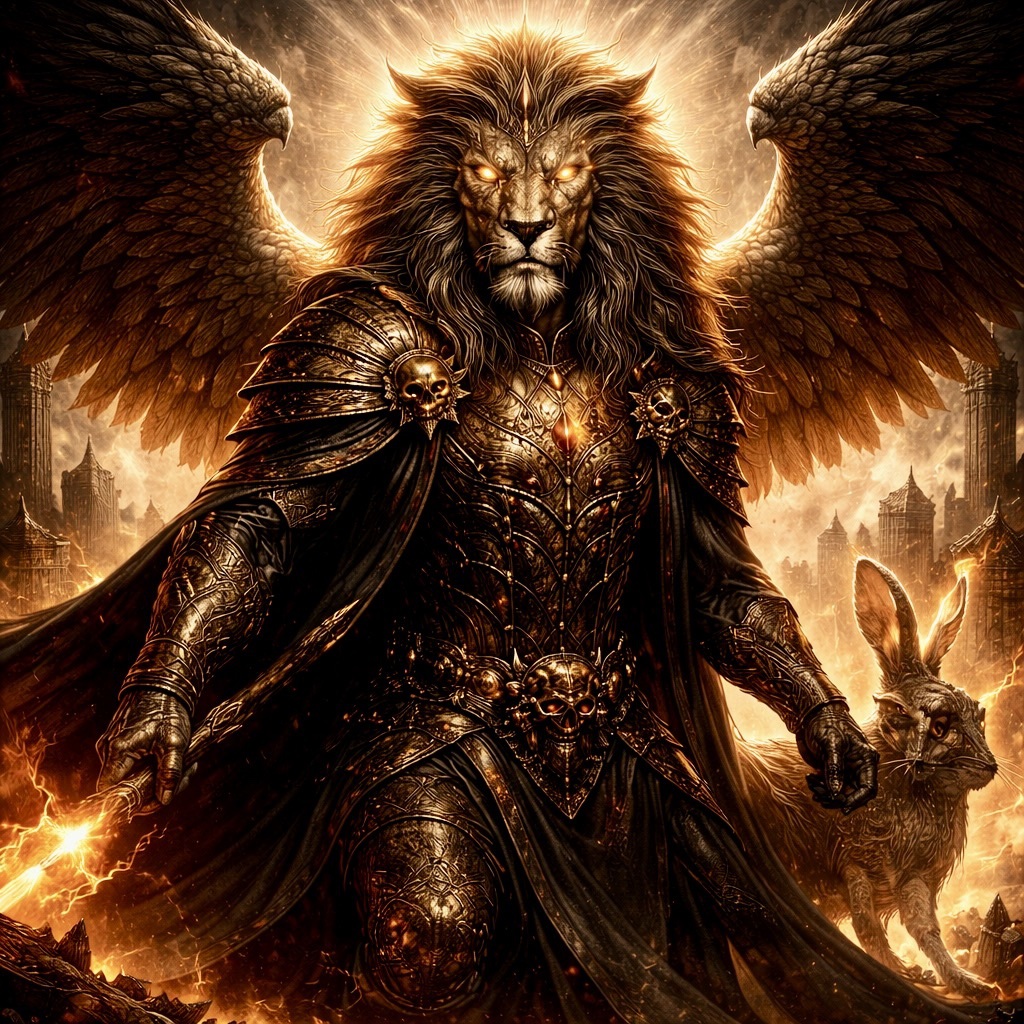
Ipos is a demon who unsettles not through cruelty or chaos, but through certainty. In the Ars Goetia, he is named as both a Prince and an Earl of Hell, commanding thirty-six legions and appearing in a form that seems deliberately contradictory: the head of a lion, the body of an angel, and the tail of a hare or rabbit. This strange hybrid is not decorative mythology. It is a psychological blueprint. Ipos embodies courage, clarity, and truth delivered without comfort.

Unlike many demons who manipulate through illusion or desire, Ipos governs knowledge of the past, present, and future. He does not predict in riddles or half-truths. He answers plainly. That is what makes him dangerous. People often believe they want truth, but what they usually want is reassurance. Ipos offers neither reassurance nor protection from consequence. He offers accuracy.

The lion’s head represents courage, authority, and dominance. Lions do not question their place in the hierarchy. They act with confidence rooted in instinct and experience. Ipos channels this quality not as aggression, but as certainty. He teaches how to stand firm in knowledge even when that knowledge is unpopular or isolating. Under Ipos, courage is not bravado. It is endurance.

The angelic body is equally important. Angels symbolize order, message-bearing, and alignment with higher structure. Ipos’s angelic form reinforces that his knowledge is not chaotic or deceptive. It is structured. He does not fabricate futures. He observes trajectories. His insights feel less like prophecy and more like inevitability explained.

The rabbit or hare tail introduces a jarring contrast. Hares are prey animals, associated with vulnerability, speed, and survival through awareness rather than strength. This aspect of Ipos represents the awareness that courage and knowledge do not make one invincible. Even those who see clearly remain exposed. Ipos does not deny fragility. He integrates it.

Together, these elements form a demon who understands time not as mystery, but as momentum. Ipos sees how decisions compound, how patterns repeat, and how outcomes harden long before they arrive. He does not intervene to change them. He reveals them.

In demonological texts, Ipos is said to make men bold and witty, and to answer questions regarding all things—past, present, and future. This wit is not humor. It is sharpness of understanding. Under Ipos, intelligence becomes decisive. Hesitation fades not because fear disappears, but because ambiguity does.

Psychologically, Ipos represents the part of the human mind that recognizes when denial has run its course. He is the internal voice that says, “You already know how this ends.” He does not comfort that realization. He demands response.

Unlike demons who thrive on manipulation, Ipos does not need leverage. He speaks plainly. This makes him unsettling in a culture accustomed to spin and narrative padding. Under Ipos, excuses evaporate. There is no ambiguity to hide behind.

Ipos’s dual rank as Prince and Earl is significant. Princes govern influence and direction. Earls govern territory and structure. Ipos controls both the conceptual and the practical. He understands ideas and how they manifest materially over time. This gives his insights weight. They do not remain abstract.

Courage under Ipos is not heroic fantasy. It is the willingness to act with full awareness of consequence. He does not teach fearlessness. He teaches resolve. Fear is acknowledged, not denied. Action proceeds anyway.

The lion symbolism reinforces this. Lions do not eliminate risk. They accept it as the cost of survival. Ipos teaches the same principle. Knowledge does not remove danger. It clarifies it.

The angelic aspect of Ipos also carries an important implication. Angels are messengers, not decision-makers. They deliver information. What is done with that information is not their concern. Ipos functions similarly. He does not guide choices. He informs them.

This makes Ipos deeply uncomfortable for those seeking validation. He will not tell you that you are right, only that you are accurate or inaccurate. He will not praise intention, only outcome.

In modern symbolic terms, Ipos resembles data-driven forecasting, strategic analysis, and brutal honesty delivered without emotional cushioning. He is present wherever people are forced to confront realities they would rather soften.

Ipos is also associated with bold speech. He grants the ability to speak with confidence and clarity, even in hostile environments. This does not mean persuasive charm. It means conviction rooted in understanding. Under Ipos, speech is not ornamental. It is declarative.

There is a quiet loneliness embedded in Ipos’s domain. Seeing clearly often isolates. Those who understand outcomes early are rarely thanked for saying so. Ipos does not resolve this isolation. He normalizes it.

Unlike demons associated with madness or excess, Ipos is stable. He does not escalate emotion. He dampens it. His presence feels cold, not cruel. He removes hope when hope is dishonest, and leaves it intact when it is earned.

The hare tail reminds us that even with knowledge and courage, vulnerability remains. Speed, awareness, and adaptability matter as much as strength. Ipos teaches when to stand and when to move quickly. He does not confuse bravery with stubbornness.

Ipos endures in demonology because humans struggle with foresight. We want to believe that clarity will make things easier. Often, it makes them harder. Ipos embodies that burden.

To engage with Ipos symbolically is to accept responsibility for what you already understand. He does not allow ignorance as refuge once insight is gained.

Ipos is not the demon of fate. He is the demon of recognition. He does not lock futures in place. He shows how tightly they are already set.

In the end, Ipos represents the cost of truth delivered without anesthesia. He does not wound. He exposes.

What you do after that exposure is no longer his concern.

Related Posts