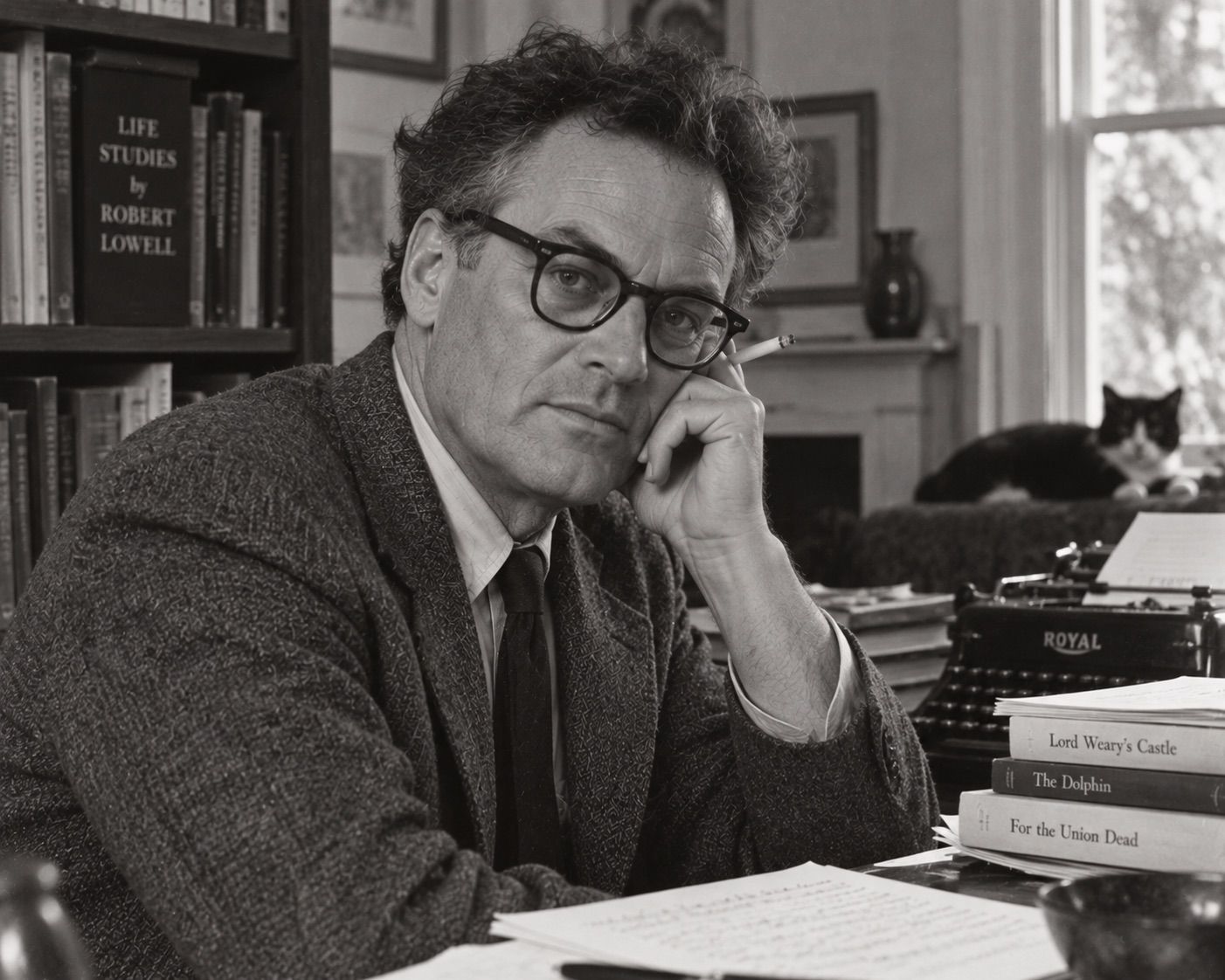
Robert Lowell’s life has been on my mind a lot lately, probably because I just finished college and am trying to figure out what comes next for me. As I reflect on his experiences, I’m drawn to the tension between his desire for authenticity and the constraints of his social class.
Growing up in Boston’s aristocracy, Lowell was constantly torn between the expectations of his family and his own creative ambitions. His poetry often grappled with this internal conflict, as if he was searching for a way to reconcile the two. I can relate to feeling like an outsider within my own world – my college friends come from all walks of life, but their parents are mostly professionals, and I’m not sure what that means about me.
Lowell’s struggles with mental illness also resonate with me. As someone who’s struggled with anxiety throughout college, I’ve often felt like I’m wandering through life in a haze, unsure of how to find my footing or quiet the constant chatter in my head. His poems about madness and despair make me feel less alone, even as they highlight the darkness that can accompany creative genius.
What fascinates me most about Lowell is his complicated relationship with his father, Lord Hartington. Their bond was intense and troubled, marked by arguments over politics, family legacy, and – ultimately – Robert’s decision to leave Harvard without a degree. I find myself wondering what it would be like to have that kind of passion and conviction in my own relationships. My parents are loving and supportive, but we don’t really talk about anything deep or meaningful.
Lowell’s conversion to Catholicism in the 1940s also intrigues me. He wrote extensively about his spiritual struggles and found solace in the Church’s traditions and rituals. I’ve always been skeptical of organized religion, but Lowell’s experiences make me think there might be value in exploring the symbolic language of faith.
As I read through his poetry collections – “The Mills of the Kavanaughs,” “Life Studies,” “Near the Ocean” – I’m struck by how personal they feel, like he’s inviting me into his inner world. And yet, that world is also deeply rooted in its time and place, reflecting the social and cultural conventions of Boston’s elite. It makes me question my own privilege and positionality as a white, middle-class woman.
Sometimes, when I’m writing about Lowell or his poetry, I feel like I’m getting too close to the surface of things – that I’m exposing myself to vulnerabilities and uncertainties I’d rather keep hidden. But it’s in those moments of discomfort that I remember why I started writing in the first place: to make sense of my own experiences, and to explore the complexities of the world around me.
As I look back on Lowell’s life, I realize that his struggles with identity and belonging are far from unique – and neither are mine. Maybe that’s what draws me to him: the understanding that our search for authenticity is a lifelong journey, full of twists and turns, but also infused with moments of beauty and insight.
I’ve been rereading “Life Studies,” Lowell’s collection of poems about his own family and upbringing. As I read through the pages, I’m struck by how he tackles the darker aspects of his childhood – the abuse, the neglect, the emotional turmoil – with a level of candor that feels both shocking and liberating.
I find myself wondering if there’s a part of me that wants to emulate Lowell’s bravery in confronting the uncomfortable truths of my own past. I’ve always been hesitant to explore the harder stuff about my family or our relationship dynamics, afraid of stirring up old wounds or causing unnecessary hurt. But reading Lowell’s poetry makes me realize that maybe it’s precisely this kind of vulnerability that allows us to truly connect with each other.
As I reflect on my own experiences, I think about how I’ve often felt like an outsider within my family – like there are certain expectations or roles that I’m supposed to fill, but that don’t necessarily feel authentic to me. Lowell’s struggles with his father’s influence and the weight of their aristocratic legacy resonate deeply with this sense of disconnection.
But what if I were to take a cue from Lowell and confront these feelings head-on? What if I were to write about my own complicated relationships, my struggles with identity and belonging, in the same unflinching way that he does? It’s scary to think about, but also exhilarating – like there might be something powerful waiting for me on the other side of vulnerability.
I’m not sure how to do this yet, or if I even want to. But reading Lowell’s poetry has made me realize that maybe the only way to truly find my own voice is by confronting the complexities and uncertainties of my own life – in all their messy, imperfect glory.
As I delve deeper into Lowell’s poetry, I’m struck by the ways in which he weaves together fragments of his family history, mythology, and personal experience. His poems are like intricate tapestries, rich with symbolism and allusion, yet also strangely intimate and relatable. It’s as if he’s inviting me to sit down at a dinner table with him, surrounded by his eccentric relatives and the ghosts of their past.
I find myself drawn to the ways in which Lowell uses language to excavate his own emotional terrain. His words are like surgical instruments, carefully probing the depths of his psyche, revealing both the beauty and the brutality that lie within. It’s a process that feels both excruciatingly painful and profoundly liberating – like he’s holding up a mirror to his own soul, reflecting back at me the complexities and contradictions of the human experience.
At times, I feel like I’m reading about my own family dynamics in Lowell’s poetry. The tensions between his mother and father, the complicated web of relationships within their aristocratic circle – it’s all eerily familiar. And yet, there’s a difference too – a sense of rawness and honesty that feels both captivating and disturbing.
I think back to my own family gatherings, where we pretend to be something we’re not, or hide behind layers of politeness and obligation. It’s like we’re trapped in a perpetual state of suspended animation, afraid to confront the messiness of our relationships, our emotions, our very lives. Lowell’s poetry makes me wonder what would happen if I were to break free from that script, to write about my own family with the same unflinching candor and vulnerability.
But it’s not just about writing – it’s about being willing to face the discomfort, the uncertainty, and the risk of rejection that comes with confronting our true selves. Lowell’s life was marked by both brilliant triumphs and devastating failures, and I wonder what would happen if I were to take a similar leap of faith into my own unknown.
As I close the book on “Life Studies,” I feel like I’m left with more questions than answers – about Lowell’s life, about his poetry, but also about my own place in the world. And yet, it’s in this uncertainty that I find a strange kind of freedom, a sense that anything is possible, even if I don’t know exactly what that means or where it will lead.
I’m left with the feeling that Robert Lowell’s life and work are like a mirror held up to my own – reflecting back at me the complexities, the contradictions, and the possibilities of being human. And as I gaze into its surface, I wonder what other secrets lie hidden beneath, waiting to be uncovered, explored, and written about.
As I sit here with Lowell’s poetry still echoing in my mind, I’m struck by the way he manages to capture the messy, imperfect nature of human experience. It’s as if he’s saying, “Yes, this is what it means to be alive – all the contradictions and paradoxes, the light and the darkness.” And that feels incredibly liberating.
I think about my own life, and how I’ve often tried to present a perfect facade to the world. But reading Lowell’s poetry makes me realize that maybe I don’t have to do that anymore. Maybe it’s okay to be messy, to be imperfect, to be uncertain. In fact, maybe that’s where the real beauty lies.
I start to think about my own writing, and how I’ve always tried to craft a narrative that’s neat and tidy. But what if I were to let go of that need for control? What if I were to write about my own flaws and weaknesses, just as Lowell does in his poetry?
It’s scary to consider, because it means exposing myself to vulnerability and criticism. But at the same time, it feels like a necessary step towards growth and self-awareness. And when I think about it, I realize that this is what I’ve been trying to do all along – not just writing about Lowell’s life and poetry, but using his work as a mirror to reflect on my own experiences.
As I continue to read through “Life Studies,” I’m struck by the way Lowell weaves together different narratives and voices. He doesn’t shy away from the complexities of family history, nor does he try to simplify them into neat, tidy stories. Instead, he plunges headfirst into the messy, untidy truth – and that’s what makes his poetry so compelling.
I start to wonder if I could do something similar in my own writing. Could I create a narrative that’s just as complex, just as nuanced? One that acknowledges the contradictions and paradoxes of human experience, rather than trying to gloss over them?
It’s not an easy question to answer, but as I sit here with Lowell’s poetry still resonating in my mind, I feel a sense of possibility opening up before me. Maybe this is what it means to be a writer – not just to tell stories, but to explore the depths of our own humanity, and to reflect that back out into the world.
I look down at the pages of “Life Studies,” now dog-eared and worn from repeated readings. I feel a sense of gratitude towards Lowell, for showing me that it’s okay to be imperfect, to be messy, to be uncertain. And I wonder what other secrets his poetry holds, waiting to be uncovered and explored.
As I close the book once more, I’m left with a feeling of restlessness – a sense that there’s still so much to discover, so much to explore. But at the same time, I feel a sense of hope, knowing that I have the tools to do it myself. And that feels like the greatest gift Lowell could have given me.
As I close the book on “Life Studies,” I’m struck by the realization that my own writing has been influenced by Lowell’s poetry without me even realizing it. His unflinching honesty and willingness to explore the complexities of human experience have seeped into my own thoughts and feelings, shaping the way I approach my writing.
I think about how I’ve always tried to craft a narrative that’s neat and tidy, one that avoids messy contradictions and paradoxes. But reading Lowell’s poetry has made me realize that maybe that’s not what writing is all about. Maybe it’s okay to be imperfect, to be uncertain, to let the reader see the cracks in our facade.
This realization feels both liberating and terrifying at the same time. It’s like I’m standing on the edge of a cliff, staring into an abyss of unknowns, but with a sense of excitement and trepidation. What if I were to write about my own flaws and weaknesses? What if I were to let go of the need for control and perfection?
I think about all the times I’ve tried to write about my family or relationships in a way that’s polished and presentable, rather than honest and raw. But Lowell’s poetry has shown me that there’s value in exploring the messy, imperfect aspects of our lives – not just as a means of catharsis, but as a way of connecting with others on a deeper level.
As I sit here, trying to process my thoughts and feelings about Lowell’s life and work, I’m struck by the realization that his poetry is like a mirror held up to my own experiences. It’s as if he’s reflecting back at me the complexities and contradictions of being human, without judgment or apology.
This feeling of recognition is both comforting and unsettling at the same time. It’s comforting because it makes me feel less alone in my struggles with identity and belonging. But it’s also unsettling because it forces me to confront the fact that I’m not immune to the same flaws and weaknesses as Lowell – that I too am a work in progress, still navigating the twists and turns of life.
As I look down at my own writing, now scattered across pages and scribbled in margins, I feel a sense of trepidation. What if I were to write about my own imperfections and vulnerabilities? What if I were to expose myself to the same kind of scrutiny and criticism that Lowell faced?
But something inside me is urging me to take this risk – to let go of the need for control and perfection, and to explore the messy, imperfect aspects of my own life. It’s like a whisper in my ear, reminding me that writing is not just about telling stories or conveying ideas, but about exploring the depths of our own humanity.
I take a deep breath, feeling the familiar rush of anxiety and excitement. Maybe this is what it means to be a writer – not just to write about Lowell’s life and poetry, but to use his work as a catalyst for my own growth and self-awareness.