Month: September 2025

Ink That Ended a World: V-J Day Aboard USS Missouri

Elias Rowen

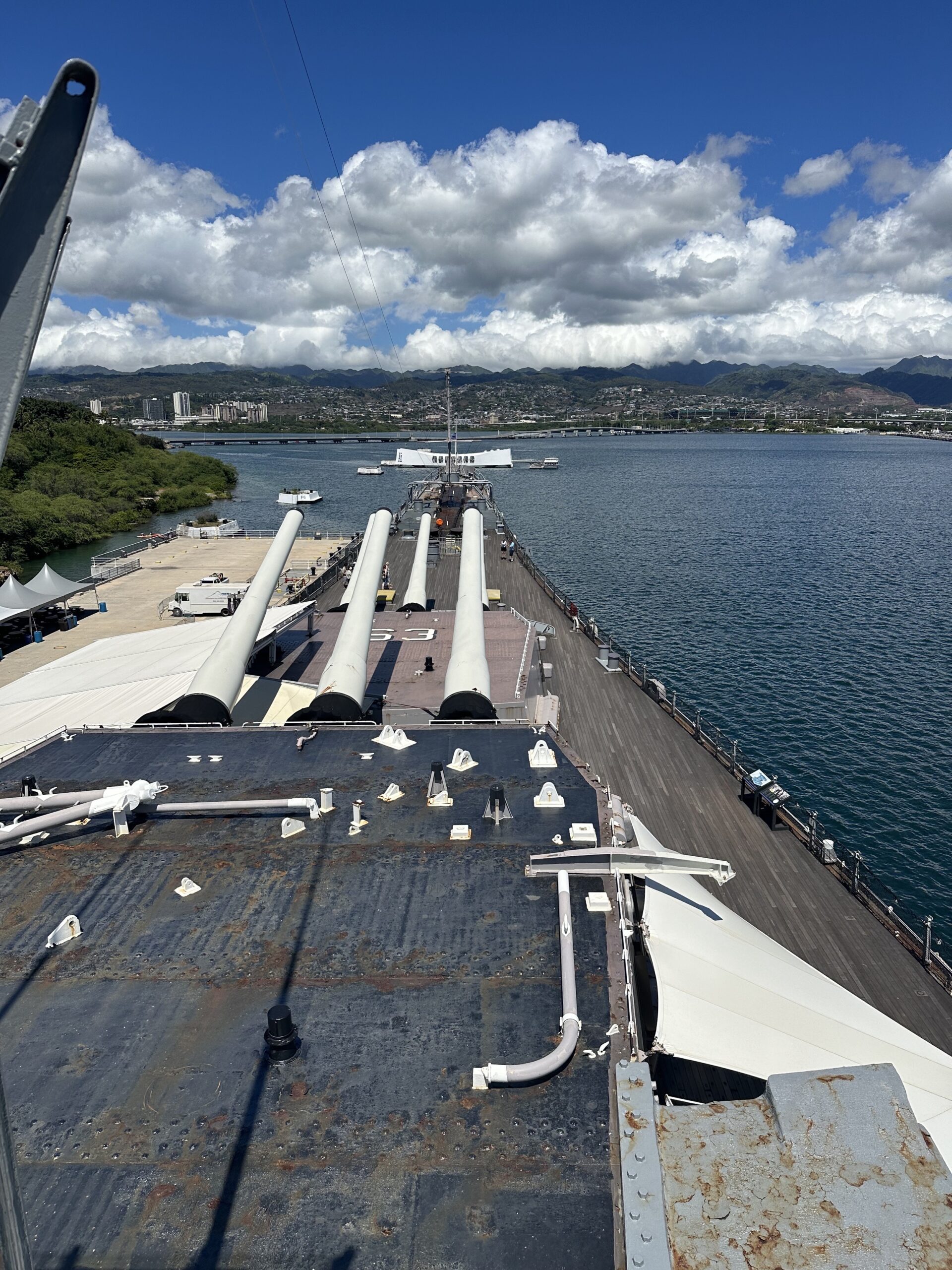
At 9:02 a.m. on September 2, 1945, the morning in Tokyo Bay felt like a held breath. The sea was pewter under an overcast sky, the air still with that strange quiet that follows thunder. Allied battleships and carriers crowded the water like punctuation marks at the end of a very long sentence, their decks lined with sailors standing shoulder to shoulder, dress khaki and blues turning into a human shoreline. And in the center of it all, moored like a stage, sat the USS Missouri—BB-63—her teak deck scrubbed, her brass polished, her bulkhead draped with an American flag that had once flown with Commodore Perry when he sailed into Japan nearly a century earlier. History rarely arranges theater so neatly. That day, it did.

On the deck, a plain table sat under a green felt cover—nothing ornate, nothing that would compete with the moment. A pair of black inkstands, a fountain pen, a neat stack of documents, and two empty chairs. Nearby, General Douglas MacArthur stood in khaki, open collar, sunglasses, all posture and angles, the very shape of declaration. Admiral Chester Nimitz waited with the relaxed intensity of a man who has carried an ocean on his shoulders for four years. Arrayed behind and around them were the representatives of nations that had bled and broken and borne the weight: Britain’s Admiral Sir Bruce Fraser, China’s General Hsu Yung-chang, the Soviet Union’s Lieutenant General Kuzma Derevyanko, Australia’s General Sir Thomas Blamey, Air Vice-Marshal Leonard Isitt of New Zealand, General Philippe Leclerc for France, Admiral Conrad Helfrich for the Netherlands, and Colonel Lawrence Cosgrave of Canada. Cameras clustered like curious birds. On the waterline, launch craft bobbed, as if even the small boats wanted a better view of the world righting itself.

Then the Japanese delegation climbed aboard. They came in morning coats and striped trousers, black formal shoes polished to a mirror. Leading them was Foreign Minister Mamoru Shigemitsu, top hat in hand, a cane under his right arm to relieve the pain of an old wound that made every step a small wince. Beside him was General Yoshijirō Umezu, the Army’s Chief of Staff, his face a practiced stillness. They did not look like victors or heroes, or even villains; they looked like men who had arrived at the end of a road that had never led anywhere else. The wind worried a corner of the surrender document as if impatient for the ink.

MacArthur spoke—measured phrases hammered flat by the steel of the ship and the sea. He said this ceremony was not a victory party, but a return to reason. He said he hoped a better world would emerge from the blood. It was the kind of speech that is easier to make when the guns are silent, but it mattered anyway because sometimes the world needs words more than it needs hardware. Then the choreography began: the Japanese signatories stepped forward first, because the order of names on paper must match the order of history. Shigemitsu lowered himself carefully into the chair, set his top hat on the table, laid his cane alongside the inkstand, and took up the pen. The scratch of nib on paper was too soft to hear over the water and the cameras and the lungs of thousands, but you could almost feel it in your teeth. That line of ink was the narrowest bridge ever built between war and peace, and somehow it held.

Within minutes, Umezu added his name. The Allies followed, MacArthur first with a pen he would later give away in pieces as souvenirs for those who had borne the burden; then Nimitz for the United States; then the others, in a roll-call of nations that had learned new meanings for the word “ally.” There was a small, human error: Colonel Cosgrave, half blind from a wartime injury, signed on the wrong line, nudging the signatures beneath his downward by one. A witness leaned in to correct him. MacArthur shrugged and smiled. After years of industrial catastrophe measured to the second and the bolt, this little misalignment felt almost like a blessing—a reminder that the future we were entering was one where mistakes could be mended with pencil marks and courtesy rather than artillery.

But the meaning of the morning wasn’t on that table alone. It was scattered across the decks in a thousand private stories: a radio operator from Kansas who had learned to sleep between general quarters, a Marine from Harlem whose last letter home still had sand in the envelope, a shipfitter from Manila who had carried another man through smoke. Some of them had names for that day—V-J Day in the American lexicon, simply “the surrender” for others. For many, September 2 was less a celebration than an exhale. The sailor beside the starboard rail held his breath longer than he meant to, then let it out and realized his hands were shaking. He didn’t raise his cap or shout; he just pressed his palm to the warm teak and told himself the wood was real.

If you pan the camera back enough, you can see the entire decade folding toward that deck: the invasion of Manchuria in 1931, the long grind through China, Pearl Harbor, the island chain strung with names that will never again mean only geography—Guadalcanal, Tarawa, Saipan, Leyte Gulf, Iwo Jima, Okinawa. You see factory floors in Detroit and Osaka; you see ration cards and code books and the steady beat of propellers that made the Pacific smaller than anyone had believed. And if you pan wider still, you glimpse the ruins in Europe and the trains that never came back and the cities made of bricks and ash. The Missouri’s deck held the Pacific war’s ending, but the relief radiated across oceans.

Think about the weather that morning: a blanket of gray cloud, as though the sky preferred to mute itself. Photographs from the ceremony have that calm, even light that portrait photographers dream of—no harsh shadows to collapse eyes into caves. It’s as if the day refused drama, at least the kind you can see, because the drama had already exhausted itself. The Pacific had eaten years; the calendar had become a stone wheel. And then, for an hour, everything was still enough for handwriting to matter.

“History is made by signatures and sergeants,” an old Navy chief liked to say. He meant that the world turns when leaders agree and when ordinary people execute. In Tokyo Bay, both kinds of history were busy. The signatures were neat; the sergeants had already done their part. You cannot have a surrender without people who refused to surrender when it cost the most. Imagine a 19-year-old gunner’s mate who had never been 19 in any ordinary way, a nurse whose hands could tie a tourniquet in the dark, a codebreaker who translated a signal that saved a convoy in seas rougher than anger. They had ferried the world to this deck plank by plank, heartbeat by heartbeat. They were not on camera. The camera rarely finds the foundation.

Some observers called the ceremony “mercifully brief.” That mercy mattered. War has a way of turning every human act into a prolonged formality, a queue that always ends in an office where someone says “Come back tomorrow.” The surrender on Missouri was the opposite—finite, precise, a bureaucracy refitted for grace. The Japanese delegation departed quickly. The Allied representatives saluted. The band played. Bells rang across the fleet, voices rolled like a tide, and then—quiet again, as if everyone wanted to be alone with the thought that they might live to be old.

What happens when a war ends? The movies cut to embraces and parades, to Times Square and kisses and ticker tape, and those are true too. But endings are also messy. Demobilization is a poem written in paperwork. Ships must be re-provisioned for peace. Promotions stall; furloughs expand; the mail has to find new towns. PTSD had not yet been named widely, but it had already moved in with many men and women, unpacking in their dreams, rearranging their breaths. On the Missouri, some sailors celebrated, some stared at the horizon, some wrote letters with hands that could not decide on a script—half block print, half cursive. “It’s over,” they wrote, then “I think,” then “No, really, it is.” But they would not fully believe until they were on a train that took them somewhere their mother recognized.

There’s a reason the world chose a battlewagon for the ceremony. The Missouri was more than steel; she was a symbol of industrial resolve, of a nation that had learned how to turn mines into hull plates and barns into airfields. But aboard that emblem of force, the instrument of peace was gentle: paper and ink and courtesy titles. That juxtaposition is worth keeping. Victory required ships and planes and islands measured by the yard; peace required chairs and pens and the patience to read out names. The future would depend on remembering both halves of the recipe.

Aboard another ship in the bay, a young photographer named Ruth adjusted her shutter speed and tried not to think about the photograph she didn’t take two years earlier because her hands had been too cold. She captured the moment when MacArthur stepped aside and Nimitz leaned in. When she developed the negative later, she saw the slight tremor at the corner of Nimitz’s mouth—a almost-smile—and understood something she hadn’t known: command is a burden you only set down in public after you have learned how to set it down in private. She kept that contact print in a drawer until she died. Her granddaughter would find it and think, “Every ending is also someone’s beginning.”

The symbolism piled up on Missouri’s deck like folded flags. Perry’s 31-star flag, brought out of the Naval Academy museum for the day, reminded everyone that Japan’s opening to the West had begun under canvas and steam and would now be reimagined under airplanes and treaties. The two copies of the instrument—one for the Allies, one for Japan—stared at each other across the table like mirror images that had finally agreed to match. Even the teak planks mattered; wood is an honest material, warm under boots, a reminder that ships are built by hands even when they are designed by equations.

We sometimes tell the story of V-J Day as a neat ending, a clean cut that frees the future from the snag of conflict. That’s tidy, and honesty has no patience for tidy. The war’s consequences spilled forward: occupation, trials at Tokyo, the new constitution in Japan, the rebuilding of cities in ashes, the long argument with the atom that would define geopolitics for the rest of the century. But “ending” doesn’t mean “erase.” It means we choose the tools of repair over the tools of ruin. In that sense, September 2, 1945 was less a full stop than a turn of the page. The story went on, but the genre changed.

Humanize the moment and you will never lose it. Picture Shigemitsu’s careful handwriting, the slight lean of his body that told a private truth about pain. Picture MacArthur removing his sunglasses before he spoke, because naked eyes make promises stronger. Picture a seaman apprentice named Ortiz, who had lied about his age to enlist, quietly palming a tiny chip of teak from a seam near the table—a pocket-sized relic he would carry for six decades, rubbing it between thumb and forefinger on particularly bad nights. Picture a Japanese interpreter who had studied English with a missionary in Nagasaki and now found himself translating his nation’s surrender; when he reached the phrase “We hereby undertake, for the Emperor, the Japanese Government, and their successors, to carry out the provisions,” his voice did not break. He would remember that steadiness for the rest of his life like a borrowed coat.

Ask ten veterans where the war ended and you’ll get eleven answers. Some will say it ended the first time they slept without boots. Others will say it hasn’t ended yet—not for them—because ending is a geography, not a calendar. But when the Missouri’s whistle blew and the documents were carried below, a particular kind of silence fell over the water. It was not the silence of emptiness; it was the silence of possibility. The fleet could leave. The boys could become men in the way that does not require gunpowder. The Pacific could return to being an ocean rather than a map of objectives.

The last words of that ceremony were not etched in marble. They were practical: orders to weigh anchor, to ferry delegations back, to secure the table. A petty officer put the inkstands in a box. A sailor reclaimed the folding chairs from the edge of the stage. Another coiled a length of rope the way his grandfather had taught him, neat and flat, looping the future onto the present. The Missouri would carry many things in her long life—missiles later, tours for schoolkids later still—but she would always carry that hour. Visitors would walk her deck and touch the brass plaque that marks the spot where the table sat and feel taller without understanding why. They would read the names and find their own family names hidden between the lines, because every generation inherits the debts and credits of those signatures.

If you squint, you can see the ceremony backwards: the Allied representatives walking to their places in reverse, the Japanese delegation stepping backward up the brow, the sailors un-saluting, the documents returning to blank paper. It’s a parlor trick, but it makes a point. War is easy to run forward and impossible to rewind. Peace is the opposite: hard to start, easier—if we’re relentless— to keep moving. The Missouri’s deck teaches that paradox perfectly. Starting peace required thousands of days of war plus one hour of ink. Keeping peace would require the next seventy-plus years of discipline, restraint, cooperation, argument, and the dull, gorgeous labor of diplomacy.

Titles like “V-J Day” can become marble if we’re not careful, a crisp acronym that hides the heat of human breath. Bring back the heat. Bring back the sailor whose hands shook. Bring back Shigemitsu’s cane, the soft thud as it touched the deck. Bring back the smell of oil and salt and paper. Bring back Cosgrave leaning to sign and placing his name on the wrong line because injuries do not keep other appointments. Bring back the way a thousand men heard the same words and assigned them a thousand private meanings. And then carry those details with you the next time the world invites you to choose between pride and pragmatism. Remember how ink outperformed steel that morning.

“Where were you when it ended?” It’s a question grandchildren love to ask because endings make good stories. The answers from that day unfurl: a nurse on a hospital ship finally sat down and cried into her hands; a submariner in drydock in Pearl Harbor looked at a patch of blue and thought it had never been so blue; a Marine in Tientsin found a bakery and bought bread even though he didn’t speak the price; a Japanese mother in Yokohama tied back her hair and told her son that the world would be different now, and she meant it as a promise, not a threat. The Missouri’s deck collected those answers the way tree rings collect rain.

“Never again” is an aspiration, not a spell. It doesn’t work on its own. It needs practice, rehearsal, patience—exactly the opposite of how wars start. But aspirations require anchors, and Tokyo Bay on September 2 is one. When we point to that morning, we’re not just remembering relief; we’re remembering a set of choices: surrender rather than annihilation, law rather than vengeance, reconstruction rather than humiliation. The choices were not perfect. They never are. But compared to the alternatives, they shine like a wet deck under soft cloud.

It is tempting to imagine that if you had been there, you would have understood instantly the scale of the moment. Maybe you would have. More likely, you would have looked for your friends in the ranks, checked the line for the mail buoy, wondered about lunch, planned to write home, and then—only later, perhaps years later—understood that you had stood fifteen feet from the hinge on which a century swung. That’s okay. History is kind to late realizations. It stores them for you until you’re ready, then presents them like a photograph you forgot you took.

When the fleet finally dispersed, the bay resumed being water instead of witness. Gulls reclaimed their airspace. The mountains watched with the patience of stone. On the Missouri, the green felt was folded, the table returned to ordinariness, the scuffed mark of a chair leg polished away. But the ship kept the echo. If you stand there today, above that brass plaque, you can hear it if the wind is right: paper sliding across wood, a pen finding its cadence, a signature completing the loop. It sounds like a door unlocking.

And that is the music of endings we should learn to recognize: not brass bands and flyovers—though those are glorious in their moment—but the smaller sounds of human agreement. Pens, breath, chairs, footsteps, a low voice reading names. We learned that music in Tokyo Bay. We can play it again, whenever we need to, if we keep the instruments tuned.

Related Posts

The Shot That Shattered Peace: The Invasion of Poland

Elias Rowen

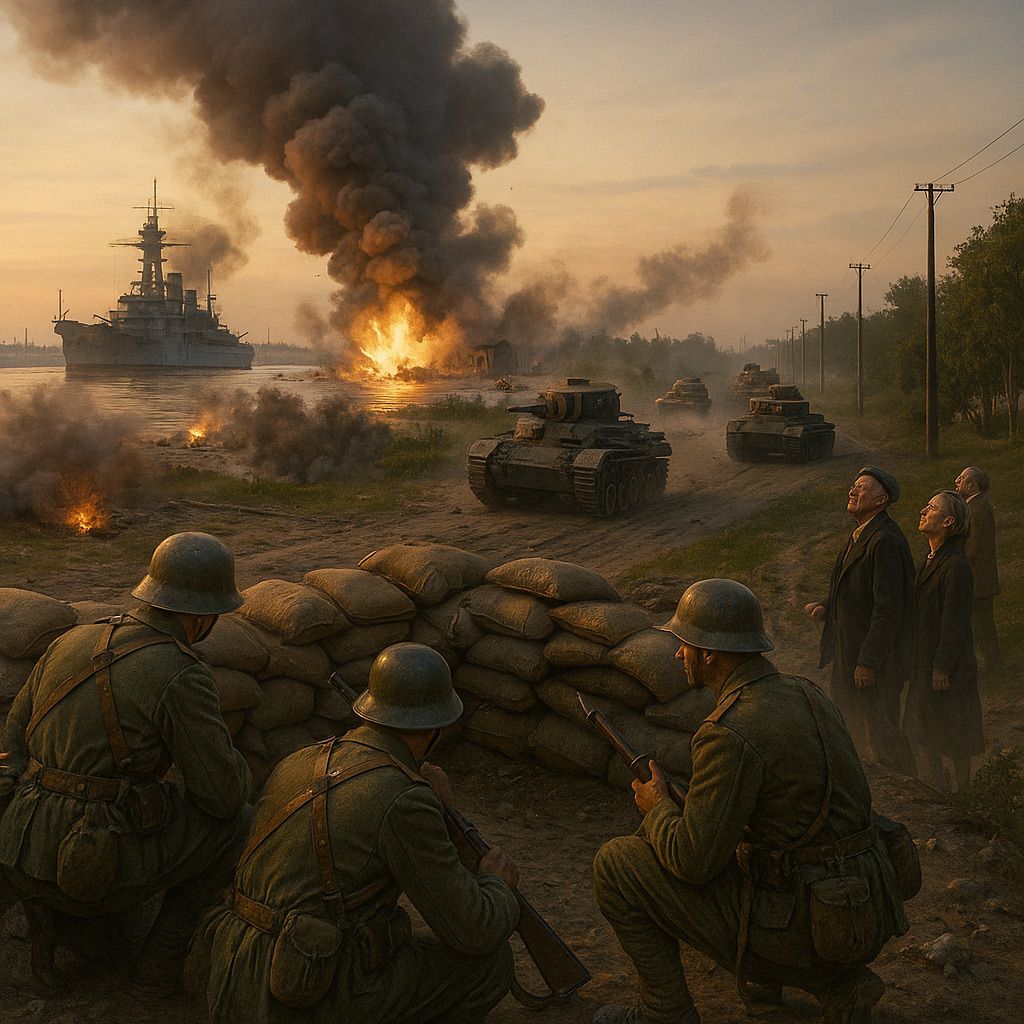
It began with a sound that didn’t belong to morning. In the gray just before sunrise on September 1, 1939, roosters and church bells and the first clatter of carts should have owned the air of Poland. Instead there was concussion—steel on silence—when the German battleship Schleswig-Holstein opened fire on the Polish Military Transit Depot at Westerplatte near Danzig. The blast flattened the dawn and folded it into history. In one violent punctuation mark, the world that still wished to be 1938 became 1939, and then, very quickly, everything else: evacuations, ration cards, ash-gray skies, and an age that would learn the vocabulary of catastrophe with a fluency no one wanted.

A baker named Zofia in Wieluń, a market town far from the front lines, was already awake. She didn’t see warships; she saw loaves. She reached for the oven door when the first Stuka sirens wrote their terrible cursive over her street. The bombs fell at about the same time the guns opened at Westerplatte—a near-simultaneous strike that made truth out of a terrifying new doctrine. The Germans had a word for it—Blitzkrieg—lightning war—but for people like Zofia there was no doctrine, only the panic you feel when the walls move and there is nothing to hold onto that will not splinter. She grabbed the nearest child and ducked under a counter that wasn’t made for this. Outside, glass turned to sand. The day had not yet properly begun, and yet it was already older than any day she had ever known.

To talk about “the beginning” is to argue with a shadow. The paper trail led back years—Versailles and the resentments it sowed; unemployment, inflation, and the demagogues that thrive in economic rot; speeches that started as thunder and ended as policy; the annexation of Austria; the dismemberment of Czechoslovakia; the guarantee to Poland that Britain and France wrote as a promise against their own consciences; and, most secretly, the Molotov–Ribbentrop Pact, which quietly carved Poland into an east-west answer key. But for ordinary people, there is always a moment the abstract turns specific. It’s the moment a radio voice lowers and says “This is not a drill,” the moment the aircraft you heard about becomes the airplane you see, the moment the border printed on a map becomes a bridge taken and renamed.

At the Military Transit Depot, Polish defenders rubbed the sleep from their eyes with grit and did the only thing that makes sense when the impossible happens: they worked their problem. Lieutenant Sucharski had a spreadsheet in his head—ammunition, positions, fields of fire—except the cells on this sheet were lives and every sum had a cost column. There were no reinforcements coming, not really, and the Schleswig-Holstein’s big guns kept talking, using steel grammar to insist that this would be quick. But the defenders, dug into their thin rectangle of earth, turned delay into a tactic. Seven days later, the German timetable for “hours” would still be broken by the human refusal to be convenient.

South and west, armored columns moved with a choreography that earlier wars could not imagine. Tanks had been tried, of course, in the First World War, but tried like a new instrument in an old orchestra. In 1939, Panzers were the melody. They moved not as solitary monsters but as part of a conversation with radios—squadrons of Stukas talking to tanks talking to motorized infantry. The map no longer mattered as a series of lines; it mattered as a series of gaps. Find a seam, flood it, turn the enemy’s front into a door that opens inward and then won’t close. If the word Blitzkrieg sounds like marketing, that’s because it was also theater: the exaggerated howl of the dive siren, the speed, the photographs staged at the roadside, the appearance of inevitability. But inevitability is always an illusion, and it always has a price.

On a dirt lane near Krojanty, a Polish cavalryman named Marek tightened the girth on his mount and tried not to think about the news racing ahead of the columns. The world would later tell a cheap myth about men with sabers charging tanks, as if the Poles were romantics galloping into geometry. The truth was more complicated: cavalry were mobile infantry, scouting, harassing, buying time; they aimed at vulnerable points—supply trains, stragglers, soft underbellies—and when the story went wrong in Krojanty it was not because men on horses didn’t understand machines but because fog and terror and bad luck can break even a good plan. Marek survived that morning with a hearing that would never fully return. He wrote home about the smell of the grass after the bombardment. “It smelled like a garden that forgot its name,” he told his sister. Years later she would cry remembering that letter because the war turned him into a man who could write a sentence like that and then took him anyway.

Wars are fought by armies, but they are felt by towns. In Bydgoszcz, in Łódź, in Poznań, people learned to measure distance by sound—how far away the front was, what kind of plane, the difference between shelling and demolition. A violinist named Dawid wrapped his instrument in a blanket and then unwrapped it again because the weight didn’t feel right; he wanted to carry it as it was, like a person, like something that might breathe if only he believed hard enough. When the air raid ended, he took it to the cellar and played to drown out the next siren. A neighbor, a German speaker who had lived in the building since before Dawid was born, sat on the stairs and cried without understanding why. It would be a long war, and the meanings of neighbor and identity would be mangled by ideology, but on September 1, 1939, the music made them two people sitting inside the same human sound.

Far away in London and Paris, the word “guarantee” turned out to have more syllables than anyone expected. Diplomats whose cheeks had been warmed by the applause for Munich now had to explain how you back a promise with tanks. On September 3, Britain and France declared war, voices crisp on radio waves that shook in the sky. But declarations are not divisions, and the armies that could have moved in the west hardly moved at all. History would call it the “Phoney War,” which is what children name things when grownups disappoint them. In Poland there was nothing phony about anything: bridges fell into rivers with a splash that shook streetlamps, and whole towns learned to keep a bag by the door.

By September 17, the other half of the pact signed in Moscow took its turn. The Red Army came in from the east, and a country already staggered had to learn that you can be divided not just by lines on a map but by the logic of men who treat other people like arithmetic problems. Refugees who had been walking toward safety became refugees who had always been walking. Those who told you there were rules stopped telling you anything at all. In Lwów, a schoolteacher who had been teaching Polish grammar on August 31 was now whispering Russian vocabulary. She wrote the words on the board with a hand that shook in a way that had nothing to do with fear of grammar.

Human beings try to organize chaos into stories because stories have beginnings, middles, and ends, and chaos has only before and after. So we make scenes. We remember Westerplatte because it was a small unit that wouldn’t fold. We remember the Polish Post Office in Danzig because postal workers—people whose daily job is to move messages—held their own position against men with better weapons until fire itself tried to write the last word. We remember Wieluń because the first dead of a world war ought to have been soldiers on a battlefield but were instead civilians in a marketplace, and if you want to understand the century you have to start there: with the idea that the front line is wherever people are alive.

A German conscript named Thomas, nineteen and convinced he was older because newspapers had made him so, rode in a muddy truck flicking a lighter he’d bought with money he didn’t have. He stared at the Polish countryside like it was a picture that had been taken for him. His sergeant told him the people they saw were dangerous. Thomas thought they looked like his mother’s cousins. When the truck stopped, he climbed down and felt the weird intimacy of invasion: the smell of someone else’s bread, the cracked paint on someone else’s windowsill, the sudden knowledge that the person who slept in this bed, this exact bed, has a different word for “blanket.” That night he wrote a letter he would never send. He said that the fields were wider than he had imagined and the sky felt too low. He said he didn’t know whether the war was outside him or already inside him.

In Warsaw, a boy named Julek, twelve, collected rumors like stamps: that the Luftwaffe had run out of bombs; that the British had landed in Gdańsk; that the city wall could stop tanks; that the city had no wall; that his father had volunteered; that his father had been turned away; that grown men could be helpless even when they tried not to be. He watched as adults negotiated with the new physics of fear: how long it takes to get from the window to the stairs, how many bottles to carry, whether to leave the cat, whether to bring the wedding photograph or leave it to prove they had been married before the ruin. When the lights went out, Julek’s mother told a story about the king who disguised himself as a farmer and wandered among his people to learn their secrets. Julek asked what he learned. “That the world is wrong sometimes,” his mother said, “but we must still do right inside it.”

There is an argument, made often by people who haven’t had to live in the middle of history, that the Second World War was inevitable: the axe-blade wedge of Versailles, the failure of the League, the calculus of power, the cruelty that had become policy. But inevitability is a story told by victors and professors. What was inevitable on September 1, 1939 was only this: people would decide, every hour, what kind of person to be. A teenager in Tarnów would choose to help strangers who did not share her last name; a train conductor near Lublin would look the other way at a crucial switch; a priest would open the door to a cellar and not ask which language the people inside said their prayers in. In a village outside Piotrków Trybunalski, a woman named Halina would judge every passerby by the weight of their bag and decide how much bread she could afford to lose.

The invasion of Poland should not be romanticized; it should be remembered. Remembered not only because it began a war that would redraw continents and alter the chemistry of the human psyche, but because in that beginning you can see the pattern that follows. There are the lies we tell to make aggression look like grievance. There are the bureaucrats who prefer a stamped order to a sleepless night. There are the small defenders whose names will be known to their grandchildren because the town will put up a plaque. There is the shock of realizing that technology built to awe can also herd and starve. There is the temptation, always, to believe that if you look away, the thing won’t be looking back.

What makes September 1, 1939 feel modern is not the old photographs; it is the feeling that a normal Tuesday can be the hinge of twenty centuries. That is the weight of the date: we can say it aloud and know exactly what it buys us. The day doesn’t just remind us of tanks and treaties; it remakes the edges of our own mornings. When we wake now to a siren test or a news alert or a sudden silence where there should be birds, we carry the muscle memory of that day, the knowledge that history is not an old story—it is your street with slightly different signage.

And yet, within the cratered outline of those first hours, there were still neighbors and bread and cats. There were still jokes—brittle, bad ones that made everyone laugh anyway because laughter is a way of insisting on grammar where there is none. There were still hands held in stairwells and birthdays that went unmentioned because candles were a luxury and names had to be whispered. A young nurse in Łomża, who had dreamed of Vienna and new surgical techniques, spent the day inventing bandages from curtains and the night learning the names of people she would never see again. She remembered Westerplatte without ever seeing it: she remembered it as “the place where people like us made time angry.”

By mid-September, the map of Poland looked like a demolished puzzle. Cities were under siege; columns of civilians moved like rivers that had forgotten their banks. The world had learned a phrase, “ refugees flow,” that makes people sound like weather. But they were not weather. They were people carrying keys to doors that no longer existed, people who could name every notch in the wooden table left behind. There is a photograph—your mind will supply one if you’ve never seen it—of a family on a road, the mother looking left as if the past might call her back, the father pointing right because direction feels like control, the children understanding none of it and all of it at once. The picture lies: it makes displacement look still. In reality, the air moved like a thing alive, and every turn held a stranger’s eyes.

What did September 1 do to the century? It trained us to hear. It taught us to listen for boots on stairwells, to parse a speech for the meanings behind the verbs. It made us suspicious of certainty and in love with the small proofs of life: the stubborn shop that opens at dawn, the book passed hand to hand, the school that meets in a cellar because learning is a rebellion against the idea that the future is someone else’s to decide. It made “never again” both a prayer and a commitment whose grammar we are still perfecting.

Memory is not a courtroom; it is a choir. When we remember the day the war began, we are not seeking a verdict but a harmony where we can sing in many keys at once: the key of strategic analysis, the key of the family letter, the key of the street that was bombed before most of the world had breakfast. We remember Zofia at the oven door, Marek with the ringing in his ears, Dawid in the cellar, Thomas with the lighter he didn’t need, Julek with the rumors, Halina counting loaves. We remember the defenders of Westerplatte who stretched hours into a week and taught the calendar that courage can bend it. We remember Wieluń because it warns us that civilians are always the front line even when the world pretends otherwise.

If there is a final lesson, it is ruthlessly ordinary: mornings matter. The decisions we make before the sun is fully up—how we speak, what we ignore, whom we believe—have a way of scaling beyond our intention. The world did not simply fall into war on September 1. People pushed, and looked away, and calculated, and hoped, and froze. And people resisted, and warned, and wrote, and ran toward danger to carry someone else out. The day began with a sound that didn’t belong to morning. It ended with the knowledge that all our mornings belong to us only as long as we are willing to share them with others.

So we honor that dawn by seeing the world more clearly at ours. We teach the names, especially to children who will inherit a sky full of sirens and thunder and planes that sometimes save and sometimes don’t. We say Westerplatte like a challenge to despair. We say Wieluń like a promise to pay attention the next time someone tells us that a town can be strategic and that this explains anything worth explaining. We hold the story until our arms ache and then we hand it to someone younger, not because the story is heavy but because it is a relay baton and stopping is a failure of imagination.

The truth is that September 1, 1939 never quite ended. It keeps starting over in smaller ways, in places with different names, each time asking us whether we can hear the difference between a dawn that belongs to bread and a dawn that belongs to artillery. The answer is a thousand small acts: a vote cast with courage, a rumor corrected, a neighbor defended, a lie refused. We cannot go back to the harbor and turn the ship around, cannot unlight the fuses or return the bombs to their racks, cannot tell twelve-year-old Julek to keep the radio off. We can, however, insist that the future keeps more of the morning and less of the blast.

And if there is any mercy to be wrung from a day like that, it is the peculiar kindness of memory itself. Remembering does not rebuild a town or resurrect a defender. But it changes the angle of the light that falls on our own lives. It teaches us to read the world for seams—to patch them before someone else learns to tear them open. It reminds us that the human project is not to avoid catastrophe—history has opinions about that—but to meet it with a stubborn insistence on the ordinary, the neighborly, the human. We cannot stop all ships from firing, but we can build, every day, a world in which fewer captains think it wise to aim at the places where people keep their bread.

That is why the day the Second World War began is not just a historical landmark but a moral one. It is a sign on the road that says, in a script learned with pain, “This Way Leads to Ruin.” And beneath it, in smaller letters that we write together each generation, another sign: “This Way Leads Home.” The handwriting is ours. The choice is always, relentlessly, now.

Related Posts

Sun, Salt, and Skin: The Ultimate Guide to Post-Beach Skincare Recovery

Dave

You know that feeling after a long, blissful day at the beach—the warmth of the sun still clinging to your skin, the salty film of the ocean lingering, and that happy exhaustion that makes everything feel softer around the edges. It’s pure magic, but it’s also a trap. Beneath that golden glow, your skin is screaming for help. UV rays have been breaking down collagen like little demolition crews, salt has been sucking moisture out of every pore, and sand has been exfoliating you whether you wanted it to or not. And yet, most of us just rinse off quickly and call it a day, totally forgetting that beach time is as much a skincare battle as it is a summer ritual.

Here’s the truth: recovery starts the moment you leave the sand. Your first move should always be hydration, inside and out. That means water—lots of it—and a moisturizer that doesn’t just sit pretty but actually repairs the barrier your skin just sacrificed to the sun. Aloe vera? Yes, but only the good stuff, pure and without alcohol. Hyaluronic acid? Absolutely, because your thirsty skin will drink it up like a desert flower after rain. And let’s not forget your scalp, which often gets ignored but takes just as much of a beating from UV exposure.

Then there’s the detox. Saltwater is amazing, but it leaves behind minerals and buildup that clog pores if you don’t wash them away. A gentle cleanser, followed by something soothing like chamomile or green tea toner, can bring down inflammation before it turns into redness or breakouts. Think of it like pressing pause before the damage sets in.

But here’s where recovery becomes more than just routine—it’s ritual. Lighting a candle, slowing down your shower, applying each layer with intention. It transforms the act from “ugh, skincare” into “I’m treating myself because I deserve it.” And that’s the secret to making it stick. Post-beach skincare isn’t just about avoiding peeling or breakouts; it’s about preserving that feeling you had on the sand. That free, glowing, effortless version of yourself who deserves to carry that energy long after the waves have quieted.

So the next time you come home with sea salt in your hair and sand in your bag, don’t collapse on the couch. Start your recovery routine like a ritual. Hydrate, cleanse, repair, and soothe. Your skin will thank you with a glow that lasts longer than any tan, and your future self will thank you for protecting it against the kind of damage you can’t see right away. Because beach days come and go, but healthy, radiant skin? That’s forever.

Related Posts

Borrowing the Tide: Ocean Sound Machines and Why They Work

Dave

If you’ve ever slept near the sea, you know the feeling: the waves don’t just fill the room, they empty it—of buzz, of traffic, of the day’s loose ends. Ocean sound machines promise to bottle that hush and pour it right onto your nightstand. The skeptic’s question is simple: can a small speaker really compete with a coastline? The answer, surprisingly often, is yes—not because it “tricks” you, but because it cooperates with the way your brain already prefers to rest. Ocean audio works by smoothing the jagged edges of your soundscape, anchoring your breath to a steady rhythm, and signaling safety to a nervous system that’s been on duty all day. It’s a gentle technology with an old soul.

First, the masking magic. Sleep is easily sabotaged by unpredictable noise: a door slam, a distant motorcycle, a late-night notification. Your auditory system is a superb novelty detector—it keeps listening even when you’re asleep, ready to alert you to anomalies. That’s great for ancient caves and modern fire alarms; it’s less great for apartment pipes and midnight garbage trucks. Ocean sound machines lay down a continuous, broadband bed of sound—think of it like audio wallpaper. This smooth layer makes sudden intruders less contrasty, so they don’t yank your attention. The brain treats the steady whoosh as “always there, always safe,” and saves the wake-up call for true outliers. You’re not deaf to the world; you’re simply less interruptible.

Second, rhythm is regulation. Classic ocean tracks aren’t pure static; they breathe—a gentle swell and recede every few seconds. Many people unconsciously begin to entrain their breathing to that rise and fall, lengthening the exhale. Longer out-breaths nudge the parasympathetic (rest-and-digest) system forward and dial down the body’s go-signals. The heart rate eases, muscle tone softens, and the “I should be doing something” part of your brain loses the argument. It’s not hypnosis; it’s good pacing. The sea provides a metronome; your body says thank you.

Third, nature’s frequency recipe. Not all noise is created equal. White noise spreads equal energy across all frequencies and can sound hissy. Pink noise—more energy in lower frequencies, less in higher—matches many natural sound profiles (rain, leaves, waves) and feels warmer. Brown noise leans even heavier on bass, like a distant waterfall. Ocean machines that skew pink/brown often feel more soothing because they align with patterns your auditory cortex evolved around. In other words, your ears like the coast because your biology grew up outside.

There’s also the matter of memory and meaning. Water sounds often come bundled with positive associations: vacations, lazy afternoons, childhood naps after swimming. Your brain is a champion of context cues—it will reuse the calm it filed away under “beach.” Pressing the ocean button becomes a tiny ritual that says, “Same safe story as last time.” Over days, that consistent pairing becomes conditioning: ocean on → body off-duty. That’s the opposite of doomscrolling, which conditions the brain to expect drama on the pillow.

Focus and stress relief benefit too, even far from bedtime. During work, a steady ocean track can raise your signal-to-noise ratio by masking chatter without demanding attention. Musicians call this “filling the room”; psychologists might call it attentional shielding. The sound occupies just enough bandwidth to keep distractions from getting a grip, while its predictability means you stop spending brain cycles on it. Think of it as soft acoustic privacy.

If you’re picky (good), here’s what distinguishes a great ocean machine from a disappointing one:

True looplessness (or very long loops): Short loops (10–30 seconds) become obvious; your brain spots patterns fast. Look for devices or apps with 45–120+ second samples, randomized layering, or synthesized ocean that doesn’t repeat in an audible way.

Timbre control (white/pink/brown): Being able to shift toward warmer (pink/brown) can make a huge difference for comfort.

No high-frequency hiss: Cheap tweeters can add a fatiguing shimmer. Test at low volume; if the top end feels crisp but not prickly, you’re good.

Volume evenness: One wave shouldn’t crash 10 dB louder than the next. Dynamic swings defeat the purpose at night.

Physical controls you can find in the dark: A tactile volume wheel beats a fiddly multi-press button at 2 a.m.

Timer + continuous mode: Some people like the sea to fade after they’re asleep; others prefer all-night masking. Options matter.

Power & portability: A quiet AC adapter (no coil whine) or a solid battery mode keeps the setup hum-free.

Setup matters as much as gear:

Placement: Put the machine across the room aimed toward you, not right by your ear. This spreads sound more evenly and lets you keep volume lower. If the noise source is specific (hallway door), place the machine between you and it for better masking.

Volume: Think “soft shower heard from another room.” Aim roughly 35–45 dB at the pillow. If you need more to drown a noisy street, keep it as low as effectiveness allows.

Tone shaping: If the track has a harsh “spit” on the break, nudge toward pink/brown or angle the speaker slightly away so you’re mostly hearing reflections.

Ritual: Start the ocean 10–15 minutes before lights-out. Pair it with low light and one repeated wind-down (book, stretch, journal). Your nervous system loves predictability.

Common use-cases—and how ocean sound helps:

Light sleepers / shift workers: Continuous waves mask neighbor noise and daytime clatter. Add blackout curtains to let the sound do less heavy lifting.

Tinnitus: For some, gentle ocean audio provides sound enrichment, giving the brain a neutral signal to mix with internal ringing. (Always keep volumes safe and ask a clinician if you’re under care.)

Kids & babies: Consistent, moderate sound helps naps survive door clicks and sibling chaos. Use at a distance; keep volumes conservative.

Travel: Hotel HVAC and street noise are chaos. A portable machine recreates “home room tone” so your brain doesn’t have to evaluate a brand-new acoustic space.

A few myths, gently rinsed:

“White noise will ruin your hearing.” Not at sensible volumes. Keep it low, diffuse, and comfortable. Your ears need rest, not silence at all costs.

“Any ocean track is relaxing.” Not if it’s bright and splashy or looped too short. Softer timbres and long loops win at bedtime; livelier surf is fine for daytime focus.

“If it works, I’ll fall asleep instantly.” Sometimes; often it’s a subtle nudge—less tossing, fewer awakenings, quicker returns to sleep.

If you don’t want to buy hardware, you can still borrow the tide:

Apps & playlists: Look for “pink ocean” or “long-form surf” with no talking. Test for loop seams by listening 2–3 minutes with eyes closed; if you catch the repeat, try another.

DIY room tone: A small desk fan plus a light ocean track at low volume creates a layered mask that feels natural and forgiving.

Smart speakers: Disable voice chimes and set a routine that lowers lights and starts surf at a set time; automation = consistency.

And if you’re lucky enough to live near real water, use it. Crack the window and let the authentic dynamic range do its thing. Pair it with a light, familiar machine on very low as a failsafe for nights when the wind swings and the sea goes quiet.

In the end, ocean sound machines work because they collaborate with three truths: your brain calms around predictable patterns, your body settles to gentle rhythms, and your memory softens at kind associations. A tiny speaker can’t replace the shoreline’s moonlit theater—but it can bring home the best part: the feeling that something bigger than your to-do list is breathing steadily beside you. When the room fills with that quiet tide, sleep stops being an achievement and becomes what it always was by the water—a return.

Related Posts