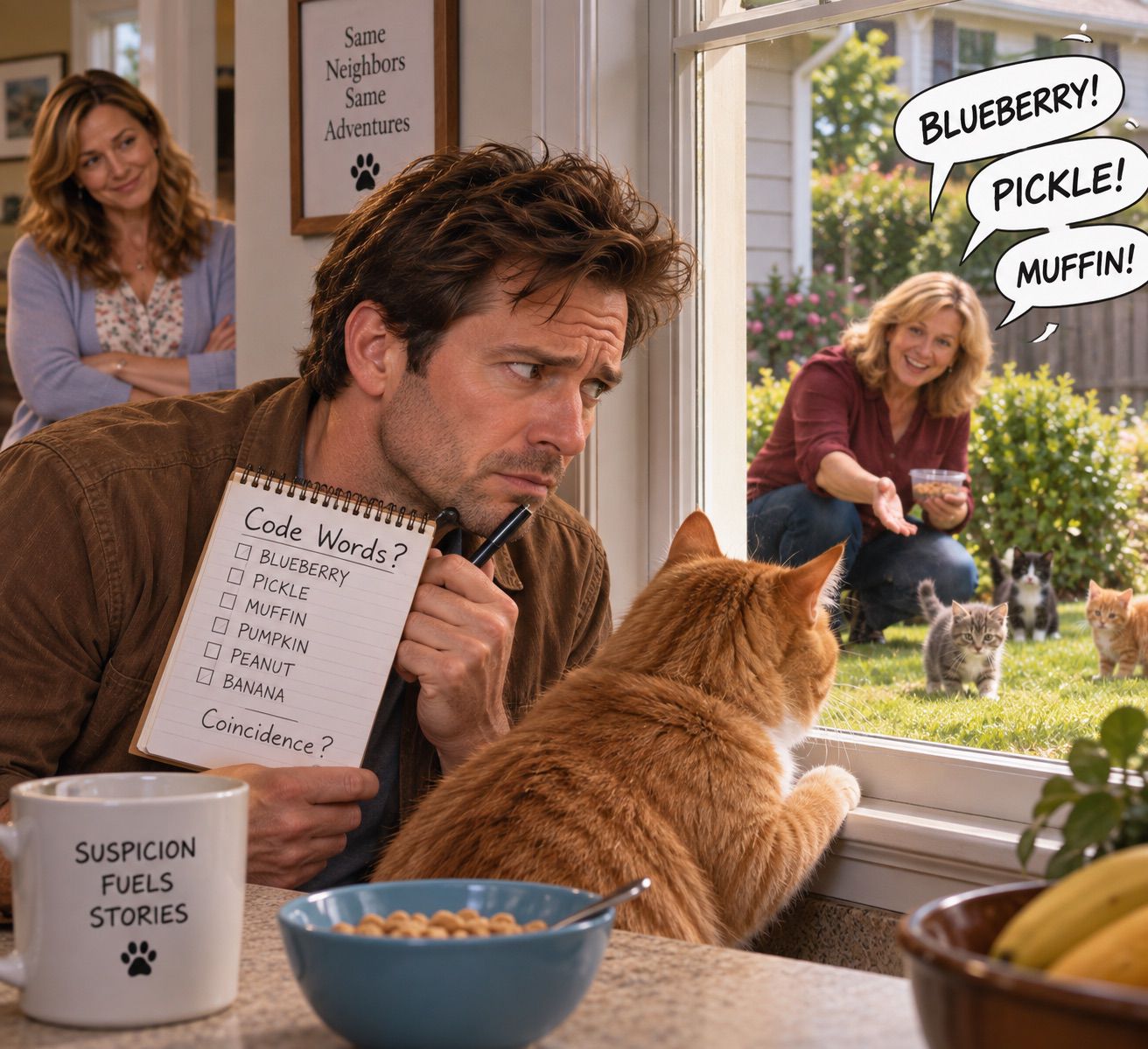
I was making breakfast when Mrs. Jenkins yelled, “BLUEBERRY!” loud enough for me to hear it through the kitchen window. Under ordinary circumstances, I probably would have assumed she was talking about blueberries, especially since Mrs. Jenkins has demonstrated a long-standing interest in baked goods, but there was something about the delivery that bothered me. It wasn’t conversational. It was one word, projected clearly and with purpose: “BLUEBERRY!” I stopped pouring milk into my cereal and waited. Nothing happened. Pandora was still upstairs, John Mercer was somewhere in his room, and Mr. Whiskers was sitting beside the refrigerator staring at a section of wall with the focused expression of an animal who either knew something important or had discovered a very small insect. I was prepared to dismiss the entire incident when Mrs. Jenkins shouted, “PICKLE!” That changed things.
I put the milk back in the refrigerator and moved closer to the window, not because I was spying on Mrs. Jenkins but because two unrelated food items shouted at thirty-second intervals constitute a pattern worth observing. There was another pause, followed by, “MUFFIN!” I wrote the three words on the back of an envelope: BLUEBERRY. PICKLE. MUFFIN. Individually, they meant nothing. Together, they also meant nothing, but in a more organized way. Mr. Whiskers abandoned the wall and joined me at the window, which I considered independent confirmation that something outside had become interesting. “You heard it too,” I whispered. He looked at me and meowed. I wrote a small question mark beside MUFFIN because I wasn’t prepared to classify that as confirmation yet.
Pandora came downstairs a few minutes later and found me sitting at the kitchen table with my cereal untouched and the envelope in front of me. She looked at the words, looked at me, and said, “No.” I hadn’t actually said anything yet, which bothered me almost as much as the words themselves. “I haven’t asked you anything,” I told her. “You wrote BLUEBERRY, PICKLE, and MUFFIN on an envelope and you’re staring out the window at Mrs. Jenkins’ house,” she said. “I’m getting ahead of this.” I explained that Mrs. Jenkins had been shouting apparently unrelated words at regular intervals and that I was merely documenting them in case a meaningful sequence emerged. Pandora poured herself some coffee and said, “Maybe she’s talking to someone.” I pointed out that I had heard no responses. “Maybe she’s talking to herself.” I asked why anyone would yell PICKLE at themselves. Pandora took her coffee and walked toward the living room. “That question is exactly why I’m leaving.”
John came into the kitchen while I was adding the fourth word, PUMPKIN, to the envelope. I gave him the complete sequence and asked whether anything stood out. He stared at it for several seconds, which initially encouraged me, before saying, “It looks like a grocery list written by somebody having a breakdown.” I explained that grocery lists usually contained nouns such as milk, bread, and eggs, whereas Mrs. Jenkins was producing isolated words at carefully spaced intervals. “Those are also nouns,” John said. I told him that wasn’t the point. Then Mrs. Jenkins shouted, “PEANUT!” and John looked toward the window. I pointed at him. “See?” He told me he had looked because a woman had just screamed PEANUT outside our house. I reminded him that yesterday he had insisted looking toward a ringing phone meant nothing. “And I was right,” he said. “You can’t keep turning normal human reactions into evidence.” I added PEANUT to the envelope while he made coffee.
By the time I left for work, I had six words: BLUEBERRY, PICKLE, MUFFIN, PUMPKIN, PEANUT, BANANA. I spent most of the drive trying to determine whether the first letters—B, P, M, P, P, B—formed an acronym, substitution cipher, or possibly coordinates if converted to numbers. At the office, Karen noticed me writing the sequence on a sticky note and asked what I was doing. I told her I was examining an unusual communications pattern occurring near my residence. She read the list and said, “Those sound like pet names.” Dave looked over from his desk and said, “Or things you buy when you’re hungry.” I explained that Mrs. Jenkins had shouted every one of them into the neighborhood that morning. Karen asked the obvious question: “Did you ask Mrs. Jenkins why?” I told her that asking the source before analyzing the available evidence could contaminate an independent assessment. Dave stared at me for a moment and said, “Hal, asking someone what they’re doing is usually how conversations work.” Neither of them seemed interested in the methodological problem.
When I got home, Mrs. Jenkins was outside near the side of her house. I had barely stepped out of the car when she yelled, “PICKLE!” and something moved behind the bushes. I stopped. A moment later she called, “MUFFIN!” and I saw another flash of movement near the porch. This was the first time I had observed a physical response to one of the words, which elevated the situation considerably. I walked toward her and decided that Karen and Dave, despite their careless attitude toward evidence collection, might have had a point. “Mrs. Jenkins,” I said, “I have a question about the words you’ve been shouting.” She smiled. “Oh, the kittens?” I looked toward the bushes. One tiny gray kitten appeared, followed by a black-and-white one. Then another emerged from beneath the porch. Mrs. Jenkins explained that a stray cat had given birth nearby and she was helping a rescue volunteer round up the kittens. Since nobody knew what to call them, she had temporarily named them after foods. Blueberry was gray, Pickle was black and white, Muffin was orange, Pumpkin was apparently also orange, Peanut was tiny, and Banana had been named by the rescue volunteer’s six-year-old granddaughter because, according to Mrs. Jenkins, “At that point we had stopped pretending there was a system.”
I stood there with my hands in my pockets while Mrs. Jenkins called, “BLUEBERRY!” and the gray kitten trotted out from behind a flowerpot. There was no code. There was no communication network. There wasn’t even a particularly interesting naming convention. Mrs. Jenkins had simply been yelling ridiculous names at kittens all morning, which was somehow both the most reasonable explanation and the one possibility I had failed to consider. When I went inside, Pandora was on the couch with John, and both of them looked at me expectantly. I placed the envelope on the coffee table. “They’re kittens,” I said. John picked up the envelope, studied my notes, and asked whether PUMPKIN and MUFFIN were different cats. “Apparently.” Pandora asked whether I had actually tried converting the names into a code. I told her that wasn’t important anymore. She turned the envelope over and found the letters and numbers I had written on the back. “You absolutely did.” I explained that eliminating possibilities is an essential part of any responsible investigation. “Observation,” she corrected. “You told me this morning you were observing.” I appreciated that she was finally respecting the terminology.
That evening I was sitting in the living room when Mrs. Jenkins called, “PEANUT!” outside. Mr. Whiskers immediately jumped off the couch, ran to the window, and stared toward her yard. A few seconds later, Mrs. Jenkins yelled, “MUFFIN!” and Mr. Whiskers meowed. I looked at him. He looked at me. I reminded myself that he had probably seen or smelled the kittens and that a cat reacting to other cats was entirely normal behavior. Then Mrs. Jenkins shouted, “BANANA!” and Mr. Whiskers ran to the front door. Pandora looked up from her book and said, “Don’t.” I hadn’t said anything. I wasn’t going to say anything. I had learned my lesson. Still, I took the envelope out of the trash and wrote MR. WHISKERS RESPONDS TO BANANA at the bottom, because learning your lesson doesn’t mean you stop documenting new evidence.