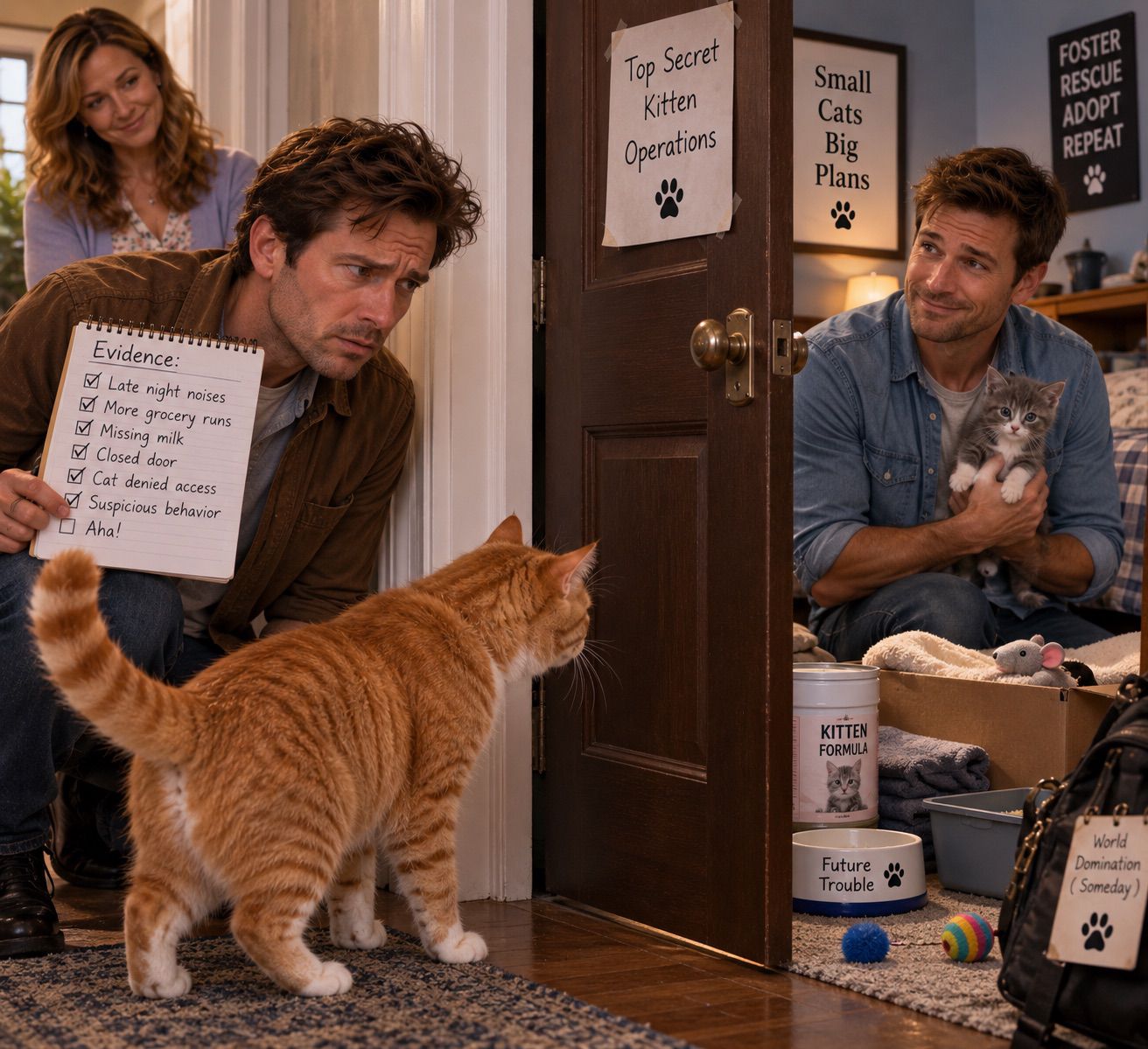
I was standing in the kitchen waiting for Pandora to finish getting ready when John Mercer came in, opened the refrigerator, looked inside for approximately four seconds, and closed it again without taking anything. Normally I wouldn’t have paid much attention to this, except John had done exactly the same thing twenty minutes earlier. He had also gone out twice that afternoon, both times without explaining where he was going, and when I asked whether he wanted to come to dinner with Pandora and me, he said, “Can’t tonight. I’ve got something I need to take care of.” Then he walked back toward his room carrying a grocery bag that he had very obviously tried to keep on the opposite side of his body from me. I watched him disappear down the hallway and looked at Mr. Whiskers, who was sitting beside the refrigerator. “You saw that.” Mr. Whiskers looked toward the hallway. That was good enough for preliminary confirmation.
The strange part was that John had been acting like this for several days. He had been leaving the apartment at odd times, coming back with bags, closing his bedroom door more often than usual, and twice I had heard him moving things around in there after midnight. I had initially attributed the nighttime noises to normal roommate activity, but normal roommate activity generally does not require whispering “Come on, come on,” followed by what sounded like something falling over. There was also the milk situation. That morning John had announced we were almost out of milk even though I had bought a new carton the previous evening. When I checked the refrigerator, he was right. Nearly half of it was gone. John drinks coffee with a little milk. He does not, under normal circumstances, consume half a carton overnight. Something had changed.
Pandora came into the kitchen fastening an earring and found me looking inside the refrigerator. “What are you doing?” she asked. I told her I was establishing whether any other food items had experienced unexplained depletion. She stopped fastening the earring. “This is about John, isn’t it?” I asked how she knew that. “Because you’ve asked me three times today if John seems different.” I pointed out that she had never actually answered the question. Pandora finished with her earring and said John seemed fine. I mentioned the grocery bags, the closed bedroom door, the unexplained trips, the nighttime noises, and the missing milk. She stared at me for a few seconds before saying, “Have you considered asking him?” I reminded her that asking someone directly what they are hiding gives them an opportunity to stop hiding it more effectively. She said, “That sentence is exactly why I’m not getting involved,” and went to find her shoes.
I decided not to investigate. That distinction is important because what I did next was simply remain attentive to my surroundings while getting ready for dinner. During this period of heightened but completely passive awareness, I observed Mr. Whiskers walking down the hallway toward John’s room. He stopped outside the closed door, sniffed underneath it, and sat down. A few seconds later, something moved on the other side. Mr. Whiskers immediately stood up. I stood up too. Neither action should be interpreted as evidence by itself, but two independent observers responding to the same stimulus deserved consideration. Then John opened the door approximately six inches, saw me, and immediately pulled it almost closed again. “What?” he asked. I told him nothing. He looked at Mr. Whiskers and said, “And you stay out.” Then he closed the door. I went back to the kitchen and wrote CAT DENIED ACCESS on the back of an envelope.
The next morning I mentioned the situation at work. I kept the description deliberately neutral: my roommate had altered his routine, increased his purchasing activity, restricted access to part of the residence, consumed an unusual quantity of milk, and demonstrated heightened concern regarding feline entry into his room. Karen listened until I finished and asked, “What do you think John is hiding?” I told her that was precisely what I was attempting to determine. Dave suggested John might have bought something he didn’t want Mr. Whiskers getting into. Karen suggested a birthday present. I pointed out that my birthday wasn’t coming up. “Maybe it isn’t for you,” she said. That possibility had technically occurred to me, but I didn’t appreciate how quickly she arrived at it. Dave asked why I didn’t simply ask John. Apparently everyone I knew had independently decided that direct communication was superior to evidence-based observation.
When I got home that evening, the situation escalated. John was standing in the hallway holding another grocery bag, and the moment he saw me he turned toward his room. Unfortunately for him, Mr. Whiskers was faster. The cat slipped between John’s legs and disappeared through the open doorway. “No, no, no—Mr. Whiskers!” John shouted, dropping the bag and rushing after him. Something inside the bag rolled across the floor. It was a small can of kitten formula. I picked it up. John came back into the hallway carrying Mr. Whiskers under one arm. Mr. Whiskers looked furious. John looked defeated. I held up the can. “Would you like to explain this?” I asked. John stared at me, then at the formula, and sighed. “Fine. But you have to promise not to make this weird.” I told him that depended entirely on the explanation.
Inside John’s room, tucked beside his desk in a cardboard box lined with towels, was the smallest kitten I had ever seen. It was gray, mostly ears, and asleep beside a shallow dish. John explained that he had found it two nights earlier beneath a parked car behind the grocery store. He had waited to see whether the mother returned, then called a local rescue group when she didn’t. The rescue was full until the weekend, so John had agreed to foster the kitten for a few days. The grocery trips had been for formula, kitten food, a tiny litter tray, and other supplies. The missing milk, he admitted, was unrelated. “I knocked the carton over yesterday morning and cleaned it up before anybody came downstairs.” I asked about the noises at night. “The kitten keeps climbing out of the box.” I asked why he hadn’t simply told us. John looked toward the hallway, where Mr. Whiskers was now attempting to push one paw underneath the door. “Because of him.”
That explanation was irritatingly complete. Mr. Whiskers had spent the previous two days smelling an unfamiliar cat behind John’s door, which explained his interest in the hallway, his attention to John, and probably several behaviors I had previously classified as suspicious. John hadn’t been hiding something from me specifically; he had been trying to keep a curious twelve-pound orange cat away from a kitten small enough to fit inside one of my cereal bowls. Pandora came home while I was still standing in John’s room and immediately said, “Oh my God,” in the tone people use when they see something tiny and furry. She crouched beside the box while John explained everything. Then she looked up at me. “So John actually was hiding something.” I told her that was an important point and one I hoped we wouldn’t lose simply because the explanation happened to be reasonable. “You thought he was involved in something sinister, didn’t you?” she asked. I said I had deliberately avoided assigning motive before establishing the facts. John pointed toward the envelope still sticking out of my pocket. “Does that say CAT DENIED ACCESS?” I put the envelope away.
For the rest of the evening, Mr. Whiskers stationed himself outside John’s bedroom door like security personnel who had been denied the necessary clearance to perform his duties. Every few minutes he sniffed underneath it, looked at me, and meowed. I explained that he would meet the kitten eventually, once John had spoken to the rescue and we knew how to introduce them safely. Mr. Whiskers meowed again. “You were right,” I told him quietly. “There was something in there.” Pandora heard me from the couch and said, “Do not encourage him.” I wasn’t encouraging him. I was acknowledging that, strictly speaking, Mr. Whiskers and I had correctly identified concealed activity inside John’s room. Our interpretation of that activity may have required minor revision, but the underlying observation was sound. Then the kitten meowed from behind the door, Mr. Whiskers immediately meowed back, and John shouted from his room, “Hal, stop holding a conversation with the cats.” I hadn’t realized John could hear me. I made a note of that too.