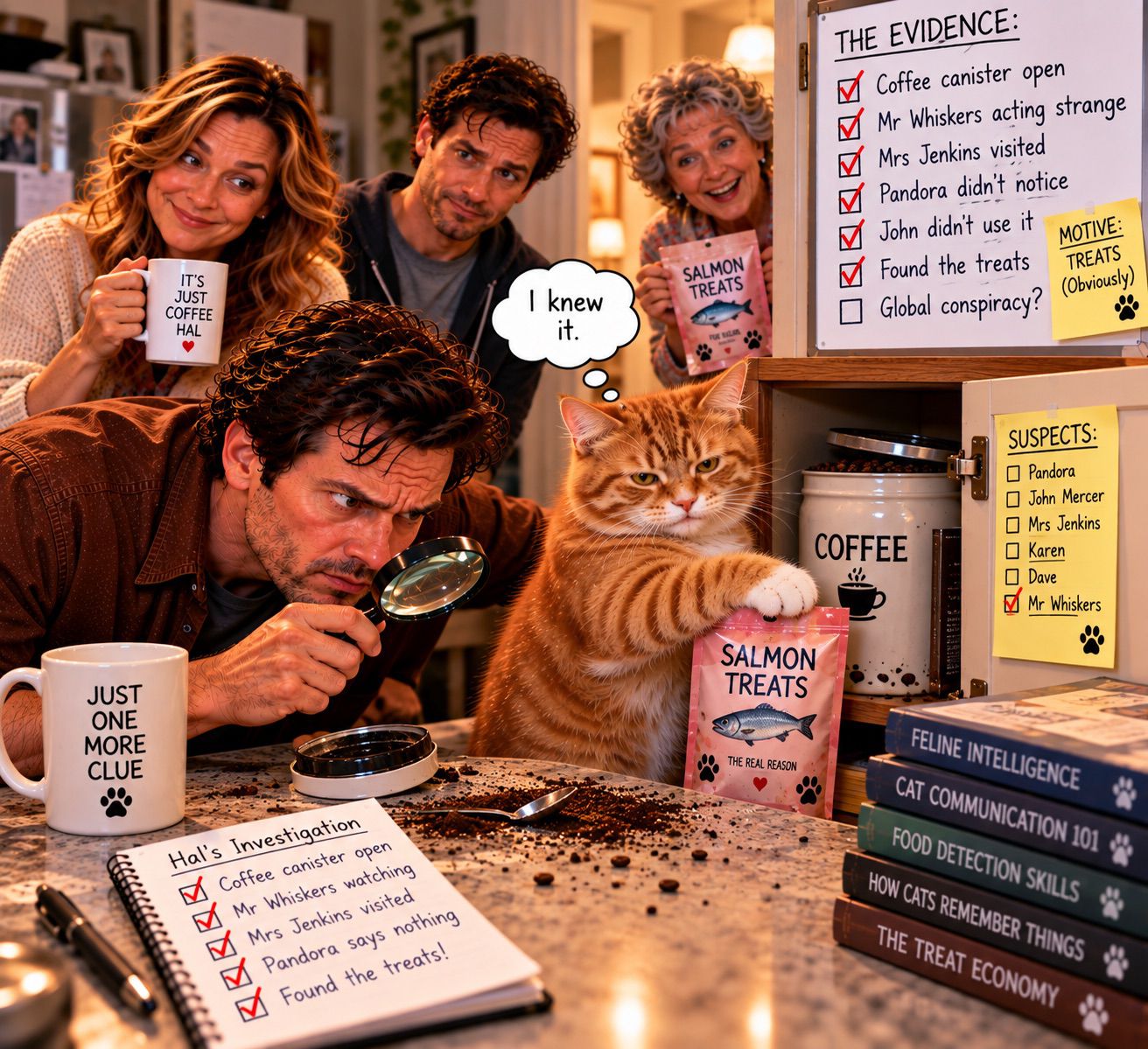
I’m making my morning coffee when I notice that the lid on the coffee canister isn’t completely closed. It’s sitting slightly crooked, leaving a narrow gap along one side, which is unusual because I distinctly remember closing it yesterday. I remember this because I had to move the canister to clean up a few coffee grounds, and I made a point of putting everything back where it belonged. Pandora is getting ready for work, John Mercer is still in his room, and Mr Whiskers is lying on the kitchen floor watching me with an expression I have recently begun to take more seriously. Under ordinary circumstances, I would assume someone simply forgot to close the lid. Unfortunately, yesterday Mr Whiskers successfully alerted us to a piece of burnt bread trapped inside the toaster, which means I can no longer dismiss his behavior as meaningless without considering the possibility that I am ignoring a demonstrated detection capability. I look at the canister, then at the cat. He looks back at me without blinking. I’m not suggesting he opened it himself. I’m simply uncomfortable with how interested he seems in my reaction.
Pandora comes into the kitchen looking for her travel mug and finds me examining the coffee canister. She asks what I’m doing, and I explain that the lid has been disturbed. She looks at it for approximately half a second before saying, “Someone probably made coffee.” I tell her that explanation accounts for the lid being opened but not necessarily for it being left crooked. She reminds me that three adults live in this house and all three are capable of making coffee without submitting a report afterward. I ask whether she used the canister last night. She says no. I ask whether she noticed John making coffee. She says she didn’t. I ask whether she remembers the lid being closed yesterday afternoon. Pandora puts down her travel mug and looks at me. “Hal, are we investigating another kitchen container?” I explain that this is entirely different from the sugar incident because the coffee canister contains a substance that people deliberately seek out, sometimes at unusual hours. She tells me that description also applies to the refrigerator, the pantry, and most of the kitchen.
John eventually comes into the room, and I ask whether he made coffee during the night. He says no, although he admits he came downstairs for a glass of water sometime after midnight. I ask whether he noticed anything unusual. He thinks for a moment and says Mr Whiskers was sitting on the counter when he came in. This gets my attention because the cat has recently developed an unfortunate interest in objects that ordinarily have no business involving him. I ask what Mr Whiskers was doing. John says, “Being a cat.” I explain that I need a more precise description. John says the cat was sitting beside the coffee maker looking toward the window. I ask whether the canister was open. He doesn’t remember. I ask whether he heard anything. He says the refrigerator was humming. I ask whether he saw anyone else. He says no. Then he looks at Pandora and asks whether I have started doing this every morning. Pandora tells him it has become something of a routine. I object to that characterization because the toaster incident was a legitimate safety concern, and the sugar investigation established an accurate timeline. John says, “You spent half an hour questioning a spoon.” I tell him the spoon was evidence, not a witness.
I try to put the matter aside, but Mr Whiskers makes that difficult. Every time I return to the kitchen, he is sitting somewhere near the coffee canister. Sometimes he looks at the cupboard. Sometimes he looks at the window. Once he stretches up on his hind legs and sniffs the counter before sitting down again. I begin to suspect he is attempting to direct my attention toward something, although the precise subject remains unclear. When I move the canister to another part of the counter, he follows it with his eyes. When I put it back, he watches that too. I repeat this twice to determine whether the response is consistent. Pandora catches me moving the canister back and forth and asks whether I am conducting an experiment. I tell her I am testing a hypothesis. She asks what the hypothesis is. I admit I haven’t narrowed it down sufficiently to explain. She says, “Then you’re just moving the coffee around.” I don’t appreciate how often she can describe my methodology in ways that make it sound ridiculous.
At work, I mention the situation to Karen because she was surprisingly supportive of Mr Whiskers’ abilities during the toaster incident. I explain that the coffee canister was open, John saw the cat near the coffee maker during the night, and Mr Whiskers has been showing unusual interest in the area ever since. Karen asks whether the cat might have knocked the lid loose. I tell her the canister is too heavy for that to be the most likely explanation. Dave overhears the conversation and asks whether anyone else used the coffee. I explain that nobody has admitted to it. He asks whether I have considered the possibility that I left the lid open myself. I tell him I distinctly remember closing it. Dave reminds me that last week I spent an entire evening investigating a messy room before discovering I had created most of the mess. I acknowledge that recent history has introduced certain questions about the reliability of my recollection, but I don’t think it justifies dismissing every new observation. Karen asks what Mr Whiskers actually did. I explain that he stared at the canister. She waits for me to continue. When I don’t, she says, “Hal, sometimes cats stare at things.” I tell her that is precisely the problem. They stare at so many things that identifying the significant observations becomes extremely difficult.
When I get home that afternoon, Mrs Jenkins is standing outside her door holding a small container. She smiles and asks whether Pandora is home because she wants to return something she borrowed yesterday. I tell her Pandora isn’t back yet and offer to take it. Mrs Jenkins hands me the container and mentions that Mr Whiskers was particularly affectionate during her visit the previous afternoon. Apparently he followed her into the kitchen, rubbed against her legs, and spent several minutes watching her while she talked to Pandora. This interests me because Mrs Jenkins has previously established a reliable method of obtaining Mr Whiskers’ attention through salmon treats. I ask whether she gave him anything yesterday. She says no, although she did bring over some homemade cookies for Pandora and John. I ask whether the cookies contained coffee. Mrs Jenkins looks confused and says they were oatmeal raisin. I thank her and return inside, where I find Mr Whiskers sitting beside the kitchen counter. He looks at the container in my hand, then at the cupboard. I tell him I know he knows something. He yawns, which is not the response I was hoping for.
Pandora arrives home about twenty minutes later, and I explain that Mrs Jenkins confirmed Mr Whiskers had been unusually interested in the kitchen yesterday. Pandora asks what I mean by unusually interested. I explain that he followed Mrs Jenkins around and watched her while she talked. Pandora says, “She had cookies.” I point out that Mr Whiskers doesn’t ordinarily eat oatmeal raisin cookies. She reminds me that he doesn’t know what is inside a cookie until he investigates it. This is a reasonable argument, but it still doesn’t explain the coffee canister. Then Pandora remembers something. Yesterday afternoon, while Mrs Jenkins was visiting, Pandora opened the canister to show her the coffee we had been using because Mrs Jenkins had asked why the kitchen smelled so good. She had apparently been thinking about trying a different brand and wanted to know whether ours was worth buying. Pandora opened the lid, let her smell it, and then became distracted when Mr Whiskers jumped onto the counter. She moved him down, finished talking to Mrs Jenkins, and forgot to close the lid properly.
I stand there considering this explanation. It accounts for the crooked lid, Mrs Jenkins’ visit, and the fact that Pandora didn’t remember using the coffee. Technically, she hadn’t used it. She had simply opened the container for someone else. I point out that the distinction matters because my original question concerned whether she had made coffee, not whether she had opened the canister. Pandora says, “You asked whether I used it last night. This happened yesterday afternoon.” I tell her that establishes why her answer was technically accurate but operationally incomplete. She looks at me for a long moment before asking whether I am seriously criticizing her for failing to provide a complete history of the coffee container. I assure her I am not criticizing anyone. I’m simply reconstructing the sequence of events. Pandora says the sequence is that she opened the coffee, showed it to Mrs Jenkins, put the cat on the floor, and forgot the lid. She then closes the canister in front of me and asks whether the case can be considered resolved.
It probably could have been, except Mr Whiskers is still sitting beside the cupboard. He has barely moved during the entire conversation, and when Pandora puts the canister away, he follows it with his eyes. I explain that while the lid has been accounted for, the cat’s continued interest remains unexplained. Pandora tells me he probably smells the coffee. I remind her that he has lived in a house containing coffee for years without showing this level of interest. John comes into the kitchen, listens to the discussion, and says, “Maybe he likes the smell.” I point out that this would represent a previously undocumented preference. John looks at Pandora and asks whether she thinks I am ever going to stop analyzing the cat. Pandora says she stopped expecting that months ago. Mr Whiskers gets up, walks to the cupboard, and scratches lightly at the door. I look at John. John looks at Pandora. Pandora looks at the cupboard. For the first time, all three of us appear to agree that the cat wants something specific.
I open the cupboard. Mr Whiskers immediately stands on his hind legs and tries to look inside. The coffee canister is on the lower shelf beside a box of tea, some filters, and a small paper bag that I don’t remember seeing before. I pick up the bag. Inside is a package of salmon-flavored cat treats. I turn toward Pandora. She smiles in the way people smile when they have just realized something obvious that another person has spent an unreasonable amount of time trying to establish. Apparently Mrs Jenkins had brought the treats over yesterday along with the cookies, but Pandora had put them in the cupboard while they were talking because she didn’t want Mr Whiskers demanding them immediately. Then she forgot about them. The cat, however, had not forgotten. He had watched her put the bag away and had been waiting for someone to retrieve it ever since. His interest in the coffee canister was entirely incidental. The canister happened to be sitting in front of the treats.
John starts laughing. Pandora leans against the counter and asks whether this satisfies my concerns about the cat’s behavior. I tell her it certainly explains why he was watching the cupboard, although it raises a separate question about his ability to remember the location of food for more than twenty-four hours. John says, “Hal, the cat knew where his treats were.” I explain that this is precisely the point. He retained the information, recognized the storage location, and attempted to communicate his objective to multiple members of the household. Pandora says, “He wanted a snack.” I tell her the two interpretations are not mutually exclusive. She opens the package and gives Mr Whiskers one treat. He eats it immediately, then sits down and looks up at her again. John says, “Looks like he wants another.” I tell him not to encourage the behavior. Mr Whiskers looks at me, then at the bag, then back at Pandora. She gives him a second treat.
Later that evening, I’m sitting on the couch thinking about the events of the day while Mr Whiskers sleeps beside me. The coffee canister has been accounted for, Mrs Jenkins has been cleared of any suspicious activity, and Pandora has confirmed that no secret coffee-related incident occurred during the night. More importantly, Mr Whiskers demonstrated that he can remember where something desirable has been hidden and persistently direct human attention toward it. I tell Pandora this represents a meaningful development in our understanding of his behavior. She says, “It means he remembers where we keep the treats.” I tell her she is reducing a potentially significant cognitive achievement to a grocery-storage issue. John calls from the kitchen that he thinks Mr Whiskers deserves another treat for being smarter than all of us. I tell him the cat has already received sufficient compensation for his participation.
A few minutes later, Mr Whiskers wakes up, stretches, and jumps down from the couch. He walks toward the kitchen, stops beside the cupboard, and looks back at me. I tell him the treats are finished for the evening. He meows once, waits, and then walks toward the front door instead. I watch him sit down on the mat and stare at the handle. A moment later there is a knock. When I open the door, Mrs Jenkins is standing there holding a fresh bag of salmon treats. She says she was at the store and thought Mr Whiskers might like another package. The cat immediately sits at her feet and looks up with an expression of complete innocence. I look at Mrs Jenkins, then at the cat, then back toward the kitchen where Pandora and John are already laughing. I’m willing to accept that Mr Whiskers knew where the treats were hidden. What I’m having considerably more trouble accepting is that he also seems to know when the next shipment is arriving.