I was sitting in the living room Thursday morning, attempting to enjoy a cup of coffee while Pandora worked on her laptop, when Mr Whiskers began meowing at the front door. This wasn’t particularly unusual, considering he’d recently developed the habit of demanding attention whenever he believed someone might be available to provide it. What struck me as odd was the timing. He’d been perfectly content a few minutes earlier, sleeping in the cardboard box beside his activity center, but the moment he heard footsteps outside, he’d abandoned his nap and positioned himself in front of the door. His tail was standing straight up, his ears were forward, and he was making the sort of hopeful little noises I’d previously associated with the arrival of food. I glanced at Pandora, who was typing something on her laptop, and asked whether she was expecting anyone. She shook her head without looking up. Mr Whiskers meowed again, considerably louder this time, as though he believed the conversation wasn’t moving quickly enough.
A moment later, there was a gentle knock at the door. I opened it to find Mrs Jenkins standing in the hallway, holding a small covered container and wearing the cheerful expression she usually reserved for occasions when she’d baked something. She greeted me warmly and asked whether Mr Whiskers was having a good morning. Before I could answer, the cat squeezed between my ankles and began rubbing enthusiastically against her shoes. Mrs Jenkins laughed, bent down, and scratched him behind the ears. “Well, hello there, handsome,” she said. Mr Whiskers responded with a series of affectionate chirps that I’d rarely heard him make for anyone in our household. I stood there watching the exchange, feeling vaguely insulted. I’d spent the previous several days retrieving his lost toys, investigating mysterious smells, and attempting to improve his sleeping arrangements, yet Mrs Jenkins received a reception usually reserved for long-lost royalty.
Mrs Jenkins explained that she’d stopped by to return a small container Pandora had lent her earlier in the week. That seemed reasonable enough, although I noticed that Mr Whiskers remained unusually interested in the container even after she handed it to me. He followed it with his eyes as I placed it on the kitchen counter, then sat down beneath it and began meowing again. Mrs Jenkins smiled and said he was probably hoping for another treat. I told her that we’d been trying to limit his snacks because he’d become increasingly demanding whenever anyone approached the kitchen. She nodded sympathetically and said that cats could be very persuasive when they wanted something. There was something about the way she said it that caught my attention. It wasn’t merely that she understood Mr Whiskers’ behavior. She sounded as though she had firsthand experience with his particular methods of persuasion, and I began wondering exactly how much time the two of them had been spending together.
After Mrs Jenkins left, Mr Whiskers remained beside the front door for several minutes, staring at it with an expression of profound disappointment. Eventually, he returned to the living room and settled into his cardboard box, but I noticed that he kept glancing toward the hallway whenever someone walked past. I mentioned this to Pandora, who suggested that he simply liked Mrs Jenkins because she was kind to him. I pointed out that we were also kind to him, and yet he rarely greeted us with such enthusiasm. Pandora smiled and said that perhaps Mrs Jenkins had a more generous interpretation of what constituted an appropriate number of cat treats. That was possible, although I couldn’t help thinking there was something more to the situation. Mr Whiskers wasn’t merely fond of our neighbor. He appeared to be anticipating her arrival, which suggested that some kind of routine had developed without my knowledge.
John Mercer emerged from his room a little later, carrying his phone and looking for something to eat. I asked whether he’d noticed Mr Whiskers behaving differently around Mrs Jenkins. John opened the refrigerator, considered its contents, and said that the cat had always liked her. I explained that this seemed different, particularly because Mr Whiskers had been waiting at the door before she knocked. John shrugged and suggested that the cat had probably heard her approaching. I told him that was a perfectly reasonable explanation, but it didn’t account for the unusually enthusiastic greeting. John closed the refrigerator and looked at me for a moment. “Hal,” he said, “she gives him treats. You make him wait for breakfast because you’re busy investigating his motives.” I informed him that I had never deliberately delayed the cat’s breakfast for investigative purposes. John raised an eyebrow, and I decided not to mention the morning I’d spent examining Mr Whiskers’ food bowl because I suspected someone had moved it.
The more I thought about it, the more I realized that Mrs Jenkins had been unusually involved in Mr Whiskers’ activities lately. She’d helped us gather materials for his cardboard activity center, made several catnip mice for him, and provided advice about how to keep him entertained without encouraging his nighttime disturbances. She’d also been remarkably successful at capturing his attention whenever she visited. I appreciated her generosity, of course, but I couldn’t help wondering whether all those little contributions had given her a better understanding of the cat than the rest of us possessed. Mr Whiskers seemed to know when she was approaching, what she was carrying, and whether she might have something interesting for him. I had spent months trying to understand his behavior, and Mrs Jenkins appeared to have achieved the same result simply by being pleasant and occasionally producing a treat. It was difficult not to feel that I was missing some important piece of information.
At work that afternoon, I mentioned the situation to Karen while we were getting coffee. She listened patiently as I described Mr Whiskers’ enthusiastic greeting and Mrs Jenkins’ apparent ability to predict his behavior. When I finished, she asked whether I’d considered that the cat simply liked our neighbor. I explained that I had considered it, but that the timing seemed unusually precise. Karen smiled and said that animals were very good at recognizing familiar sounds and routines. Dave, who had been standing nearby, joined the conversation long enough to suggest that Mr Whiskers had probably figured out which human was most likely to give him something he wanted. I told him that was an interesting theory, although I wasn’t sure it explained everything. Dave took a sip of coffee and said, “Hal, your cat has spent the last week making you retrieve his toys. I think he’s already demonstrated that he knows how to get what he wants.” Karen laughed, and I found myself wishing I’d chosen a different topic of conversation.
When I returned home that evening, Pandora was preparing dinner while John watched television in the living room. Mr Whiskers was sitting on the windowsill, looking toward Mrs Jenkins’ apartment with the same intense concentration I’d noticed several times before. Every now and then, his tail would twitch, and he’d make a soft chirping sound that seemed directed toward something outside. I moved closer to the window and looked across the courtyard. Mrs Jenkins was standing near her own window, watering a small collection of plants. When she noticed Mr Whiskers watching her, she smiled and gave him a little wave. The cat immediately stood up, pressed his front paws against the glass, and began meowing. Mrs Jenkins laughed and waved again before returning to her plants. I watched the entire exchange with growing interest. It wasn’t exactly evidence of a secret arrangement, but it certainly suggested that the two of them had developed a way of communicating.
I called Pandora over and asked whether she’d ever noticed Mrs Jenkins waving to Mr Whiskers. She glanced toward the window and said she’d seen it happen plenty of times. I asked whether she thought it was unusual that the cat seemed to recognize our neighbor from across the courtyard. Pandora shook her head and explained that Mr Whiskers had probably learned to associate Mrs Jenkins with pleasant experiences. That made sense, but I was beginning to wonder whether the pleasant experiences were occurring more frequently than anyone had told me. I asked whether Mrs Jenkins ever came over while I was at work. Pandora said she sometimes stopped by to chat or drop off something she’d made, which was hardly surprising given how friendly they were. Still, I couldn’t help noticing that Mr Whiskers seemed particularly interested whenever her name came up. He’d turn his head, prick up his ears, and look toward the front door as though expecting her to appear at any moment.
The following morning, I decided to pay closer attention to Mr Whiskers’ routine. I wasn’t planning anything elaborate. I simply wanted to see whether his behavior followed a recognizable pattern. After breakfast, he spent several minutes exploring his activity center, then climbed onto the windowsill and settled down to watch the courtyard. Around ten o’clock, he suddenly became alert, lifted his head, and hurried toward the front door. I checked the time, then listened carefully. A few seconds later, I heard footsteps in the hallway, followed by the faint sound of someone humming. Mr Whiskers began meowing before the footsteps had even reached our door. I opened it just as Mrs Jenkins was passing by with a shopping bag. She looked pleasantly surprised to see me, although the cat seemed considerably less surprised by her appearance.
Mrs Jenkins greeted us both and asked whether everything was all right. I told her I’d been curious about how Mr Whiskers always seemed to know when she was nearby. She laughed and said he probably recognized her footsteps. I asked whether she came past our door at roughly the same time every morning, and she considered this for a moment before admitting that she often did. She liked to take a short walk after breakfast, and our hallway happened to be part of her usual route. Sometimes she stopped to chat, and sometimes she simply passed by on her way outside. That explained the timing, but I was still curious about the cat’s extraordinary enthusiasm. I asked whether she’d been giving him treats during those visits. Mrs Jenkins hesitated for just a moment, then smiled in a way that immediately confirmed my suspicions.
“Well,” she said, “only a little something now and then.” I looked down at Mr Whiskers, who was sitting beside her shoes with an expression of complete innocence. I asked what she meant by a little something, and she explained that she’d occasionally brought him a small cat treat when she stopped by. Nothing excessive, she assured me, just enough to make him happy. I asked how often this happened, and she looked thoughtful. “Oh, perhaps a few times a week,” she said. Then she added, almost as an afterthought, that she’d sometimes given him a treat when she saw him sitting by the window as well. I stared at her for a moment, trying to reconcile this information with the increasingly demanding behavior we’d been experiencing at home. Mr Whiskers, meanwhile, had begun rubbing against her ankles again, apparently hoping that the conversation would produce an immediate reward.
I thanked Mrs Jenkins for explaining and assured her that I appreciated how much she cared about the cat. I also mentioned that we’d been trying to establish a more consistent routine for his treats because he’d become increasingly insistent about receiving them. She looked genuinely apologetic and said she hadn’t realized her generosity might be contributing to the problem. I told her it wasn’t a serious issue, although it did explain why Mr Whiskers had been treating the front door like a scheduled delivery service. Mrs Jenkins laughed and promised to coordinate with Pandora before giving him anything else. Then she reached into her shopping bag and produced a small packet of cat treats. “I suppose I should put these away for now,” she said. Mr Whiskers immediately stood on his hind legs and reached toward the packet, confirming that he’d understood considerably more of the conversation than I had.
After Mrs Jenkins continued down the hallway, I returned to the living room and told Pandora what I’d discovered. She listened with growing amusement as I explained that our neighbor had been giving Mr Whiskers treats during her regular morning walks. Pandora nodded and said that she’d suspected something like that, particularly because the cat had become so enthusiastic whenever he heard footsteps outside. I asked why she hadn’t mentioned it before, and she said she hadn’t realized I was conducting an investigation. John, who had been listening from the couch, started laughing. “So Mrs Jenkins has been feeding the cat,” he said. I explained that it was slightly more complicated than that because Mr Whiskers had learned to recognize her schedule and anticipate the rewards. John nodded solemnly. “Right. She’s feeding him on a schedule.” I decided that explaining the behavioral implications to John would probably be a waste of time.
Still, I felt a certain satisfaction at having uncovered the truth. Mrs Jenkins really did know more than she’d initially let on, although her secret was hardly sinister. She’d simply developed a habit of giving Mr Whiskers small treats, and he’d responded by learning exactly when and where to expect them. The mysterious waiting at the door, the enthusiastic greetings, and the intense attention directed toward her window were all perfectly understandable. Mr Whiskers wasn’t receiving secret messages or participating in some elaborate scheme. He’d discovered a reliable source of snacks and had organized part of his daily routine around it. I had to admit that this was a fairly impressive accomplishment for an animal who occasionally became confused by his own reflection.
That afternoon, Pandora and I agreed that we should coordinate treats with Mrs Jenkins so Mr Whiskers wouldn’t receive more than was appropriate. She was happy to help, and we decided that the cat could still enjoy her visits without expecting food every time. I assumed this would settle the matter, but Mr Whiskers seemed less enthusiastic about the arrangement. The next time Mrs Jenkins passed our door, he hurried over and began meowing as usual. She stopped to say hello, scratched him behind the ears, and chatted with Pandora for a moment before continuing on her way. Mr Whiskers watched her leave with an expression of profound disappointment. Then he turned toward me, sat down, and gave a long, accusing meow. I told him that the new arrangement was for his own good. He blinked slowly, which I interpreted as disagreement.
Over the next few days, Mr Whiskers made several attempts to restore the previous system. He would sit by the front door at the usual time, waiting patiently for Mrs Jenkins to appear. When she passed by without offering a treat, he’d follow her footsteps with his ears and then return to the living room looking deeply dissatisfied. Occasionally, he’d approach Pandora or me afterward and meow insistently, as though expecting us to compensate him for the missing reward. John found the entire situation hilarious and began referring to Mrs Jenkins’ visits as the cat’s former breakfast service. I told him that wasn’t particularly helpful, but he pointed out that Mr Whiskers seemed to understand the concept perfectly well. I couldn’t argue with that. The cat had apparently managed to establish a second breakfast without any of us realizing it, and now he was making his displeasure known because we’d interrupted the arrangement.
One evening, Mrs Jenkins stopped by to return another small container, and Mr Whiskers immediately appeared beside her. She greeted him warmly, scratched his ears, and then sat down for a few minutes to chat with Pandora. I watched the cat settle comfortably beside her chair, purring so loudly that I could hear him from across the room. There were no treats involved this time, and yet he seemed perfectly content simply being near her. I began to wonder whether I’d been too focused on the food aspect of their relationship. Perhaps Mr Whiskers genuinely enjoyed Mrs Jenkins’ company, and the treats were merely an added benefit. It was a reassuring thought, particularly because I’d spent so much time trying to understand why he seemed to prefer her attention to mine. I was beginning to think that maybe the cat had simply developed a friendship with our neighbor, which was a perfectly pleasant explanation.
Then Mrs Jenkins reached into her handbag to retrieve her reading glasses, and Mr Whiskers immediately sat upright, his eyes fixed on the bag. She laughed and said, “Oh, you little rascal. You thought I had something for you, didn’t you?” The cat gave a hopeful chirp and moved closer. Mrs Jenkins showed him the glasses case, and he sniffed it carefully before looking up at her with an expression of disappointment. Pandora started laughing, and I couldn’t help joining in. Apparently, the friendship was genuine, but Mr Whiskers hadn’t entirely abandoned his interest in the possibility of snacks. He watched Mrs Jenkins put the glasses away, then settled back beside her chair as though willing to overlook the misunderstanding. I had to admire his persistence.
Later that evening, after Mrs Jenkins had gone home, I sat on the couch reflecting on everything I’d learned. I’d suspected that our neighbor knew something she wasn’t telling us, and technically I’d been right. She’d been quietly providing Mr Whiskers with treats during her regular walks, and the cat had turned those occasional rewards into a carefully anticipated daily event. There was no hidden danger, no secret communication network, and certainly no reason to involve Karen or Dave in the investigation. The entire mystery had been explained by a friendly neighbor, a generous supply of cat treats, and an orange tabby who possessed an extraordinary ability to recognize opportunity. It was almost disappointing how ordinary the explanation turned out to be, although I had to admit that it was considerably more pleasant than some of the alternatives I’d imagined.
I was just beginning to feel that the matter had been resolved when Mr Whiskers climbed onto the windowsill and began staring toward Mrs Jenkins’ apartment. A moment later, her curtains moved, and she appeared at the window holding a small watering can. She noticed the cat, smiled, and gave him a wave. Mr Whiskers immediately stood up, pressed his paws against the glass, and began meowing with renewed enthusiasm. Mrs Jenkins laughed and waved again before disappearing from view. I watched the exchange for a moment, then turned toward Pandora. “You know,” I said, “I still think those two have some kind of arrangement.” Pandora looked up from her book and smiled. “Of course they do, Hal. She likes him, and he likes her.” I considered this explanation, but something about the cat’s satisfied expression made me wonder whether there was more to it.
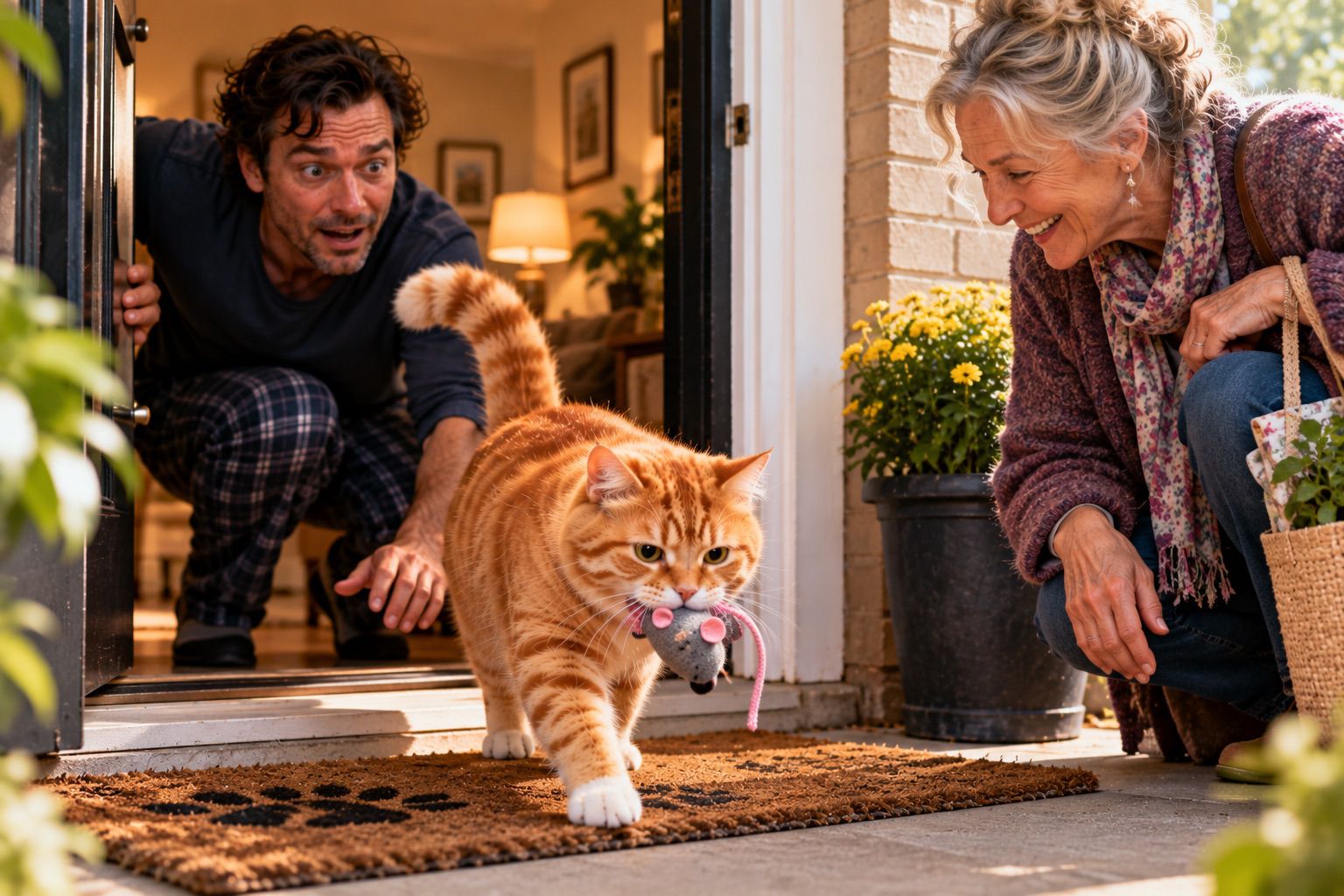
The following morning, I discovered exactly what that something was. I was making coffee when I heard Mr Whiskers meowing at the front door, right on schedule. I glanced at the clock, expecting Mrs Jenkins to be passing by, but there was no knock. Instead, I heard the faint sound of a small object sliding across the floor on the other side of the door. Mr Whiskers became immediately animated, pawing at the gap beneath it with extraordinary enthusiasm. I opened the door and found a little fabric mouse resting on the doormat, apparently left there by Mrs Jenkins during her morning walk. It was one of her homemade toys, carefully stitched and decorated with a tiny ribbon. I picked it up and looked down the hallway, but our neighbor was already gone.
I carried the mouse into the living room and showed it to Pandora. She smiled and said Mrs Jenkins must have wanted to give Mr Whiskers something that didn’t involve food. That was a thoughtful gesture, and I appreciated her willingness to help us maintain a more sensible treat routine. Unfortunately, Mr Whiskers had already decided that the new arrangement was even better than the old one. He seized the mouse from my hand, carried it triumphantly to his activity center, and spent several minutes batting it around before returning to the front door. There he sat, staring at the gap beneath it with an expression of intense concentration. I watched him for a moment before realizing what he’d learned. Mrs Jenkins no longer needed to knock, come inside, or even stop to chat. She could simply leave something interesting outside, and Mr Whiskers would wait for me to retrieve it.
John wandered into the kitchen just as I reached this conclusion. I explained that Mrs Jenkins had apparently found a new way to entertain the cat without giving him treats, but that Mr Whiskers now seemed to expect deliveries at the front door. John looked at the cat, then at the little fabric mouse, and started laughing. “So let me get this straight,” he said. “Mrs Jenkins leaves him a toy, he makes you open the door, and you bring it inside for him?” I nodded, although I wasn’t particularly pleased with the way he summarized the situation. John grinned. “Hal, I think your cat has started receiving mail.” I looked at Mr Whiskers, who was still sitting patiently by the door, and realized that John had a point.
I suppose the lesson is that sometimes the people around us really do know more than they initially reveal, but that doesn’t necessarily mean they’re hiding anything important. Mrs Jenkins had simply been trying to make Mr Whiskers happy, and the cat had responded by developing an increasingly sophisticated system for obtaining whatever he wanted. First it had been treats, then homemade toys, and now he’d apparently discovered the benefits of doorstep delivery. I was beginning to wonder how long it would take before he started expecting someone to bring his meals directly to his cardboard box. As I finished my coffee, Mr Whiskers gave another hopeful meow and looked toward the front door. I told him that Mrs Jenkins had already made her delivery for the day and that there was nothing else waiting outside. He stared at me for a moment, then turned around and walked toward the living room with an air of quiet disappointment. I watched him go and felt a brief sense of victory. For once, I’d managed to resist his demands. Then I noticed that he’d left the new fabric mouse in the hallway, just beyond the edge of the rug, and was now sitting beside his activity center waiting for me to bring it to him. I sighed, put down my coffee, and went to retrieve it. Mrs Jenkins might know more than she lets on, but Mr Whiskers apparently knows exactly how much I’ll put up with.